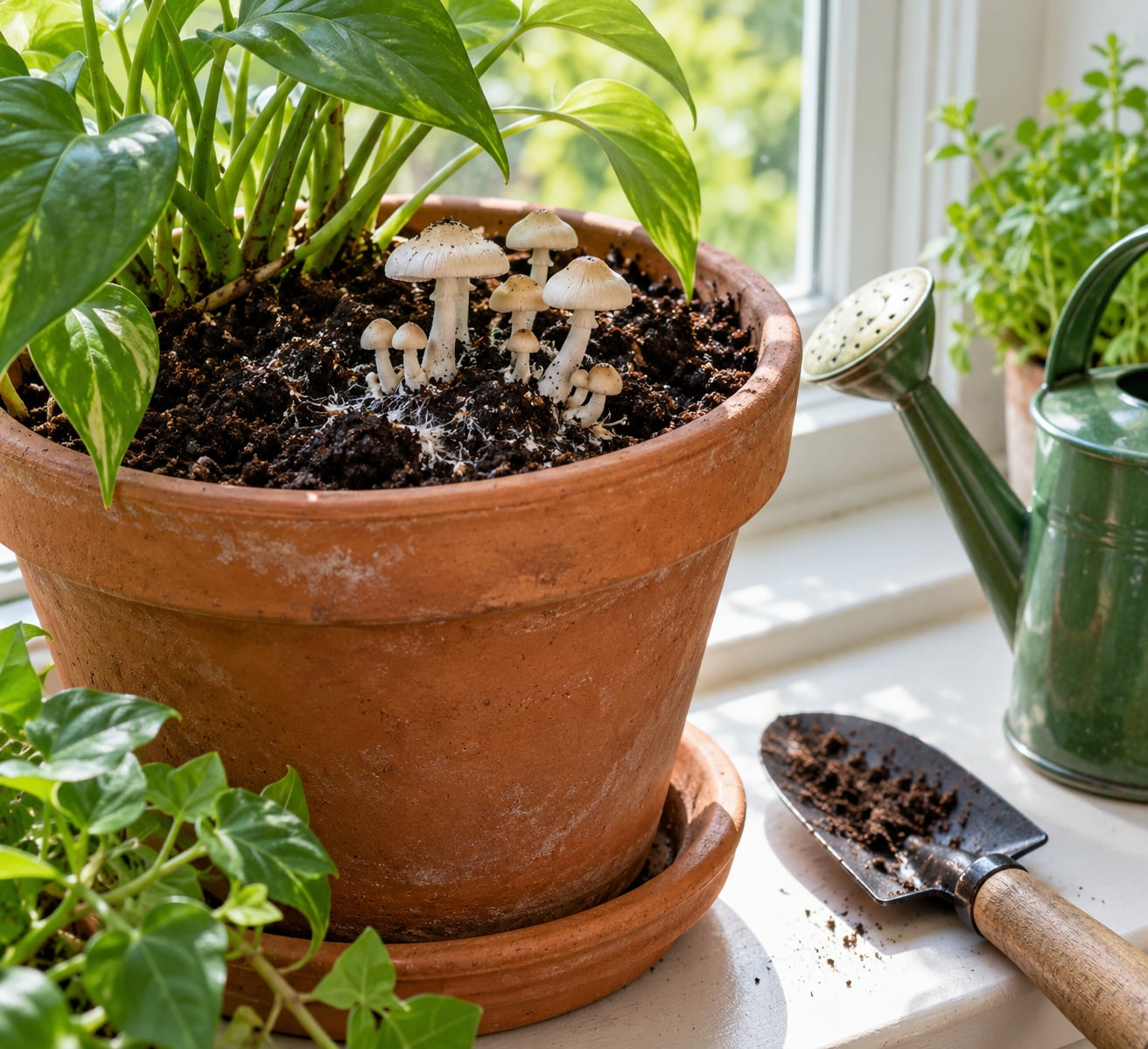
Small mushrooms in a pot usually mean one simple thing: fungal spores were already in the mix, and warm, damp soil let them grow. The mushroom is only the visible fruit. The organism doing the work sits underground, feeding on bark, compost and other organic matter, and it is not eating your plant’s roots. That said, mushrooms show up most often when soil stays wet for long stretches, so they double as a warning about watering and drainage.
Most of the time you can leave them, or pluck them out by hand. The cases that need real attention are the ones where white mold, sour soil and rotting roots show up alongside the mushrooms. Here is how to tell those apart, and what to do about each.
Table of Contents
- What Causes Mushrooms to Grow in Potting Soil?
- How the fungus actually grows
- Where the spores come from
- Why potting soil grows mushrooms after repotting
- Are Mushrooms in Houseplant Soil Dangerous?
- For people, pets and children
- How to Tell What Is Growing in the Pot
- Identification from a photo is not reliable
- When the plant itself is in trouble
- Why Potting Soil Grows Mushrooms More Often in Certain Conditions
- How to Remove Mushrooms from Potted Plants
- How to Stop Mushrooms from Returning
- When to Replace the Potting Soil
- Frequently Asked Questions
- Can I eat mushrooms that grow in potting soil?
- Should I throw away houseplant soil if mushrooms are growing in it?
- Are mushrooms a sign that my plant has mold or root rot?
- How often should I water a pot if mushrooms keep appearing?
- Can I use the same potting soil on another plant after removing mushrooms?
- Why do mushrooms appear in potting soil after repotting?
- What to Do First
What Causes Mushrooms to Grow in Potting Soil?
Potting soil is a food source, and fungal spores are already in it. Most mixes are built from composted bark, peat, wood fibre and other plant material, and none of that is sterile. Spores survive the composting process in tiny numbers and wait for conditions to improve.
How the fungus actually grows
The life cycle has three parts, and beginners rarely hear the first two explained. Spores are the microscopic seeds. They germinate into mycelium, a spreading web of fine threads that dig through organic matter. When the mycelium is well fed and the air is humid enough, it pushes a fruiting body up through the surface. That fruit is the mushroom you found, and it is a reproductive structure rather than the whole organism.
This matters because pulling the mushroom out removes almost none of the fungus. The colony stays in the soil, which is why a second wave often appears a week or two later.
Where the spores come from
- The mix itself. Composted bark, sawdust and wood fibre all carry spores. Gardeners on r/GardeningUK note the same point about peat-free compost: mushrooms are an expected byproduct of how modern compost is made.
- The air. Spores travel on air currents and are effectively everywhere. As one r/houseplants commenter put it, eliminating them from a home is not possible.
- Pets, clothing and shoes. Mud on boots and fur that walks on garden soil carries spores indoors.
- The container itself. A reused pot that held soil from the yard brings the whole community with it.
- Deliberate inoculation. Some mixes are seeded with mycorrhizae, beneficial fungi that trade nutrients with roots. Users on forums report mushrooms appearing within the first month of using those mixes.
Growing in a pot also concentrates the effect. There is a limited volume of soil, so organic matter breaks down faster than it would in open ground, and the fungus fruits in a tight cluster rather than spreading out.
Why potting soil grows mushrooms after repotting
Fresh mix means fresh spores, and repotting also wets everything thoroughly. Add the stress of root disturbance and a suddenly shaded, humid pot, and a wave can appear within days. One r/whatisit user summarised the fix in two steps: repot, then water less often.
Are Mushrooms in Houseplant Soil Dangerous?
For the plant, almost never. The fungus is decomposing organic matter, not parasitising roots, and growers on r/gardening describe it plainly: the soil is alive, those mushrooms are just the fruit. A plant next to a flush of mushrooms is often perfectly healthy.
There are two exceptions worth naming. The first is that the conditions mushrooms enjoy are the same conditions that cause root rot, so treat them as a prompt to check drainage rather than as a disease in themselves. The second is a dense white mat of mould across the surface, which is a different problem entirely and is covered below.
For people, pets and children
Do not eat them, and do not let pets or children handle or chew them. That is not alarmist. Potting soil can hold fungi that are not identified by casual inspection, and a spore print taken by an amateur is not a reliable identification. If a pet eats one, call your veterinarian rather than waiting to see what happens.
Beyond that, ordinary handling is fine. Wash your hands after working in soil, as you would with any gardening task.
How to Tell What Is Growing in the Pot
Beginners often lump three different things together under the word mould. They look similar from across a room and need different responses.
| What you see | Appearance | What it means |
|---|---|---|
| Mushroom | A distinct cap and stem, often clustered, sometimes with a ring on the stem or a skirt | Fruiting body of a soil fungus feeding on organic matter. Harmless to the plant. |
| Mycelium | Fine white threads stretched across the surface or over the pot rim, sometimes cobweb-like | The fungus itself, spreading through damp organic matter. Normal, and a good sign of activity. |
| White mould | Dense, crusty or fluffy white coating, often on the soil surface or lower leaves, not thread-like | A surface fungal bloom favoured by still, humid, wet conditions. Reduce moisture and airflow is usually enough. |
| Mineral crust | White or yellowish crusty deposit on the soil surface and pot rim, no growth in it | Dried mineral salts from watering. Scrape it off; it has nothing to do with fungi. |
One detail gets missed: a mature mushroom can release billions of spores at once, which is why a flush appears overnight and why users on r/mushroomID describe them sprouting in waves across several containers at the same time.
Identification from a photo is not reliable
Small caps in potting soil are hard to place accurately from a picture alone, and colour shifts with age and moisture. Where a name is certain, the most commonly reported is Leucocoprinus birnbaumii, the flowerpot parasol, a bright yellow or yellow-green mushroom that University of Florida extension agents have identified in potted plant soil. Ink caps such as Coprinus atramentarius, grey and bell-shaped with darkening edges, are also frequent.
Use names for orientation, never as permission to eat. If you need a firm identification, a local mycological society is a better route than an app.
When the plant itself is in trouble
Mushrooms are background noise. These signs are not. Yellowing leaves that started at the bottom, soft or dark stems near the soil, a sour or swampy smell from the pot, and soil that stays wet days after watering all point at waterlogged roots. Lift the plant and check: healthy roots are firm and pale, rotted roots are brown, mushy and pull apart easily.
Why Potting Soil Grows Mushrooms More Often in Certain Conditions
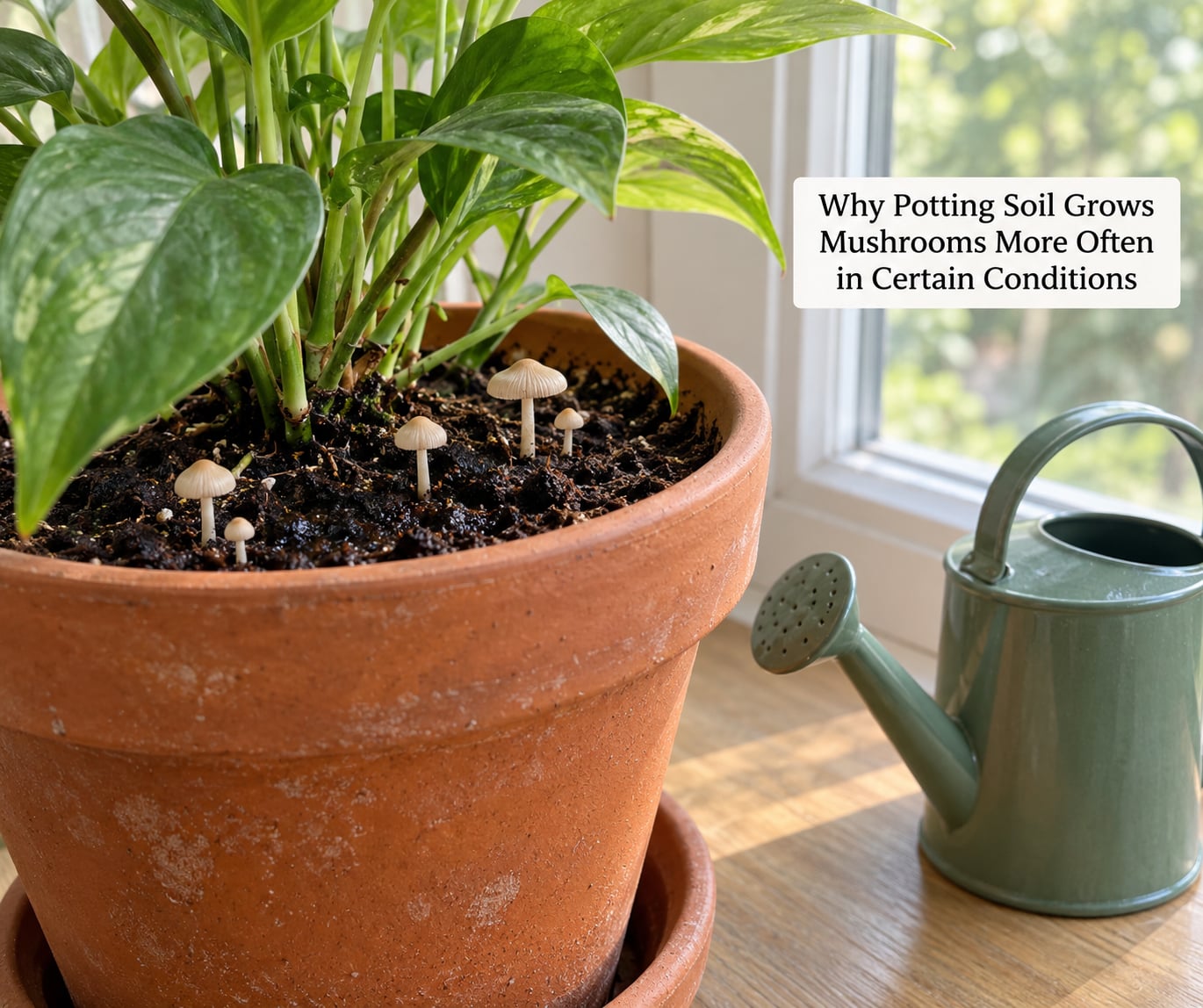
Fruiting is triggered by a specific combination, and you can change most of it. This table covers the conditions that come up most.
| Condition | Effect | Correction |
|---|---|---|
| Soil stays wet for days | Keeps humidity high enough to fruit, and starves roots of oxygen | Water less often; let the top inch or two dry before watering again |
| Pot without drainage holes, or a blocked saucer | Water cannot leave the root zone | Check holes, empty the saucer, repot into a draining container |
| Heavy, dense mix high in fine material | Holds water too long and packs down | Add perlite, pumice or coarse bark to open it up |
| Low air circulation indoors | Trapped humidity around the soil surface | Space plants apart, run a fan occasionally |
| Warm, dark spot | Warmth and darkness suit many species better than light | Move to brighter, indirect light |
| Plenty of organic matter, or fallen debris on the surface | Supplies the food the fungus needs | Top-dress with a mineral surface layer such as grit or coarse sand |
| Poorly fitting pot lid or a pot sitting inside a cachepot | Traps stale, wet air at the surface | Remove inner pot after watering and let it drain fully |
Notice that most of these are about the same underlying habit: moisture that lingers. Gardeners on r/houseplants consistently report that fungi appear as a symptom of overwatering, and that cutting back the watering stops them.
How to Remove Mushrooms from Potted Plants
Removal is cosmetic. Ranked from least to most invasive, here is what actually works.
- Pull them by hand. Pinch the stem at soil level and lift. It stops the visible fruit and most spore release, and it costs nothing. Removing the cap alone works too, since the stem is what anchors it.
- Take the surface soil with them. Scoop out a centimetre of mix around the cluster and bag it. This clears fruiting bodies and any surface mould.
- Let the top layer dry out. Skip watering until the upper soil is dry to the touch. Dry conditions stop new fruit from setting.
- Top-dress. Cover the surface with a thin layer of coarse grit, sand or perlite. Organic material sits underneath, where it keeps feeding the fungus but light and dryness cover it.
- Repot. The only method that removes the mycelium itself. Refresh at least the top third of the mix, or change it entirely if roots are affected.
Expect a second wave. Mycelium survives removal of the fruit, so if conditions have not changed, new mushrooms appear in a week or two. That is the argument for doing steps three and four rather than stopping at step one.
Skip the folk remedies. Household vinegar, bleach and fungicide sprays damage roots and soil life without removing the colony, and none of them change the moisture conditions that caused the flush.
How to Stop Mushrooms from Returning
Mushrooms are a symptom, so prevention is watering practice and pot hygiene.
- Water less, and more deeply. Check the soil before you water rather than following a schedule. When the top inch or two is dry, soak thoroughly and let it drain completely.
- Confirm drainage. Every pot needs unobstructed holes. Empty standing water from saucers and cachepots after watering.
- Match the mix to the plant. A cactus or succulent wants a gritty, fast-draining mix; a fern will hold moisture much longer. Most mushroom waves come from using one dense mix for everything.
- Move to brighter light. Direct sun bakes off small fruit and discourages new flushes, and r/HotPepperGrowing users rely on exactly that.
- Keep air moving. A fan across the plant group dries the soil surface between waterings.
- Clean before you reuse. Wash pots and tools, and never scoop garden soil into indoor containers.
- Repot into the right size. Oversized pots hold more water than the plant can use, leaving soil wet for long stretches.
Once watering is corrected, most people never see another mushroom. The fungus may stay in the soil for years without fruiting.
When to Replace the Potting Soil
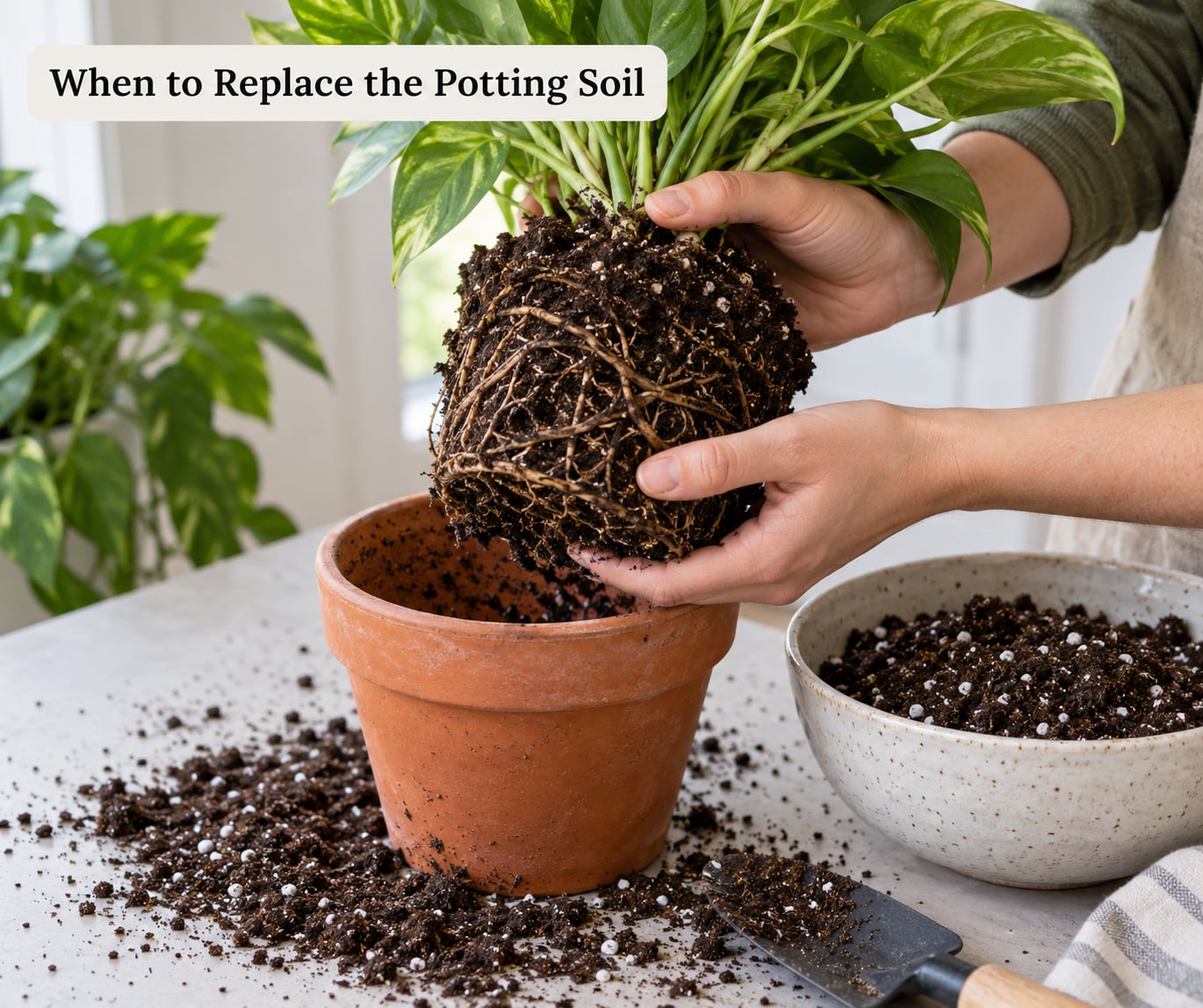
Replacing the mix is worth it in a short list of situations, and unnecessary in almost all others.
- Mushrooms keep returning through repeated dry-downs.
- The soil smells sour or swampy, or has gone compacted and dense.
- Roots are brown and soft when you lift the plant.
- White mould covers the surface and returns within days of cleaning it off.
- Water stands on the surface or runs out the sides without soaking in.
- The plant has been in the same mix for several years and has compacted.
If none of those apply and the plant looks fine, keep the soil. Throwing out a healthy pot because of a few mushrooms wastes a season and the plant’s roots along with it.
To repot, water lightly a day ahead so the root ball holds together. Tip the pot, support the stem at the soil line, and slide the root mass free rather than pulling on the plant. Shake loose the old mix and trim any dark, mushy roots with clean scissors. Set the plant into a pot one size up with fresh, appropriate mix, firm it lightly, and water once to settle.
Frequently Asked Questions
Can I eat mushrooms that grow in potting soil?
No. Never eat a mushroom from potting soil, even one you think you recognise. Potting soil can carry fungi that cause serious poisoning, and identification from a cap in a dim room is not reliable. Handle them with bare hands if you like, wash afterwards, and keep pets and children away while they are in the pot. A photograph sent to a local mycological society is a better route than a guess.
Should I throw away houseplant soil if mushrooms are growing in it?
Usually not. Mushrooms mean fungal activity in the organic matter, which is normal, and the plant is rarely harmed. Check for the real warning signs instead: sour smell, soil that stays wet for days, soft brown roots, yellowing leaves. If none of those are present, pluck the mushrooms, let the surface dry and move on. Repot only when drainage has failed or roots are decaying.
Are mushrooms a sign that my plant has mold or root rot?
They are a signal to check, not a diagnosis. Mushrooms and root rot both like continuously wet, poorly aerated soil, so they often appear together. Mushrooms on their own mean living soil. Thin white threads stretched over the surface are mycelium and are normal. A dense, crusty white coating on the soil is surface mould, which needs drier conditions and more airflow. Soft brown roots and a sour smell mean rot, and that does need repotting.
How often should I water a pot if mushrooms keep appearing?
Water less often, and check the soil before you do. Let the top inch or two dry out, then soak thoroughly until water runs from the drainage holes and empty any saucer. Skip the fixed schedule many people follow and go by the soil instead. Mushrooms appear in waves, so expect another flush about a week after you remove one, and it should stop once the mix dries between waterings.
Can I use the same potting soil on another plant after removing mushrooms?
It depends on why the soil is wet. If the pot drains freely and the roots are firm and pale, you can reuse the mix outdoors or for a plant that tolerates heavier soil, after removing any visible growth. If the soil is sour, compacted or the roots were decaying, do not reuse it, because the underlying drainage problem will follow the soil to the new pot. Refreshing the top third is often enough for an otherwise healthy plant.
Why do mushrooms appear in potting soil after repotting?
Fresh mix carries fresh spores, and freshly watered soil plus disturbed roots gives fungi exactly the damp, shaded, organic matter they need. Repotting also moves a plant into a pot where nobody has yet learned its watering rhythm, so overwatering in the first few weeks is common. Use fresh appropriate mix, water thoroughly once, then let the top layer dry before watering again and mushrooms usually stay away.
What to Do First
Do not eat the mushrooms, and do not throw the soil out. Pull them out by hand, take a centimetre of surface soil with them, and stop watering until the top layer is dry. Then look at the pot rather than the fungus: check the drainage holes, the saucer, and the mix itself. If the roots are firm and pale and the soil drains freely, leave it alone and let the fungus stay buried.