Sticky residue on houseplant leaves is almost always a sugary film of honeydew, the sugary waste that sap-sucking pests excrete after feeding. In a minority of cases it is harmless: guttation, a few drops of water pushed out at the leaf edge, or the natural sap dots some plants release in bright light. Identifying which one you have takes about five minutes, and skipping that step is how people end up spraying a healthy plant with soap for weeks.
I’ve pulled apart enough sticky ficus and Calathea leaves to know the pattern well. The residue almost always shows up before the insects do, because the bugs hide along veins, in leaf axils and on the underside while the film spreads across the open surface above. So treat the stickiness as the clue, not the problem.
Below is what each cause looks like, three tests that confirm whether pests are actually present, and the safest way to clear the film without burning the foliage.
Table of Contents
- Sticky Residue on Houseplant Leaves: Common Causes at a Glance
- How to Tell What Is Causing the Sticky Film
- Run three tests before you spray anything
- The look-alikes that get misdiagnosed
- The Most Common Sticky Residue on Houseplant Leaves Causes
- 1. Scale insects
- 2. Mealybugs
- 3. Aphids
- 4. Whiteflies
- 5. Spider mites
- 6. Damp soil and fungus gnats
- 7. Fertilizer, pesticide or spray deposits
- 8. Honeydew from outdoor insects
- How to Remove Sticky Residue Without Damaging the Plant
- What to use, and what to avoid
- Cleaning sticky residue off everything else
- When Sticky Leaves Mean a More Serious Plant Problem
- How to Prevent Sticky Residue Returning
- Frequently Asked Questions
- How can I treat sticky leaves on my indoor plant?
- Can I use Dawn dish soap to clean my plant leaves?
- Why do my plants have honeydew but no bugs?
- Is it okay to leave aphids on plants?
- Is sticky residue on leaves harmful to plants?
- Conclusion
Sticky Residue on Houseplant Leaves: Common Causes at a Glance
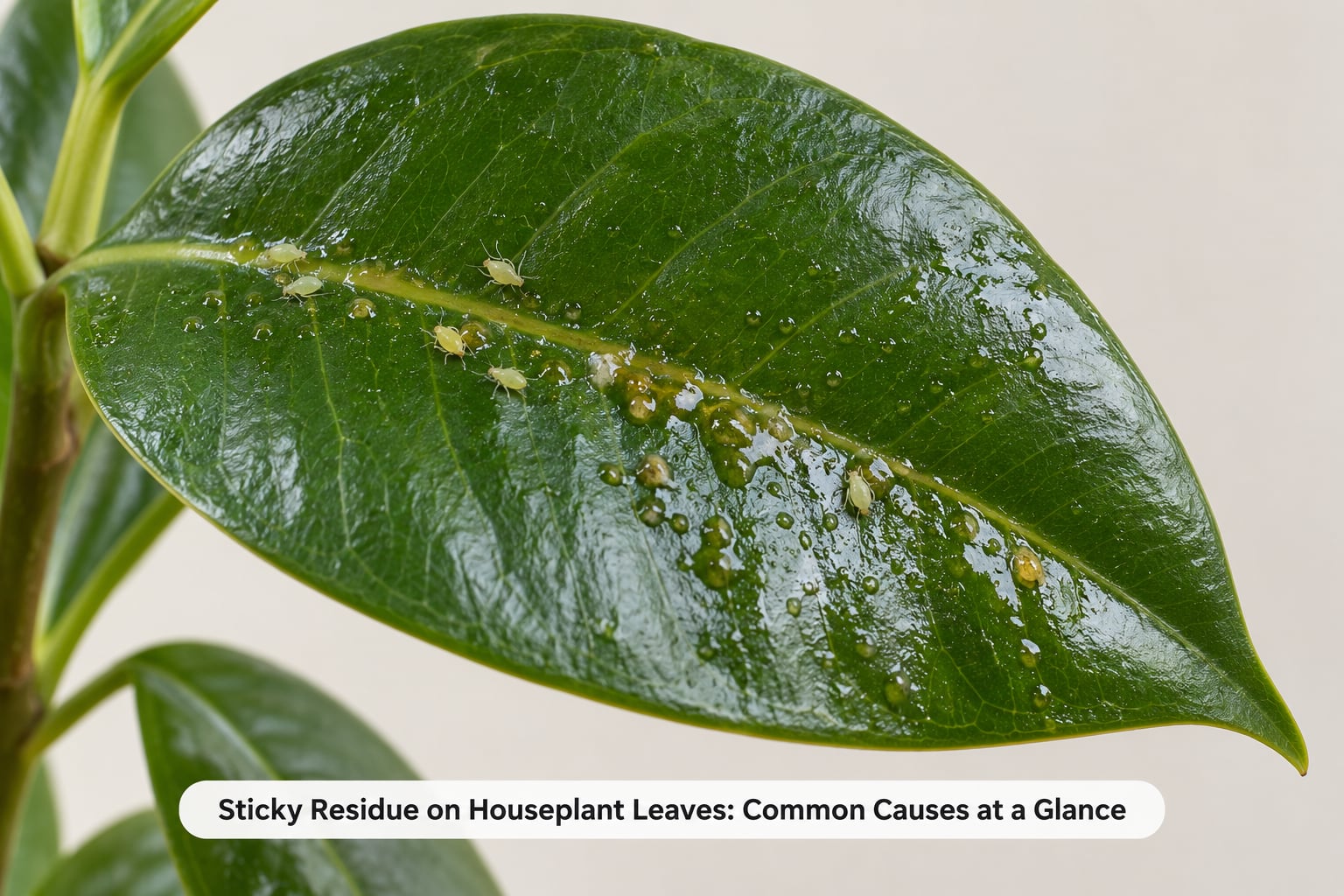
Match what you see in this table before you do anything else. It takes ten seconds and saves an hour of spraying the wrong problem.
| Cause | What the residue looks like | Where it appears | Signals nearby | Safest first response |
|---|---|---|---|---|
| Honeydew from scale | Clear, glossy, varnish-like film | Upper leaf surfaces, stems, and every surface the plant touches | Raised brown or black bumps on veins and leaf undersides | Isolate the plant, then run the sticky-hand test |
| Honeydew from mealybugs | Sticky patches near white cottony clusters | Leaf axils, stem nodes, leaf undersides | White fluff, sometimes a faint pink tint | Isolate, dab each cluster with alcohol on a swab |
| Honeydew from aphids | Thin, tacky film, often newest growth | Tips, young leaves, flower buds | Clusters of soft-bodied insects, curled or yellowed new leaves | Blast with water, then treat the underside of leaves |
| Honeydew from whiteflies | Shiny film plus black specks | Lower leaves, undersides | A cloud of small white flies when you tap the plant | Tap-test to count them, use sticky traps, treat undersides |
| Spider mite damage | Fine sticky residue with dull, bronzed leaves | Undersides, along veins | Webbing, stippling, moving dots on a white paper test | Wash leaf undersides, raise humidity, treat undersides |
| Guttation | Clear water droplets that dry to a faint mineral ring | Leaf tips and edges, overnight | Soil is very wet, pot feels heavy, room is warm and bright | Skip a watering and let the pot drain fully |
| Fertilizer or pesticide deposits | Flat, water-soluble white or tan crust | Evenly on every leaf, including new growth | Recent feeding, spraying or a gritty top-dressing | Rinse leaves with plain water, flush the soil|
| Natural sap exudation | Scattered small dots or beads, not a film | Undersides, or where leaves rub each other | Only on one species, usually in strong light | Nothing. Leave it alone.
Note the row that gets missed most often: guttation. It produces a genuinely sticky leaf in bright, warm rooms, and it looks alarming when the water dries into a crusted ring. It is not a pest and no treatment applies.
How to Tell What Is Causing the Sticky Film
Texture does most of the work. Honeydew is sugar, so it stays tacky, feels slightly slimy under a fingertip and smears when you rub it. Mineral deposits from guttation or from hard water are crystalline, dry to a hard gritty ring and come off with a dry cloth. A fertilizer crust is flat and dull, and it appears on every leaf rather than in patches.
Location is the second clue. Residue that has transferred to the windowsill, saucer, shelf or wall means something is dripping onto it, which almost always points to insects above rather than water from below. Dots that sit in neat scattered spots on the underside of one species are a plant trait, not a problem. Garden.org’s plant consultant Will Creed made this exact call on a Calathea thread, noting the sticky sap spots on leaf undersides in good light and describing them as normal rather than disease.
Third, look at what surrounds the plant. Tiny white specks that rise into the air when you tap the canopy are whiteflies. Ants walking in a steady line up the trunk are farming scale or mealybugs for their honeydew, and that alone tells you what is living in the canopy. Dusty grey movement on a white background under a leaf means spider mites.
Run three tests before you spray anything
The sticky-hand test: tap or shake the plant over an open palm, then rub the residue between thumb and finger. Honeydew feels tacky and leaves a slightly greasy film. If your hand stays dry and the leaf is still tacky, the stickiness comes from the leaf surface itself rather than from insects above it.
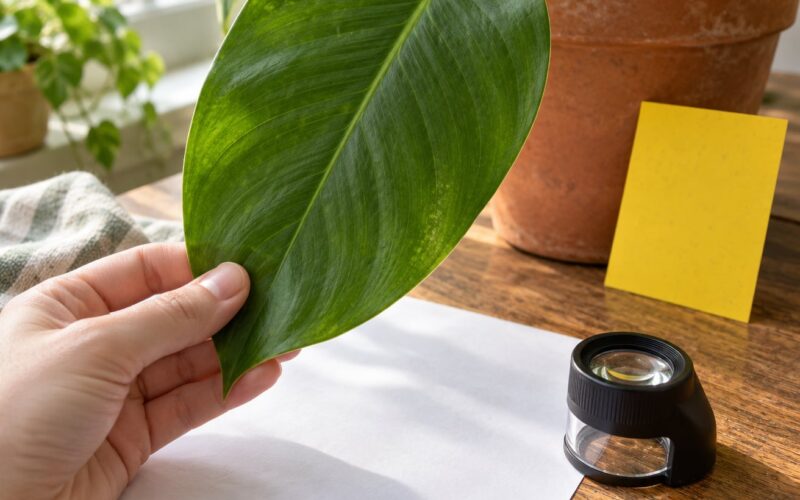
The white paper test: lay a sheet of plain white paper under the plant and tap the foliage. Anything that moves on the paper is alive. This is how you confirm spider mites, thrips and whitefly adults, all of which hide better than you expect.
The flash test: darken the room, turn on your phone flashlight, and rake the beam across the underside of each leaf at a low angle. Moving specks catch the light like dust in a sunbeam. This is the fastest way to find scale on new growth before the film spreads.
Run all three before treating. Ten minutes of checking saves weeks of spraying something that was never the problem.
The look-alikes that get misdiagnosed
Guttation happens when the roots push more water into the leaves than the leaves can evaporate, and it exits at the edges as droplets, usually overnight. That is why it feels sticky in the morning. It shows up on plants in warm, bright, well-watered spots: rubber plants, monsteras, palms. The leaves are healthy, the new growth is normal, and no bugs exist anywhere. Reduce watering and improve drainage.
Mineral deposits look like a crust rather than a film. They come from hard water or from a wet finger touching a leaf as you water. Scrape one gently with a fingernail; it feels gritty.
Natural sap exudation is species-specific. Calathea and some ficus and Schefflera release small sticky sap spots, usually on leaf undersides or where leaves overlap, and it shows up more in strong light. A dwarf umbrella plant (Schefflera) is also the plant most often identified on r/houseplants as a scale outbreak, so check for the brown or black bumps before you assume the dots are natural.
The Most Common Sticky Residue on Houseplant Leaves Causes
Five of the eight causes below are insects or mites, and they all leave the same sticky film behind. The table below tells them apart, because the treatment for a soft-bodied aphid is very different from the treatment for armored scale.
| Pest | Where to look | What it looks like | Sticky residue? | Severity |
|---|---|---|---|---|
| Soft scale | Stems, leaf veins, undersides | Flattened, translucent to brown domes, sometimes with a cottony ovisac | Heavy | Moderate to high |
| Hard scale | Attached along veins and midribs | Immovable brown, black or grey bumps that scrape off like barnacles | Moderate | High if stems are covered |
| Mealybugs | Leaf axils, stem nodes, soil surface | White cottony clusters, oval and slightly pink underneath | Yes, in patches | Moderate, spreads slowly |
| Aphids | New growth, buds, undersides | Soft pear-shaped bodies in clusters, sometimes winged | Yes, on fresh growth | Low to high, reproduces fast |
| Whiteflies | Undersides, lower leaves | Adults fly in a white cloud; nymphs are flat pale discs | Yes, with black specks | Moderate, hard to reach |
| Spider mites | Undersides along veins | Moving dots, fine webbing, yellow stippling on the top surface | Later sign | High once webbing appears |
1. Scale insects
Scale is the single most common culprit indoors, and it is the one people miss longest. The community consensus on DavesGarden is that sticky secretions on indoor plants are usually scale, and scale is hard to identify because it does not look like a moving bug.
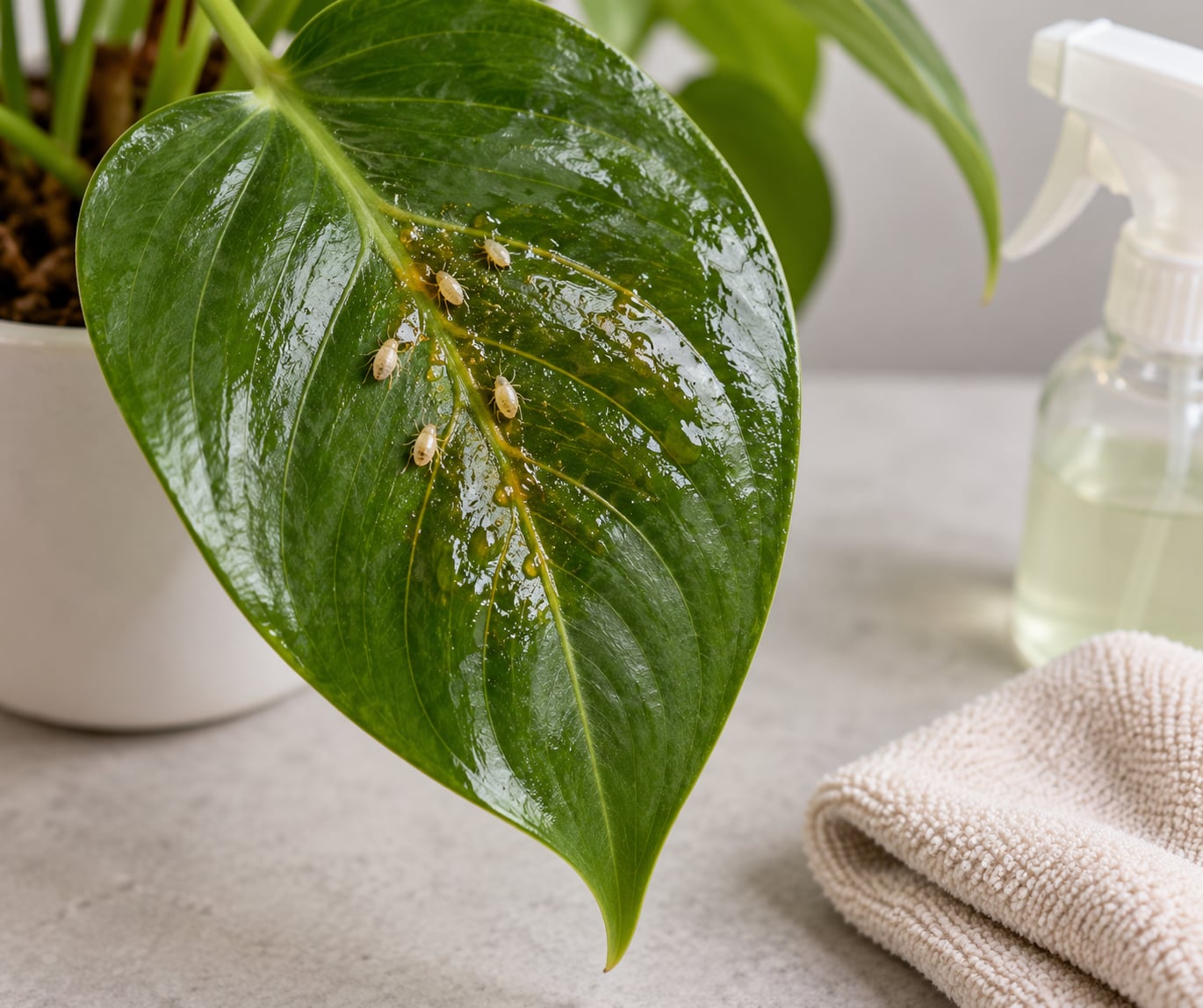
Hard scale sits as raised brown, black or grey bumps that scrape off like a tiny barnacle. Soft scale is flatter, slightly translucent and produces far more honeydew. Adults are immobile, which is exactly why a sticky film often appears before any visible insect does.
2. Mealybugs
Mealybugs are sap-suckers too, sheltered in leaf axils and stem nodes where cottony white fluff protects them. Look for residue that concentrates near those junctions rather than evenly across the leaf. A heavily infested plant often looks dusty or slightly yellow before it drops leaves.
3. Aphids
Aphids cluster on tender growth, flower buds and leaf undersides, and they curl new leaves as they feed. They reproduce fast, so a small cluster in spring can cover a plant within weeks. The film appears first on the newest growth because that is where the colonies sit.
4. Whiteflies
Whiteflies hide on leaf undersides and scatter in a white cloud when disturbed. They leave a glossy film plus scattered black specks of waste. Two things separate them from everything else on this list: the adults fly, and the nymphs are flat, pale discs that look like tiny scale but shed skins that resemble white fluff.
5. Spider mites
Spider mites are arachnids, not insects, and two-spotted spider mites are the usual indoor offender. Fine webbing, stippled yellow dots and bronzed leaves come first; sticky residue is a later sign. They thrive in warm, dry, dusty conditions, which is why they appear in heated indoor air through winter.
6. Damp soil and fungus gnats
This one is not sap. Fungus gnats breed in consistently wet soil, and the sticky film people notice near them is often a combination of surface algae and a wet saucer under the pot. If the topsoil is damp and there are small dark flies around the soil, fix the watering regime rather than treating the leaves. Overwatering is what invited them.
7. Fertilizer, pesticide or spray deposits
Foliar feed, self-watering fertilizer sticks, or a spray applied too heavily leave a flat crust on every leaf, new and old alike. Insecticides containing fatty soaps or oils leave a dull film that catches light once it dries. Check the evenness of the coating: anything uniform across the whole plant is almost certainly deposited, not excreted.
8. Honeydew from outdoor insects
If the plant sits near an open window, on a balcony or against a door, the honeydew may not be coming from the plant at all. Outdoor aphids and scale on nearby trees fall or fly in, feed, and move on. That explains cases where sticky film appears on a plant that has never been near another infested plant, and it also explains sticky windowsills with no pests on the plant itself.
How to Remove Sticky Residue Without Damaging the Plant
Work from the leaf outward. Cleaning the film without treating the source is the single most common reason people’s sticky leaves return within days.
- Isolate the plant. Move it away from its neighbours, take it out of the room if you can, and put a paper barrier under the pot so existing honeydew does not spread while you work.
- Confirm the cause. Run the sticky-hand, white paper and flash tests described above. Decide whether you are dealing with insects, deposits, or a benign cause.
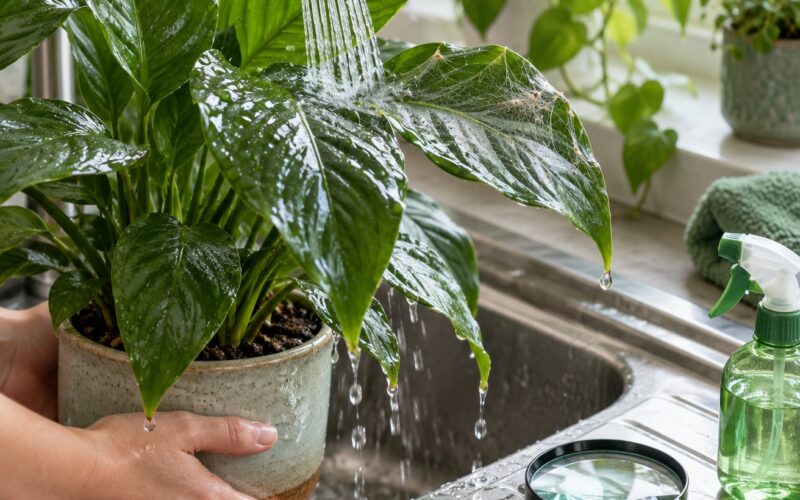
- Wash the leaves. Move the plant to a sink or shower, remove it from the pot if it is light enough, and wash both leaf surfaces with lukewarm water. Hold the leaves from below so you do not snap stems. Take care not to flood the soil; if you must, tip the pot to drain afterward.
- Treat the insects, if any. Wipe each leaf with a solution of insecticidal soap diluted per the label, or a dish soap mix at roughly 1 teaspoon of mild, fragrance-free dish soap per quart of water. Always test one leaf first and wait 48 hours before treating the whole plant. Spray the undersides, where the insects actually are.
- Remove scale and mealybugs by hand. Dab each visible bump or cottony cluster with a cotton swab dipped in 70 percent rubbing alcohol. This is faster and far more reliable than spraying armored scale, which shrugs off contact products.
- Repeat on a schedule. Treat every five to seven days for at least three cycles, because most insecticides kill what they touch and not what is still inside an egg case. Stop when the white paper test comes back clean.
- Clean the room. Wipe the saucer, shelf, windowsill and any surface the plant touched, since honeydew transfers and will re-wet the leaves.
What to use, and what to avoid
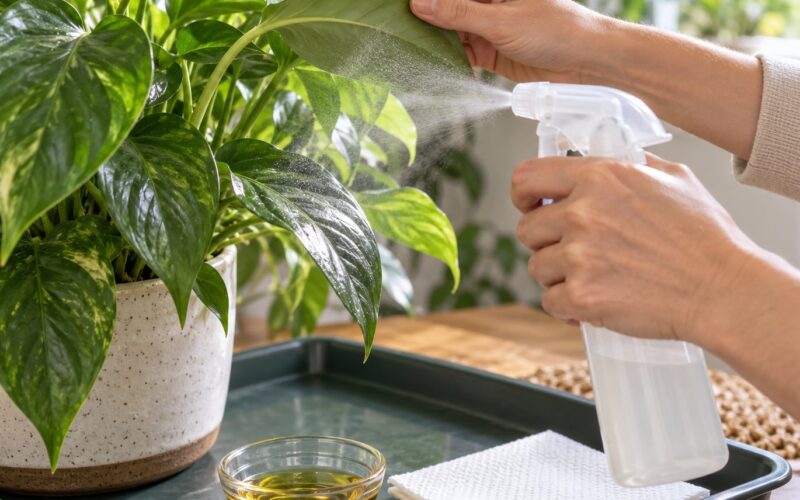
Insecticidal soap and horticultural oil are the safest broad options. Both work by breaking down the waxy coating that protects soft-bodied pests, so coverage matters more than strength. Dilute to label directions and skip plants in bloom, since soap residue on a flower can burn it.
Dawn dish soap does work on soft-bodied insects, and it is the mix most often recommended on plant forums. The caution is that Dawn’s surfactants are harsher than a mild dish soap, so use the mildest product you have, keep the mix weak, and never apply it to Calathea, ferns, succulents, jade or any fuzzy-leaved plant. Test a single leaf and wait two days.
Rubbing alcohol is the right tool for individual scale and mealybugs, not for whole-plant spraying. It will scorch leaves if you soak them.
Avoid fungicides. Sooty mould is a secondary growth on honeydew, not a disease. The fungal community on the leaf surface is what keeps the pests fed, and removing the pests is what clears the mould. If black residue wipes away, it is sooty mould. If it does not wipe away and is spreading despite dry foliage, that is a different problem worth identifying on its own terms.
Cleaning sticky residue off everything else
The plant is usually the smallest part of the cleanup. Honeydew transfers to saucers, shelves, windowsills, walls and any surface beneath the canopy, which is why the problem reads as a house problem. Once the pests are handled, wash those surfaces with warm soapy water; for stubborn films on non-porous surfaces, a little rubbing alcohol on a cloth works well. Porous materials like untreated wood absorb the film and may need sanding or refinishing.
When Sticky Leaves Mean a More Serious Plant Problem
Sticky residue on its own is a symptom, not a diagnosis, and most cases are manageable. A few signals mean the situation has moved past a wipe-down.
Widespread yellowing, leaf drop and a plant that no longer pushes new growth point to a root problem or a sustained infestation. When insects drain enough sap, the plant declines no matter how much you clean the leaves. Check the roots: mushy, dark or sour-smelling roots in wet soil mean rot, and rot is a different treatment entirely.
Heavy webbing across leaf spans between plants is a sign of a spider mite population that has already passed the treatable-with-a-spray stage. Heavy, sticky, unmovable scale covering stems and leaf veins means the same thing for scale. Isolate immediately, because these spread to neighbouring plants on hands, tools and clothing.
Sticky residue transferring to walls several feet from the plant, or appearing on plants that were never near each other, points to a winged outdoor source or a shared pest problem in the room rather than a single plant.
Discard a plant when the infestation covers most of the foliage and the plant is already declining, when roots are compromised, or when the species is a known magnet for pests and you have other plants at risk. Isolate for at least three weeks, not three days; pests hidden in leaf axils survive well past the point where you stopped seeing them. If symptoms are spreading fast or you cannot identify the pest, a local extension service or a reputable plant clinic can identify it from a photo faster than you can.
How to Prevent Sticky Residue Returning
A ten-minute weekly routine catches almost every infestation before honeydew appears.
- Inspect weekly. Check leaf undersides, leaf axils and stems, especially on new growth. The flash test takes seconds per leaf and catches scale earlier than anything else.
- Quarantine new plants for two to three weeks. Keep them out of the main plant room, inspect them properly, and treat if needed before they join the collection. Repeated self-reports trace scale outbreaks to second-hand plants that were never quarantined.
- Watch the floor. Ants on the plant or on the windowsill are an early warning for scale or mealybugs, since they farm the honeydew. Treat the insects, not the ants.
- Use sticky monitoring traps. Yellow cards near the canopy tell you whiteflies or fungus gnats are active even when you cannot see them.
- Clean leaves periodically. A monthly wipe with plain water or a very dilute soap solution keeps dust down and lets you feel the leaf surface, where a tacky patch shows up before anything is visible.
- Water correctly. Let the top layer dry between waterings, drain fully, and empty saucers. This cuts fungus gnats and reduces guttation.
- Be restrained with fertilizer and sprays. Excess feeding pushes out tender growth that pests prefer, and heavy foliar applications leave their own residue.
- Give plants air and light. Good circulation and bright light reduce mite pressure and dry leaves faster, which breaks the conditions pests enjoy.
Frequently Asked Questions
How can I treat sticky leaves on my indoor plant?
Start by isolating the plant and confirming the cause with a sticky-hand or white paper test. Wash both leaf surfaces with lukewarm water, then treat undersides with insecticidal soap or horticultural oil diluted to label directions. Dab scale and mealybugs individually with a cotton swab dipped in rubbing alcohol. Repeat every five to seven days for three cycles, then clean the saucer and surrounding surfaces.
Can I use Dawn dish soap to clean my plant leaves?
Dawn does kill soft-bodied pests, and it is the mix people most often reach for on forums. Its surfactants are harsher than a mild dish soap, so use the mildest product you have at roughly one teaspoon per quart of water. Never use it on Calathea, ferns, succulents or fuzzy-leaved plants. Test one leaf first and wait 48 hours before treating the whole plant.
Why do my plants have honeydew but no bugs?
Usually because the insects are on the underside of the leaf, in the leaf axils, or attached to veins where you rarely look. Scale adults are immobile and blend into stems, and spider mites and whitefly larvae hide in the same places. Lay white paper under the plant and tap it, then rake a phone flashlight across the leaf undersides in a dark room. If both tests come back clean, consider guttation or deposits instead.
Is it okay to leave aphids on plants?
No. Aphids reproduce quickly, drain sap from new growth, and curl or distort the leaves they feed on, and they are one of the easiest pests to control early. Blast them off with water, then treat leaf undersides with insecticidal soap and repeat every five to seven days. Leaving them risks spread to every plant in the room.
Is sticky residue on leaves harmful to plants?
The film itself blocks light, and sooty mould growing on it can reduce photosynthesis badly. The insects producing it weaken the plant far more than the residue does. Guttation and natural sap dots, by contrast, are harmless and need no treatment. Telling the two apart is the first job, and the texture test settles it in seconds.
Conclusion
Isolate the plant first, then look at the undersides of the leaves rather than the tops. Decide whether the residue is tacky and smeared, which means honeydew, or dry and gritty, which means deposits or guttation. Clean the leaves gently with water and a mild soap, then treat the source: insects if the tests find them, watering if the cause is damp soil, and nothing at all if the plant is simply doing what that species does. Wiping the leaf without removing the cause is why most people watch the stickiness come back within days.