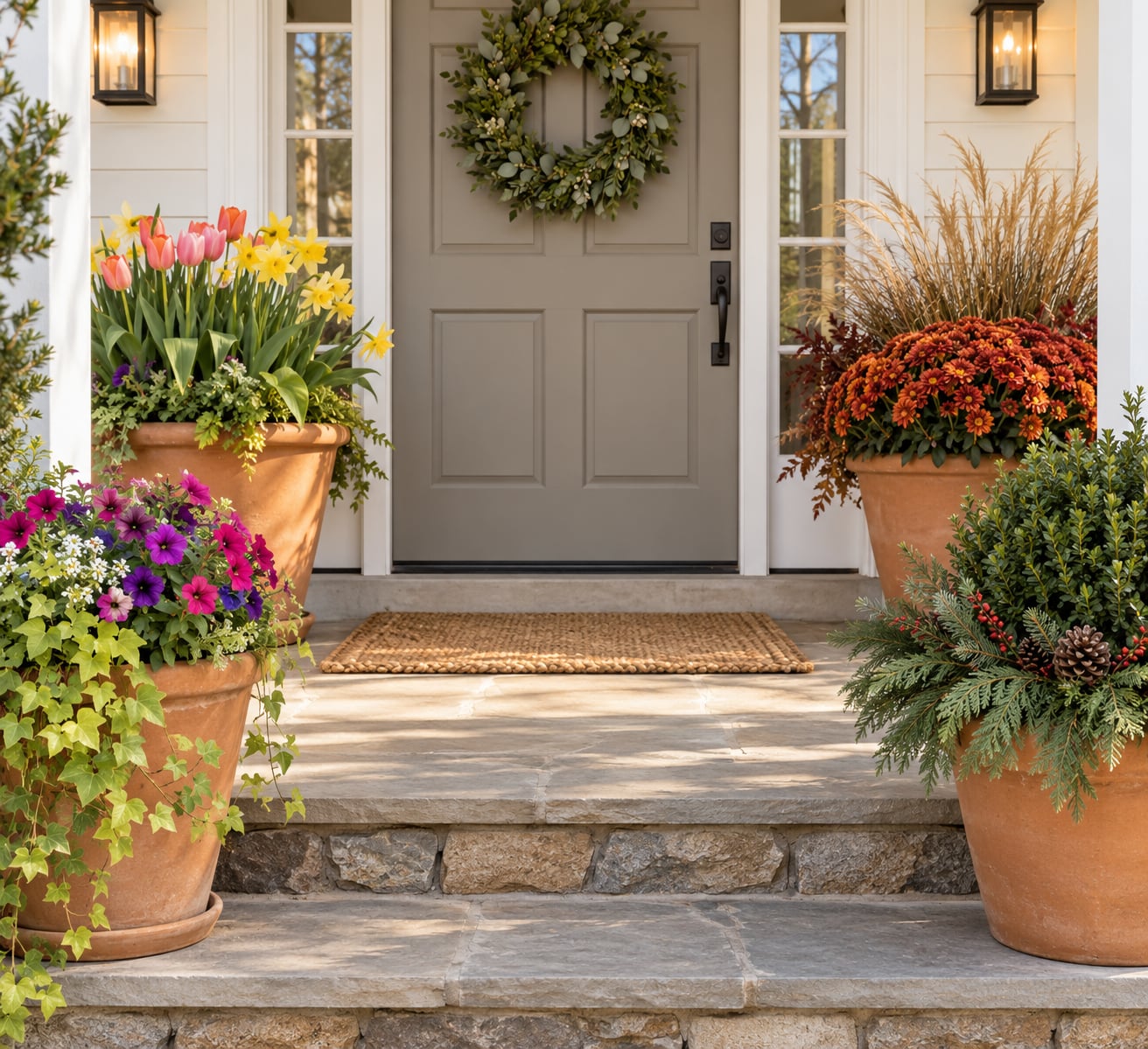
A seasonal plant swap is the practice of changing what is planted in your front porch containers on a fixed schedule, usually four times a year, so the entryway matches the weather instead of forcing one planting to survive all of it. You keep the same pots and swap the plants: bulbs and pansies in spring, heat-lovers in summer, mums and grasses in autumn, evergreens and cut branches in winter.
These seasonal plant swap ideas for a front porch are written for anyone with a stoop, a covered entry or a couple of planters by the door who wants curb appeal without buying a whole new arrangement every spring. Most of the ideas below cost the same as one season’s worth of flowers because the container stays put and only the green changes.
The unglamorous part is the transition itself. Plants hauled from a warm greenhouse onto a windy porch in April sulk for about two weeks, and the same thing happens in reverse when summer annuals come inside in September. Gardeners on r/gardening and r/containergardening talk about that adjustment window more than anything else, so the plan here assumes you will do it gradually.
Table of Contents
- Seasonal Plant Swap Ideas for a Front Porch at a Glance
- 1. Refresh Spring Porch Planters with Bright Bulbs
- 2. Build a Layered Summer Container
- 3. Create a Fragrant Summer Entrance
- 4. Add Color with Late-Summer Foliage
- 5. Make an Autumn Porch with Texture and Warm Color
- 6. Transition to Winter with Evergreens
- 7. Design a Winter Hanging-Basket Swap
- 8. Use Bulbs for a Long-Lasting Spring Display
- 9. Refresh a Small Porch with One Focal Planter
- 10. Create a Polished Four-Season Porch Palette
- How to Make Seasonal Plant Swaps for a Front Porch Easier
- Frequently Asked Questions
- What plants work best for a front porch that gets full sun?
- How often should I change plants on a front porch?
- Can I reuse the same pots for every season?
- What plants are easiest to care for on a porch?
- How do I choose plants that look good together?
- Conclusion: Make Your First Seasonal Swap
Seasonal Plant Swap Ideas for a Front Porch at a Glance
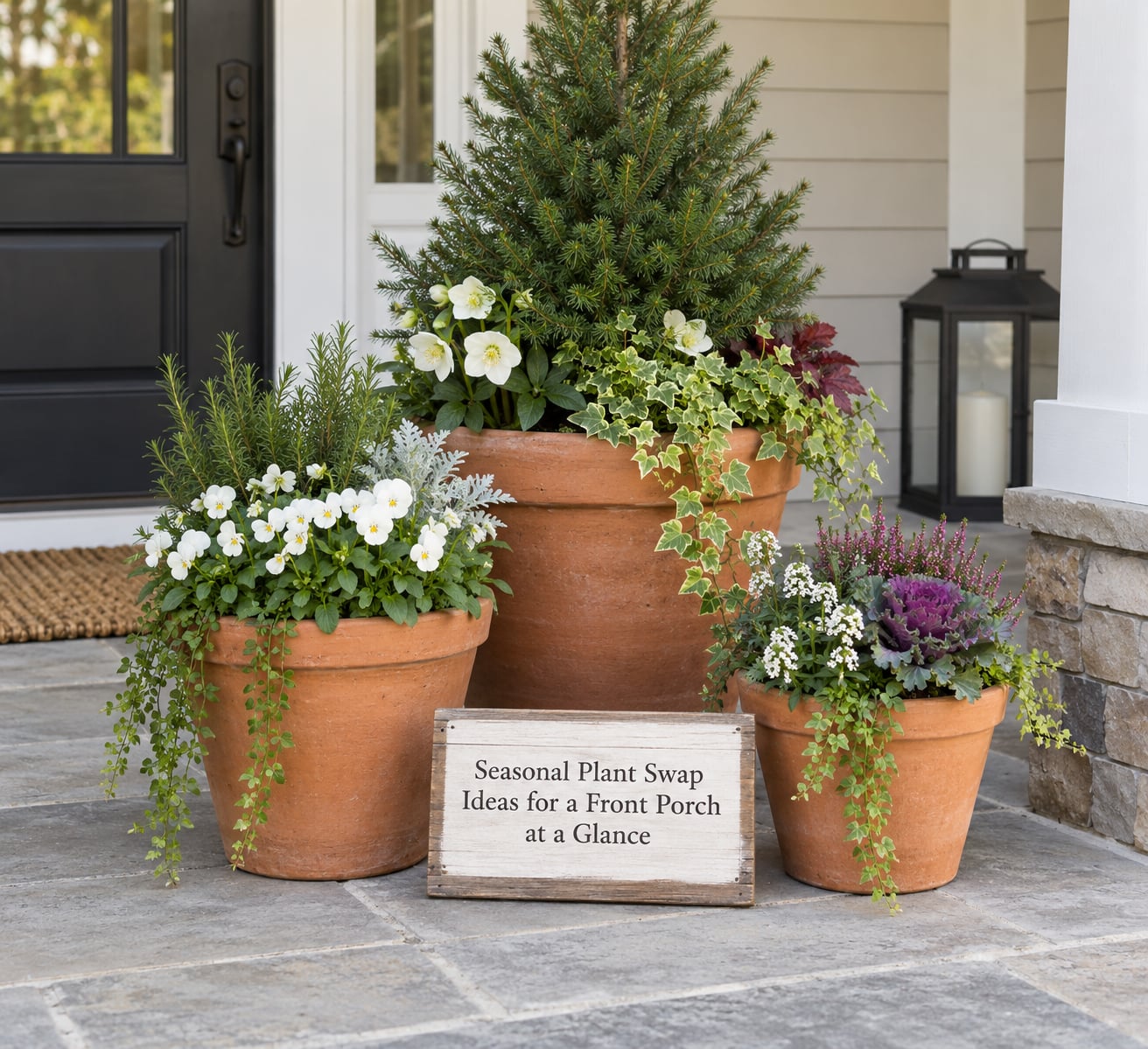
| Swap | Season | Plants to plant | Light | Design effect |
|---|---|---|---|---|
| 1. Bright bulbs | Spring | Daffodils, tulips, pansies, hyacinths | Full sun to part shade | Cheerful, high-contrast entry |
| 2. Layered summer container | Summer | Canna, verbena, sweet potato vine | Full sun | Full, overflowing look |
| 3. Fragrant entrance | Summer | Basil, rosemary, lavender, scented geranium | Full sun | Welcoming before you ring the bell |
| 4. Late-summer foliage | Late summer | Coleus, alternanthera, ornamental kale | Part shade to full shade | Colour without spent flowers |
| 5. Autumn texture | Autumn | Mums, asters, grasses, celosia | Full sun | Warm, textured palette |
| 6. Winter evergreens | Winter | Boxwood, dwarf conifer, holly, skimmia | Full sun to part shade | Structure through the cold |
| 7. Basket swap | Winter | Ivy, winter greens, compact pine | Part shade | Trailing movement overhead |
| 8. Layered bulbs | Late winter to spring | Crocus, narcissus, daffodil, tulip | Full sun | Weeks of successive colour |
| 9. One focal planter | Any season | One thriller, one filler, one trailer | Match to your porch | Big impact in small space |
| 10. Four-season palette | All year | Fixed palette, rotating plants | Full sun mostly | Coherent, polished look |
1. Refresh Spring Porch Planters with Bright Bulbs
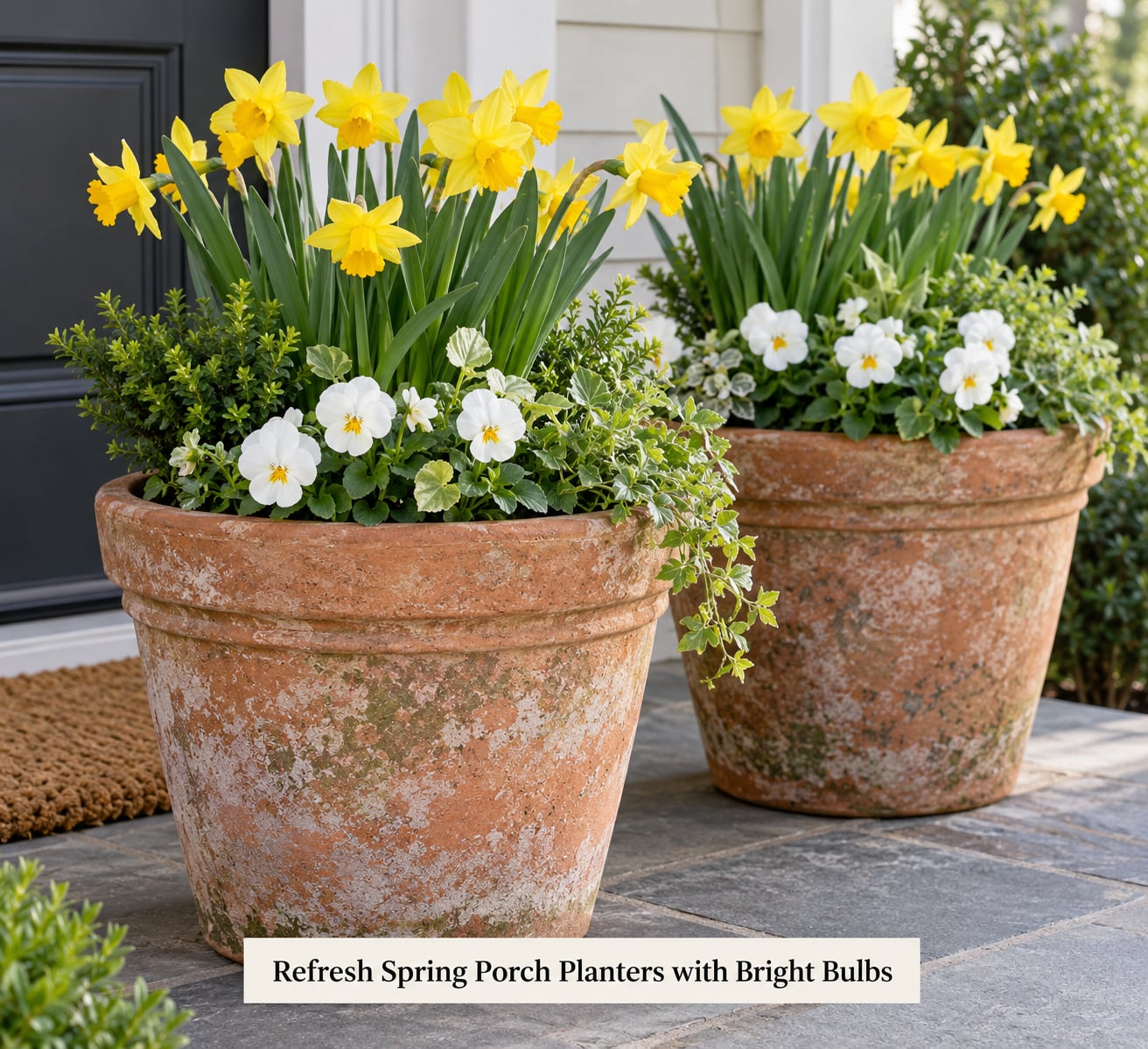
Spring is the easiest swap because cool-season plants do the work for you. Daffodils and tulips need weeks of cold before they open, so plant them the previous autumn and let them come up on their own, then fill the gaps with pansies or primrose that bloom straight away.
The trick is timing against your last frost date, not the calendar. Leave tulips in until the tips are clearly colour before you cut them down, and keep the pansies going until they stretch in the heat. Yellow and white against dark green leaves reads cleanly from the street, so two colours are plenty.
Example: a pair of terracotta planters on either side of the steps, daffodils in the centre, pansies around the base, with a few green leaves from a leftover houseplant tucked in to hide the bulb tops.
2. Build a Layered Summer Container
Summer containers look abundant because they are built in three tiers rather than filled flat. The thriller sits in the middle and stands taller than the pot rim, the filler covers the soil in a low mound, and the spiller drops over the lip and hides the hardware underneath.
A canna or a tall verbena makes a reliable thriller, calibrachoa or a dense coleus works as filler, and sweet potato vine spills over in a way that looks intentional rather than messy. Keep the tallest plant off-centre by about an inch so the pot reads as layered from the side too.
Containers in full sun on a porch can dry out twice a day in a heat wave. I check them by weight before by sight, and if one feels light I water until it drains from the bottom hole.
3. Create a Fragrant Summer Entrance
Scent does something colour cannot. A fragrant container gives guests a reason to slow down at the door, and the plants that deliver it tend to be the ones you would pick for cooking anyway.
Rosemary and basil want the sunniest corner you have and only need water when the top inch is dry. Lavender and scented geraniums stretch wider and reward a handier, leaner mix. Mixing one upright herb with one sprawling scented plant gives you scent plus structure without a crowded pot.
Rosemary in particular is worth planting in its own container. Its roots resent being crowded, and a pot on a porch edge dries at a different rate from one buried in a bed.
4. Add Color with Late-Summer Foliage
By the second half of summer most annual flowers look tired, and that is the moment most planters get thrown out. Instead, swap the spent petunias for foliage plants that hold colour for weeks without a single bloom.
Coleus comes in enough colours to build a whole scheme on its own, alternanthera gives a low mat of deep purple, and ornamental kale holds a ruffled blue-green that looks good into frost. Caladium fills shaded porches where flowering annuals sulk by August.
This is the swap that solves the shade problem too. Coleus and caladium will flower badly and leaf out beautifully, so a north-facing entry gets its best season exactly when the sunny side of the house starts to look worn.
5. Make an Autumn Porch with Texture and Warm Color
Autumn is when a porch can stop looking tidy and start looking designed. Mums give the colour, ornamental grasses give the movement, and celosia or asters fill the middle with texture that holds up through October.
Buy mums a little under-bloomed rather than fully open. They have room to grow in the pot and usually last several weeks longer than a plant that spent its budget in the greenhouse, and they take a few trims without sulking.
For a warm palette, run copper and rust through it rather than going red and orange only. One bright mum, one grass, one trailing celosia repeated across two planters reads as a plan rather than a pile of plants.
6. Transition to Winter with Evergreens
Winter is when most porches go bare, and that is a wasted opportunity. A hardy evergreen in a pot gives you shape and colour that no amount of cut branches can fake, and it is the plant you keep in place year after year.
Boxwood, a small dwarf conifer, holly and skimmia all tolerate container life in zones 6 to 8, and all of them look better paired with winter-barked branches or trailing ivy than standing alone. Check that the pot can take the weight of wet soil after freezing.
In zones 3 to 5, play the same idea with hardy perennials and spring bulbs that you leave in the container, plus a cut branch of something red or white for contrast. In zones 9 to 11, winter is your second spring, so rotate back to cool-season pansies and snapdragon.
7. Design a Winter Hanging-Basket Swap
Hanging baskets are the easiest thing on a porch to swap because they are small and already framed. Take the summer trailing petunias out and put in something with a stronger winter silhouette instead of a bare basket hanging all season.
Trailing ivy, winter greens such as kale and ornamental cabbage, and a small conifer wired into the back of the basket give you layers without new hardware. Cut branches like curly willow or dogwood pushed into the soil stay upright and cost far less than a plant.
Check that your hooks are rated for a wet basket. Winter baskets are heavier than the spring ones they replace, and the failure point is always the hook, never the plant.
8. Use Bulbs for a Long-Lasting Spring Display
If you plant one pot in autumn, plant it in layers. Crocus and narcissus go deepest, daffodils in the middle band, tulips and hyacinths near the surface, and a shallow bowl of pansies on top to cover the gap while everything comes up.
Each layer wakes at a different time, which is exactly the point. The pot gives you colour from the first thaw in late winter to the last tulip in mid-spring, and it needs no attention in between.
A pot that does double duty is worth it on a small porch: plant summer annuals straight into the same container once the bulbs have died back in late spring. The spent bulbs go in the bin, the soil stays, and you have not bought a new pot.
9. Refresh a Small Porch with One Focal Planter
If you have room for one container, give it the whole job. Pick one planter, one colour direction and one arrangement formula, then change the three plants inside it each season rather than adding more pots.
The formula holds all year: one thriller, one filler, one spiller. Spring is tulips plus pansies plus ivy, summer is canna plus coleus plus sweet potato vine, autumn is mum plus grass plus celosia, winter is boxwood plus winter greens plus trailing ivy.
On a narrow stoop, keep the tall element to one side rather than centred. It stops the planter from blocking the door and gives the arrangement an asymmetry that reads as intentional from the walkway.
10. Create a Polished Four-Season Porch Palette
The difference between a porch that looks good once and one that looks good all year is restraint. Pick two or three colours before you buy anything and hold to them across all four swaps, changing the plants rather than the palette.
A burgundy, cream and green scheme works in every season: pansies and white tulips in spring, burgundy coleus and cream calibrachoa in summer, rust and cream mums with grasses in autumn, boxwood and burgundy branches in winter.
Repeat the same combination of plants in every planter on the porch. Odd-numbered groupings of three or five read calmer than mixed pairs, and identical planters on both sides of a door do more for curb appeal than one spectacular pot.
How to Make Seasonal Plant Swaps for a Front Porch Easier
Time each swap to a signal rather than a date. The signals are your last spring frost, the week tomato plants go in the ground, the first run of nights under 45F, and the first hard frost after autumn. Everything else on the calendar is guesswork.
Between seasons, empty the container and check the drainage holes. Clear the top inch of old mix, loosen what is below it, and work in a couple of handfuls of compost. Reusing the same soil in the same planters is fine once it is amended, which is the consensus on the container gardening forums, and it saves you both soil and trips to the store.
Harden plants off over roughly two weeks. Start new arrivals in shade for a few days, move them to morning sun, then full exposure, and do the reverse when you bring plants in for the winter. Skipping this is what causes the wilting decline people describe a few weeks after planting.
Match each plant to the light your porch really delivers, not the label on the plant. Six hours of direct sun on a brick wall is a different porch from six hours filtered through trees, and a plant that would thrive on one will burn on the other. Set a timer on your phone for a few days of observation if you are not sure.
Finally, decide in advance what happens to the plants you remove. Geraniums and coleus overwinter indoors on a sunny sill, mums often get planted in a bed, and healthy annuals can be divided and given away. Deciding early means nothing ends up as a dead pot in the corner until spring.
Frequently Asked Questions
What plants work best for a front porch that gets full sun?
Full-sun porches give you the widest choice of container plants. Petunias, calibrachoa, geraniums, mums, cannas, sweet potato vine and most ornamental grasses all perform well with six or more hours of direct light. Watch terracotta and dark metal pots in high heat, since both dry out fast and can scorch roots by mid-afternoon in July.
How often should I change plants on a front porch?
Four swaps a year is the standard rhythm: spring after the last frost, summer once nights are reliably warm, autumn in the six to eight weeks before the first hard frost, and winter after that. You can hold a planting longer if it still looks good. Swaps are about matching plants to the weather, not meeting a schedule.
Can I reuse the same pots for every season?
Yes, and it is the most practical part of a seasonal plant swap plan. Scrub the pot, confirm the drainage holes are open, remove the top inch of old mix and work in fresh compost before each new planting. Pots that held a diseased plant should be washed with a dilute bleach solution first, and any pot too small for a season of root growth needs a size up.
What plants are easiest to care for on a porch?
For the least work, choose plants that suit the light rather than fighting it. Boxwood, a dwarf conifer, snake plant and most ornamental grasses tolerate missed waterings and heat. Trailing petunias and sweet potato vine ask for daily attention in a heat wave. On a porch with lower light, ferns, caladium and coleus need less than you would guess.
How do I choose plants that look good together?
Use the thriller, filler and spiller formula: one plant taller than the pot rim in the middle, one mounding plant to cover the soil, one trailing plant to spill over the lip. Then limit yourself to two or three colours and repeat the same mix in every planter. A restrained palette read from the street beats a crowded pot with eight different plants.
Conclusion: Make Your First Seasonal Swap
Start with the swap you are closest to. If autumn is a few weeks out, replace your tired summer annuals with mums and one ornamental grass, keeping the pots you already own. Then note how many hours of sun the porch actually gets before you plan the spring planting, because that one observation decides what goes in next.