Orchid roots rot in a glass pot because the container holds water at the bottom and gives the roots no way to dry or breathe. A sealed glass vessel has no drainage hole and no sidewall porosity, so the velamen, the spongy outer layer of an orchid root, stays saturated, the inner tissue suffocates, and bacteria move into the dead tissue.
This is the single most common way people lose a Phalaenopsis, and usually nobody sees it happen. The decorative pot looks fine, the leaves look fine for weeks, and the damage is happening at the bottom where you cannot see it. By the time the plant wilts, the roots have been soft for a while.
Good news: rot found early is very fixable. Below is what actually goes wrong in glass, how to tell dead roots from healthy ones, and a rescue sequence that keeps every firm green root you have.
Table of Contents
- Why Orchid Roots Rot in a Glass Pot
- What Causes Root Rot in Glass Orchid Pots?
- A pot that is too big for the root mass
- Medium that has broken down
- Watering on a calendar instead of by feel
- Poor air movement around the pot
- Cool, damp conditions
- Damaged root tips
- Fertiliser and salt build-up
- How to Tell Rotting Roots from Healthy Roots
- How to Fix an Orchid with Root Rot
- Choosing a Better Pot and Growing Medium
- How to Water an Orchid in a Glass Pot Safely
- How to Prevent Orchid Root Rot After Repotting
- What to do if you want to keep the same glass pot
- Frequently Asked Questions
- Are glass pots bad for orchids?
- Can an orchid recover from root rot?
- How often should I water an orchid in a glass pot?
- Do glass orchid pots need drainage holes?
- Should I move my orchid from a glass pot to an opaque pot?
- What do healthy orchid roots look like?
- Conclusion
Why Orchid Roots Rot in a Glass Pot
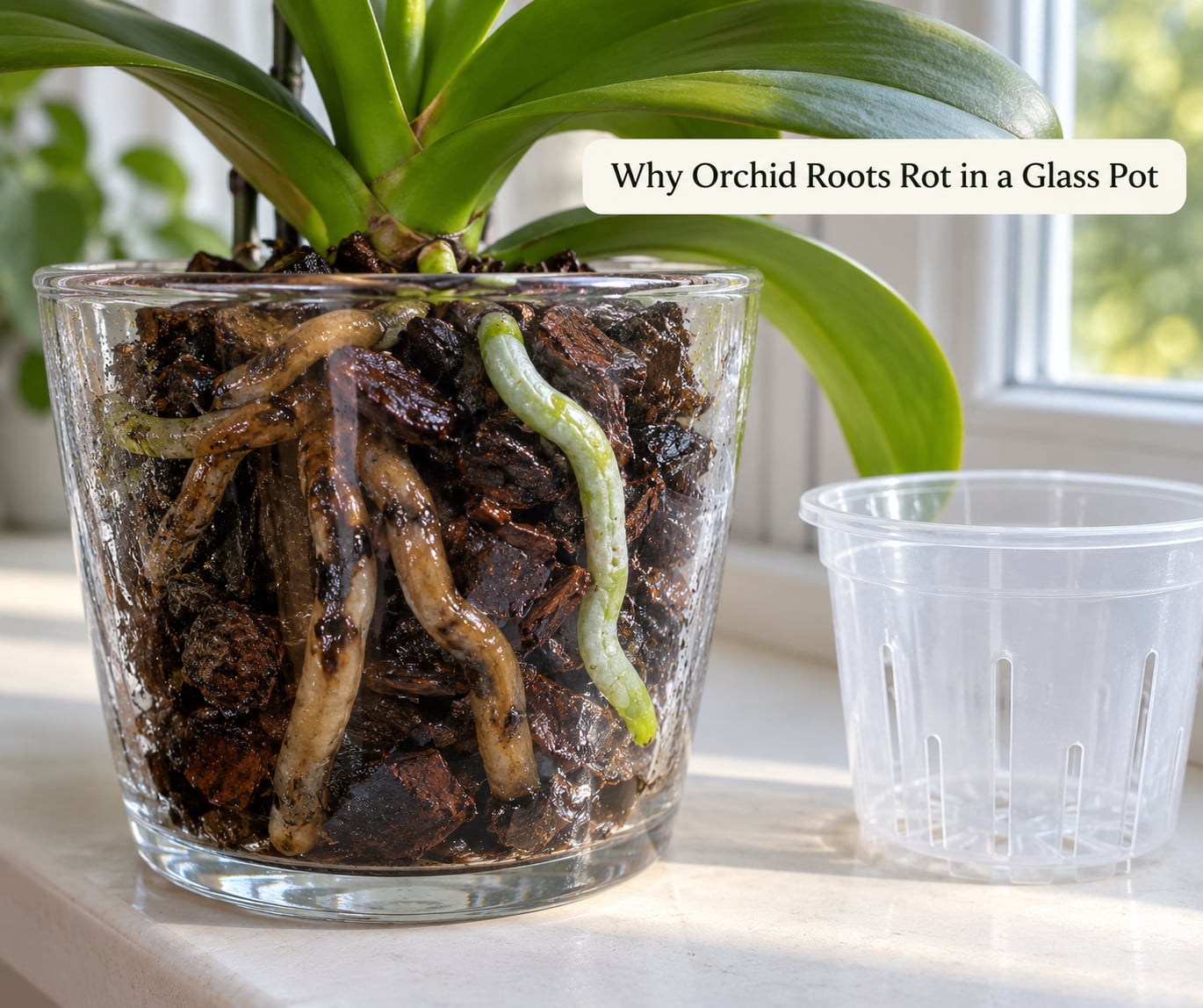
Five things happen at once, and any one of them on its own is survivable. Together in a closed glass vessel they are usually fatal.
- No drainage hole means water never leaves. Every time you water, a portion of the water settles at the bottom and stays there. The pot has no exit, so the lowest roots sit in standing water continuously rather than for a few minutes.
- Glass has zero sidewall porosity. Terracotta and plastic breathe to some degree through their walls, which lets oxygen reach the root surface. Glass is non-porous, so all air exchange has to happen through the top opening, which is usually the smallest part of the pot.
- The wet zone sits exactly where the roots are densest. Growers describe larger glass vases as containers that almost never dry out, because the wet centre keeps being re-wetted by capillary action from the bottom.
- You lose the ability to read the medium. In a clear pot you can see roots but not moisture. The top layer of bark or moss looks dry while the lower half is still saturated, so the visual cue that should warn you is the one thing the container hides.
- Glass gets hot in direct sun. Sun through a window onto a glass wall can raise the wall temperature enough to scald roots pressed against it, and that damaged tissue is an easy entry point for rot.
An expert on the UBC Botanical Garden forum put it plainly about a similar container: it is not just a matter of drainage, air needs to circulate around the roots, and that pot allows none at all. A dry-looking surface is not the same thing as a dry pot.
One more detail that confuses beginners: a glass pot is not always the problem. Orchids kept in water culture or semi-hydroponic setups live happily in glass bowls for years, because the water level is controlled, shallow, and emptied on a schedule. The rot comes from an uncontrolled reservoir, not from glass itself.
What Causes Root Rot in Glass Orchid Pots?
Glass removes your safety margins. These are the situations that push a plant over the edge, with the clue each one leaves behind.
A pot that is too big for the root mass
Extra medium holds extra moisture, and a large pot has a wet core that never dries. Symptom: the mix smells sour when you push a finger into the middle.
Medium that has broken down
Sphagnum moss compacts into a dense wet plug, and fine bark pieces break into dust. Old medium holds far more water than it did when you bought the plant. Symptom: the medium no longer springs back, and it packs down hard.
Watering on a calendar instead of by feel
A schedule tuned for a porous clay pot will overwater a sealed glass vessel every time. Symptom: roots stay dark and wet well beyond the usual interval.
Poor air movement around the pot
A glass pot pushed into a shelf corner, a cabinet, or a dense plant grouping gets very little moving air, and moving air is what dries the velamen between waterings.
Cool, damp conditions
Wet medium plus cool temperatures plus poor airflow is the classic setup for Pythium and Phytophthora, the water moulds that attack orchid roots. Warm, bright, airy conditions make the same mistake far less damaging.
Damaged root tips
Teasing apart roots that have grown against the glass, or a pot two sizes too small, breaks root tips. Damaged tissue is where infection starts.
Fertiliser and salt build-up
Repeated feeding in a container that never flushes leaves salts in the medium, which pulls moisture out of roots and makes them look like victims of rot when the real problem is different. Occasional flushing, or feeding only on a well-drained setup, avoids this.
How to Tell Rotting Roots from Healthy Roots
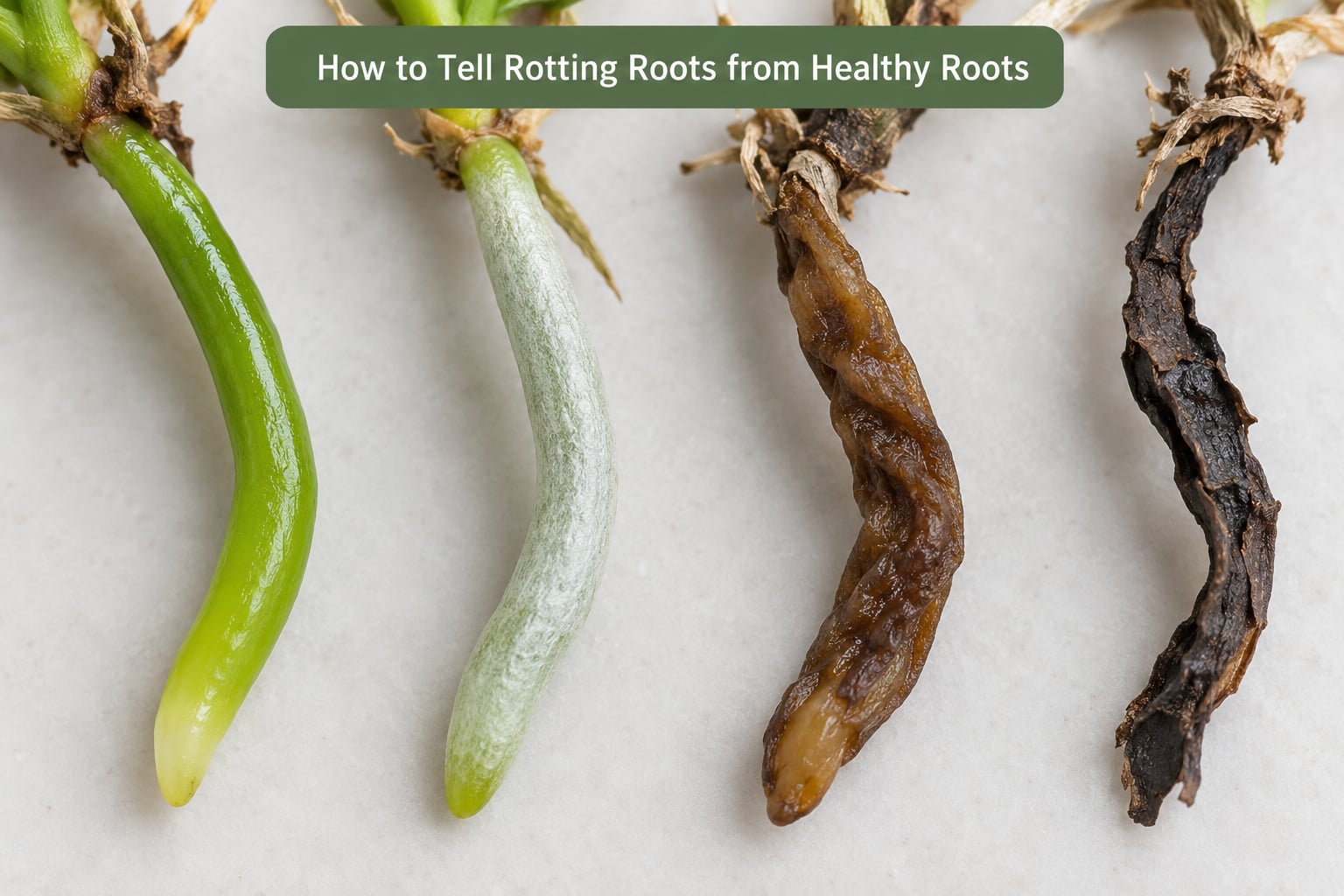
Healthy roots are firm when you squeeze them between your fingers and thumb. Dead ones collapse, snap, or crumble. Colour helps, but firmness is the test that never lies.
| What the root looks like | What it means | What to do |
|---|---|---|
| White or silvery-green, dry, shrivelled | Dehydrated but alive | Soak or water thoroughly, no trimming |
| Bright green, plump, firm | Healthy and hydrated | Leave alone |
| Dark green, wet, firm | Healthy, just watered | Let it dry fully before the next drink |
| Brown or tan, soft, spongy | Rotting | Trim back to firm tissue |
| Black or papery, hollow, crumbles | Dead | Cut away completely |
Two mistakes trip up almost everyone. First, silver-grey roots are the normal colour of a root that is simply dry, not a dead root. Second, aerial roots poking out of the top of the pot can look perfect while every buried root has turned to mush, which is exactly what happens in a deep glass vessel.
Rot and dehydration look different once you handle them. Rot is soft, wet, sometimes slimy, and often smells unpleasant. Dehydrated roots are papery, light, and shrivelled but still intact, and they plump back up within an hour or two of a soak. Firmness and smell settle it every time.
How to Fix an Orchid with Root Rot
Work on a tray, expect to lose roots, and go slowly. Most of the plant is usually still fine.
- Slide the orchid out of the glass pot.Tip it sideways and ease the root ball free. If it is stuck, soak the outer pot in warm water for ten minutes first rather than pulling.
- Discard the old medium completely.Do not reuse it. Rinse the roots under lukewarm water so none of the sour material stays in the root ball.
- Lay the plant down and let it dry.Twelve to twenty-four hours of open air in a shaded, airy spot lets you see clearly which roots are dead and firms up the tissue you are about to cut.
- Trim dead roots with a sterilised tool.Use clean scissors or shears wiped with alcohol between cuts. Cut into firm, white tissue and stop. Every soft brown section you leave behind is a fresh infection site.
- Treat the cuts.A pour of 3% hydrogen peroxide over the trimmed roots, or a soak in a solution of one part bleach to nine parts water for a few minutes, followed by a rinse, is the common approach. Skip kitchen remedies like cinnamon powder on roots; growers warn it just forms a paste that traps moisture against the tissue.
- Repot in fresh airy medium.Use a slotted or perforated pot slightly smaller than the remaining root mass, with bark-based mix that drains freely. Bare-root orchids can be set straight into a small bowl of water as an interim rescue, covering only the bottom third of the roots and changing the water regularly.
- Wait two to three days before watering.Let the cut surfaces close over first, then resume careful watering in bright indirect light with good airflow. Hold off on fertiliser until you see active new root growth.
What success looks like takes a few weeks. The leaves should firm up within two to three weeks, and new root tips, usually visible as small green points, appear within four to six weeks. The number of firm roots you kept at repotting is the best predictor of recovery, so take your time cutting.
Choosing a Better Pot and Growing Medium
Pot material changes how fast medium dries. These are the tradeoffs, and why orchid roots rot less often in some containers than others.
| Container | Drainage | Airflow | Root visibility | Sun exposure risk |
|---|---|---|---|---|
| Glass without holes | None | Very poor | Good, moisture invisible | High, heats up fast |
| Clear plastic with slots | Good | Good | Best of both | Low |
| Slotted ceramic | Good | Excellent | None | Low |
| Terracotta or clay | Good, wicks | Excellent | None | Low |
| Opaque plastic | Good with holes | Fair | None | Low |
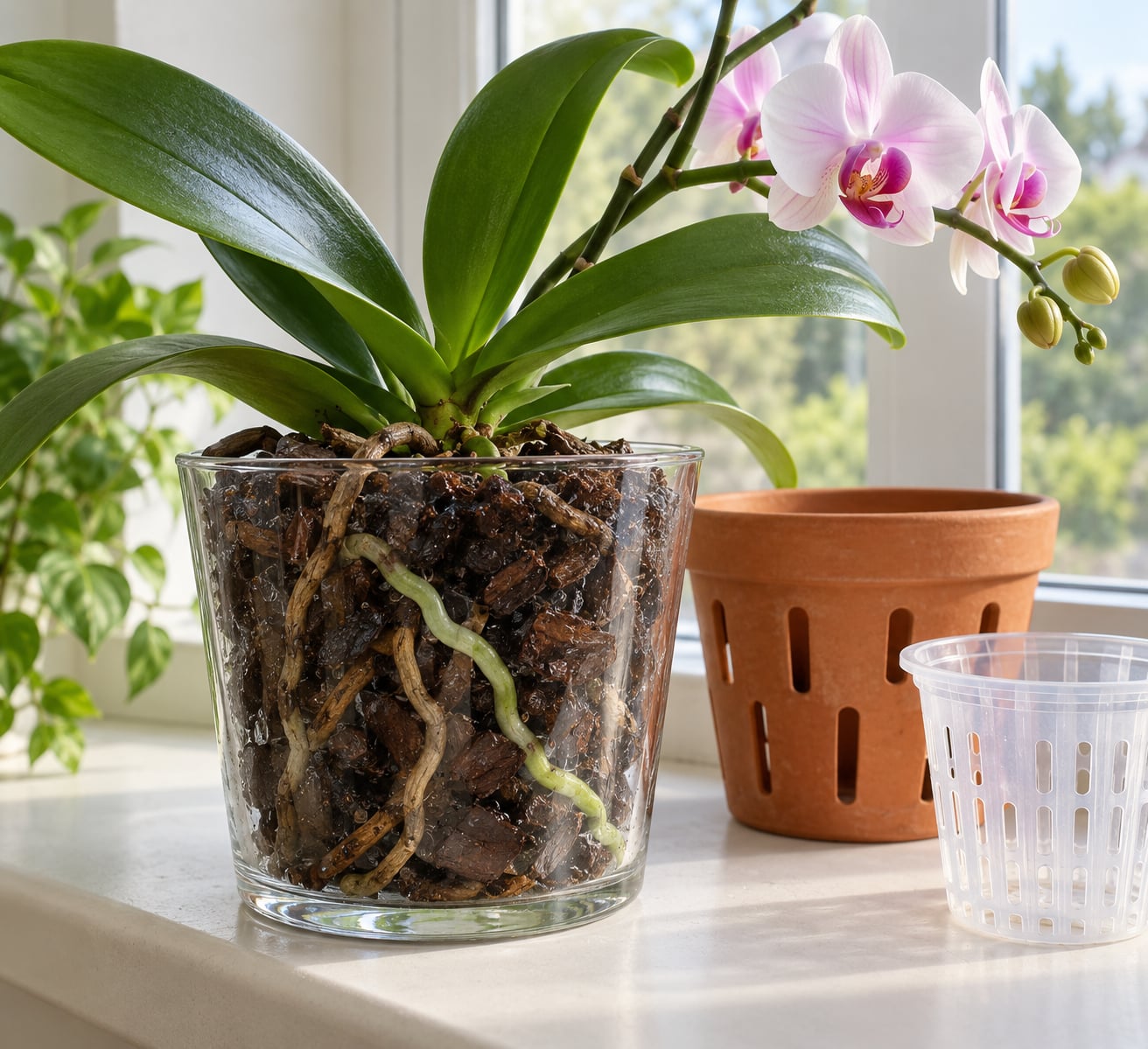
If you want to keep the glass look, three options work. The simplest is double potting: a small nursery pot with side slots and bottom holes sits inside the decorative glass, so the glass is pure decoration and the inner pot does the draining. Clear plastic slotted pots are the second option and are the easiest switch, since you can still watch the roots. The third is deliberate water culture, where the glass holds a shallow reservoir you empty and refill on a schedule rather than an accidental one that never empties.
Size matters as much as material. Choose a pot where the roots fill most of the volume, because air pockets inside a large pot of bark stay damp too long. For medium, chunky pine bark mixed with perlite or a little sphagnum drains and dries far faster than straight moss, and it is easy to see when it has broken down.
How to Water an Orchid in a Glass Pot Safely
Water when the roots and medium tell you to, not when the calendar says. In practice that means checking the middle of the pot, not the surface.
- Check root colour through the glass.Green roots mean wait. Bright silver-grey roots with visible wrinkling mean water now.
- Push a finger or a wooden chopstick into the centre of the medium.If it feels cool and damp, the middle is still wet even when the top looks pale. If it feels light and room temperature, water.
- Water in the morning and pour until water runs freely out of the drainage hole, or until the inner pot of a double-potted setup feels heavy in the hand.
- Empty any outer glass or cachepot every time.Water sitting in the decorative vessel is the reservoir that causes rot. Tilt it out completely.
- Adjust the interval to the season.An orchid in warm, bright, airy conditions dries faster in spring and summer, so it wants water more often. In a cool, dim winter window it needs longer between drinks, and a glass pot exaggerates that difference.
Two small habits help more than anything. Turn the pot a quarter turn each watering so no side of the bark stays wetter than the rest, and set it where air moves around it, not in a crowded corner. Growers on orchid forums report that rotating the pot and clearing the cachepot fixed problems they had assumed meant repotting.
How to Prevent Orchid Root Rot After Repotting
A recovering orchid is fragile for a few weeks, then settles into routine care.
Give it bright indirect light, near an east or north window, and keep air moving. Hold fertiliser until new growth is obvious, then feed at reduced strength. Keep humidity up without trapping wet air around the pot, and remember that warm dry air and cold wet medium are very different problems needing opposite fixes.
The habit that prevents most recurrence is repotting on schedule. Medium that has broken down cannot be fixed by watering less, because the water inside it will not leave. Refresh the medium every two years or when it starts to compact and sour.
What to do if you want to keep the same glass pot
Put a slotted plastic liner inside the glass so water has somewhere to go, and empty the glass after every watering. If the glass has no hole and you do not want to drill one, a permanent liner solves the drainage problem in about two minutes of work.
Frequently Asked Questions
Are glass pots bad for orchids?
Glass is not the problem, the absence of drainage and airflow usually is. An orchid can live in glass for years when water drains away and air reaches the roots, as in water culture or a slotted liner inside a decorative vessel. It goes wrong when water collects at the bottom, glass walls block sidewall gas exchange, or the pot sits in direct sun.
Can an orchid recover from root rot?
Often yes, if some firm roots survive. Trim away everything soft, brown or black, repot into fresh airy bark mix in a pot with drainage, and wait two to three days before watering. Leaves usually firm up within two to three weeks and new root tips appear in four to six weeks. If no firm green tissue remains, the plant usually cannot recover.
How often should I water an orchid in a glass pot?
As often as the plant needs, which is often less than people assume. Check through the glass: water when roots turn bright silver-grey and wrinkle, not while they are green. Push a finger into the centre of the medium, since the surface dries long before the middle does. Empty any outer glass vessel after each watering and expect longer intervals in cool, dim winter conditions.
Do glass orchid pots need drainage holes?
If glass is the growing pot, yes, and it should have side slots or holes as well as a bottom opening. Roots need both water to leave and air to reach them. Without holes, the only way to make a sealed glass vessel work is to put a perforated liner inside it or to treat the glass as a decorative cachepot and grow the orchid in a proper slotted pot.
Should I move my orchid from a glass pot to an opaque pot?
Moving to a clear slotted plastic pot is the move worth making, since you keep root visibility and gain drainage. An opaque pot works too, but you lose the ability to check root colour and you have to judge by the medium and the weight of the pot instead. A solid terracotta pot dries faster still, so water a little more often if you switch to one.
What do healthy orchid roots look like?
Healthy roots are firm when squeezed, plump, and green or silvery-green depending on how recently they were watered. Dry roots turn bright silver or white and wrinkle slightly, which is normal and not a sign of death. Dead roots feel soft and hollow, look brown or black, collapse under pressure, or crumble into papery fragments. Firmness in the fingers is a better test than colour alone.
Conclusion
Start by taking the orchid out and looking. Squeeze each root: anything soft, hollow, or papery is gone, and anything firm stays, no matter how brown it looks. Throw away the old medium rather than rinsing and reusing it, because decomposed bark and sphagnum hold the moisture that caused the problem.
Then put the plant in a container that drains, filled with chunky airy bark, in bright indirect light where air moves around it. If the glass is part of the decor you want to keep, nest a slotted plastic liner inside it and empty the glass after every watering. Protect every firm root you have, and new growth will follow within a few weeks.