Choosing a hook for a macrame plant hanger comes down to three numbers: the loaded weight of the potted plant, the material you are fixing into, and the thickness of your hanging loop. Get all three right and the hardware is a five-minute job, get one wrong and the whole pot ends up on the floor. Here is how to work out each one before you buy anything.
The surprising part is how little the macrame itself matters. A braided cotton loop will happily carry far more than most hooks behind it will hold, so the failure almost always happens at the anchor or the hook, never in the cord.
Table of Contents
- What You Need
- Step-by-Step
- Step 1: Check the hanger’s total loaded weight
- Step 2: Identify the mounting surface
- Step 3: Match the macrame plant hanger hook to the hanger’s attachment
- Step 4: Choose a hook with a suitable load rating
- Step 5: Check clearance, access, and appearance
- Step 6: Install and test the hook safely
- Common Mistakes
- Frequently Asked Questions
- How much weight should a hook hold for a macrame plant hanger?
- What type of hook is best for a macrame plant hanger on drywall?
- Can I use a macrame plant hanger hook in a bathroom or near a humid area?
- How do I know if my ceiling can support a hanging plant?
- Should I use a screw-in hook or a ceiling-mounted hook?
- What should I do if the hook feels loose after the plant is added?
- What to Do First
What You Need
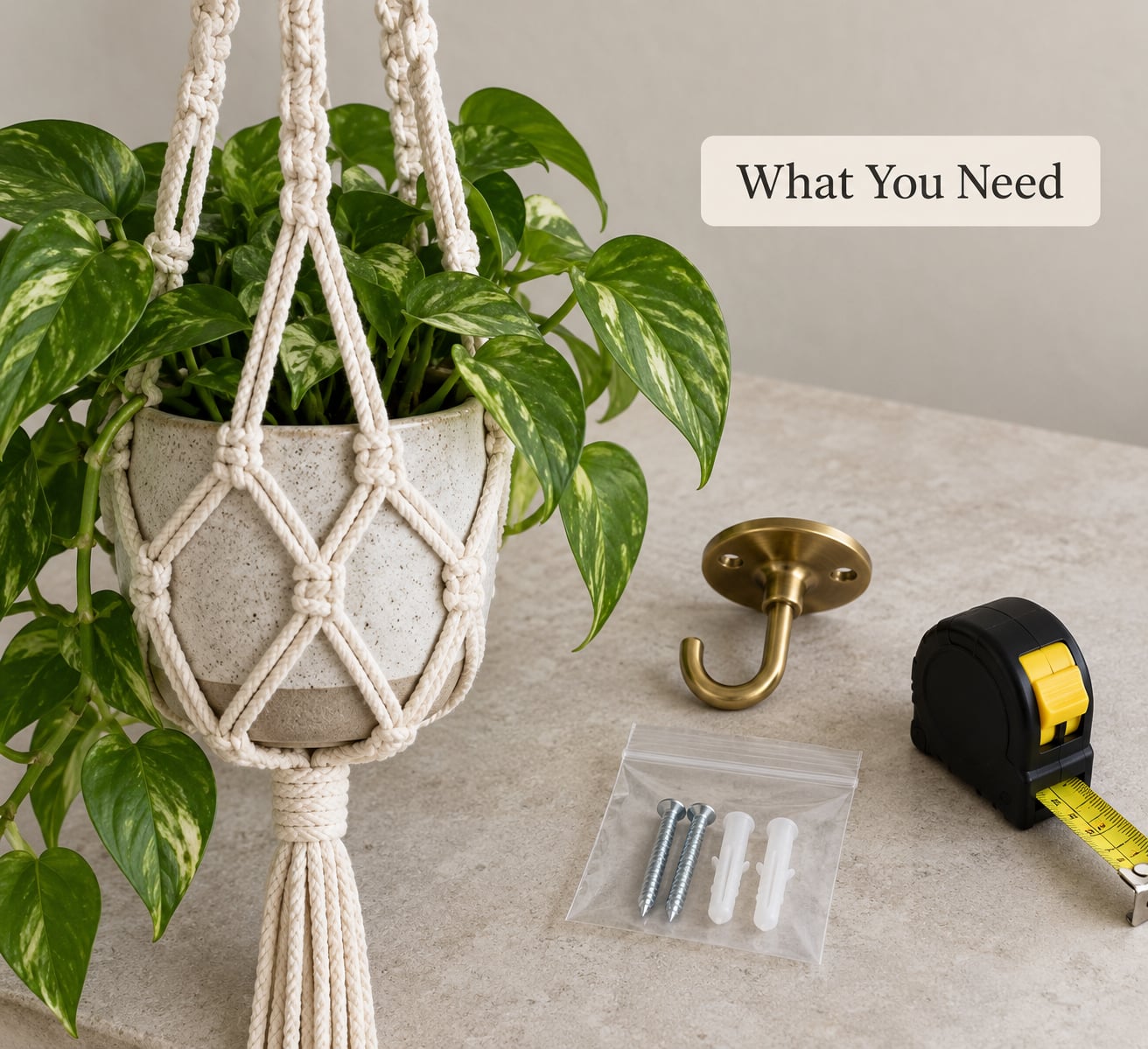
Before you pick a hook, gather four pieces of information and a few tools. Knowing them turns a guess into a decision.
- The loaded weight. Pot, soil, water and the plant itself, weighed after a proper watering. Not the empty hanger.
- The mounting surface. Ceiling joist, drywall, plaster over lath, concrete, brick, a metal stud, or a surface where drilling is not allowed at all.
- The location. Indoors, on a covered patio, or on an open balcony where rain and salt air reach the metal.
- The attachment style. Whether your hanger ends in a cord loop, a metal ring, a gathered cord knot, or a wooden or metal spreader bar.
- Tools: a kitchen scale for the wet weight, a tape measure, a stud finder or joist detector, a level, and a drill with bits and screws matched to the surface.
If you rent and cannot drill, say so now and plan around it. The no-drill options at the end of this guide have honest limits, and it is better to know them before the plant is bought.
Step-by-Step
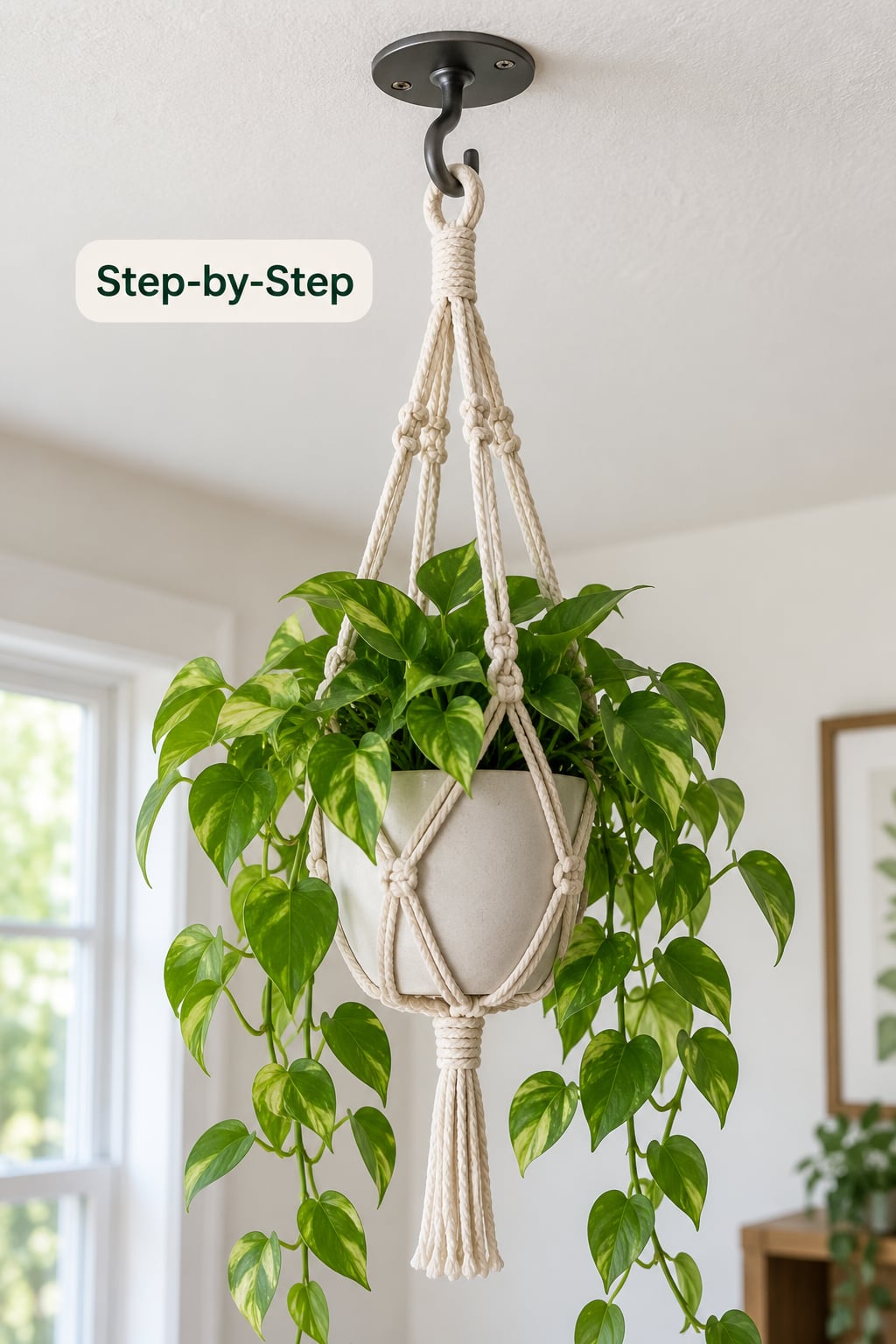
Step 1: Check the hanger’s total loaded weight
Most people size a hook from the weight of the hanger in their hand, which is close to nothing. Weigh the pot after it has been watered and left to drain for ten minutes, then add the plant’s own weight and a margin.
Rule of thumb for planning: choose a hook rated at least twice the loaded weight, with 10 lb as the floor for anything under a 6 inch pot. A published 10 lb rating on a 5 lb load leaves room for the moment someone bumps the pot or a cat jumps.
| Pot diameter | Typical loaded weight | Minimum hook rating | Mounting note |
|---|---|---|---|
| 4 inch | 2 to 3 lb | 10 lb | Any properly anchored surface |
| 6 inch | 4 to 6 lb | 10 lb | Toggle bolt or better into drywall |
| 8 inch | 10 to 15 lb | 25 lb | Fix into a joist wherever possible |
| 10 inch and up | 20 to 30 lb and up | 50 lb or more | Joist or masonry anchor; skip drywall |
Those loaded weights are estimates for a typical indoor plant, which is why the double-the-weight rule matters more than the exact figure. Soil is the variable people forget: a pot that feels light empty can add 8 lb of damp soil on its own. Heavier plants in the potter’s soil mix run higher still, and a wet plant weighs more after a watering than it will ever be again on a shelf.
How it worked: your chosen rating sits comfortably above the number in the table for your pot size.
Step 2: Identify the mounting surface
The surface decides the hardware. A hook that would be fine in a joist can fail completely in drywall, because drywall alone crushes and pulls out under a steady downward load.
| Surface | What to look for | Suitable hardware |
|---|---|---|
| Wood ceiling joist | Solid timber 1.5 inch or thicker, found with a stud finder or by knocking | Screw-in ceiling hook or lag screw into solid wood |
| Drywall between studs | Gypsum board over framing, hollow to the touch | Toggle bolt or heavy-duty hollow-wall anchor with a hook plate |
| Metal stud | Thin steel C or S stud, no wood behind | Self-drilling metal stud anchor or a drywall anchor rated for the load |
| Concrete or poured surface | Solid grey, no hollow sound | Masonry screw with a hook plate; drill with a masonry bit |
| Brick | Red clay units with grey mortar between them | Masonry anchor placed in the solid brick, never in the joint |
| Plaster over lath | Brittle, older homes, soft grey material | Screw eye into a lath strip or a stud; avoid plain drywall anchors |
| No drilling allowed | Rental, or a surface you must not mark | Command-type rated strips for light pots only, or a tension rod system across a window |
One brick rule is worth keeping: drill the solid brick, not the mortar between the bricks. Mortar crumbles, and a hole in it holds nothing. If the drill bit lands in a pale grey line, move over.
How it worked: you can name the surface and the fastener that suits it without guessing.
Step 3: Match the macrame plant hanger hook to the hanger’s attachment
A hook’s opening, called its throat, has to pass through your loop or accept your ring. If the throat is narrower than the loop, the hanger will not go on, and if it is far wider the pot hangs at an angle and rocks.
- Screw-in ceiling hook. A threaded hook you twist into a joist or solid wood. Curved throat, no closing gate. The usual choice when you have timber to screw into.
- Swag hook. A screw-in hook with a hole in the shank so you can drive a separate screw beside it for extra hold. Good on drywall when paired with an anchor, and the shape people picture when they imagine ceiling hooks.
- Toggle bolt with hook plate. A spread toggle behind the drywall carrying a small plate with a hook or eye. The strongest drywall-only option and the one to reach for in an apartment.
- Screw eye and ring. A plain eye screwed into the surface, then a metal ring the hanger’s loop drops over. A good way to upgrade a weak spot on a ceiling and keep the decor look you want.
- S-hook or carabiner with a fixed anchor. The anchor stays put and the S-hook or carabiner clips on, so the whole planter comes down for watering without tools. This is the single best choice for anything with a spreading plant that needs regular attention.
- Ceiling plate with hook. A small round plate with several fixing points and a hook in the centre. Distributes load better than one screw and looks tidier than a bare hook.
On loop fit, one measurement does most of the work. Braid about 15 cm, fold it over, and that loop clears most ceiling hooks comfortably. Shorter than that and the hook will not pass through the braid at all, which is the most common reason a finished hanger will not hang.
How it worked: the loop passes through the throat with a finger’s width of room, and the hanger hangs level when loaded.
Step 4: Choose a hook with a suitable load rating
Read the rating, not the packaging words. Marketing copy is full of “heavy duty” and “industrial grade” that mean nothing, while a printed figure in pounds does. Some swag hooks with butterfly anchors are marked as 40 to 50 lb; plenty of decorative hooks at home stores carry no rating at all.
A hook that only just reaches your loaded weight is the wrong hook, even if it works on day one. Loads creep upward as soil compacts, the plant grows and someone waters more than they used to, and a hook working at 95 percent of its rating has nothing left for a bump.
If two hooks fit the same loop and look similar, take the heavier rated one. Brass and solid steel bodies outlast thin zinc-plated stamping for the same fit, and a hook rated double your load is cheaper than replacing a dropped planter.
How it worked: the marked rating is at least twice your loaded weight and at least 10 lb.
Step 5: Check clearance, access, and appearance
Stand where the plant will hang and look at the room, not at the plant. Things to check before drilling:
- Head clearance. Nothing hanging over a walkway, a doorway, a chair or the edge of a bed. Aim well above head height, and never above a staircase.
- Light and airflow. A hanger that blocks a window or sits against a radiator or vent hurts the plant more than the plant hurts the hook.
- Watering access. If you will need a ladder or a second person every watering, plan the S-hook or carabiner instead.
- Door and fan swings. Ceiling fans and cabinet doors reach further than people expect.
- Finish. Match the room. Matte black reads as modern, brushed brass and copper warm up, and galvanized steel suits a covered patio.
How it worked: you can walk the route from pot to watering can without anything in the way.
Step 6: Install and test the hook safely
Follow the manufacturer’s instructions for the fastener, since a toggle bolt and a masonry screw are not interchangeable and misuse is what causes most pull-outs.
- Locate the joist, stud or a spot clear of cables and pipes. Keep well away from ceiling light boxes and junctions, and never drill where you suspect wiring.
- Fit the hook or plate and tighten it properly. A hook that turns by hand after tightening is under-anchored, not merely annoying.
- Hang the empty hanger first and check that it sits level. Level now means level later.
- Add the plant gradually, then leave it for a day and look again.
- Stop using the mounting point if the hook moves, bends, cracks, or pulls out of the surface, or if the drywall around it shows a widening ring or crumbling.
For electrical, gas or structural work, call a qualified professional rather than improvising. So did people on the macrame and houseplant forums who got stuck: the ceiling is not where you experiment.
Common Mistakes
Almost every hanging-plant failure traces back to one of these. Most have a simple fix, and all of them are cheaper than a broken pot.
- Sizing the hook to the empty hanger. The hanger weighs almost nothing; the wet pot is the load. Fix: weigh the potted plant and take twice that figure.
- Using a plastic drywall anchor for a plant. Small hollow-wall anchors are meant for picture frames, not for a permanent downward load. Fix: a toggle bolt or a joist.
- Ignoring mature plant weight. A pothos is light, a fern in an 8 inch pot is not. Fix: check the plant’s expected mature size against the table in Step 1.
- Trusting “heavy duty” with no pound rating. Sellers mislabel capacity more often than not. Fix: if there is no printed rating in pounds, assume it is not rated for a plant.
- Braiding the loop too short or too tight. A tight loop will not pass a hook at all and can crush the cord. Fix: about 15 cm of braid folded over, with room for the hook throat.
- Hanging crooked. Knot drops measured by eye on three sides rarely match. Fix: measure and mark each drop before the final knot, then hang and re-level.
- Using adhesive strips for a heavy pot. The most repeated complaint on the plant forums: heavy-duty strips fail under a real watered plant. Fix: use them only for pots around 4 lb or less, never above a walkway, and check them every month.
- Leaving the metal outside untreated. Standard zinc plating pits and stains within a season on an open balcony. Fix: galvanized, stainless or powder-coated hardware, checked each spring.
- Swag hook on the wrong surface. A swag hook is still only as good as what holds its screw. Fix: match the anchor to the surface first, then the hook.
Renters get one honest option that holds a small pot safely: a ceiling tension pole pressed between floor and ceiling, with a hook built into its head. No holes, no adhesive, and it comes down with the plant. The limit is the span between surfaces and the pot weight, so it suits small plants, not an 8 inch pot of damp soil.
Frequently Asked Questions
How much weight should a hook hold for a macrame plant hanger?
Pick a hook rated at least twice the loaded weight of the plant, and never below 10 lb. A 6 inch pot with damp soil runs roughly 4 to 6 lb, so a 10 lb hook gives sensible headroom. For an 8 inch pot at 10 to 15 lb loaded, choose 25 lb or more and fix into a joist where you can. The rating covers steady load, not a bump, so the margin matters.
What type of hook is best for a macrame plant hanger on drywall?
A toggle bolt with a hook plate is the strongest drywall-only choice, because the toggle spreads load behind the board instead of relying on the crumbling face. For small pots under 4 lb, a properly rated adhesive strip can work away from walkways, though adhesive is the option forums report failing most often. With a joist or stud available, screw into timber instead.
Can I use a macrame plant hanger hook in a bathroom or near a humid area?
Yes, but pick corrosion-resistant metal. Solid brass, stainless steel and powder-coated hooks handle humidity far better than plain zinc plating, which pits and stains over time. Keep the fix itself out of the direct splash zone, since repeated wetting weakens some anchors and encourages rust around the screw head. Check the hook every few months for staining or swelling.
How do I know if my ceiling can support a hanging plant?
Find a joist first, since a plant’s weight is a permanent downward load and drywall alone will not carry a heavy pot. Use a stud finder or knock along the ceiling to locate timber, and fix into that. If no joist is reachable, a toggle bolt rated above twice your loaded weight is the next best option. For anything over 20 lb, use joist or masonry and skip drywall.
Should I use a screw-in hook or a ceiling-mounted hook?
Use a screw-in hook when you have solid timber to twist into; it is quick, removable and strong. Use a ceiling plate with a toggle bolt when you are in drywall with no joist nearby, or when the load is heavy, because a plate spreads the force across more fixing points. Whichever you choose, match the anchor to the surface first and buy the version with a printed pound rating.
What should I do if the hook feels loose after the plant is added?
Take the plant down immediately rather than tightening a loaded hook. A hook that turns in the wall, drags the drywall outward or shows a crumbling ring is an anchor failure in progress. Take the whole set-up apart, patch the hole, and move to a joist, a properly rated toggle bolt, or a tension pole system. Never re-tighten a failing anchor and leave the plant hanging.
What to Do First
Weigh the potted plant after a watering, find out what is behind your ceiling, and only then open the hardware drawer. A macrame plant hanger hook rated at twice that weight, fixed into the best surface available, with a loop braided around 15 cm folded over, is a setup that quietly works for years.