Yes, you can grow plants in a room with no windows. Add a full-spectrum LED grow light on a timer, run it 10 to 14 hours a day, and choose species that handle low light, and a snake plant, ZZ plant or pothos will sit happily in a corner that never sees the sun.
The honest limit is worth stating first: no plant survives in genuinely zero light. What survives is a plant plus a light source aimed at it. Forum consensus across r/houseplants and r/plants is blunt on this, and it is the right expectation to walk in with.
- Pick tolerant species: snake plant, ZZ plant, pothos, cast iron plant, peace lily, spider plant.
- Add a full-spectrum LED at roughly 3000K with a CRI of 90 or higher so foliage still looks natural.
- Hang it 12 to 24 inches above the leaves for a desk plant, up to 36 to 48 inches for a tall floor plant.
- Run the light 10 to 14 hours a day on an outlet timer, then give the plant at least 10 hours of darkness.
- Water less than you would on a windowsill, and only when the top 2 inches of soil are dry.
- Aim for 200 to 300 µmol/sec at the canopy, the range foliage plants use well.
This guide covers the whole setup rather than the plant shelf alone, because light, watering and species have to be decided together. Get any one of them wrong and the plant declines slowly, which is harder to diagnose than a sudden failure.
Table of Contents
- What You Need
- Step-by-Step
- How to grow plants in a room with no windows: choose plants that tolerate low light
- Position the grow light correctly
- Water only when the soil supports it
- Keep temperature, humidity, and airflow stable
- Common Mistakes
- Frequently Asked Questions
- Can plants really grow in a room with no windows?
- Do grow lights provide enough light for healthy plant growth?
- What are the best plants for a room without natural light?
- How many hours a day should a grow light be on?
- How often should I water plants in a windowless room?
- Can I use a regular lamp instead of a grow light?
- Conclusion
What You Need
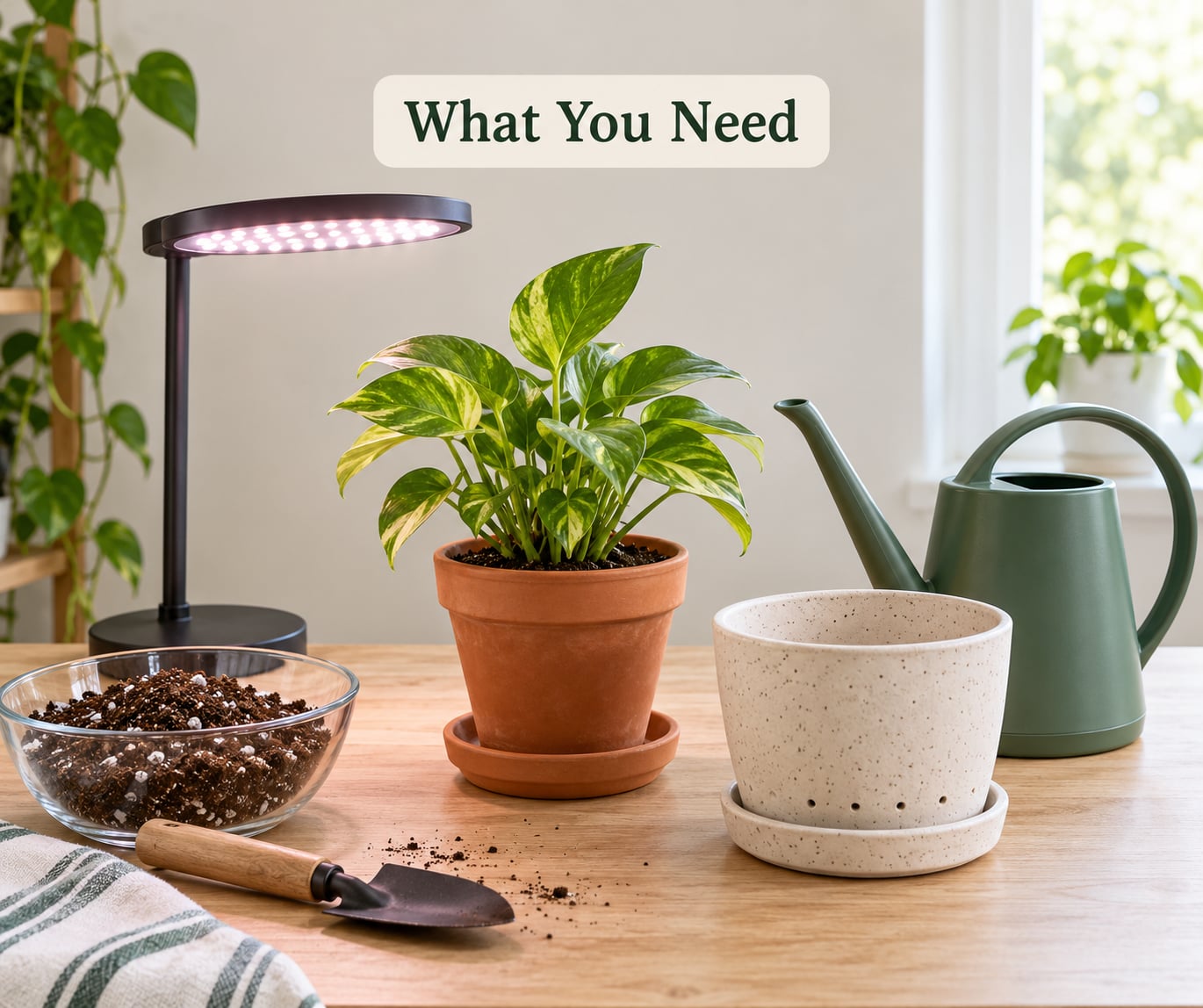
Most windowless plant corners are assembled from about six things, and only two of them cost real money. Here is what each piece actually does for you.
- Low-light tolerant plants. Start with one plant rather than a shelf of them. Snake plant and ZZ plant are the two I would bet on first because they hold their shape in the dimmest workable spot.
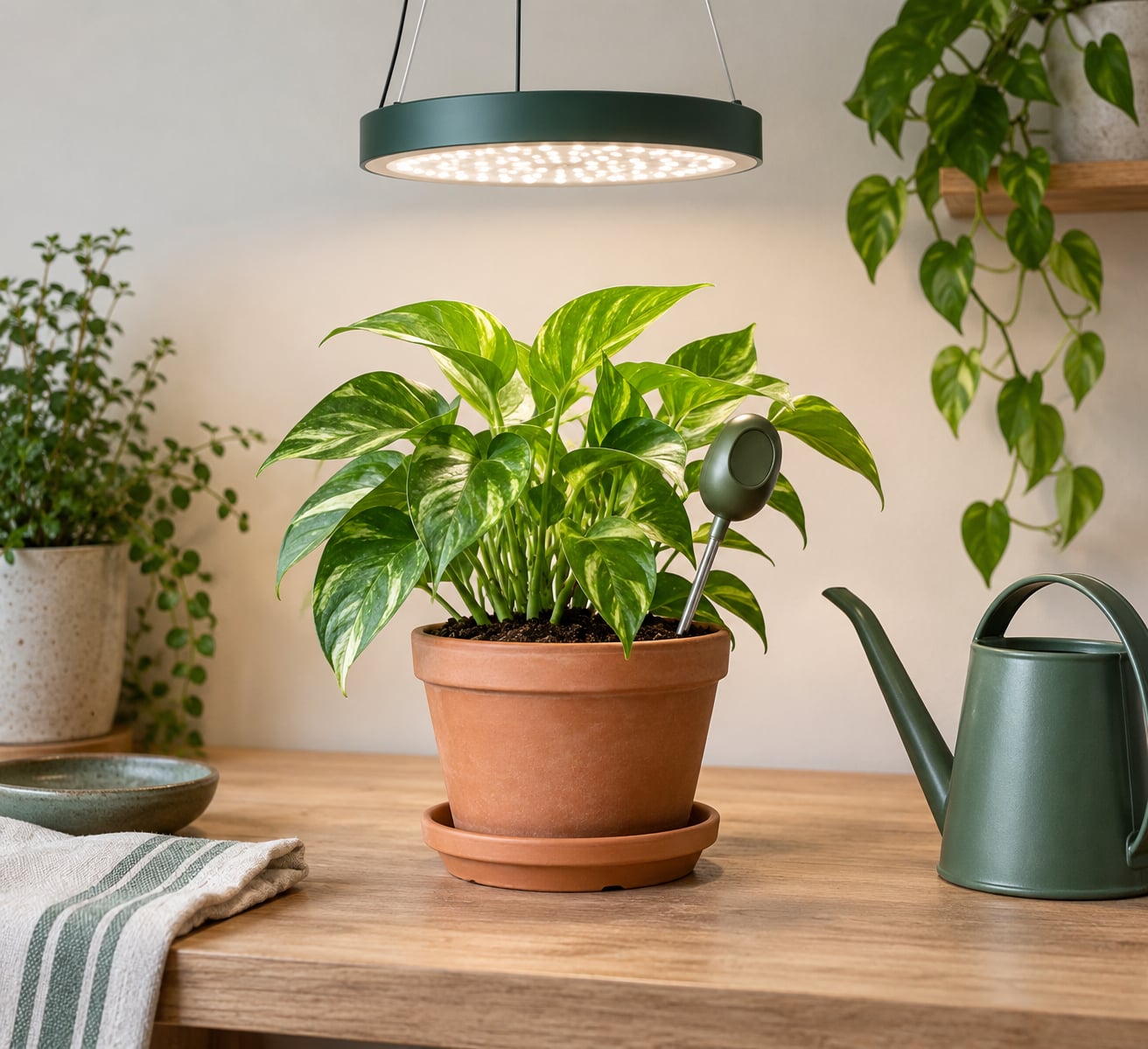
- A grow light. A screw-in bulb in an existing desk lamp is the cheapest route and needs no drilling. A bar light suits a shelf, a pendant suits a single floor plant, and a track system suits several pots in a row.
- A pot with a drainage hole and a saucer. Cachepots without holes hold water against the roots and are the fastest route to root rot in a room with no evaporation.
- Well-draining potting mix. A standard indoor mix amended with perlite or pumice dries out faster, which matters when there is no sun driving evaporation.
- A narrow-spout watering can and a moisture meter. The meter is the single tool that fixes the most common mistake in this room. Growers on r/plantclinic rely on one for exactly this problem.
- An outlet timer or a Wi-Fi smart plug. A drifting schedule produces the same result as no schedule at all.
- Optional: a small humidifier for a bathroom or basement, and a thermometer-hygrometer to tell you what the room is really doing.
Skip the humidifier if you have a lamp with a fan pointed at the canopy. Moving air does more for fungal problems than humidity does, and it costs nothing to run.
Step-by-Step
Four decisions, in this order, and you will not have to redo them. Start with the plant, because the light requirement sets everything else.
How to grow plants in a room with no windows: choose plants that tolerate low light
Read the light requirement on the label, not the marketing. Medium to low light is the range you want. Skip anything labelled high light, bright indirect, or full sun, because those are the ones that go leggy and then decline.
Two tiers cover almost every windowless room. The first tier survives the least light: snake plant (Dracaena trifasciata), ZZ plant (Zamioculcas zamiifolia), cast iron plant (Aspidistra elatior), Chinese evergreen (Aglaonema) and pothos (Epipremnum aureum). The second tier needs a proper grow light and will flower or push vigorous new leaves under one: peace lily (Spathiphyllum), spider plant (Chlorophytum comosum), peperomia (Peperomia obtusifolia), prayer plant (Maranta leuconeura) and parlour palm (Chamaedorea elegans).
Match the plant to the room as well as the light. A basement holds cooler air and swings more, so a ZZ plant and a pothos suit it better than a peace lily. A windowless bathroom runs humid but often has a vent fan running, so anything needing steady moisture is fine there.
You will know the choice worked when new leaves come in at the centre at roughly the same size as the older ones, and nothing drops within the first two months. Long internodes, small pale leaves and leaning toward the fixture all mean the light is too weak rather than that the plant is wrong.
One more check before you buy: stand in the intended spot and read a book. If the page is comfortable at normal indoor brightness, a low-light plant will manage there for months, even without a dedicated fixture.
Position the grow light correctly
Height matters more than most people expect, and plants grow into the problem. A desk plant sits 12 to 24 inches below the light, a shelf or hallway plant 24 to 36 inches, and a large floor plant or one in a basement 36 to 48 inches. Raise the light a little every week or two as the plant pushes new growth, and log the height so you can tell whether the new growth is compact or stretched.
Too close and you get leaf scorch: bleached, crispy, tan patches on the leaves facing the fixture, usually appearing within a week of moving the light down. Move the fixture up 6 to 12 inches and those leaves will not recover, but the plant will. Too far and you get etiolation, the technical word for leggy growth: long bare gaps between leaves, small pale new leaves, and stems bending toward the lamp.
Check intensity where the leaves actually are, not at the fixture. A cheap lux meter or a phone lux app held at canopy height gives you a usable number, and most growers working with foliage plants land between 200 and 300 µmol/sec, roughly equivalent to 50 to 100 foot-candles at the leaf surface.
For timing, 10 to 14 hours of light followed by 8 to 14 hours of solid darkness is the working range. Many people report that an ordinary overhead fluorescent fixture left on for 8 hours a workday is enough for low-light species, which is useful news if your building already has one.
Water only when the soil supports it
This is where windowless rooms kill plants. Without sun-driven transpiration, soil stays wet far longer than a watering schedule on the label assumes, and root rot is the result that shows up in forum threads again and again.
Push a finger 2 inches into the soil. Water when it feels dry at that depth, not before, and not on a fixed day of the week. A moisture meter gives you the same answer with less guesswork, and lifting the pot to compare its weight tells you how your particular mix dries, which varies with pot size and mix.
Signs of underwatering are crisp, curled or browning leaf edges and a plant that feels light for its size. Signs of overwatering are yellowing lower leaves, a soft or mushy stem near the soil, sour-smelling soil, and leaves that drop while the soil is still wet. That second set is the dangerous one, because the fix is repotting into fresh dry mix rather than more water.
Two habits help more than anything else. Water thoroughly and let the pot drain fully rather than topping up with small splashes, and empty the saucer after 10 minutes. Both speed the dry-down that a sunless room lacks.
Keep temperature, humidity, and airflow stable
Most houseplants are comfortable between 65 and 75 degrees Fahrenheit, and they care more about swings than about the reading itself. A basement that is 58 degrees at night and 70 in the afternoon stresses a plant more than a steady 64 degrees would.
Keep foliage away from heating vents, radiators and air conditioning units, and away from cold exterior walls that sweat in winter. In a windowless room the walls are the equivalent of the windowsill problems you already know about.
Humidity around 40 to 60 percent suits nearly everything on the list above, and a cheap hygrometer on the shelf tells you whether a humidifier is even needed. Air circulation is the free upgrade: a small fan on low, or the lamp’s own fan, keeps leaf surfaces dry and cuts pests. Standing water under a shelf after watering is a mould invitation, so water early in the day.
Common Mistakes
- Choosing a high-light plant for a room with no light. Succulents, fiddle leaf fig, calathea and flowering herbs all need real daylight and will stretch or fail in a windowless room. Fix: pick from the tolerant list, and put anything demanding back near a sunny room.
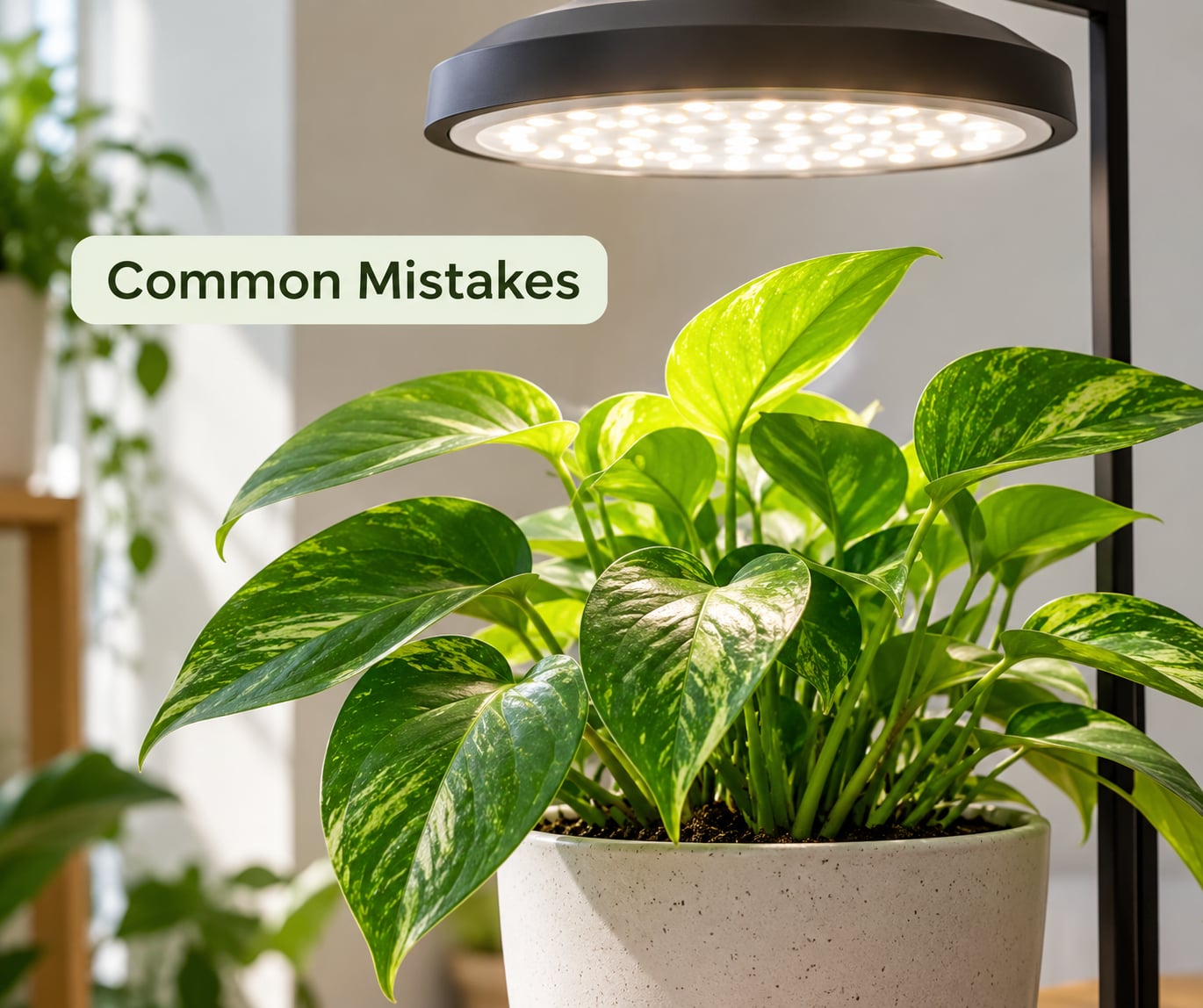
- Mounting the grow light too close. Bleached patches and crispy edges on the leaves facing the fixture mean heat and intensity are too high. Fix: raise the light 6 to 12 inches and keep the schedule the same.
- Watering on a rigid schedule. A sunless room dries out far more slowly, so a Tuesday ritual kills the plant. Fix: test the top 2 inches and lift the pot before every watering.
- Using a cachepot with no drainage. Water sits at the roots and never dries. Fix: repot into a pot with a hole and a saucer you empty after 10 minutes.
- Crowding plants under one fixture. Six pots under a lamp meant for one all go leggy at the edges. Fix: fewer plants, one fixture each, and a second light rather than a crowded shelf.
- Ignoring early yellowing and pests. Mealybugs and spider mites show up first on stressed, low-light plants. Fix: isolate the pot, wipe the leaves, check leaf undersides weekly, and treat the light problem at the same time.
A workable routine takes a few minutes a week. Check moisture and glance at leaf undersides on the same day each week, raise the light a little when you see a new leaf unfurling, and turn each pot a quarter turn so growth stays even. Growing growers take plants back to a sunny room for a few days every couple of weeks to recharge, and swap them out again, which works well for a small collection.
If pets or small children share the room, check the species before you buy. Pothos, ZZ plant, peace lily, dumb cane and most philodendrons irritate or inflame on contact and ingestion. Snake plant, spider plant, peperomia and prayer plant are the easier choices for a shared room, and a heavy pot on a high shelf solves the rest of the problem.
Frequently Asked Questions
Can plants really grow in a room with no windows?
Yes, as long as you supply the light yourself. A windowless room on overhead lighting often measures 40 foot-candles or less, while a sunny window reaches several thousand. A full-spectrum LED hung 12 to 48 inches above the leaves and run 10 to 14 hours a day closes that gap for tolerant species like snake plant, ZZ plant and pothos. In genuinely zero light, no plant survives.
Do grow lights provide enough light for healthy plant growth?
For foliage plants, yes, and for vegetables with more light and space, usually. Foliage plants do well at 200 to 300 µmol/sec at the canopy, which is roughly 50 to 100 foot-candles. Aim for a full-spectrum LED near 3000K with a CRI of 90 or higher, so growth is compact and leaf colour still looks natural rather than purple or washed out.
What are the best plants for a room without natural light?
Start with the species built for low light: snake plant, ZZ plant, cast iron plant, Chinese evergreen and pothos. With a real grow light above them you can add peace lily, spider plant, peperomia, prayer plant and parlour palm. Avoid succulents, fiddle leaf fig, calathea and flowering or fruiting plants, which all need daylight intensity that a windowless room cannot provide.
How many hours a day should a grow light be on?
Ten to fourteen hours of light, then eight to fourteen hours of uninterrupted darkness. Put the light on an outlet timer or Wi-Fi smart plug so the schedule never drifts, since plants read the cycle rather than the total hours. Long days without a proper dark period encourage stretched growth and can hold flowering back in peace lily and spider plant.
How often should I water plants in a windowless room?
Less often than in a room with daylight. Without sun-driven transpiration the soil stays wet far longer, so check the top 2 inches with a finger or a moisture meter and water only when it is dry there. Water thoroughly, let the pot drain, and empty the saucer after 10 minutes. Yellow leaves with wet soil mean you are watering too much, not too little.
Can I use a regular lamp instead of a grow light?
A regular warm-white LED lamp is better than nothing, and it will keep low-light species alive in a bright office. It is weaker than a dedicated grow light because much of its output sits outside the 400 to 700 nanometer range plants use for photosynthesis. Swapping a screw-in grow bulb into the same desk lamp costs you nothing in setup and gives noticeably tighter growth.
Conclusion
Four things to do this week, in order. Buy one tolerant plant, such as a ZZ plant or a pothos, and put it in a pot with a drainage hole. Fit a full-spectrum grow light 12 to 24 inches above the leaves and set an outlet timer for 12 hours a day. Fill the pot with an indoor mix amended with perlite, then leave the soil alone until the top 2 inches feel dry.
That setup takes under an hour and it is the whole answer to how to grow plants in a room with no windows: replace the sunlight, choose the right plant, and adjust the watering to match the slower dry-down. Everything after that is watching the leaves and raising the light as the plant grows.