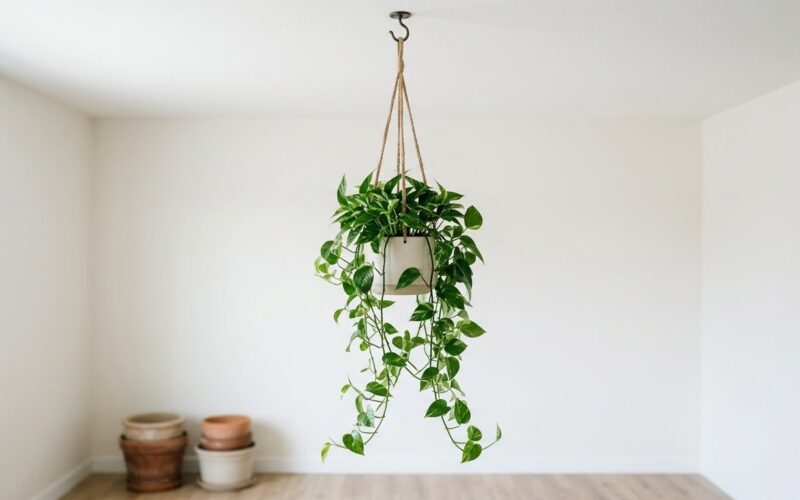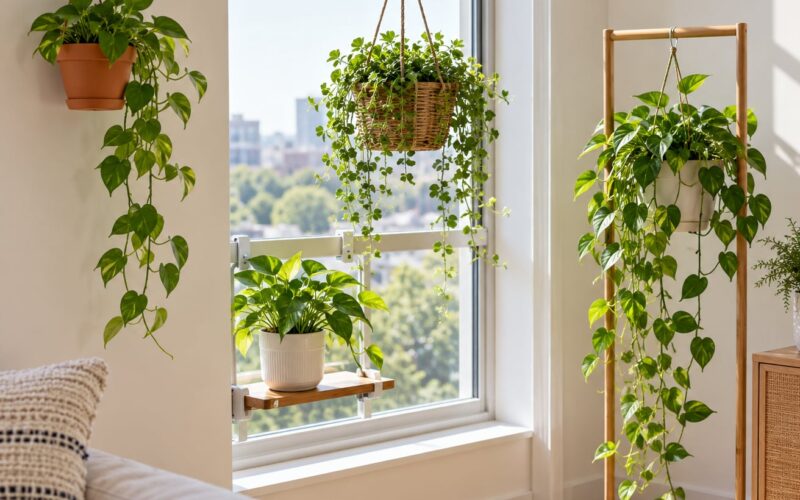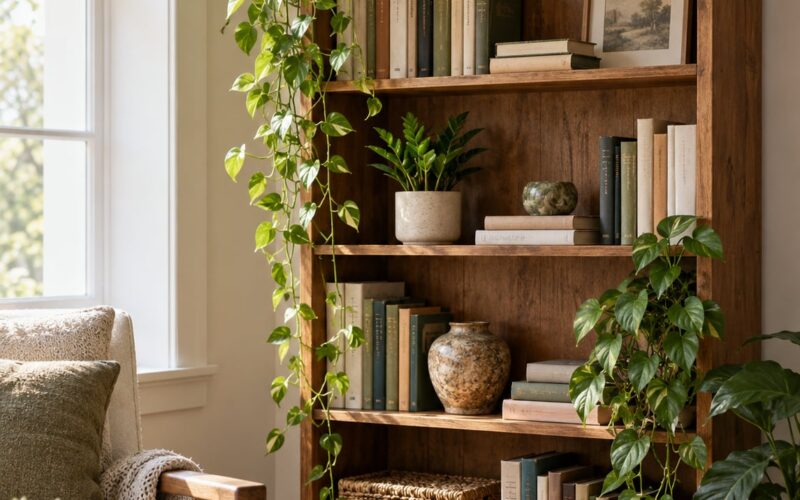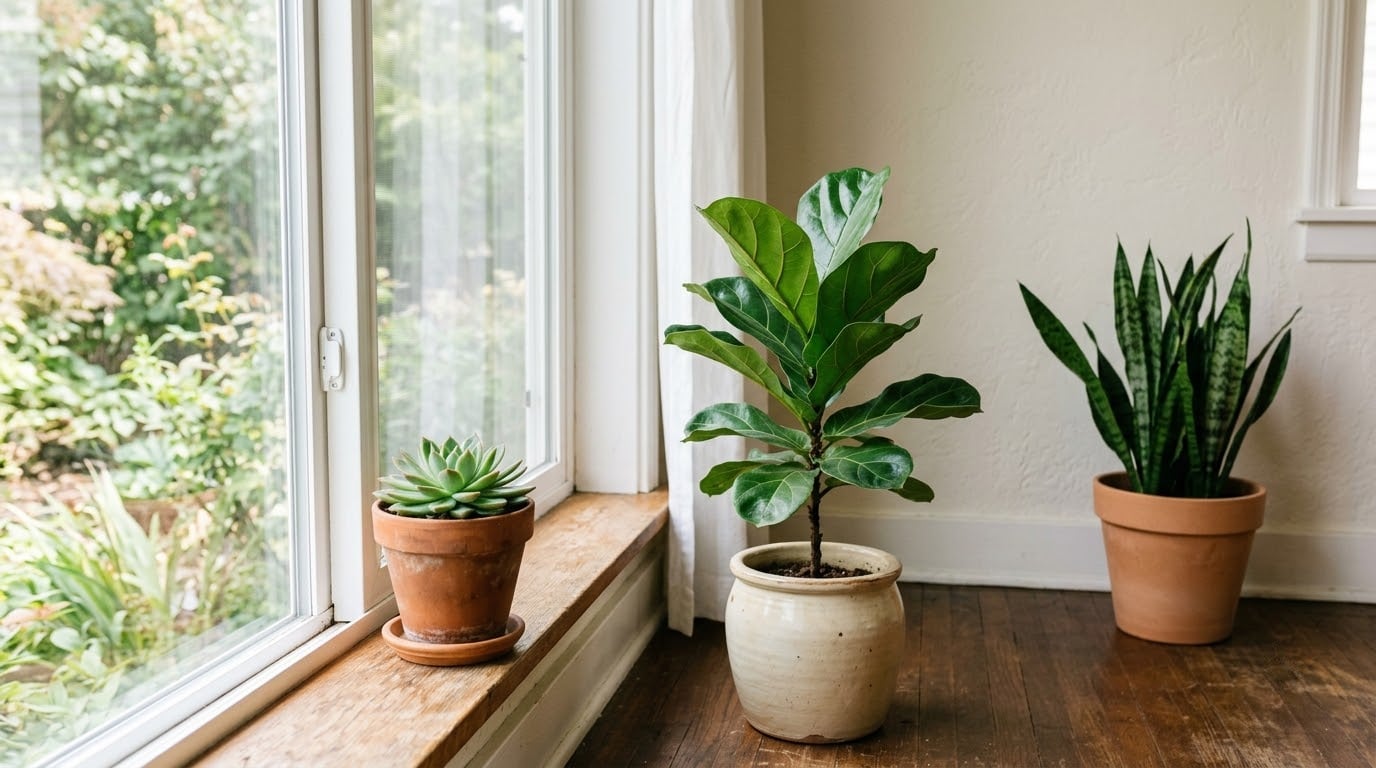
There is no single correct answer to how far from a window should a houseplant sit, because light strength drops sharply the further a plant moves from the glass. A workable starting point: sun-loving plants want the sill or within about 12 inches of it, bright-indirect plants usually sit 3 to 5 feet back, medium-light plants 5 to 8 feet back or behind a sheer curtain, and low-light plants can go 8 feet away or sit near a bright wall. Set the plant to its light preference first, then adjust from there.
I have moved the same pothos between four spots in one apartment and learned that the distance number matters far less than what you see the plant doing. Two weeks of watching beats any rule of thumb, including the ones below.
Table of Contents
- What You Need
- Step-by-Step
- How Far from a Window Should a Houseplant Sit by Light Need?
- Measure the Light in the Room
- Watch the Plant for Two Weeks
- Adjust as the Seasons Change
- Common Mistakes
- Frequently Asked Questions
- Do all houseplants need to be placed the same distance from a window?
- Should I move my houseplant closer to the window in winter?
- How can I tell if a houseplant is too close to the window?
- Does a sheer curtain provide enough light for every houseplant?
- Is measuring in feet or inches more useful than checking light conditions?
- What to Do First
What You Need
Before you pick a spot, gather four things:
- The plant’s light preference. Most plant tags and care guides state it plainly: full sun, bright indirect, medium, or low. If you cannot find it, look at where the plant lived in the shop.
- The window’s direction. Stand outside the glass at midday with a compass app on your phone, or use a maps app that shows which way your windows face. Indoors, the sun path is the reverse of what you see outdoors, so check carefully.
- A tape measure or a piece of tape on the floor to mark candidate positions, since estimates are usually wrong.
- Optionally, a light meter or a lux-meter app. Phone apps give rough numbers, not laboratory readings, but they are enough to compare one part of a room with another on the same day.
One thing to clear up first: direct sunlight, filtered light, and shade are completely different. Light through a window can be direct, especially at midday on a south or west wall. Light two feet back from that same window is filtered, and the far corner of the room is shade. Treating those three as interchangeable is the most common reason placement advice goes wrong.
Step-by-Step
How Far from a Window Should a Houseplant Sit by Light Need?
Match the plant to a starting distance, then treat that as a starting point rather than a promise. Your window direction, glass and season will shift the result by a foot or two in either direction.
| Light need | Starting position | Window type that fits | Typical plants |
|---|---|---|---|
| Full sun | On the sill, or within 12 in (30 cm) | South or west, unobstructed | Succulents, cacti, aloe, jade |
| Bright indirect | 3 to 5 ft (1 to 1.5 m) back | East, south or west, or behind a sheer curtain | Monstera, fiddle leaf fig, bird of paradise |
| Medium | 5 to 8 ft (1.5 to 2.4 m) back, or in a north window | North, or any window with curtain-filtered light | Pothos, philodendron, calathea |
| Low | 8 ft (2.4 m) or more back, near a bright wall | Any window, with supplementary light | Snake plant, ZZ plant, fern |
Distance and direction work together. An east window delivers gentle light for a few hours, so a bright-indirect plant often does well right on the sill with no adjustment at all. A south-facing window at midday is intense enough that most foliage plants belong 3 to 4 feet back, and a west window usually needs a sheer curtain or a set-back distance because its afternoon light is the harshest of the day.
North-facing windows are the odd ones out. They rarely deliver direct sun, so plants that want bright indirect usually need to sit close, while genuinely low-light species can go almost anywhere in the room.
Measure the Light in the Room
Check the same spot three times: around 9 in the morning, near noon, and an hour or two before sunset. Note where the sun patch lands and how long it stays there.
If you have a meter or a lux app, take a reading at the plant’s canopy height rather than on the sill. A rough benchmark worth remembering: around 500 lux suits low-light plants, 1,000 to 2,500 lux suits medium-light plants, and above 5,000 lux suits bright-indirect species, with readings above 10,000 lux approaching full sun.
Taking three readings also settles the question of how far from a window should a houseplant sit, because intensity roughly halves every time you double the distance. Readings that look fine at the sill and fall off a cliff by the wall mean you have more room than you thought.
Several things will throw those readings off. Single-pane and double-pane glass filter light differently, and some low-iron glass passes more of it. Heavy drapes can cut light by more than half. A street tree or a building across the way may remove most of what you expect from that window, which is why measuring beats assuming. In a dim room, a mirror or a pale wall opposite the window will noticeably lift the light a plant receives.
Watch the Plant for Two Weeks
Give the plant a fortnight before deciding anything, then check four things:
- New leaves are coming in at normal size and normal color.
- The stem is not stretching quickly toward the glass.
- No pale, papery or crispy patches on the leaves facing the window.
- The plant is neither dropping leaves nor holding on to old ones.
Telltale signs of too little light: long gaps between leaves, small new leaves, a stem leaning, and colors going flat. Too much light looks different. You get bleached or brown patches on the sun-facing side of a leaf, crisp edges that the window side hit first, and scorched patches that do not recover.
The confusion usually starts with a plant that is both stretching and browning. That usually means the light is fine in the middle of the day and far too weak the rest of it, so the plant stretches and then gets scorched at noon. The fix is a grow light or a brighter position rather than moving closer to the glass.
Adjust as the Seasons Change
In winter the sun sits lower, so its light travels deeper into a room. A plant that was too close to a south window in July may be perfect at 4 feet in January, and anything with thin leaves can often move a foot or two closer. Be aware that low winter sun behind glass can also burn frosted patches, so tuck tender tropicals away from the pane on freezing nights.
Summer runs the opposite way. The sun climbs, the light stays nearer the glass, and a west-facing window turns into a heat source after lunch. Plants that liked that sill in April may need to move back a foot or two or gain a sheer curtain.
A low-light north-facing room changes the least, but its usable light still drops in midwinter. That is a good room for a lamp with a full-spectrum bulb positioned about 12 to 18 inches above the leaves, running 12 to 14 hours a day.
Common Mistakes
- Checking only at midday. A noon reading tells you the peak and nothing about the rest of the day. Fix: measure morning, midday and late afternoon, and go with the weakest one if you have no way to add light.
- Counting a dim window as direct sun. A tree or a building can turn a south window into a north one. Fix: watch where the sun patch actually falls before you decide.
- Pressing leaves against the glass. That means heat in summer and cold in winter, plus no airflow. Fix: leave 6 to 12 inches of clearance and check back each season as the plant grows.
- Moving a plant across the room in one jump. A sudden change in intensity shocks the leaves. Fix: move it in stages, a couple of feet at a time, over a week or two.
- Reacting to a single drooping leaf. Drooping usually points to watering or roots, not light. Fix: check soil moisture first and treat light as the second question, not the first.
One habit worth keeping: rotate plants a quarter turn every week or two so growth stays even on all sides.
Frequently Asked Questions
Do all houseplants need to be placed the same distance from a window?
No. A cactus and a fern cannot share one spot. Sun-loving plants want the sill or within about 12 inches of it, bright-indirect plants sit 3 to 5 feet back, medium-light plants 5 to 8 feet back, and low-light plants 8 feet away or near a bright wall. Group plants by light need and place each group where its range fits your room.
Should I move my houseplant closer to the window in winter?
Usually yes. Winter sun sits lower on the horizon, so its light reaches deeper into a room than summer light does. A plant that was pushed back to avoid summer scorch can often move a foot or two closer around October. Move it gradually rather than in one jump, and keep tender tropical foliage off the glass on nights that freeze.
How can I tell if a houseplant is too close to the window?
Look for damage on the side of the leaf facing the glass: bleached patches, brown crispy margins, or spots that appear after a sunny stretch and never recover. Too close also means leaves physically touch the pane, which exposes them to summer heat and winter cold. Move the plant back 12 inches and watch whether new growth comes in clean.
Does a sheer curtain provide enough light for every houseplant?
It works well for bright-indirect plants in south and west windows, where it tames harsh afternoon rays without going dim. It often blocks too much for low-light species, which need every available lumen. Measure before and after hanging the curtain, and if readings drop sharply, take the curtain down and set the plant back from the glass instead.
Is measuring in feet or inches more useful than checking light conditions?
Light conditions are far more useful. Feet are a proxy for intensity, and the proxy breaks down as soon as you change window direction, glass type, curtains or obstructions. Two homes with identical floor plans can have very different light in the same spot. Use distance to set a starting position, then judge the spot by what the plant does over two weeks.
What to Do First
Start by classifying your window, not the plant: stand outside at midday, confirm the direction, and note what blocks the view. Then match the light you found to your plant’s stated preference and place it at the closest position that will not scorch it, roughly 3 to 5 feet back for most foliage plants. Two weeks from there, let the new leaves tell you whether to move closer or further. That observation is worth more than any fixed number of feet, and it keeps working in every season.