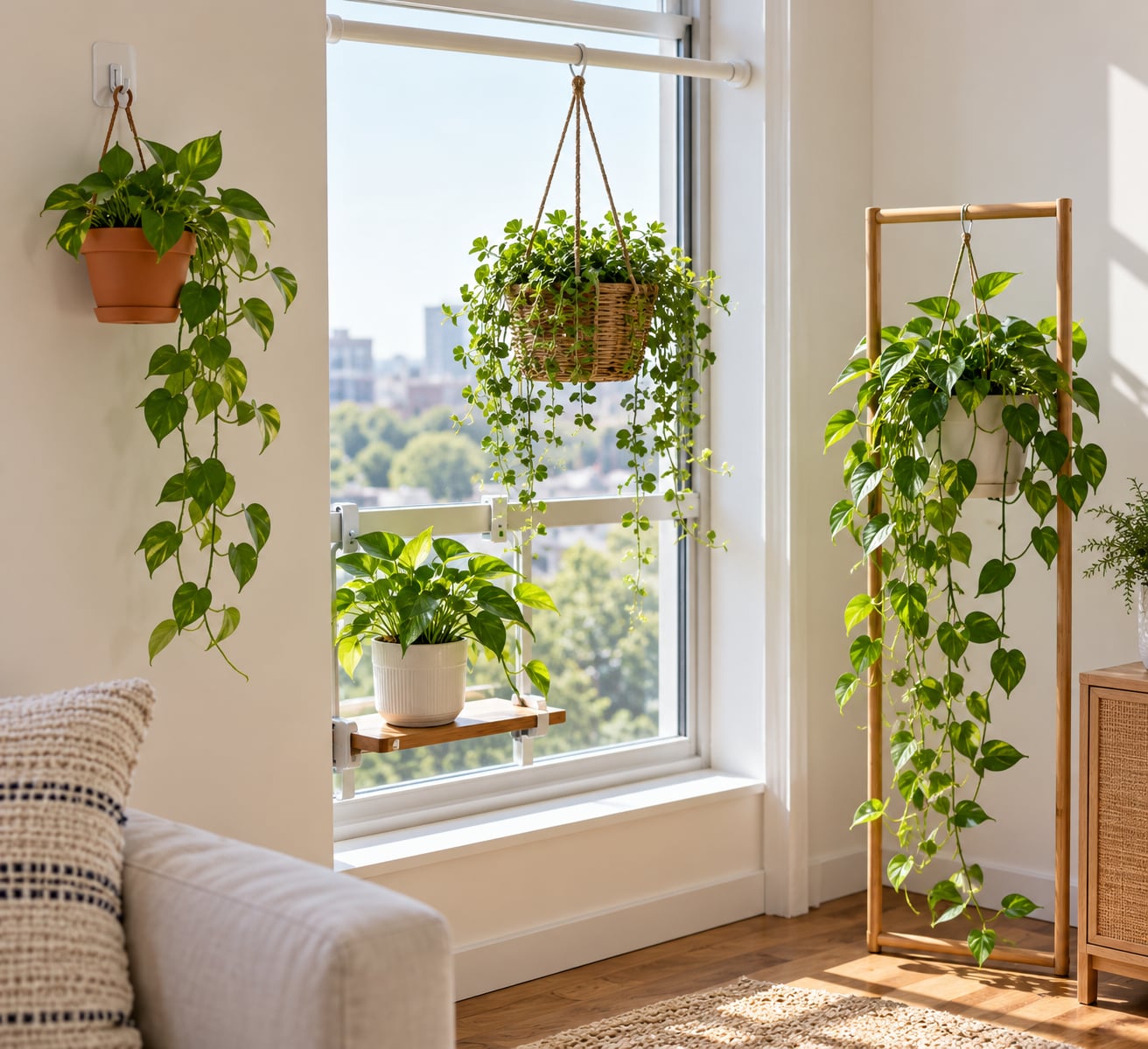
You can hang plants without drilling holes by using adhesive hooks, a tension rod fitted into a window frame, clip-on shelves, or a freestanding frame. Each method works on a different surface, so the right choice comes down to how heavy the plant is and what the wall is made of. Most of these installs take under ten minutes and cost nothing but hardware.
The mistake people make is trusting the number printed on the package. A hook rated for five pounds that hangs straight down behaves very differently when the pot swings when you water it, or when a door slams and the wall shakes. Treat every rating as a ceiling, not a target.
Here is how to hang plants without drilling holes, method by method, with the load range each one handles and a simple way to confirm it is actually holding.
Table of Contents
- What You Need
- How to Hang Plants Without Drilling Holes: Step-by-Step
- Use Adhesive Wall Hooks for Lightweight Plants
- Install a No-Drill Tension Rod or Ceiling Pole
- Use Removable Adhesive Strips for Pots and Hooks
- Place Plants on No-Drill Shelves or Ledge Systems
- Create a Freestanding Plant Hanging Frame
- Common Mistakes
- Frequently Asked Questions
- Can I hang a plant without drilling into a wall?
- What is the best no-drill method for heavy plants?
- Do Command strips work for hanging plant pots?
- Can I hang plants in an apartment I rent?
- What surfaces are safe for adhesive plant hooks?
- How do I remove an adhesive hook without damaging the wall?
- Conclusion
What You Need
Nothing here requires a drill, but you do need to match the hardware to the job. Gather the group before you start so you are not hanging an empty hook first and shopping again later.
- Adhesive hooks or strips for light plants under about 3 pounds on smooth painted drywall. Bring rubbing alcohol and a cloth for cleaning the surface.
- A tension rod for window displays. Any rod with a spring or threaded end that fits snugly works, plus two small hooks or S-hooks for the pot.
- Clip-on or over-the-door shelves for medium plants up to about 10 pounds, and S-hooks if you want trailing plants to spill over the edge.
- A freestanding frame, garment rack, or tall plant stand for anything heavy. No wall contact means no risk to paint or drywall.
- A small kitchen scale if you are unsure how much your pot weighs. Lift it, weigh it, and write the number on the pot with a marker.
- Command strips in small and large sizes, or a heavier-duty adhesive hook brand, if you want the option to reconfigure the display later.
Sort your plants into three groups before you buy any hardware: light under 3 pounds, medium between 3 and 10, heavy over 10. Most hanging plants including their soil and water fall into the first two groups. A mature 10-inch potted plant with wet soil crosses into heavy territory fast.
How to Hang Plants Without Drilling Holes: Step-by-Step
Five methods cover nearly every wall, ceiling, and window. Work through them in order from lightest to heaviest, and stop at the first one that suits your surface and plant.
Use Adhesive Wall Hooks for Lightweight Plants
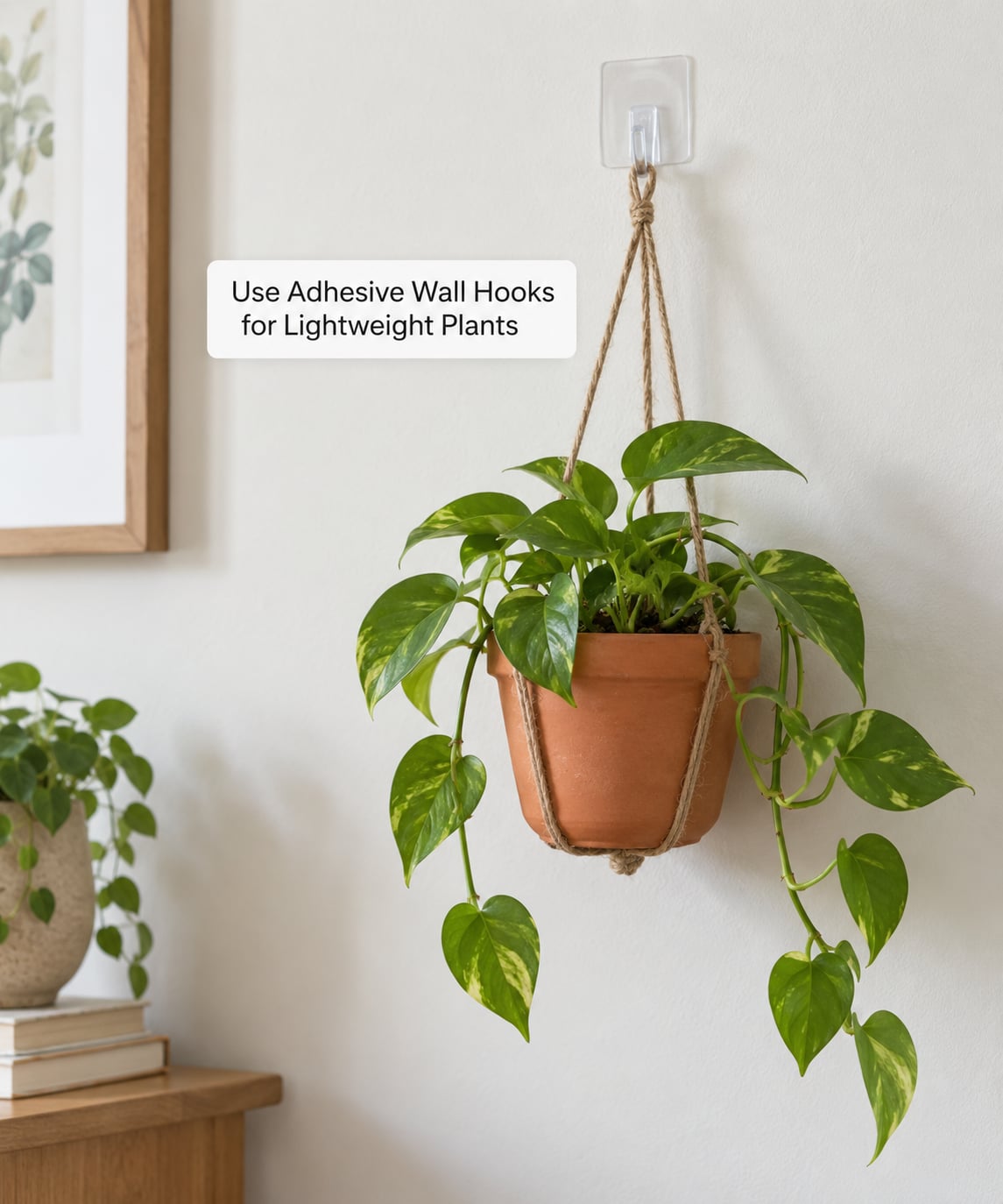
Adhesive hooks are the fastest fix. Clean the spot with rubbing alcohol, let it dry fully, press the hook against the wall for 30 seconds, then walk away for 24 hours before you hang anything. That waiting period is the single biggest factor in whether the bond holds.
What to hang on them: small pots of pothos, hoya, or a trailing plant in a nursery pot under three pounds. What to leave alone: terracotta planters, anything saturated with water, and anything that will swing. Adhesive fails in peel and shear, and a swinging pot loads both.
Before you commit to a visible wall, run a paint test. Press a spare strip onto an inconspicuous area such as behind the couch or inside a closet, wait a day, then peel it off slowly at a low angle. If any paint lifts, that wall is textured or freshly painted and adhesive is the wrong tool there.
Install a No-Drill Tension Rod or Ceiling Pole
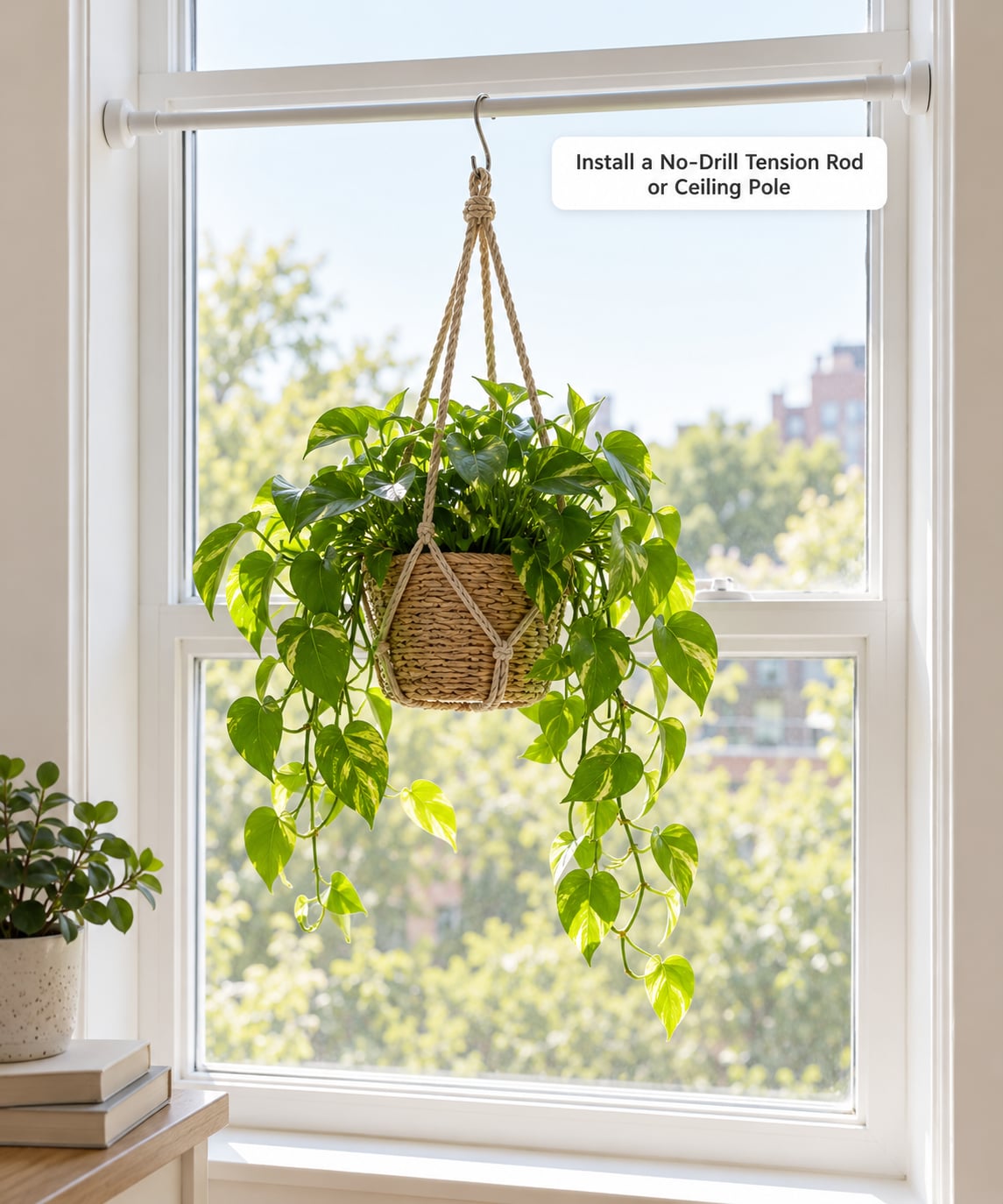
A tension rod spans a window frame, a narrow recess between two walls, or the gap under a cabinet. Screw the rod to length, push it into place until both ends make firm contact, and hang a basket or pot from a hook on the rod.
This is the best-looking no-drill method in a window because the rod does the work visually and leaves the wall untouched. It also tolerates more weight than adhesive, and you can run two rods at different heights for a layered look.
Know the limits. People posting in renter and apartment-hacking forums report the same failure repeatedly: a tension rod creeps downward once a real pot with wet soil is on it. Check the fit with your hand before adding the plant, and re-check it after watering. For anything over about 10 pounds, use a clamp on a beam or a rod under a cabinet instead.
Test the seal with a firm outward push on the basket. If the rod slides more than a few millimeters, tighten it or add a rubber pad at each contact point.
Use Removable Adhesive Strips for Pots and Hooks
Adhesive strips do something hooks cannot: they attach a pot directly to a wall or ceiling. A strip pair fixed to a small planter lets a pothos trail from a flat wall with nothing else in the way.
Attach the strips to the back of the pot, not the sides, so the load pulls straight down through the back panel. Push each strip firmly along its whole length, wait 24 hours, and hang the empty pot first. Add the plant once the bond has had time to fully set.
Use strips rated well above the pot weight. People in plant forums commonly report adhesive hooks rated at 5 pounds giving out between 3 and 4, once you count the pot, the soil, and the swing. If a strip can carry 12 pounds and your pot weighs 4, you are inside the range where it holds.
Textured walls, wallpaper, and ceiling with heavy texture are the weak spots here. Adhesive needs a smooth, non-porous, painted surface to bond across a wide area.
Place Plants on No-Drill Shelves or Ledge Systems
A clamp-on shelf grips the edge of a window frame, a door, or a bookcase, which makes it the most versatile method for medium plants. It is also the easiest to move when you want to rearrange or take everything down at the end of a lease.
Clamp the unit, tighten both screws evenly, and check for movement by pushing down on the shelf corner with your palm. Any wobble means one side is not seated. Line the inside of the clamp with a thin felt or rubber strip so it does not mark the wood or the painted frame.
Over-the-door hooks work in a similar way. They hang off the top edge of a door, so they add no weight to the wall. Keep in mind that the plant moves every time the door swings, so use a short pot and a trailing variety that tolerates being jostled rather than a tall one with a heavy base.
These shelves hold a pot of 3 to 10 pounds comfortably. Above that, the clamp depends entirely on the thickness and material of what it grips.
Create a Freestanding Plant Hanging Frame
When the plant is heavy or the wall is brick, concrete, or textured, skip wall hardware entirely. A floor frame, a garment rack, a tall plant stand, or a leaning trellis behind the sofa gives you hanging height with zero wall contact.
A garment rack in the style of the widely sold RAKKURT works because it is wide, weighted at the base, and easy to move between rooms. Hang a few pots from the top bar with S-hooks, keeping the heaviest one centered over the legs so the frame does not tip forward.
A leaning trellis behind a sofa or a wide piece of furniture is the safest no-drill option of all. Lean it at about five degrees, wedge the base behind the furniture, and the furniture does the tipping prevention. Our rule with both: the heaviest plant sits at the bottom, and nothing that pets can knock over goes on the lowest shelf.
This is also the method that travels well. Moving to a new rental, you pack the frame instead of patching the wall.
Common Mistakes
Using adhesive on the wrong surface. Textured paint, wallpaper seams, and drywall with heavy texture have too little flat area for the adhesive to grab. Move to a tension rod, a clamp, or a freestanding frame instead of trying a bigger strip.
Loading the hook past its rating. Manufacturers test static weight on a clean lab wall. A wet pot with soil can double the dry weight, and every breeze adds a sideways pull. Stay at or below half the stated rating.
Skipping the 24-hour wait. Most adhesive failures happen because something was hung onto the strip minutes after it went up. Set the pot empty, leave it alone overnight, then plant it in place.
Forgetting to test the paint. The spare-strip test takes a day and costs nothing. Skipping it is how a rental deposit gets reduced.
Assuming the tension rod will hold its position. Rods drift with weight and with temperature changes that move the frame slightly. Check the fit after watering, and add a rubber or felt pad where the ends press if it creeps.
Hanging a plant where you cannot water it. A pot at ceiling height needs a watering can with a long spout, a pulley basket you can lower, or a mister for ferns and moss. Pick the plant and the access method together, or you will regret the height on a dry weekend.
Ignoring soil and drainage. A hanging pot with a drainage hole will trail water down the wall. Use a pot with a saucer, a cachepot with a reservoir, or a liner, and check that the hanger allows the pot to sit level rather than tipped.
Frequently Asked Questions
Can I hang a plant without drilling into a wall?
Yes. Adhesive hooks, tension rods, clip-on shelves, over-the-door hangers, C-clamps on exposed beams, and freestanding frames all suspend plants with no holes at all. The catch is load. Adhesive handles light pots, tension rods and clamps handle medium to heavy ones, and a floor frame handles anything. Match the method to the plant weight and the surface, not to the look.
What is the best no-drill method for heavy plants?
A C-clamp or a clamp mounted on an exposed beam, or a tension pole fitted tightly into a window recess, will carry plants over 10 pounds. Magnetic hooks rated for heavy duty work on bare metal shelving. What matters is that the clamp bites a solid material and is tightened evenly, then checked with a firm push for movement.
Do Command strips work for hanging plant pots?
They work for light pots, usually under 3 pounds, on smooth painted drywall. Real-world results run below the printed rating once you add soil, water, and movement from watering. Use the largest strip the surface allows, keep the weight under half the stated rating, wait a full 24 hours before hanging, and test a spare strip on a hidden area first.
Can I hang plants in an apartment I rent?
Yes, as long as nothing is drilled and the wall is left unmarked. Take photos of every wall before you start and again when you move out. Choose methods that lift off cleanly, avoid any hook near a door frame that gets handled constantly, and check your lease, since some landlords restrict adhesive on painted surfaces.
What surfaces are safe for adhesive plant hooks?
Smooth painted drywall, finished wood, glass, metal, and sealed laminate all bond well. Textured or popcorn ceilings, brick, concrete, unfinished wood, wallpaper, and freshly painted surfaces do not. Clean the area with rubbing alcohol, dry it, and run a spare-strip test somewhere hidden for 24 hours before you commit to a visible wall.
How do I remove an adhesive hook without damaging the wall?
Soften the adhesive first with a hairdryer on low for 15 to 20 seconds, then peel slowly at a low angle, almost flat to the wall, rather than straight out. Pull one strip tab at a time. If paint starts to lift, stop, let the adhesive cool, and slide a thin plastic card under the strip to break the bond without dragging the surface.
Conclusion
Start light. Pick the smallest plant on the lightest hook, hang it on a wall you have already tested with a spare strip, and give it a full day to set. Once you know how that behaves, move up to a tension rod in the window or a clamp-on shelf for something heavier, and take anything over 10 pounds off the wall entirely onto a freestanding frame.
Take photos of the walls before you start. When you move out, the display comes down in ten minutes and your deposit stays where it was.