Short answer: yes, self watering globes do they work. They genuinely water a plant for roughly a week to two at a time, and they do it automatically. What they are not is a replacement for checking your soil, your drainage and what the plant actually needs this week. So the honest verdict is a qualified yes, and the rest of this guide is the part that tells you when the qualification matters.
I have used glass and plastic globes on a windowsill, on patio containers and on a hanging basket that gets no attention for days. The summary from all that: they are brilliant for moisture-loving tropicals in medium pots, and a bad idea for anything that likes to dry out.
Table of Contents
- Do Self Watering Globes Actually Work?
- How Do Self Watering Globes Work?
- How self watering globes regulate water
- What Happens When the Water Runs Out?
- Which Plants and Pots Are Best for Them?
- Why Might a Self Watering Globe Stop Working?
- Trapped air inside the globe
- An airlock in the neck
- Clogged or mineral-stained porous tip
- Soil packed too hard around the neck
- Insertion depth or angle
- Damaged or blocked drainage
- Reservoir volume that is simply too small
- How to Set One Up for Best Results
- Are Self Watering Globes Better Than a Watering Can?
- Frequently Asked Questions
- How long do self watering globes last?
- Are self watering globes suitable for indoor plants?
- Can self watering globes be used outside?
- Why is my self watering globe not watering?
- Do self watering globes prevent overwatering?
- Can I use a self watering globe for succulents?
- Conclusion
Do Self Watering Globes Actually Work?
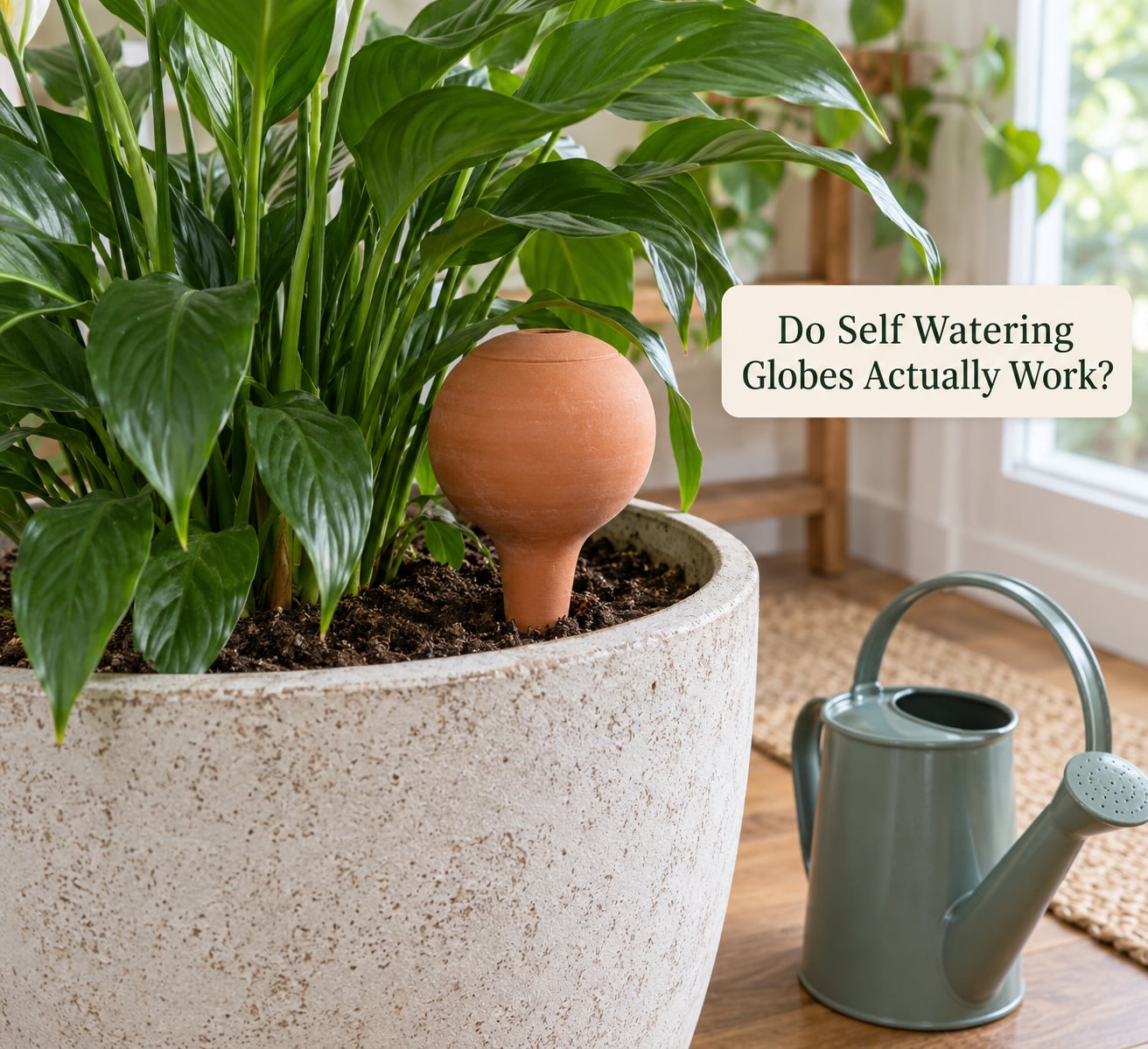
Yes, they work. A globe is not a timer or a drip line attached to a hose. It reacts to the moisture level of the soil around its neck, which is why it slows down when the soil is wet and picks back up when the soil dries.
That is the whole trick, and it explains both the good and the bad reviews. When the soil is genuinely moist, the globe releases very little water, so the plant is far less likely to be drowned by a fixed daily schedule. When the soil dries out, the flow rises again.
They work best when four things line up:
- The plant likes evenly moist soil rather than a wet-dry cycle.
- The pot is medium sized, with drainage holes and loose soil.
- The globe size roughly matches the pot volume.
- Somebody checks the pot every few days anyway.
They fail in predictable situations. Compacted or dry soil pulls water out faster than the globe can meter it. A globe pushed into a small pot can empty in minutes. And a globe fitted to a succulent or a cactus is a slow-motion overwatering, which is how root rot starts.
Long-running houseplant forum threads on the topic return a consistent verdict. Users report that the same globe on the same plant sometimes seems to deliver a lot of water and sometimes almost none, described as the equivalent of pouring a jugful in on one day and nothing at the next. Multiple people in those threads recommend setting the globe up at least 24 hours before leaving, as a test run.
How Do Self Watering Globes Work?
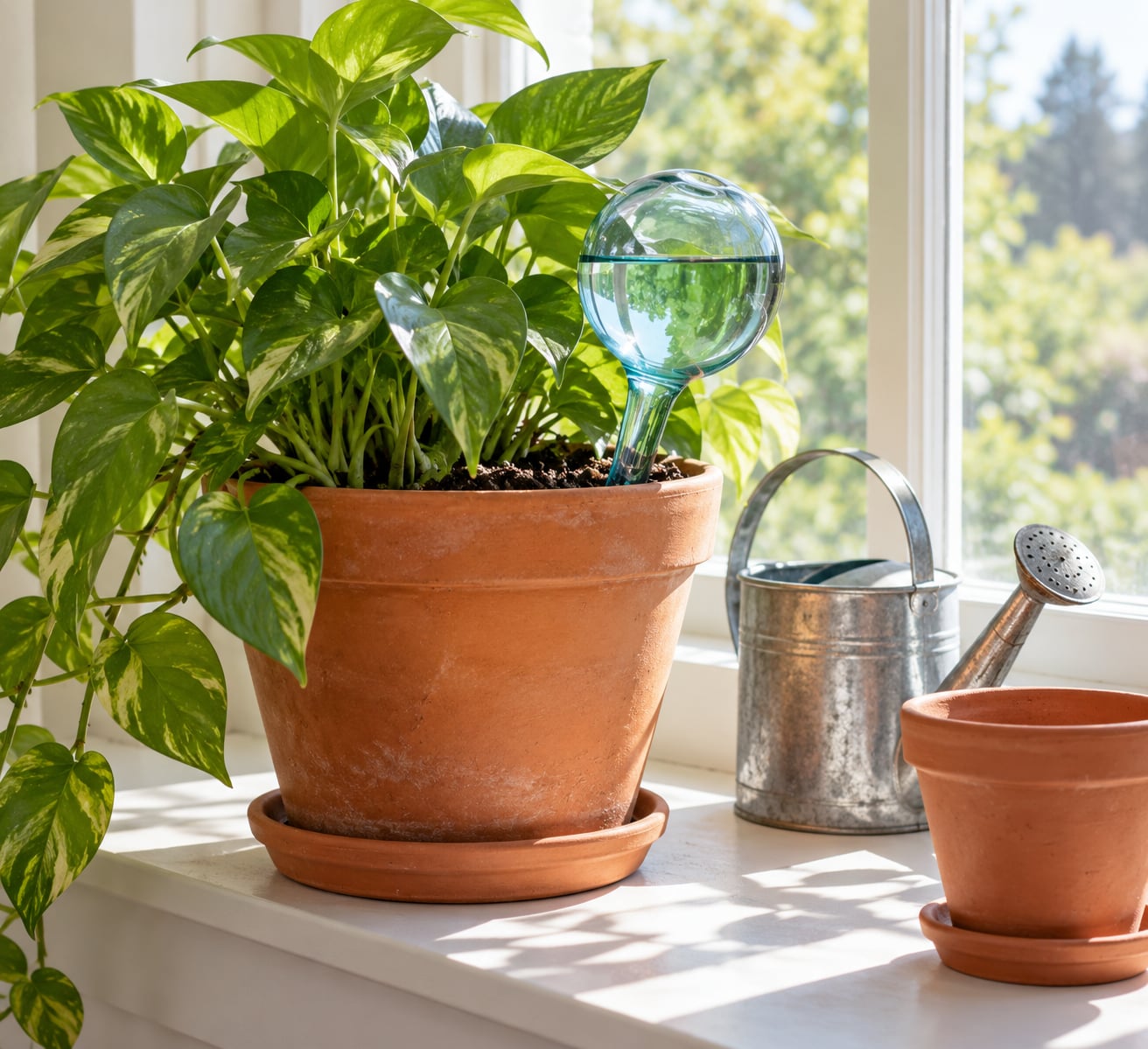
A watering globe, also sold as an aqua globe or a plant watering bulb, has four parts: a hollow reservoir that holds the water, a long narrow neck, a porous tip or cone, and a small vent hole. The glass versions are hand-blown and decorative. The plastic versions are frosted or clear and cheaper to replace.
The sequence runs like this:
- You fill the reservoir completely and let the water settle, with no air trapped inside.
- You make a hole in the soil with a finger or a pencil and insert the neck at an angle, not pressed straight down.
- The porous tip touches moist soil, which starts drawing water out of the reservoir.
- As water leaves the globe, air enters through the vent at the top, and the flow settles into a slow drip.
- When the soil dries enough for air to reach the neck opening, more water follows.
How self watering globes regulate water
Two forces decide how fast water moves out, and they pull in opposite directions. Capillary action pulls water from wet soil into the porous neck and down into the globe. Pressure difference pushes water back up and out. When the soil is wet, the capillary side wins and the flow nearly stops. When the soil dries, the pressure side wins and the flow speeds up.
This is also why the vacuum seal matters. If air gets trapped in the neck, the pressure balance breaks and the globe either gurgles empty or stops entirely.
What Happens When the Water Runs Out?
You should not trust a fixed number of days. A small globe in a sunny terracotta pot on a hot balcony can be empty in a day or two. A larger globe in a glazed ceramic pot of living-room pothos in winter can last several weeks.
The factors that shorten or extend the interval:
| Factor | What it does to the interval |
|---|---|
| Small globe volume | Shortens it sharply |
| Large globe volume | Extends it |
| Unglazed terracotta pot | Shortens it, because the pot wall wicks moisture out |
| Glazed ceramic or plastic pot | Extends it |
| Compacted or dry potting soil | Shortens it, because dry soil sucks water hard |
| Mulch layer on top | Extends it by slowing evaporation |
| Hot, dry, windy weather | Shortens it |
| Cool, humid indoor room | Extends it |
| Large or fast-growing plant | Shortens it, because uptake is heavier |
| Small plant in a big pot | Extends it, because roots cannot use the volume |
The practical move is to measure rather than assume. Set the globe up, write the date on it with a pencil, and check it after two days. That single habit removes almost every surprise.
Which Plants and Pots Are Best for Them?
Indoor and outdoor containers behave differently, and the pot material matters more than most people expect.
Terracotta is porous and breathes, which is good for roots and bad for duration. Globes in terracotta run faster because the pot itself loses water. Glazed ceramic and plastic hold moisture longer and give the globe a much wider window. Outdoors in full sun, expect a terracotta pot to cut your watering time roughly in half compared with a plastic one.
Very small pots are the worst case. A globe that suits a six-inch pot can empty in a single afternoon once the neck is in dry soil. Very large containers are the opposite problem: one small globe sits in a vast volume of soil, keeps it locally damp near the neck while the rest of the root ball stays dry, and gives you false confidence.
Globes suit plants with moderate, consistent moisture needs. That covers peace lily, pothos, philodendron, most ferns, many tropical foliage plants, herbs in containers like basil and mint, and hanging baskets that dry out fast on a warm balcony.
Leave globes out for succulents, cacti, most orchids, lavender, rosemary and anything that wants a dry period between drinks. Those plants evolved to be punished by constant moisture, and a globe keeps the soil around the roots damp for weeks, which is exactly the condition that invites root rot.
A quick note on the outdoor container: make sure the pot has drainage holes and that water can leave the saucer. A globe sitting in a pot with a blocked drain can push the whole system into swamp conditions.
Why Might a Self Watering Globe Stop Working?
Almost every complaint about these things traces back to one of a handful of mechanical problems.
Trapped air inside the globe
Air in the reservoir breaks the pressure balance. The fix is to fill it under a thin stream of water, tap the sides to release bubbles, and top it up until it runs a little full. If it has already gone dry, squeeze it gently to expel air, then refill.
An airlock in the neck
A vacuum forms at the base and stops the flow. Lift the globe out, refill it completely, and reinsert it in damp soil so the tip never sits in dry ground.
Clogged or mineral-stained porous tip
Hard water leaves deposits on the ceramic cone or plastic neck. Soak the tip in a weak vinegar solution for a couple of hours, rinse, and push a fine pin through the opening. A dedicated bottle brush works well.
Soil packed too hard around the neck
This is the single most common cause of a five-minute runoff in forum reports. Loosen the soil, mix in some perlite or compost, and make the pilot hole with a pencil rather than shoving the globe straight in with your fist.
Insertion depth or angle
Pushed straight down into compacted soil, the glass neck snaps. Insert at a slant, stop when you feel resistance, and never force it. On outdoor pots, insert shallowly so the top of the neck sits in air, not submerged in wet soil.
Damaged or blocked drainage
A cracked neck or a hole in the reservoir ruins the seal. Check the globe for chips before every fill, and clear the pot’s drain holes.
Reservoir volume that is simply too small
Not a fault at all, just a mismatch. For a large container, use a big globe, add a second one, or set up a drip line instead.
How to Set One Up for Best Results
- Test it the day before. Set the globe up at least 24 hours in advance of travel and watch how the soil changes. This is the habit experienced growers keep repeating, and it is the cheapest insurance you can buy.
- Loosen the soil first. If the top of the pot is crusty or the soil is compressed against the wall, work in perlite or compost first. Loose soil is what makes the flow predictable.
- Make a pilot hole. Use a pencil or your finger. Push the neck in at an angle with a gentle twisting motion.
- Keep the neck away from the root ball when the pot is small. If the globe sits right against the roots, you get a wet spot and a dry pot at the same time.
- Leave the top of the neck exposed. The globe needs some air space above the soil line to vent. Burying it fully cancels the regulation.
- Add mulch on top. A thin layer slows evaporation and extends the interval meaningfully in summer.
- Set a checking routine. Every few days, press a finger two knuckles into the soil. If it is dry, top up. The globe is a helper, not a system you install and forget.
- Refill before it empties. A globe allowed to run completely dry loses its seal and usually needs a squeeze and a full re-prime.
A note on safety and placement. Keep globes out of reach of pets and small children, particularly glass ones, and never leave a globe where an animal can chew a ceramic tip. Outdoors, remove globes before hard frost, since frozen water cracks glass, and move them under cover during heavy downpours so they do not overflow a full reservoir.
Are Self Watering Globes Better Than a Watering Can?
They solve a different problem. A watering can gives you control; a globe gives you a slow, self-adjusting trickle. Neither replaces the other, so the useful question is what situation you are in.
| Method | Best for | Weak point |
|---|---|---|
| Watering globe | Vacation cover, busy schedules, one or two indoor plants, consistent moisture for tropicals | Flow is not precisely predictable; fragile glass neck |
| Watering can | Daily care, precise control, watering the soil not the leaves | You have to remember to do it |
| Terracotta or Blumat-style spikes | Large containers and outdoor pots where you want more control than a globe gives | Can still clog; more fiddly to set |
| Bottle drip irrigation | Cheap, high-volume vacation watering for several pots | Fixed flow, no soil feedback |
| Self-watering planters | Plants that want steady moisture, wicking reservoirs in the pot | You cannot use your own containers |
If the plant is healthy and you are home, a watering can is the better tool, because you can see what the soil is telling you. If you are away for a week or two, globes earn their place. If you have ten containers to cover on a balcony, drip irrigation beats ten glass globes on both cost and breakage.
Glass versus plastic is a smaller decision. Glass looks better on a shelf and resists scratching and mineral staining, but the neck is fragile and replacement is expensive. Plastic will not break and is cheaper, which matters more outdoors or in a house with children.
Frequently Asked Questions
How long do self watering globes last?
Most glass globes holding a few hundred millilitres run between a week and two in a typical indoor pot. Outdoors in summer, or in an unglazed terracotta container, you may get three to five days. In a glazed pot in a cool room, it can stretch to several weeks. Test yours for two days before you rely on it.
Are self watering globes suitable for indoor plants?
Indoors is where they work best, because conditions are stable and the soil dries at a predictable rate. They suit peace lily, pothos, philodendron and ferns in medium pots. Keep them away from succulents and cacti, and remember that a warm, dry room or a radiator will pull water out of the pot much faster.
Can self watering globes be used outside?
Yes, though you should expect shorter intervals than indoors. Sun, wind, heat and porous terracotta all speed up water loss. Insert the globe shallowly so the top of the neck stays in air, add a mulch layer on top of the soil, and bring globes in before frost, since freezing water can crack glass.
Why is my self watering globe not watering?
The usual causes are an airlock in the neck, a clogged porous tip or compacted soil pulling water out too fast. Lift it out, refill it completely to push the air out, soak the tip in warm water to clear deposits, and loosen the surrounding soil. If the tip sat in dry ground, reinsert it into damp soil so the seal reforms.
Do self watering globes prevent overwatering?
They reduce the risk rather than remove it. Because the flow slows as soil gets wet, a globe will not keep dumping water into already saturated soil the way a fixed drip line can. But a globe left in a pot with no drainage, or one filled in compacted soil, will still keep roots wet for weeks and can cause root rot.
Can I use a self watering globe for succulents?
I would not. Succulents and cacti need a dry period between drinks, and a globe holds moisture around the neck and roots for long stretches, which is the classic setup for root rot and mushy leaves. If you travel often and own succulents, move them to a sheltered spot or ask someone to water them on a schedule instead.
Conclusion
Whether self watering globes do they work is a fair question, and the honest answer is that they do, within a narrow and well-understood range. They reliably deliver slow, soil-responsive moisture to medium pots of plants that want consistent water, and they cut down the chance of both underwatering and overwatering.
Start with three things: pick a globe sized to the pot, use it only on a plant that wants steady moisture rather than a dry cycle, and set it up at least a day early to see how fast it actually runs. Then keep checking the soil. The globe handles the gap between waterings, not the judgement behind them.