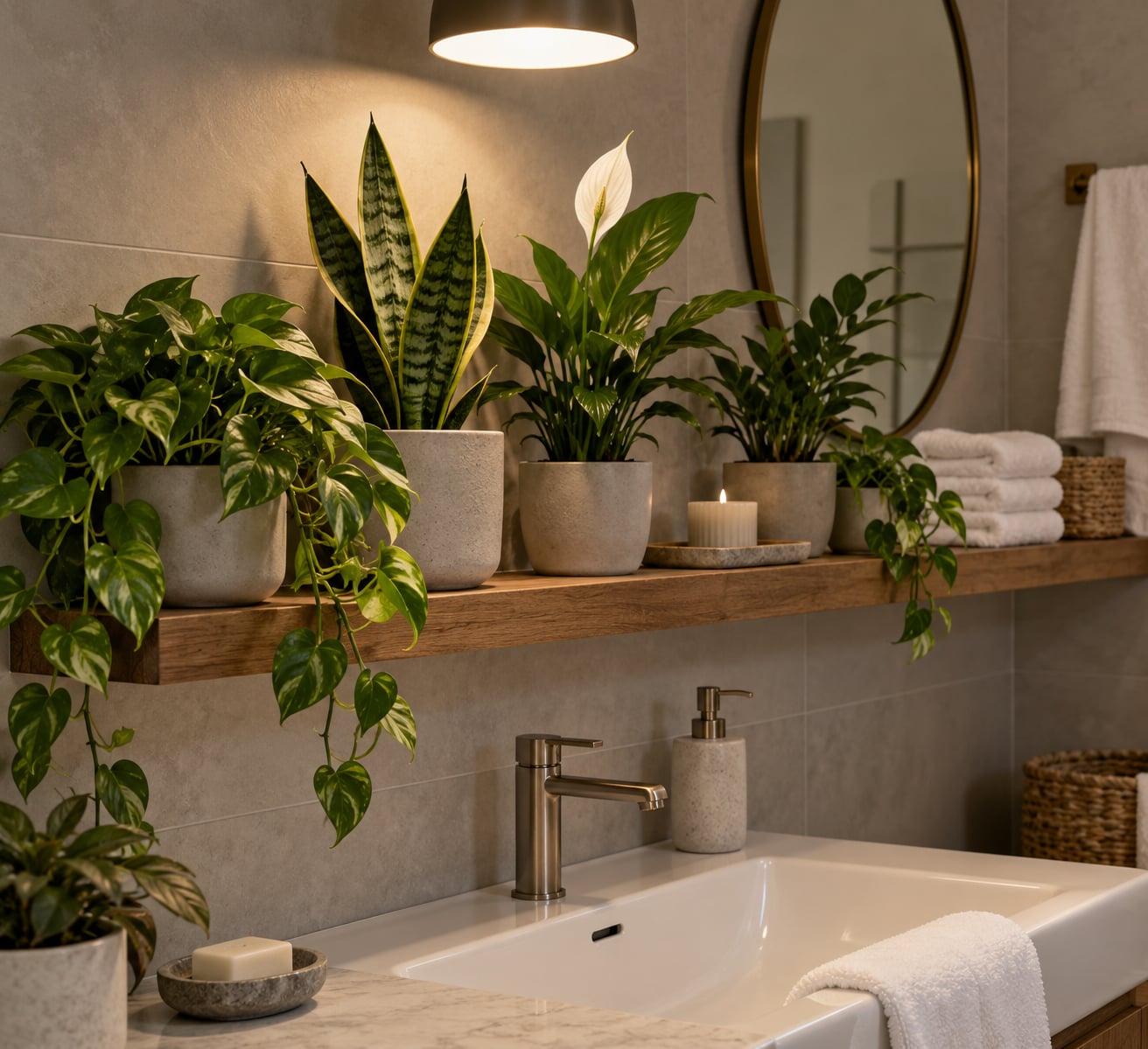
No plant survives absolute zero light, but the best plants for a bathroom with no window do very well on 8 to 12 hours of artificial light a day. The ZZ plant, snake plant, pothos, spider plant, peace lily, cast iron plant and Chinese evergreen all photosynthesize happily under a bulb, and shower steam covers the humidity side of the equation.
The catch is watering. A dark bathroom dries far more slowly than a lit living room, so plants kept there rot from overwatering long before they run out of light. That single fact should shape every choice you make below.
This list covers interior baths, basement bathrooms, dark hallway powder rooms and windowless ensuites, ordered by how forgiving each plant is when you get the light and water wrong. Botanical names are given so you can search for the right thing at a nursery, and I’ve flagged pet toxicity for every entry, because bathrooms are shared rooms.
Table of Contents
- Best Plants for a Bathroom With No Window at a Glance
- 1. ZZ Plant for a Windowless Bathroom
- Growing a ZZ plant in a room with no daylight
- 2. Snake Plant for a Bathroom With No Window
- 3. Pothos for Humid, Low-Light Spaces
- 4. Spider Plant for a Bathroom Without Natural Light
- 5. Peace Lily for a Shady Bathroom
- 6. Boston Fern for a Humid Bathroom
- 7. Chinese Evergreen for a Dim Bathroom
- 8. Cast Iron Plant for a Low-Light Bathroom
- 9. Aluminum Plant for Tropical Bathroom Conditions
- 10. Moth Orchid for an Elegant Bathroom Display
- Frequently Asked Questions
- Can plants really grow in a bathroom with no window?
- How much artificial light do bathroom plants need?
- Should I mist plants in a bathroom?
- What plants are safest for a bathroom with pets?
- How often should I water plants in a bathroom without natural light?
- Conclusion
Best Plants for a Bathroom With No Window at a Glance
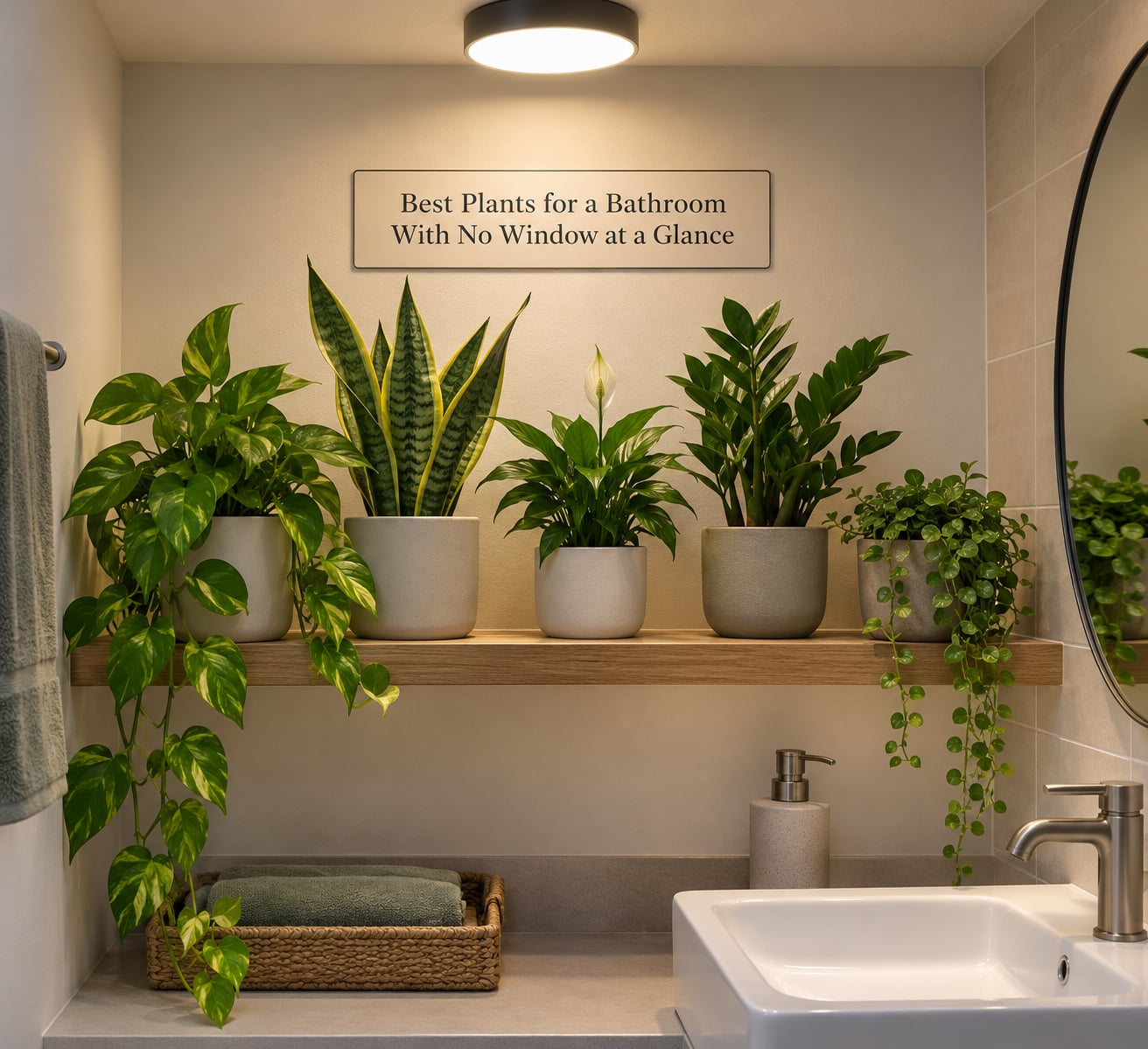
| Plant | Light tolerance | Humidity | Mature size | Care level | Best spot |
|---|---|---|---|---|---|
| ZZ plant | Low to medium | Prefers moderate | 2 to 3 ft indoors | Very easy | Dark corner or shelf |
| Snake plant | Low to medium | Tolerant | 1 to 4 ft | Very easy | Doorway or basin |
| Pothos | Low to medium | Happy | Trailing or climbing | Easy | High shelf or hanging |
| Spider plant | Low to medium | Prefers higher | 10 to 12 in, arching | Easy | Vanity edge or hook |
| Peace lily | Low to medium | Happy | 1 to 2 ft | Moderate | Shower-adjacent shelf |
| Boston fern | Low to medium | Needs high | 12 to 24 in | Moderate | Beside the shower |
| Chinese evergreen | Low to medium | Prefers moderate | 1 to 3 ft | Easy | Small vanity shelf |
| Cast iron plant | Low | Moderate | 2 to 3 ft | Hardy | Floor planter |
| Aluminum plant | Medium indirect | Prefers high | 1 to 2 ft | Moderate | Countertop |
| Moth orchid | Bright artificial | Prefers moderate | 1 to 2 ft with spike | Moderate | Focal display |
The single most useful column here is the first one. Everything marked low to medium will hold steady growth under a bathroom bulb, which rules out the big tropical foliage plants that need real daylight.
1. ZZ Plant for a Windowless Bathroom
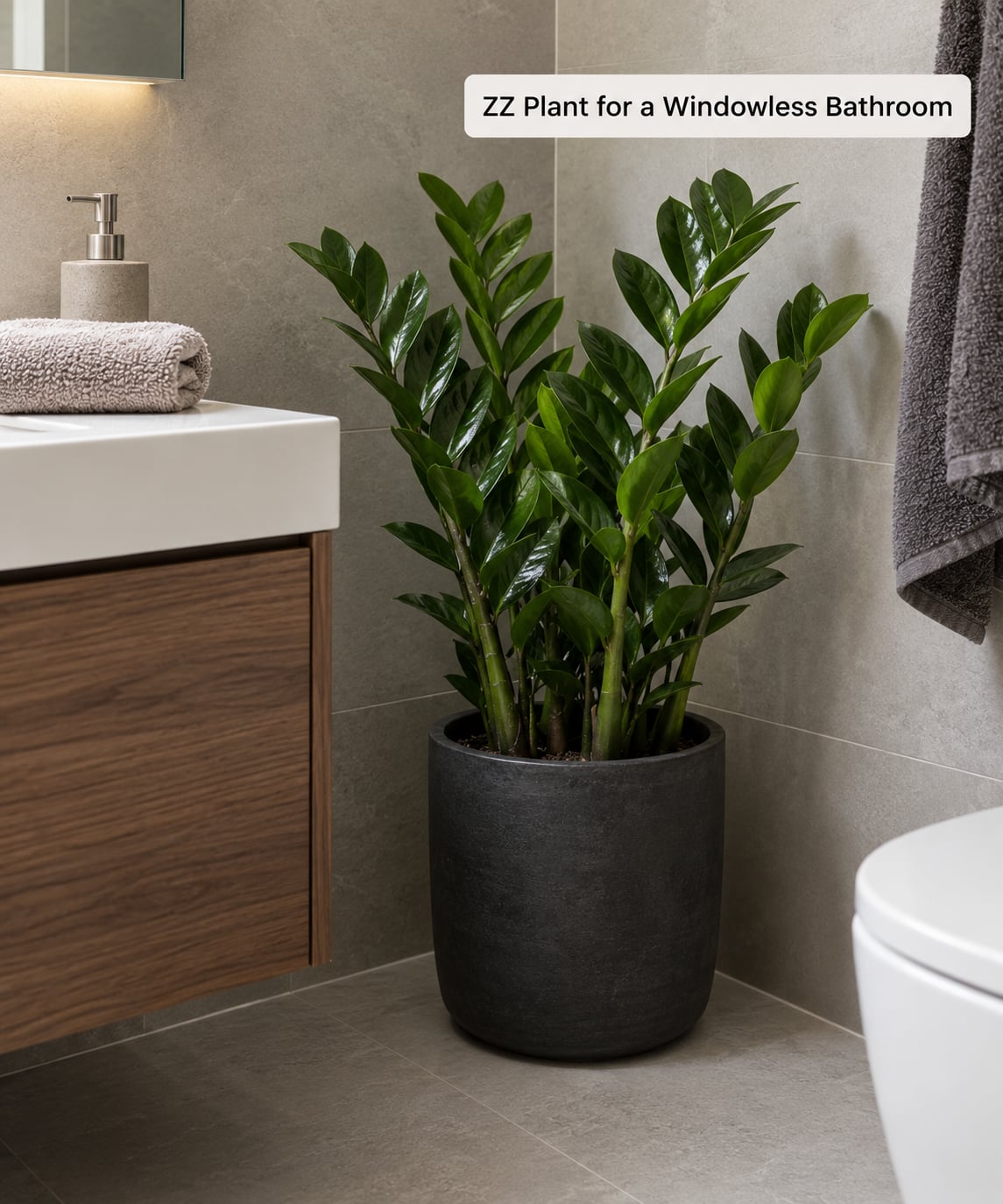
The ZZ plant (Zamioculcas zamiifolia) is the plant people recommend first, and the reason is simple: it stores water in thick underground rhizomes and treats a missed watering as a non-event. It also slows its own growth in low light, which means it rarely stretches toward a bulb and rarely drops leaves.
Its leaves are compound and glossy, each stem carrying paired leaflets along a central rachis, so it reads as a full plant on a shelf even when it is only 18 inches tall. That makes it a good pick for the awkward spot behind a door or above a toilet where a trailing plant would look cramped.
Growing a ZZ plant in a room with no daylight
Water only when the top two inches of mix are dry, which in a dark bathroom might be every three weeks in winter and every ten days in summer. Let the pot drain fully between waterings; a pot sitting in a saucer of water is the fastest route to root rot. Wipe the leaves every couple of months, since dust blocks a meaningful share of the available light in a dim room.
One honest warning: every part of the ZZ plant is toxic to cats and dogs if chewed, and the calcium oxalate crystals cause painful mouth irritation. Put it on a high shelf rather than the floor if a cat shares the room.
2. Snake Plant for a Bathroom With No Window
The snake plant (Dracaena trifasciata, formerly Sansevieria trifasciata) is the most cited plant on bathroom plant forums, and the reports go back years rather than weeks. A comment on an r/IndoorGarden thread asked which plants could handle hot showers and no sunlight at all, and the top answer named ZZ plants and snake plants together, with the suggestion to swap the bathroom bulb for a full-spectrum LED.
Its upright, sword-shaped leaves make it the best space-economiser in this list. In a narrow powder room where floor space is a few square feet, vertical leaves use the volume that a round bushy plant wastes. It tolerates drought, irregular routines and warm, damp air without complaint.
Water it roughly every two to three weeks, less in a dark bathroom, and let the mix dry out completely. It sulks far more easily from wet feet than from neglect. A pot without drainage holes is the single most common killer, since water sits at the roots with nowhere to go.
It is mildly toxic to pets, mostly in the way that any plant causing mouth drooling is unpleasant. If you want a genuinely non-toxic upright plant, the cast iron plant at number eight fills the same role.
3. Pothos for Humid, Low-Light Spaces
Pothos (Epipremnum aureum) grows in almost any indoor condition you can name, and a bathroom is one of the easier ones. It vines rather than stands, so it earns its space by using vertical room, and it comes in varieties with different mature sizes, which matters in a bathroom where a full-size vine will hit the ceiling.
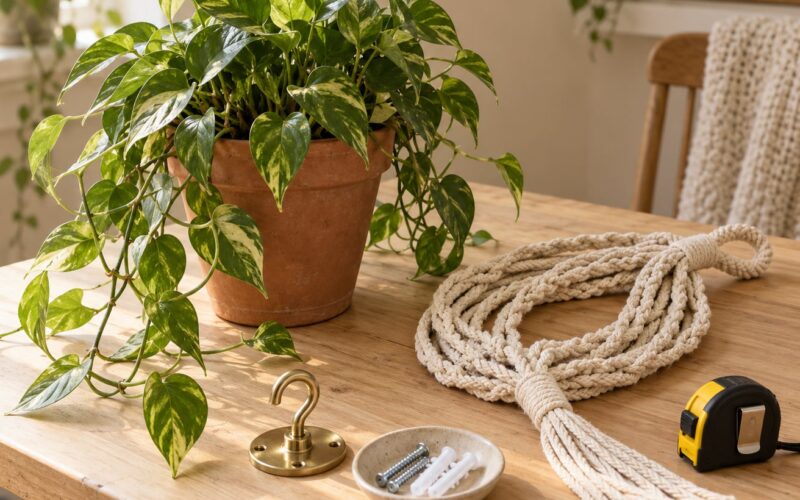
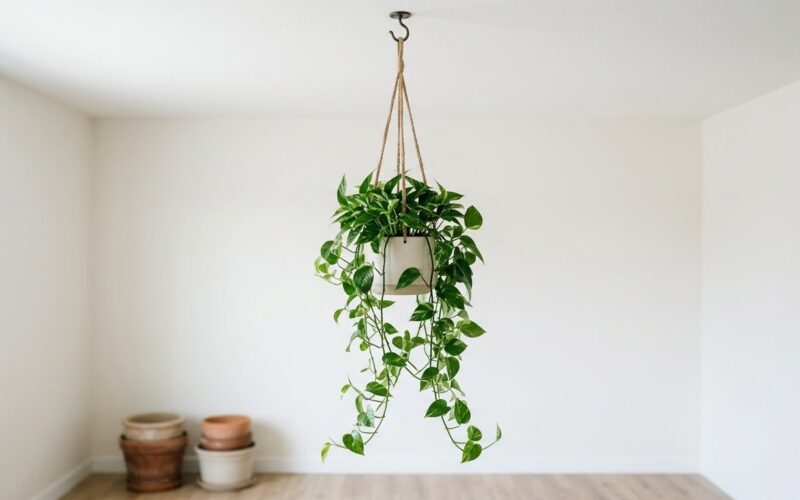
Pick a compact cultivar for a shelf or small pot: golden pothos ‘Neon’ stays small and bright, ‘Marble Queen’ and ‘Pearls and Jade’ hold a tighter, slower habit. ‘Jade’ is the big variety, so treat it as a floor specimen rather than a vanity plant. Trailing pothos in a hanging planter off a macrame cord is the classic bathroom look, and it works in a room with no window because the vine trails regardless of light direction.
Water when the potting mix surface is dry to the touch, which again takes longer than you would guess in the dark. Peat-based mix with perlite or bark drains freely and dries more predictably than a heavy soil, and that matters more here than in a sunny room. Train the vine along a wall with a few removable clips and it will fill the corner instead of the counter.
Pothos contains insoluble calcium oxalates and is toxic to cats and dogs if chewed.
4. Spider Plant for a Bathroom Without Natural Light
The spider plant (Chlorophytum comosum) is the answer on most gardening forums when someone asks for the lowest-maintenance option, and it adapts to artificial light faster than most people expect. Its arching, striped leaves look decorative from every angle, and it stays compact enough for a countertop at around 10 to 12 inches.
It is also the cheapest plant here to multiply. The little plantlets that dangle from long stems root in water on a windowsill in about a week, which makes a good bathroom propagation station in a jar on the shelf. Forum members frequently report spider plants doing well in windowless rooms after a few months of adjusting to the artificial light.
Brown tips are the usual complaint, and they are a water problem rather than a light problem. Fluoride and dissolved minerals in hard tap water build up at the leaf tips. Switch to filtered, distilled or left-out overnight water and the new growth comes in clean.
This is one of the few genuinely non-toxic picks in the list, which makes it a sensible default when cats or small children are in the house.
5. Peace Lily for a Shady Bathroom
The peace lily (Spathiphyllum wallisii) wants consistent moisture, so it behaves differently from the drought-tolerant plants above it. In return it gives you white flowers on a schedule, which nothing else on this list does in a dark room. It sits happily in low to medium indirect light and appreciates the humidity a bathroom provides.
It also tells you when it is thirsty with an unmistakable signal: the leaves droop dramatically, then stand back up within hours of watering. That predictability is why it does well with beginners, even though it will sulk if you let it dry out completely week after week.
Keep the mix evenly moist but never waterlogged, and empty any cachepot or saucer after watering so the roots sit in air rather than water. Yellowing lower leaves usually mean saturated soil, so cut back the interval rather than adding more water.
Despite the common belief, peace lilies are not lilies, but they do contain calcium oxalate crystals and are toxic to cats and dogs. Place them on a shelf above nose level.
6. Boston Fern for a Humid Bathroom
The Boston fern (Nephrolepis exaltata) is the humidity specialist of this list. If your shower runs often and the room genuinely steams up, this is the plant that rewards it most, with fronds that stay deep green and arching instead of browning at the edges.
It wants evenly moist soil, indirect light and regular attention. Think of it as the peace lily’s foliage cousin with higher humidity needs and no interest in drying out. Misting is optional rather than essential, since it raises humidity around the leaves briefly; a small humidifier or a grouping with other plants has a steadier effect.
Trim the fronds when they yellow or fray, and remove dead material from the soil surface. Ferns rot at the crown in cold, wet conditions, so never leave the pot standing in a saucer and never use a pot without a drainage hole. Repot every year or two in a loose, peat-based mix with plenty of drainage, and give it a little more room than you think it needs.
It is non-toxic to pets, another point in its favour for a shared room.
7. Chinese Evergreen for a Dim Bathroom
The Chinese evergreen (Aglaonema) combines the two things a bathroom offers in abundance: low light tolerance and a liking for humid air. Modern cultivars come in red, pink, cream and deep green, with silvered patterns that hold their colour even away from a window, which is unusual for a variegated foliage plant.
Compact varieties such as ‘Silver Bay’ and ‘Suksun’ stay at 12 to 18 inches and look right on a small vanity shelf or a floating cabinet. Larger red cultivars like ‘Red Valentine’ stretch past 24 inches and need a floor or a stand rather than a shelf.
Care is straightforward: water when the top inch or so dries, use a well-drained mix, and wipe the leaves to keep them glossy and clear for the available light. Very low light will slow growth, and a plant in deep shade stays compact rather than reaching.
Like pothos, it contains calcium oxalate crystals, so keep it out of reach of pets and small children.
8. Cast Iron Plant for a Low-Light Bathroom
The cast iron plant (Aspidistra elatior) is the tough one. It tolerates dim conditions, warm rooms, neglect and irregular watering better than almost anything else sold as a houseplant, which is exactly why it earns a spot in the darkest corners of a bathroom.
Its long, dark green, lance-shaped leaves on individual stalks give it an architectural look that suits a floor planter beside a freestanding tub or a dark hallway corner. It grows slowly, so a mature plant at two to three feet is a long-term project rather than something you will re-pot every year.
The risk with the cast iron plant is the same as with the ZZ plant: it survives neglect, so people keep watering it on schedule long after the soil has turned sour. In a dark bathroom, check the mix with a finger before every watering rather than following a calendar. Wipe the leaves monthly; dust on a broad leaf meaningfully cuts the light a plant can capture in a dim room.
It is non-toxic, which makes it a good floor-level choice in a bathroom where pets and children are around.
9. Aluminum Plant for Tropical Bathroom Conditions
The aluminum plant (Pilea cadieri) is the most decorative option on the list. Its leaves are oval and covered in silver patches that look almost painted on, and it is happiest in exactly the conditions a bathroom creates: warmth, humidity and no direct sun.
It does need the brightest corner you can give it. Bright indirect light keeps the silver markings strong; a very dark corner will fade them and slow growth. Set it on a vanity near the fixture rather than on the far floor. If your bathroom only has one dim ceiling light, a small clamp-on grow light aimed at the plant for 10 hours a day makes a visible difference within a couple of months.
One detail that catches people out: use room-temperature water for the roots. Pilea dislikes cold water poured straight onto the root ball, and a habit of rinsing a watering can in cold tap water before using it in the bathroom is enough to cause a reaction. Let the tap run for a minute first.
The aluminum plant is mildly toxic to pets and children, so keep it on a counter rather than a low ledge.
10. Moth Orchid for an Elegant Bathroom Display
The moth orchid (Phalaenopsis) is the one entry on this list that will genuinely flower in a windowless bathroom, provided you give it the most artificial light available. It needs several hours of bright light every day, more than the foliage plants above, so it belongs directly under a lamp or beside a vanity fixture that stays on.
Set it in a clear pot or a cachepot with drainage, never in a decorative planter without an exit for water. Bark-based orchid mix dries unevenly and waterlogged crown rot is the standard failure. Water by running water through the pot until it drains freely, then let it soak in the sink for a minute before it goes back on the shelf.
Flowering and routine watering are two separate jobs. During bloom, keep the same even-watering rhythm as a foliage plant. Between flowers, back off slightly, because the orchid slows down and holds its roots more tightly to the bark. It typically reflowers on its own schedule once the plant is established and mature, with no forcing required.
Frequently Asked Questions
Can plants really grow in a bathroom with no window?
Yes, as long as there is usable artificial light. Plants photosynthesize from any light strong enough, not sunlight specifically, so a bathroom ceiling fixture or vanity bulb left on 8 to 12 hours a day supports steady growth for resilient low-light species. In a room with no light source at all, no plant survives indefinitely. The workaround many readers use is rotating plants out to a brighter room for a few weeks at a time.
How much artificial light do bathroom plants need?
Plan on 8 to 12 hours of light per day. The cheapest upgrade is swapping the existing bulb for a full-spectrum LED, which many forum users recommend over buying a separate fixture. If you go further and add a grow light, a small clamp-on lamp roughly 12 to 24 inches above the leaves on a timer works well. More hours help compact foliage plants far more than extra brightness does.
Should I mist plants in a bathroom?
Only when the room itself is dry. If your shower steams up the space, misting adds nothing because humidity is already high, and wet leaves sitting in still, damp air invite fungal problems. In a bathroom without a shower, or one used rarely, a light misting or a small humidifier genuinely helps humidity-loving plants like Boston fern and peace lily. Skip misting moth orchids, which are prone to crown rot.
What plants are safest for a bathroom with pets?
The non-toxic options in this list are the spider plant, Boston fern and cast iron plant. These are the three to choose if a cat or dog can reach the pot. Snake plant, ZZ plant, pothos, peace lily, Chinese evergreen, aluminum plant and moth orchid all contain calcium oxalate crystals, which cause painful mouth irritation if chewed. Place those on high shelves out of reach rather than on the floor.
How often should I water plants in a bathroom without natural light?
Less often than in a lit room, and never on a fixed schedule. Put a finger into the top inch or two of the potting mix and water only when it feels dry. Low light slows evaporation, so the same soil stays wet far longer and calendar-based watering is the main cause of root rot. Always use a pot with a drainage hole and empty the saucer or cachepot afterwards.
Conclusion
Start with what your bathroom actually offers. A dim room that gets an hour or two of evening light will support a ZZ plant, a snake plant or a pothos, all of which forgive mistakes. A bathroom with a steadily lit vanity can handle an aluminum plant or a moth orchid that will flower. A steamy shower room opens up Boston ferns and peace lilies, which want that humidity more than they want light.
Pick the best plants for a bathroom with no window by matching your light hours, your humidity and your shelf space to the list above, then water by touch rather than by calendar. Replace the bulb with a full-spectrum LED before you buy anything else. It costs less than a plant and it is the change that decides whether the whole shelf works.