Snake plant, ZZ plant, pothos, cast iron plant, Chinese evergreen and spider plant are the ones that genuinely hold up in a dim room for years. Everything else advertised as a low light houseplant usually needs a north-facing window at minimum, and most die within a year. The difference comes down to light, not water: low light slows photosynthesis, so plants drink far more slowly than they do in a sunny room.
That single fact changes everything about how you care for them. Watering on a schedule is what kills low light houseplants, not the darkness itself. Get the watering right and a dim corner can hold a plant for a decade.
Before buying anything, it helps to know how dark “low light” actually is in your home. A north-facing window, an interior room six feet from glass, and a windowless basement hallway are three very different situations, and plants that handle one will fail in another.
Table of Contents
- Low Light Houseplants That Actually Tolerate Low Light at a Glance
- 1. Snake Plant (Sansevieria)
- Why snake plant is the benchmark low light houseplant
- 2. ZZ Plant (Zamioculcas zamiifolia)
- 3. Pothos (Epipremnum aureum)
- 4. Peace Lily (Spathiphyllum)
- 5. Chinese Evergreen (Aglaonema)
- 6. Rubber Plant (Ficus elastica)
- 7. Bird’s Nest Fern (Asplenium nidus)
- 8. Spider Plant (Chlorophytum comosum)
- 9. Cast Iron Plant (Aspidistra elatior)
- 10. Maidenhair Fern (Adiantum)
- Frequently Asked Questions
- What does low light mean for houseplants?
- Can low light houseplants grow without a window?
- How often should I water plants in low light?
- What is the best low light houseplant for a bathroom?
- Are low light houseplants safe for cats and dogs?
- How do I know if my plant is getting too little light?
- What to Do First
Low Light Houseplants That Actually Tolerate Low Light at a Glance
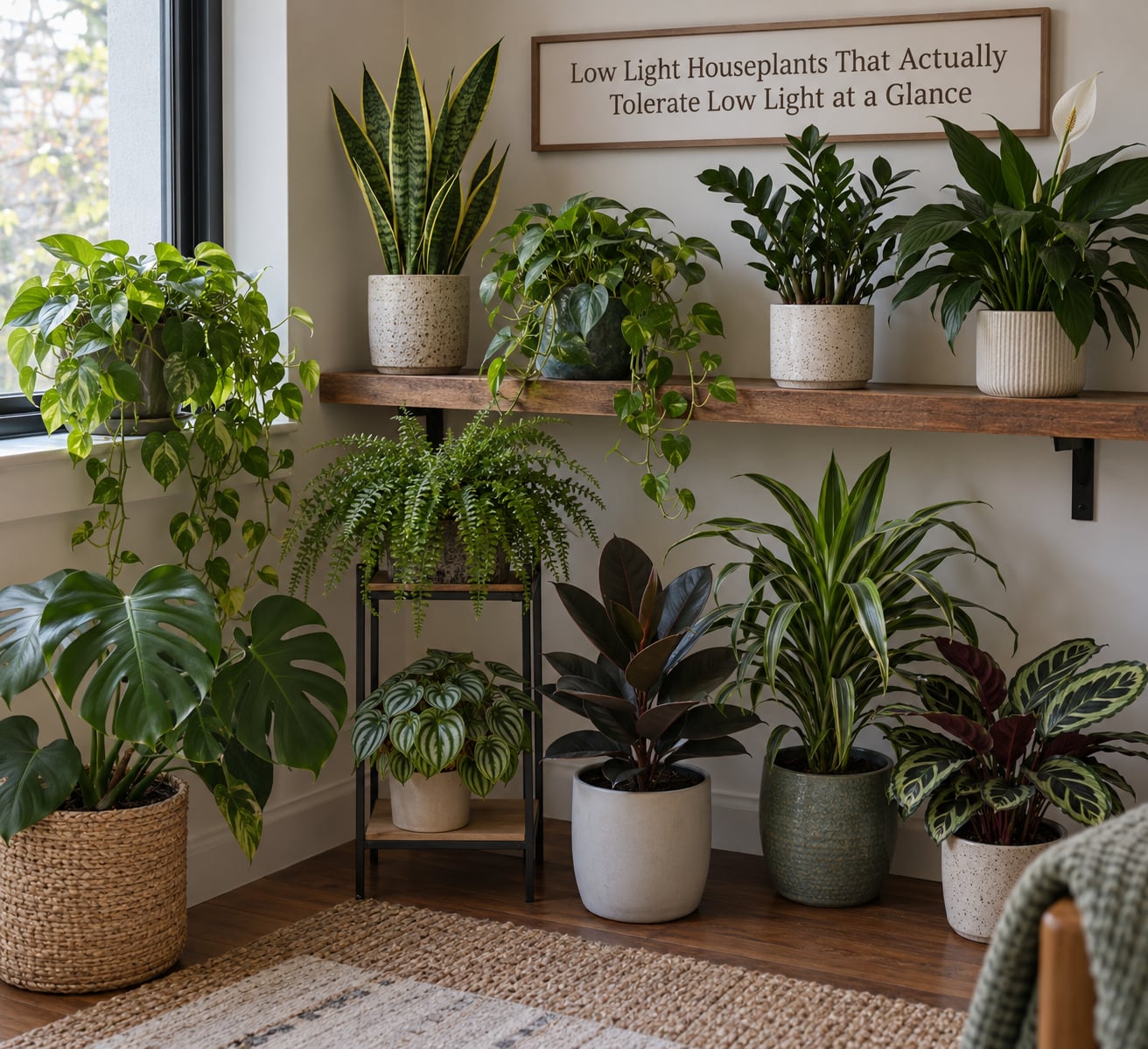
This is the fastest way to narrow the field. Light tolerance tells you how dark the spot can be, watering tells you how often you will touch the soil, and pet safety tells you whether the plant can go on a low shelf where a cat can reach it.
| Plant | Light tolerance | Watering | Pet safe | Best room placement |
|---|---|---|---|---|
| Snake plant | Low to very low | Every 2 to 3 weeks | Toxic | Hallway, dim bedroom corner |
| ZZ plant | Low to very low | Every 2 to 3 weeks | Toxic | Office, shelf away from window |
| Pothos | Low, prefers medium | Every 1 to 2 weeks | Toxic | Trailing from a high shelf |
| Peace lily | Low to medium | Weekly, consistently moist | Toxic | Bathroom, bedside table |
| Chinese evergreen | Low to medium | Every 1 to 2 weeks | Toxic | Desk, bookcase, dim corner |
| Rubber plant | Medium, tolerates low | Every 1 to 2 weeks | Toxic | Brightest corner of a dim room |
| Bird’s nest fern | Low to medium | Twice weekly, moist | Non-toxic | Bathroom, humid hallway |
| Spider plant | Low to medium | Every 1 to 2 weeks | Non-toxic | Hanging near a window |
| Cast iron plant | Very low to none | Every 2 to 4 weeks | Non-toxic | Windowless room, basement |
| Maidenhair fern | Low, needs humidity | 2 to 3 times weekly | Non-toxic | Bathroom with a window |
Only four of these ten are non-toxic to cats and dogs, so placement matters if you have pets. The cast iron plant, spider plant, bird’s nest fern and maidenhair fern are the safe ones.
1. Snake Plant (Sansevieria)
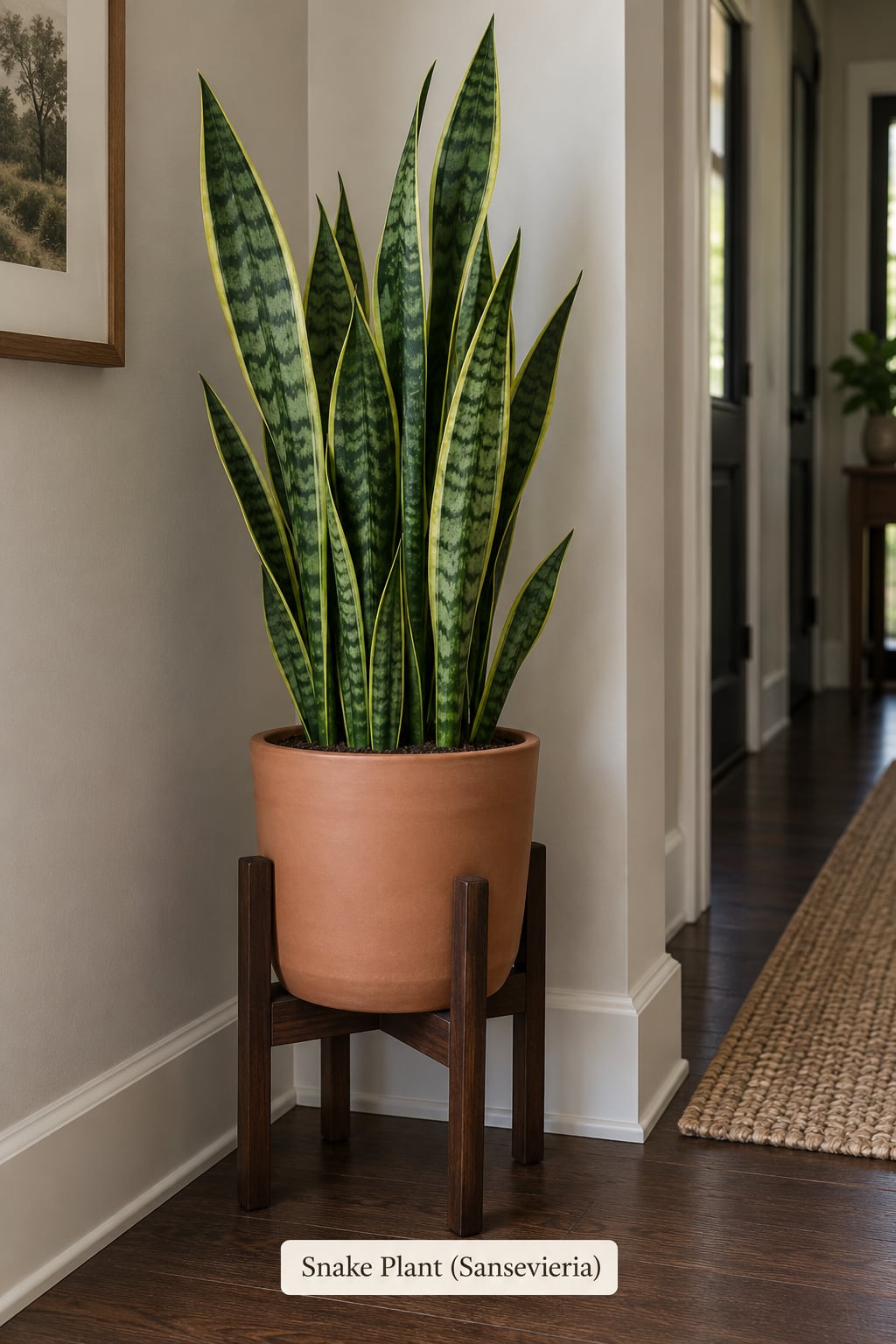
Snake plant is the benchmark. It handles indirect light, tolerates being forgotten for weeks, and keeps its upright form in conditions that would stretch most other foliage plants within a season.
The leaves are thick and waxy, storing water the way the ZZ plant’s rhizomes do. In practice that means you water it when the soil is dry all the way down, which in a dim room is often every two or three weeks. Less is definitely more here. A snake plant sitting in wet soil will rot at the base, and that rot moves fast.
Why snake plant is the benchmark low light houseplant
It also moves well. Gardeners regularly report shifting one between rooms without stress, which makes it the easiest plant to reposition as the seasons change and the light in a room shifts with them.
Look for the varieties with yellow-edged blades, sold as Laurentii, or the plain green trifasciata type. Both do the same job indoors. One warning: it is mildly toxic to cats and dogs, so a floor-level corner or a high shelf is better than a spot beside a favourite chair.
2. ZZ Plant (Zamioculcas zamiifolia)
The ZZ plant tolerates low light about as well as anything sold for indoor use, and its glossy leaflets stay attractive without any direct sun at all.
Underground rhizomes hold the water, which is why the plant shrugs off missed watering but collapses quickly in soil that stays wet. This is the single most common way ZZ plants die: a pot on a shelf with no drainage hole, watered on a Sunday schedule forever.
Growth is seasonal. You will see little or nothing for weeks, then a shoot that unrolls quickly. That is normal, not a sign the plant is unhappy. Give it the brightest spot in a dim room and it will do more of this, and it needs almost no fertilizer at all.
3. Pothos (Epipremnum aureum)
Pothos grows in dim indoor spaces easily, which is why it turns up in offices lit by fluorescent tubes and in corners nobody looks at. It trails, which makes it the best low light option for a high shelf or a hanging planter where floor space is tight.
That said, pothos prefers bright indirect light and merely tolerates low light. In a genuinely dark corner the leaves come in smaller, the stems stretch between nodes, and variegated forms fade back toward solid green. Those are signs of etiolation, and they do not reverse.
Propagation is the easiest of any plant on this list. Cut a stem below a node, put it in water until roots appear, then pot it in soil. Within a season one plant becomes five. Note that every part of it is toxic to pets and children if chewed, and the sap can irritate skin.
4. Peace Lily (Spathiphyllum)
Peace lily genuinely handles low light, and it is the only flowering plant on this list that will push out blooms in a dim room. It needs consistently moist soil, though, which is the opposite of the snake plant and ZZ plant approach.
Its wilt-and-recover behaviour makes it beginner friendly. When it is thirsty the leaves droop dramatically, and a thorough drink brings them back within a few hours. That visible signal is why so many people succeed with it where they fail with quieter plants.
Flowering needs a little more light than survival does. In a very dark corner expect green leaves and no blooms. Peace lily is mildly toxic, so keep it off a low surface in a home with pets.
5. Chinese Evergreen (Aglaonema)
Chinese evergreen is a compact foliage plant built for dim corners, with patterned varieties that hold their colour without direct sun as long as the light is at least indirect.
Most houseplant trouble here traces back to tap water, and this plant is no exception. A few crystals of yellowing leaf edges usually mean fluoride and salts are building up. Filtered or rainwater fixes it. It also likes average household humidity, so a bathroom or a grouped arrangement with other plants suits it better than a dry, draughty hallway.
Watch for the highly variegated cultivars, the white and pink ones. They need more light than the plain green or red forms to keep their pattern, and in deep shade the colour fades. Toxic to cats and dogs if chewed.
6. Rubber Plant (Ficus elastica)
The rubber plant can handle lower light than most people expect, as long as “lower” still means bright indirect light. It wants to be as close to a window as a tolerating plant can get, and it will hold its glossy leaves there for years.
Its real weakness is temperature, not light. An open doorway, a draughty sill or an air conditioning vent can drop leaves fast. Keep it away from those, keep it in one spot rather than rotating it weekly, and water when the top few centimetres are dry.
It grows into a tall statement plant, so it works best on the floor in the brightest corner of an otherwise dim room. Toxic if chewed, and it can weep irritating latex when cut or repotted.
7. Bird’s Nest Fern (Asplenium nidus)
Bird’s nest fern is a real low light option, but only if you hold up the humidity side of the deal. It grows as a rosette of broad fronds and does well in a bathroom or any room with regular moisture in the air.
Unlike most plants on this list, it never wants to dry out. Water it twice a week in summer, keep the soil evenly damp, and mist or group it with other plants to raise humidity around it. Dry air is what browns the frond edges, even when the soil is fine.
There is one real trap: no fluoride and no salt. Its leaves react to the same hard tap water as Chinese evergreen, and a browned frond will not recover. Use filtered water if you have hard water. It is non-toxic, which makes it a good choice in a pet household.
8. Spider Plant (Chlorophytum comosum)
Spider plant is one of the easiest low light houseplants to keep, and it is genuinely pet friendly, which almost nothing else on this list is. The arching leaves throw plantlets on long stems, and it is not unusual to get three or four free plants within a year.
It prefers indirect light. Directly behind glass in strong sun the leaves scorch and turn brown, and a spot far from any window gives you small, pale leaves. A shelf near a window but out of the beam suits it.
Dry soil and hard water are the two complaints that come up most. Brown tips usually mean dry air or a buildup of salts in the pot. Water less frequently but more thoroughly, and the plant recovers on its own. Its own plantlets can be left attached or potted separately once they have roots.
9. Cast Iron Plant (Aspidistra elatior)
The cast iron plant is the hardestiest low light houseplant there is, and it is the answer to the room with no window. Gardeners regularly report keeping one alive for years in a windowless basement or hallway, watered rarely.
That reputation is earned. The thick, dark green leaves shrug off temperature swings, drafts, dust, missed waterings and general neglect. It will not grow fast, and it is not going to produce a showy display. It just stays green, quietly, in the darkest corner of a home.
Two practical notes. It is non-toxic, so a floor corner beside a cat’s bed is fine. And expect slow growth: a plant that looks exactly the same for three months may be perfectly healthy. New leaves emerge on a rolled spike from the base, and that is the only reliable sign of progress.
10. Maidenhair Fern (Adiantum)
Maidenhair fern belongs on this list with conditions attached. It is a genuine low light plant that needs filtered light, consistently moist soil and humidity above what most living rooms offer, and it declines quickly when any of the three slip.
It has thin, dark stems and delicate fan-shaped leaflets, and it reacts fast to drying out. Water it two or three times a week rather than on a schedule, and never let the surface go fully dry for long. Misting helps, though a humidifier or a bathroom placement works far better than spraying the leaves.
Use filtered or rainwater. Hard water browns the tips within weeks. If you can offer steady moisture and decent humidity, it is one of the few plants that will actually prefer shade over sun and keep producing new fronds there. It is non-toxic to pets.
Frequently Asked Questions
What does low light mean for houseplants?
Low light means indirect light with no direct sun on the plant, such as a north-facing window, a spot several feet back from a south window behind a sheer curtain, or an interior room lit by a lamp. Practically, you should be able to read a book in the spot during the day without turning lights on. Below roughly 100 foot-candles most tropical foliage plants stop producing new growth, though the ten plants here hold their foliage well under that.
Can low light houseplants grow without a window?
Yes, but only a few. The cast iron plant is the reliable choice for a genuinely windowless room and is widely kept alive for years in basements and hallways. Snake plant, ZZ plant and Chinese evergreen will also hold on for a long time. If you want actual new growth rather than surviving foliage, add a full-spectrum LED grow light on a timer for 10 to 12 hours a day and the range of plants you can grow opens right up.
How often should I water plants in low light?
Far less often than in a bright room, because low light slows photosynthesis and the plant uses water slowly. Water based on soil dryness rather than a schedule: push a finger two or three centimetres into the pot and water only when it feels dry. For snake plant, ZZ plant and cast iron plant that is often every two to four weeks. Ferns and peace lily are the opposite and want moisture at all times.
What is the best low light houseplant for a bathroom?
For a bathroom with no window, the cast iron plant is the most forgiving choice, though a ZZ plant also works well and looks tidier on a shelf. If the bathroom does have frosted glass or a small window, a bird’s nest fern or maidenhair fern will do better than most plants because the regular humidity suits them. Spider plant is another safe option and handles the temperature swings common in bathrooms.
Are low light houseplants safe for cats and dogs?
Only some of them. Cast iron plant, spider plant, bird’s nest fern and maidenhair fern are non-toxic. The rest on this list, including snake plant, ZZ plant, pothos, peace lily, Chinese evergreen and rubber plant, are all mildly to moderately toxic if chewed, mostly causing mouth irritation, drooling and vomiting rather than anything more serious. If your cat treats plants as toys, put the toxic ones up on a high shelf.
How do I know if my plant is getting too little light?
Look for stretched stems with long bare gaps between the leaves, new growth that stays small and pale, and leaves leaning hard toward the nearest window. Variegated plants go one step further: their patterns fade back to solid green, and that loss does not reverse once the light improves. Moving the plant closer to the window or adding a grow light is the only fix, because a plant cannot stretch its way back to a compact shape.
What to Do First
Start by measuring the spot rather than the plant (these notes were checked for 2026). If you can read comfortably there without a lamp, low light houseplants from this list will settle in and mostly look after themselves. If you cannot, add a grow light before you buy anything.
Then pick one plant, put it in a pot with drainage holes, and learn its watering rhythm before you add a second. Snake plant, ZZ plant and cast iron plant cover almost every dim corner in a home, and all three want to be left alone far more than beginners expect.