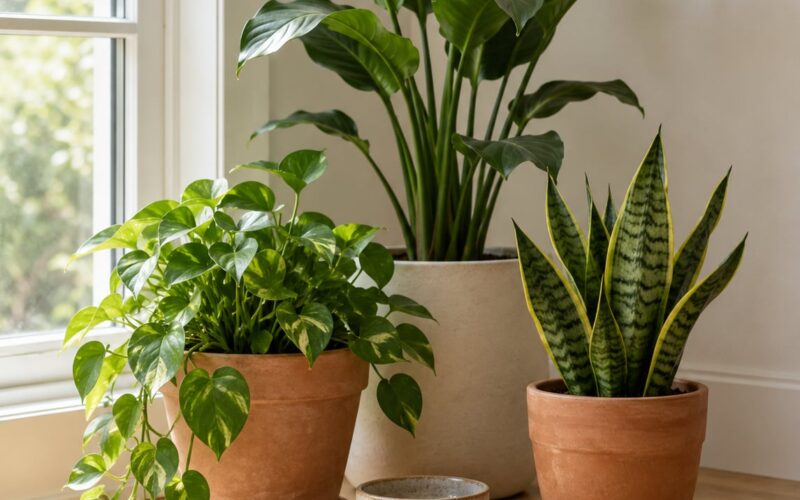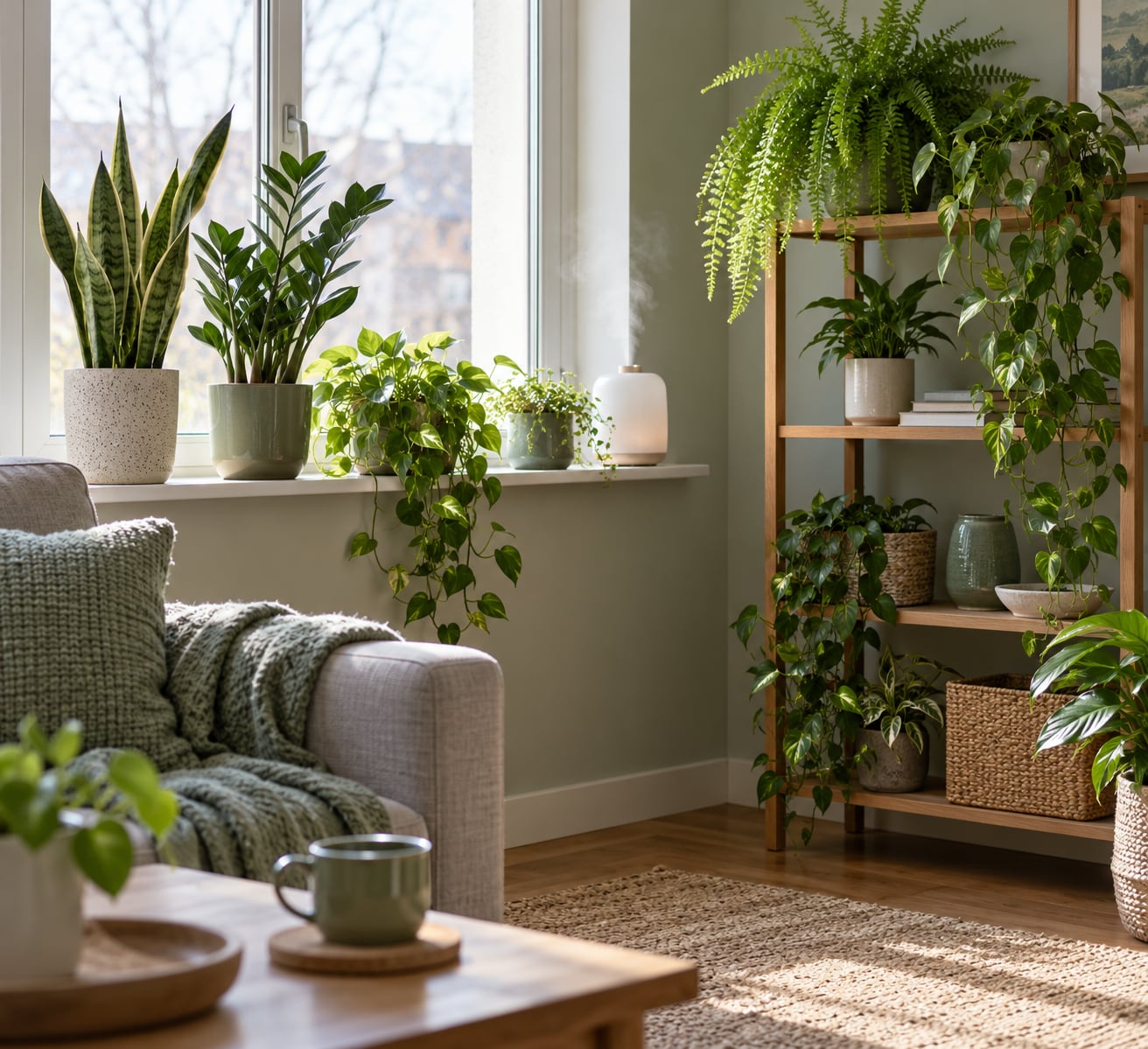
A north-facing window gets bright, diffuse light all day but almost no direct sun, so the best plants for a north facing window are shade-tolerant understorey species: snake plant, ZZ plant, peace lily, pothos, spider plant, ferns, aglaonema, philodendron, aspidistra and Boston fern. Swap in anything that wants full sun or heavy bloom and you will get stretched stems and pale leaves instead.
The trick most guides skip is that “north-facing” is not one condition. A large unobstructed window in a Victorian front room is a genuinely bright spot; a small window behind a neighbouring block in a basement flat is close to useless for most foliage. This guide sorts the plants by how little light they will put up with, tells you how far to sit them from the glass, and flags which ones are safe around cats.
I keep a north-facing sill and a shelf about four feet back from it, and those two spots get completely different plants. The sill gets the ferns and the peace lily; the shelf across the room gets the ZZ plant and aspidistra, which are the only two things that have looked good there for more than a year.
Table of Contents
- Best Plants for a North Facing Window at a Glance
- Is your north window bright, dim or dark?
- 1. Snake Plant for a North Facing Window
- 2. ZZ Plant for a North Facing Window
- 3. Peace Lily for a North Facing Window
- 4. Pothos for a North Facing Window
- 5. Spider Plant for a North Facing Window
- 6. Fern for a North Facing Window
- Which ferns need the most light in a north facing window?
- 7. Aglaonema for a North Facing Window
- 8. Philodendron for a North Facing Window
- 9. Aspidistra for a North Facing Window
- 10. Boston Fern for a North Facing Window
- Frequently Asked Questions
- Should plants be in a north-facing window?
- What kind of light do north-facing windows get?
- How far from the window should a low light plant be?
- Which plants are safe for a home with cats?
- Which plants will not bloom in a north-facing window?
- What plants are good for a north-facing window box outdoors?
- Conclusion
Best Plants for a North Facing Window at a Glance
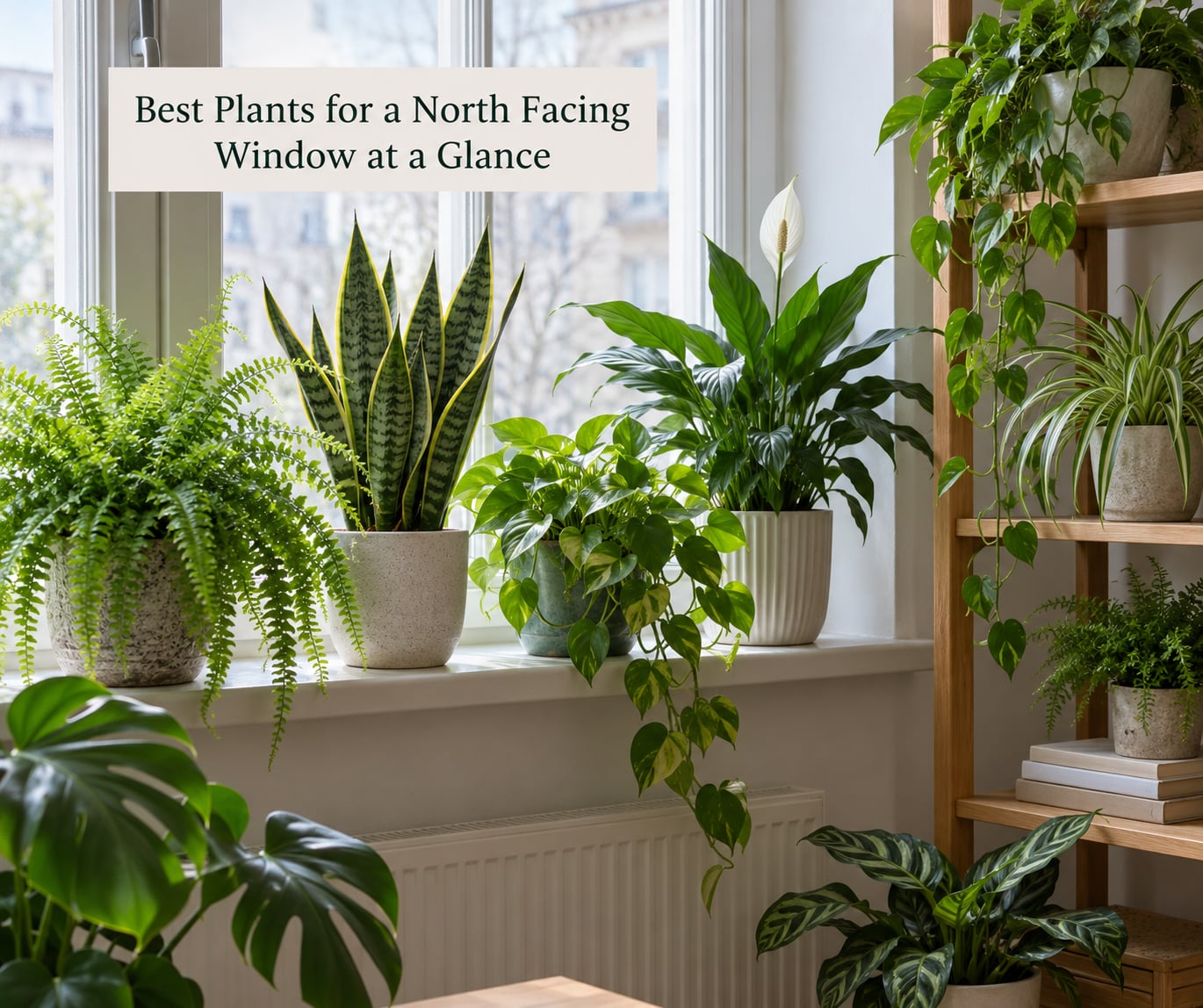
Every plant below tolerates indirect light and none of them need a grow light to stay alive. The care level column is the one to read first if you are new to this: low means it forgives missed waterings, moderate means it will tell you clearly when it is unhappy.
| Plant | Light tolerance | Growth habit | Mature size | Pet-safe | Care level |
|---|---|---|---|---|---|
| Snake plant (Dracaena trifasciata) | Low to moderate | Upright, clumping | 60-90 cm indoors | Toxic | Low |
| ZZ plant (Zamioculcas zamiifolia) | Very low | Upright, clumping | 60-90 cm | Toxic | Low |
| Peace lily (Spathiphyllum) | Low to moderate | Clumping, flowering | 40-60 cm | Toxic | Moderate |
| Pothos (Epipremnum aureum) | Low | Trailing or climbing | Trailing to 1.5 m | Toxic | Low |
| Spider plant (Chlorophytum comosum) | Low to moderate | Mounding, arching | 30-45 cm | Non-toxic | Low |
| Ferns (Asplenium nidus, Nephrolepis) | Moderate, hates sun | Mounding, arching | 30-60 cm | Non-toxic | Moderate |
| Aglaonema (Aglaonema spp.) | Low to moderate | Upright, clumping | 30-60 cm | Toxic | Low to moderate |
| Philodendron (Philodendron hederaceum) | Low to moderate | Trailing or climbing | Trailing to 2 m | Toxic | Low |
| Aspidistra (Aspidistra elatior) | Very low | Upright, spreading | 60-90 cm | Non-toxic | Low |
| Boston fern (Nephrolepis exaltata) | Moderate, hates sun | Arching clump | 45-60 cm | Non-toxic | Moderate to high |
Pet-safety flags follow ASPCA listings. Only four of these ten are non-toxic to cats and dogs, so if you have pets and a north window full of plants, the shortlist narrows to spider plant, ferns, aspidistra and peace lily-adjacent options you have not yet picked up.
Is your north window bright, dim or dark?
Work out which of these you have before you buy anything, because it decides half the list.
- Bright: a large window, no buildings or trees opposite, no net curtain, and you can see sky glow on an overcast afternoon. Almost the whole list works, ferns included.
- Dim: medium glass, or an obstruction such as a fence, balcony or opposite building that cuts out a chunk of the view. Snake plant, ZZ plant, pothos, philodendron and aspidistra are the safe bets.
- Dark: small or heavily blocked glass, or a spot several feet back in the room with no window nearby. Only ZZ plant and aspidistra hold up, and even those slow down to almost nothing between October and March. Add a grow light if you want growth rather than survival.
As a rough number, Illinois Extension puts usable light at roughly 150 foot-candles in front of a north window and around 75 a few feet back from it. That drop is why distance from the glass matters so much.
1. Snake Plant for a North Facing Window
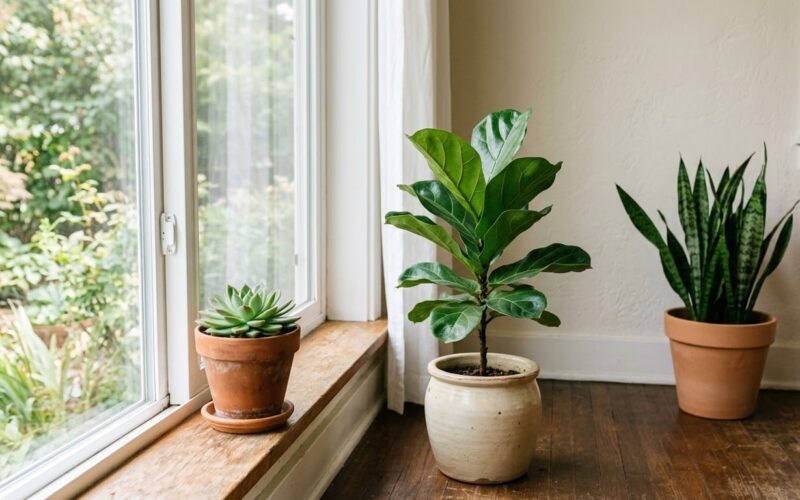
Snake plant is the plant people hand beginners who already kill things, and for good reason. Dracaena trifasciata stores water in thick, upright leaves and photosynthesises happily in conditions that would stretch a fussy plant within a month.
Place it as close to the glass as you can manage. It tolerates dimmer spots, but the fastest, most upright growth comes from the brightest part of a north-facing sill. A metre or more back, expect shorter, softer new leaves rather than new leaves.
Water it when the soil is dry all the way down, which in shade can mean every three weeks in summer and every six weeks in winter. A heavy, gritty mix with perlite or grit keeps the base of the rosette from sitting wet, which is the only reliable way to kill one. Never leave it standing in a full saucer.
Worth knowing: it is toxic to cats and dogs, and the cats usually discover this by chewing the leaf edge.
2. ZZ Plant for a North Facing Window
The ZZ plant is the most forgiving plant on this list and the one I trust most in a room with no window at all. Its underground rhizomes hold weeks of water, so a forgotten ZZ is a story rather than a funeral.
Give it the brightest corner of the window rather than the middle. Low light does not kill a ZZ, it just stops it growing, and a plant that never grows is not really earning its pot. Expect new shoots only in the warmer months, and only if it has been repotted recently into a pot with drainage.
Soak it thoroughly, then let the whole thing dry out before you water again. Wilting leaves in a ZZ are usually a sign of too much water, not too little, so the instinct to pour more is exactly backwards. Wipe the leaflets every couple of months; dust on that glossy surface costs the plant real light.
Like snake plant, it is toxic to pets.
3. Peace Lily for a North Facing Window
Peace lily (Spathiphyllum) is the closest thing to a flowering plant you can keep happy in a north-facing window, and the one people most often give up on too early. It wants bright indirect light, which is precisely what a north window provides all day.
Position it near the glass but not against it, and out of cold draughts in winter. Leaf edges going brown usually means cold dry air rather than a watering problem, and moving the pot back 30 cm from the pane fixes more of those brown edges than any change to the watering routine.
The balance to hold is moisture against drainage. Peace lily sulks when it dries out and rots when it sits waterlogged, so use a pot with a clear drainage hole and a mix that lets water through. Water with filtered or stood water if your tap is hard; the tips react to fluoride.
Expect flowers in brighter months and mostly foliage in a dim spot. It is toxic to pets, so keep it off a low shelf if you have a nibbling cat.
4. Pothos for a North Facing Window
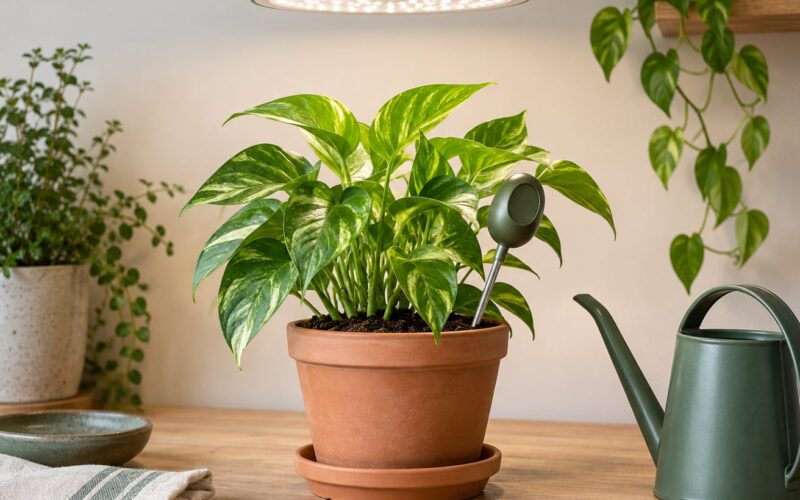
Pothos is the answer when your window is small or sits several feet from a plant table. Golden pothos (Epipremnum aureum) will trail from a hanging planter in light that would leave a fiddle-leaf fig bare within a season, and it grows faster in summer than anything else you will own.
Choose your variety by light level. The plain green golden form and the neon Epipremnum ‘Marble Queen’ are the most shade-tolerant. The highly variegated cultivars, especially white varieties, need more light than a north window usually delivers and will green up as they acclimate.
Let the top 5 to 8 cm of soil dry between waterings, and empty any cachepot after you water. Overwatered pothos is the single most common problem I see: the leaves go limp and yellow, the stems feel soft, and the plant collapses within days.
If you want fuller growth rather than a long bare vine, pinch the trailing tips. Each cut makes the plant branch, and it fills out a lot faster than you would expect.
5. Spider Plant for a North Facing Window
Spider plant (Chlorophytum comosum) prefers bright filtered light, which a north-facing window is close to ideal for. It also handles a cooler window better than most tropical houseplants, so it is a good choice for a bedroom or a hallway that gets no heating.
Keep it within a metre or two of the glass. Push it further back and the narrow leaves shorten and the plant throws out fewer plantlets, which defeats half the reason people buy one.
Water when the surface has dried out, using a pot that drains properly. Brown tips are usually a reaction to tap water minerals rather than thirst, so switching to filtered water fixes it without changing anything else. The plantlets that appear on long stems can be left to grow or potted up once they have roots of their own, which usually happens while they are still attached.
It is non-toxic to cats and dogs, which makes it the easiest recommendation on this list for a home with pets.
6. Fern for a North Facing Window
Ferns are the reason a north-facing window works for something other than foliage that tolerates being ignored. They evolved on the forest floor, they actively dislike strong direct sun, and a north window is closer to their natural light than any other spot in the house.
Bird’s nest fern (Asplenium nidus) is the safest first choice. It has no runners, it grows upright rather than sprawling, and it forgives a missed watering better than the feathery types. Boston fern (Nephrolepis exaltata) is more dramatic and more demanding, so keep the two on different schedules rather than watering them the same day.
Humidity is the part people skip. Group ferns together, stand them on a tray of pebbles with water in it, or keep them in the bathroom if you have one. Water whenever the surface soil feels dry, and expect to do it two or three times a week in summer in a shaded spot.
Ferns drink a lot and then need air around the roots. Soil that stays saturated for days turns sour, and no amount of misting fixes it.
Which ferns need the most light in a north facing window?
Maidenhair fern (Adiantum) is the one to skip unless your window is bright. It browns at the edges within a fortnight in dim light and needs humidity so high it rarely settles indoors. Boston fern and most Asplenium varieties hold up at moderate light; maidenhair wants the glass, the humidity and the attention of somebody who has done this before.
7. Aglaonema for a North Facing Window
Chinese evergreen (Aglaonema) is sold as a bright, colourful plant, which is misleading. The red, pink and cream cultivars, including ‘Red Valentine’ and the variegated Siam Aurora types, hold their colour best in low to moderate light, and the strongly patterned ones fade in a bright position faster than they scorch.
Put it where it gets filtered light and no hot afternoon beam comes through the glass. If your window is north-facing you are unlikely to have that problem, which is one of the reasons aglaonema works so well here.
Water when the top few centimetres are dry and let it dry right back between drinks. It stores some water in the rhizome, so an occasional forgotten week does not hurt, but a pot sitting in water does. Brown leaf tips usually come from dry air or tap water rather than thirst, and a humidifier or grouped plants reduce both.
Note that an aglaonema is toxic to pets, and the red-leaved varieties are the ones most likely to be chewed because they look like a treat.
8. Philodendron for a North Facing Window
Heart-leaf philodendron (Philodendron hederaceum) is about as forgiving as a vining plant gets. It grows in bright indirect light, tolerates a dimmer corner than pothos, and will quietly extend itself across a shelf over months.
Match the pot to the habit. If you want a fuller plant, use a wider, shallower pot than feels generous; a philodendron in an oversized pot of wet soil is the classic route to root rot. If you want long trailing vines, let the pot sit on a shelf edge or in a hanging planter and prune back rather than repotting up.
Give it something to climb if you want larger leaves. A moss pole or a simple trellis increases the surface area for aerial roots and the plant responds with bigger foliage over time. Skip the support and it will trail happily instead, which is a perfectly good look.
Keep the mix open with bark or perlite, water when the top third has dried, and never leave the base pot standing in water. One of the more forgiving philodendrons for beginners is the climbing variety ‘Brasil’; it is less fussy about light than most and grows fast once it settles.
9. Aspidistra for a North Facing Window
The cast iron plant (Aspidistra elatior) is the plant for the worst spot on this list. It handles dim light, draughts, neglect and being moved around, and it will sit several feet back from a north window looking entirely unbothered while a pothos next to it stretches.
Because of that tolerance it is often sold as the answer to a dark hallway. It is more useful to place it in the brightest part of a dim room, where you can also give it decent light, and enjoy the fact that it will forgive you when the winter light drops to nothing.
Water sparingly, in a deep soak, and only once the soil has dried most of the way through. Its thick underground rhizome is the whole survival strategy, and keeping it damp does not make it grow faster. Half-strength feeding a few times between spring and autumn is plenty.
Keep it clear of cold glass and draughts, which is what usually ends an aspidistra. Brown patches in winter are almost always cold damage rather than thirst. It is non-toxic to pets, and among the few houseplants on this list where a chewed leaf causes no harm.
10. Boston Fern for a North Facing Window
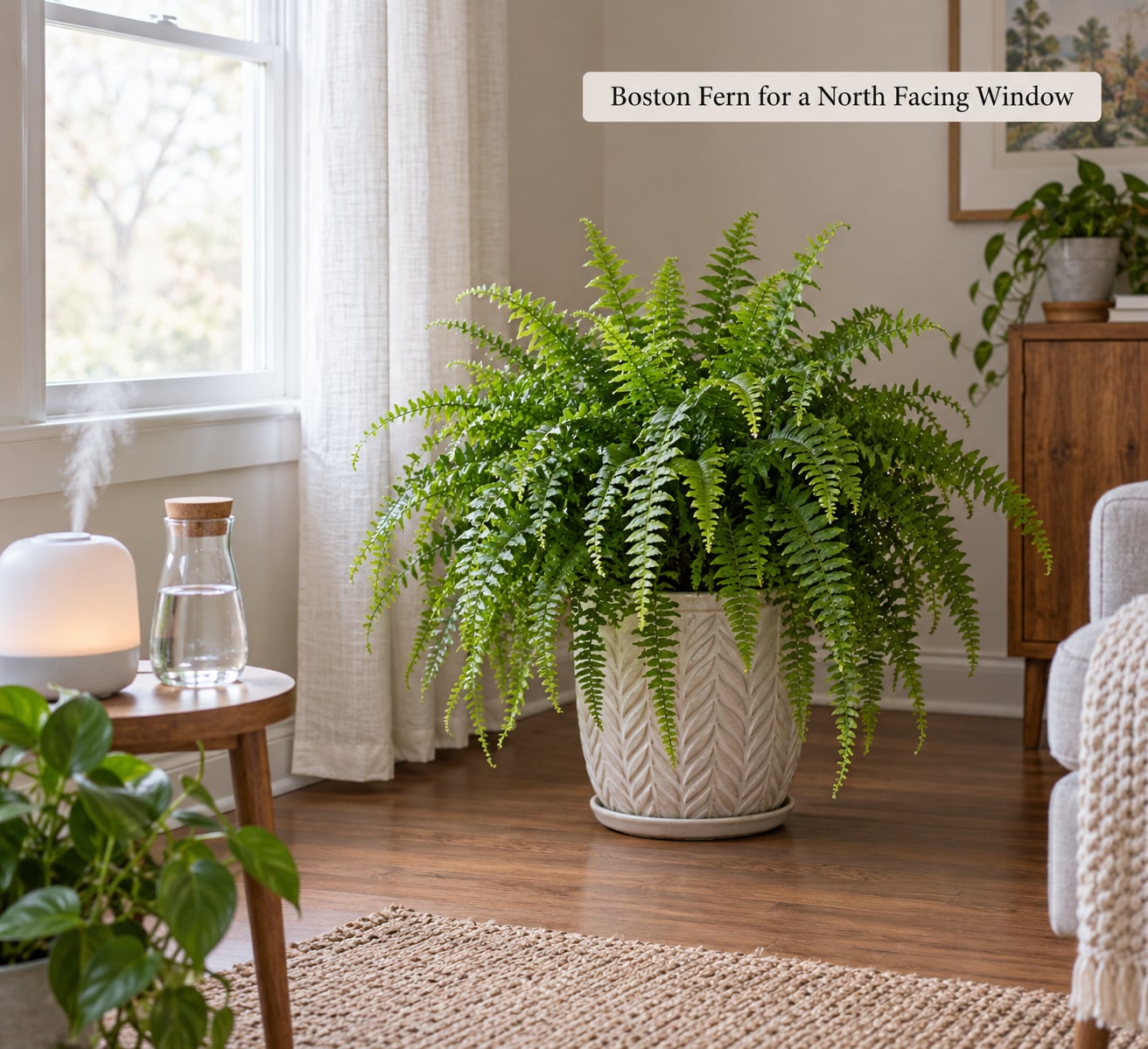
Boston fern (Nephrolepis exaltata ‘Bostoniensis’) gives a north-facing window its best show, provided you are honest about the humidity it needs. A dry flat or a draughty hallway will do it in a few weeks; a lived-in room, a bathroom or a spot near a humidifier will keep it throwing fronds all year.
Set it two or three feet back from the glass, where the light is soft and even. Right up against the pane the fronds can scorch in bright afternoon glare, and against a cold frame in winter the tips go brown first.
Consistently moist soil is not the same as waterlogged soil, and this is where most people go wrong. A Boston fern wants the top inch damp at all times, so check it daily in summer, but it should never sit in a tray of water. Water thoroughly when the surface starts to dry, then drain fully. Water sitting in the crown for days is what turns fronds black at the base.
Use filtered or stood water if your tap is hard, trim any fronds that have gone brown at the base rather than waiting for the whole crown, and repot every second spring into a mix that drains freely.
Frequently Asked Questions
Should plants be in a north-facing window?
Yes, for shade-tolerant species. A north-facing window delivers bright, diffuse light all day with no direct sun, which suits understorey plants such as snake plant, ZZ, pothos, ferns and aspidistra. It is too dim for sun-lovers like succulents, cacti, aloe and fiddle-leaf figs, which will stretch and scorch there instead.
What kind of light do north-facing windows get?
Bright but never direct. The sun stays on the southern side of the sky in the northern hemisphere, so a north window receives only reflected and diffused light. As a rough guide, about 150 foot-candles reaches the glass and around 75 a few feet back, which is why plants sitting across the room grow much more slowly.
How far from the window should a low light plant be?
As close as the plant’s tolerance allows. Put a fern and a peace lily within a metre of the glass, allow pothos and philodendron about a metre and a half, and put ZZ plant and aspidistra closest if you want them to actually grow. Light falls sharply with distance, so every extra metre roughly halves what reaches the leaves.
Which plants are safe for a home with cats?
Spider plant, Boston fern, bird’s nest fern, maidenhair fern and aspidistra are all non-toxic to cats and dogs. Snake plant, ZZ plant, peace lily, pothos, aglaonema and philodendron are toxic, and cats tend to chew the leaves of the colourful aglaonema varieties first. If you cannot place toxic plants out of reach, stick to the ferns and the spider plant.
Which plants will not bloom in a north-facing window?
Most flowering houseplants will hold buds there rather than open them, which is a light problem rather than a care problem. Peace lily, moth orchids and African violets flower in a bright north window, and a smaller window is usually not enough. Expect foliage, not flowers, and skip flowering varieties entirely if blooms matter more than leaf shape.
What plants are good for a north-facing window box outdoors?
Use hardy plants built for shade rather than indoor favourites. Ferns, hostas, heuchera, brunnera, lungwort and evergreen ivy all handle a north or north-east balcony in most climates. Keep tender tropicals like pothos and peace lily indoors, as they will not survive a cold night outside.
Conclusion
Start by standing at your window on an overcast afternoon and deciding whether you have a bright, dim or dark spot. Bright gets you a peace lily, a spider plant or a Boston fern; dim gets you snake plant, pothos, philodendron or aglaonema; dark gets you a ZZ plant or an aspidistra, plus a grow light if you want growth rather than survival. Pick the plant whose care routine matches how much attention you actually want to give, put it as close to the glass as its tolerance allows, and water only when the soil tells you to.