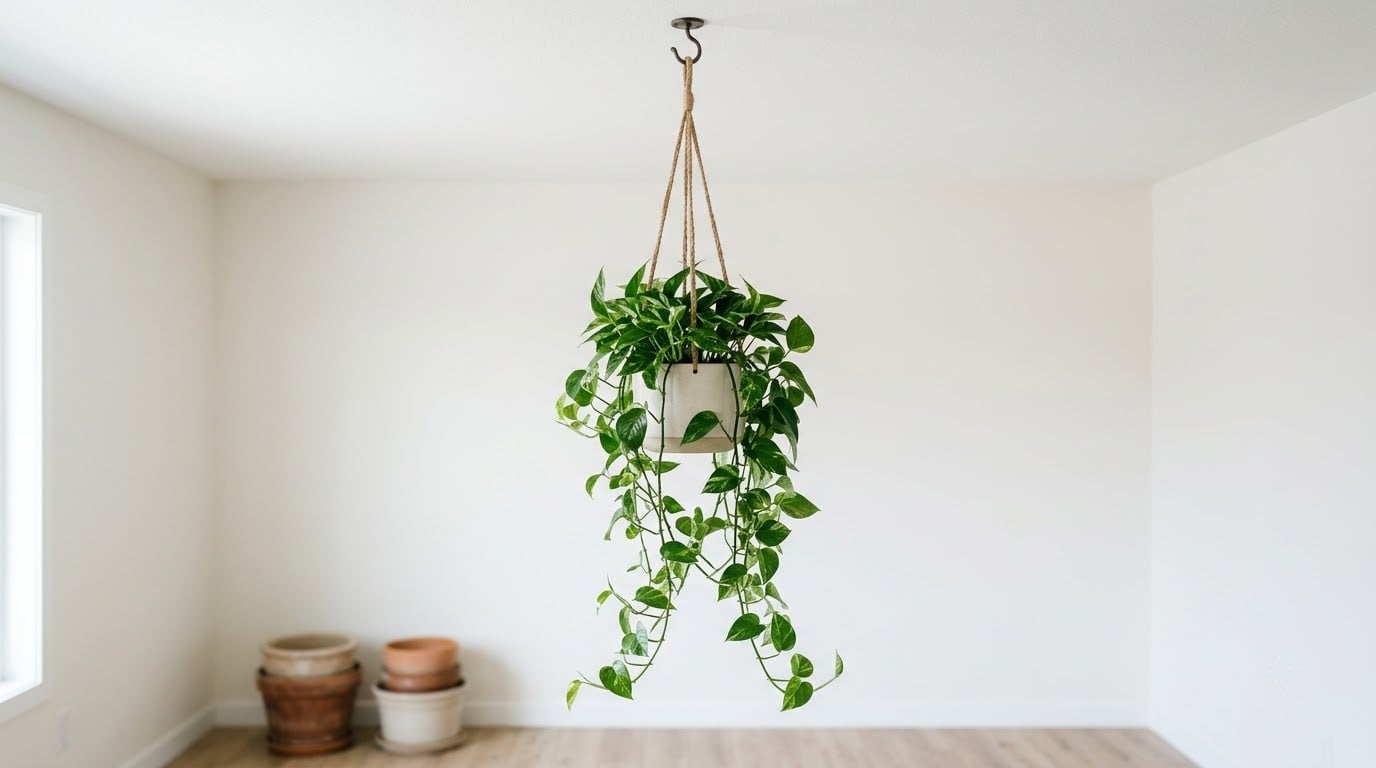
To hang plants from the ceiling safely, anchor into a wooden ceiling joist with a heavy-duty screw hook whenever you can, and use a spring toggle bolt rated well above your plant’s weight when the ceiling is hollow drywall with no framing behind it. Most of the job is deciding what your plant weighs wet and matching hardware to that number.
The whole installation takes about 30 minutes once you have the hardware, and the only genuinely hard part is knowing what is behind the drywall. I have hung planters in rentals with nothing but adhesive hooks and in old plaster-and-lath houses where the ceiling crumbled under a pencil, and the difference between those two outcomes is almost always the same: someone matched the anchor to the wall instead of matching it to the load.
Here is the sequence I use, including the weight maths that decides the hardware before the drill ever comes out.
Table of Contents
- What You Need for How to Hang Plants from the Ceiling Safely
- Step-by-Step
- How to Hang Plants from the Ceiling Safely: Check the Ceiling First
- How to Hang Plants from the Ceiling Safely: Choose the Right Support
- How to Hang Plants from the Ceiling Safely: Install and Test the Fixing
- Watering Without Wrecking the Ceiling
- Common Mistakes
- Frequently Asked Questions
- How much weight can I safely hang from a ceiling?
- Can I hang plants from a drywall ceiling?
- What is the best ceiling hanger for a heavy plant?
- How do I hang a plant without damaging the ceiling?
- How often should I check a hanging plant for safety?
- Conclusion
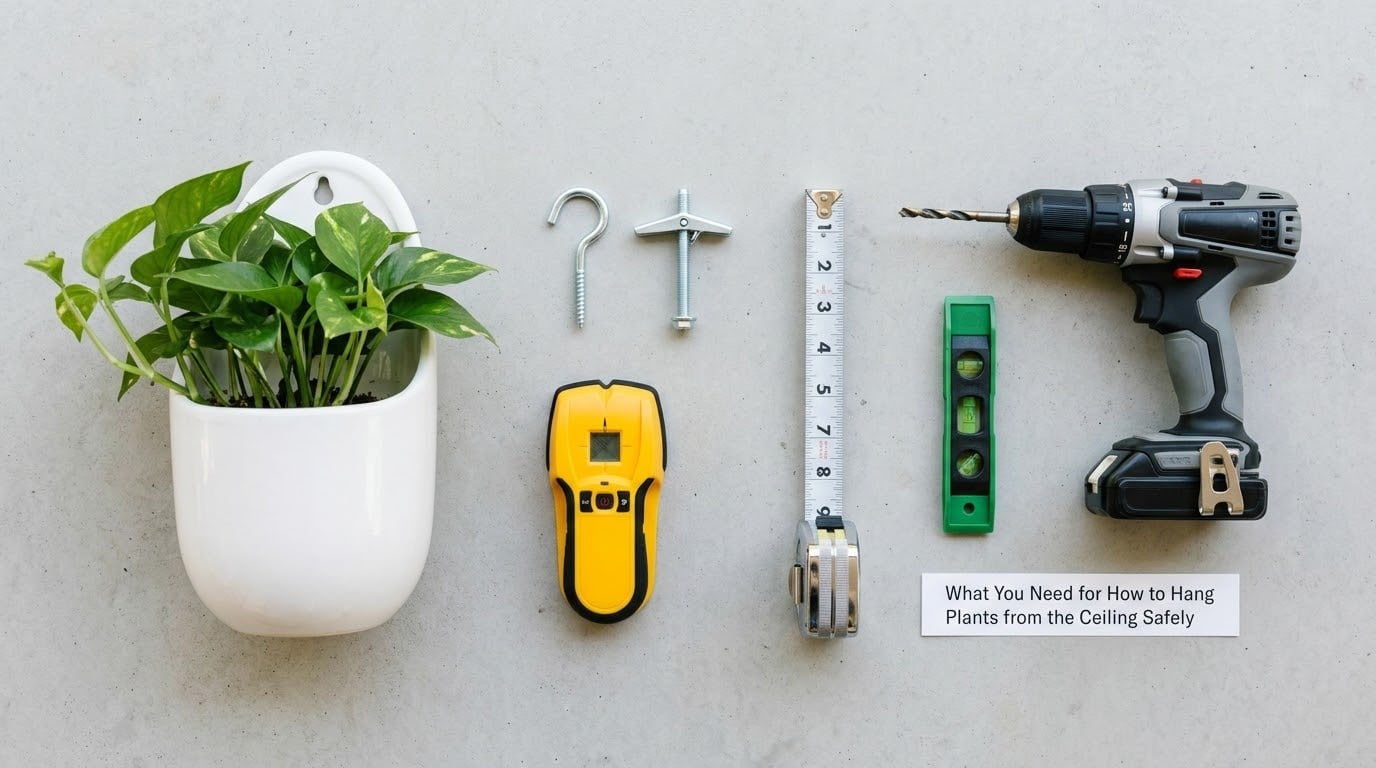
What You Need for How to Hang Plants from the Ceiling Safely
Start by working out the total weight you are suspending, because that number drives every other choice. A hanging plant is not just the plant: you are also lifting a pot, dry soil, the plant’s own mass, and water still held in the soil and the saucer.
Wet soil is the trap here. A gallon of dry potting mix weighs roughly 3 to 4 pounds, and the same volume fully saturated with water pushes past 10 pounds. Buyers routinely size an anchor for the plant’s nursery weight and then discover the difference the first week after watering.
A worked example, using a 6-inch glazed ceramic pot with a trailing pothos:
- Pot: about 3 lb
- Dry soil: about 3 lb
- Plant itself: about 1 lb
- Water retained after watering, plus a full saucer: about 7 lb
- Total hung weight: roughly 14 lb
Size your hardware to four times that figure, about 56 lb, so the fixing is working well inside its rating. That margin covers a plant that grows, a wet week, and the moment a friend lifts it down to repot it.
Your tool list is short:
- Stud finder or a thin finishing nail and a hammer to probe for joists
- Cordless drill, plus a bit matched to the shank diameter of the hook
- Pencil and tape measure for marking and for checking ceiling clearance
- Step ladder, and a helper if the planter is heavy or the ceiling is tall
- Small spirit level for confirming the pot hangs level
- Safety glasses, especially on popcorn or textured ceilings where debris falls
On hardware, you are choosing between two families. Screws and hooks go into solid material: joists, blocking, or masonry. Anchors go into a cavity: toggles, snap toggles, and sleeve anchors that expand behind the drywall panel.
Match the drill bit to the smooth shank of the hook or the bolt, not to the threaded section. A pilot hole that is too big strips the threads, and too small splits the drywall face as the screw goes in.
Step-by-Step
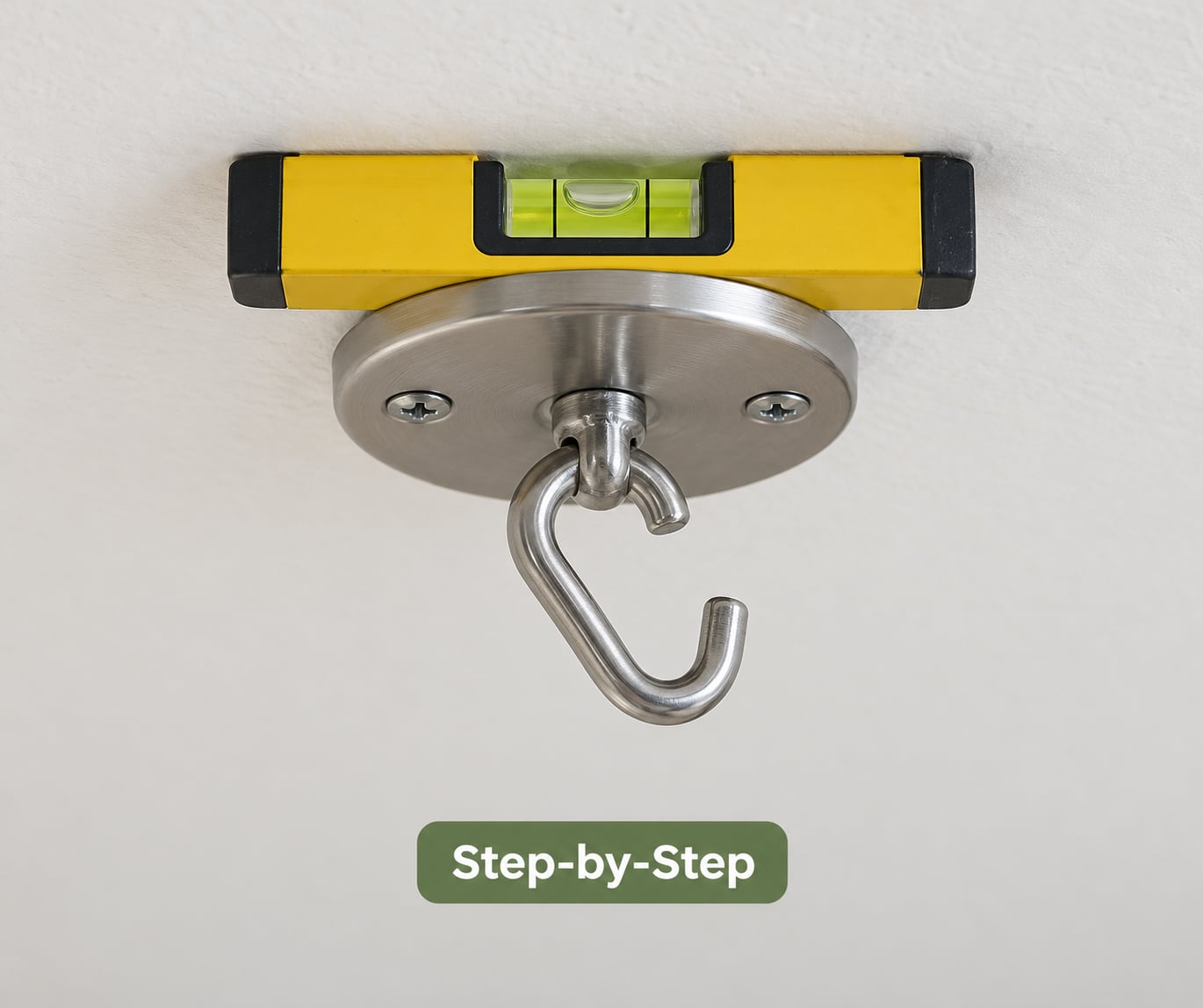
Work through these in order. Rushing the first two is how ceilings get damaged.
How to Hang Plants from the Ceiling Safely: Check the Ceiling First
Knock on the ceiling and listen before you measure anything. A hollow thud means drywall with a cavity behind it, possibly with a joist somewhere off to one side. A solid, dull knock means you have hit framing.
Then find the framing. Run a stud finder across the area and mark both edges, because joists are commonly 1.5 inches wide and the centre is what you want. If your stud finder gives inconsistent readings, which cheap units often do, probe with a thin finishing nail driven a few millimetres in along a straight line. Where it suddenly meets solid resistance, you have found the joist edge; keep probing along the line to find the centre.
Before drilling anywhere, check what is behind or above the spot:
- Watch for fire sprinkler heads. If the head is within about 6 inches of your proposed location, move the plant, and never cover a sprinkler head with a planter.
- Look for pipes. In older homes, supply lines often run through the joist bays near plumbing fixtures, and a sounding hollow joist can be a pipe chase.
- Assume cable or conduit runs near the edges of joists and along the top of the drywall. Stay well inside the joist, away from the edges.
- Check for recessed lights. Ceiling electrical boxes sit close to framing, and you want clearance from any box, not just the cable.
Finally, measure the drop. A pot needs room for its full height plus the length of the plant, plus a hand’s width above the widest foliage, so you can lift it off without scraping. Keep it clear of doorways, ceiling fans and light fixtures.
Plaster and lath is the case where you stop and get a tradesperson. Old plaster cracks along a line rather than failing cleanly, and lath can be unsupported in places where the ceiling was patched. Concrete and brick need a masonry bit and a sleeve or wedge anchor. A popcorn or heavily textured ceiling is not a load-bearing surface, so treat any anchor in it as cavity work and go through to a joist behind.
How to Hang Plants from the Ceiling Safely: Choose the Right Support
With the ceiling identified, pick hardware that suits both the material and the load. Here is what each option is for.
Screw hook into a joist. The strongest and most straightforward option for wood framing. A heavy-duty hook with a long shank, driven at least 1 inch into the centre of the joist, is what most people mean when they say a plant hook. It is also the easiest to remove later, because it backs out of solid wood.
Lag screw eye into a joist. A ring instead of a hook, so you hang a chain, macrame hanger or carabiner through it. This is the better choice when you are suspending something on a cord or chain rather than clipping a hanger directly on.
Spring toggle bolt or snap toggle in hollow drywall. The standard answer when no joist is behind the spot. The wing folds flat to pass through the pilot hole and springs open behind the panel, spreading the load across a much wider area than the hole itself. Midweight toggles commonly publish ratings in the region of 40 to 60 lb, and heavy-duty versions go considerably higher, but the number on the box is the one that matters because plaster board, board thickness and the diameter of the hole all change it.
Self-drilling drywall anchors. Small, metal, and pointed, so they go straight in with a screwdriver. Convenient, and genuinely useful for light loads and light plants. They are not the right choice for a heavy, wet planter because they rely on the paper face of the drywall rather than on anything structural.
Plain plastic expansion anchors. These are the ones people already have in a drawer. Fine for a picture hook on a wall, marginal for a soaked hanging pot, and the reason a surprising number of ceiling anchors fail. The forum consensus is that a lightweight pot on a plastic anchor feels fine until the soil is saturated, then the anchor pulls a wider hole and the whole thing drops.
Adhesive hooks. Useful for very light plants and for renters who cannot drill. The number to watch is the weight limit on the pack, which assumes a clean, dry, smooth surface. Dust, texture and a textured ceiling cut adhesion dramatically.
No-drill options. S-hooks over an exposed beam or a ceiling pipe, a tension rod wedged between two walls, a magnetic hook, or a curtain rod hung off the wall. All of them work well for small pots. A tension rod is the one worth checking carefully, because the sideways force it applies is different from a straight downward hang, and a narrow wall gap gives it very little room to spread the load.
One more rule for grouped displays: spread multiple plants across separate joists rather than stacking three hooks in one bay. A single joist has capacity, but three saturated 14-pound pots on one point is a load the drywall around it has never seen.
How to Hang Plants from the Ceiling Safely: Install and Test the Fixing
Drill the pilot hole slightly smaller than the shank, keeping the drill straight and pushing gently so the bit does not wander across the face of the ceiling. Vacuum or wipe the dust out afterwards, because grit pushed into the anchor seat reduces its grip.
Screw the hook in by hand first to start the thread, then finish with the drill on a low setting. Stop when the head sits flush against the ceiling. Over-tightening cracks the drywall face around the hole, and that crack is what later widens into the torn-out hole people worry about.
For a toggle bolt, drive the bolt through, then finger-tighten until the wings spring open behind the panel and the head pulls up against the ceiling. Tighten a further half turn or so. Never draw it up so hard that the paper face dimples.
Now the pull-test, before the pot goes anywhere near it. Give the installed hook a firm downward tug with your whole weight behind it. Nothing should move, creak, or turn. Then hang the empty pot and its hanger and load it gradually: dry pot, then dry pot with dry soil, then water it in place. If it survived the first two stages but creeps when you add water, the anchor is undersized and needs replacing, not tightening.
Check the pot hangs level with a small spirit level, and adjust the hanger length rather than twisting the pot. Group the planter with a secondary safety line if it sits above a walkway or a seating area.
Watering Without Wrecking the Ceiling
Water damage is the most common way a hanging plant ruins a ceiling, and it has nothing to do with the anchor. Take the planter down and water it over a sink or in the shower, let it drain fully, wipe the pot base, and only then hang it back up. A saucer or a cached-watering insert catches the run-off that would otherwise travel down the hanger and drip onto the surface below.
Check the pot actually drains. A planter with no drainage hole holds water against the rim until it finds a way down the outside, and that is the drip everyone notices. A shallow layer of lava rock or a mesh layer over the drainage hole reduces the soil washing out each time you water.
Check the fixing twice a year as well, giving the hook or bolt a firm tug and looking for any movement, drywall dust, or a rust stain around the fixing point.
Common Mistakes
Forgetting wet soil. People size hardware from the nursery tag weight and end up at double the load after the first watering. Weigh the pot empty and full of wet soil if you can, and add the plant and a full saucer.
Trusting a plastic anchor with a soaked pot. Plastic expansion anchors work in drywall, just not reliably at plant weight in a ceiling. Use a joist hook or a metal toggle, and treat plastic anchors as a renter-friendly option for the lightest of plants only.
Hanging over seating, a walkway or stairs. A falling pot injures people and pets, and it lands where someone is sitting. Keep planters over empty floor space, well away from door swings, and think about where a child reaches.
Over-tightening the screw. The instinct is to bury it. Over-driving cracks the paper face, which then flakes away and leaves a much larger hole than you drilled. Hand-tight until flush, then a quarter turn.
Ignoring the pull-test. A hook that rotates a few degrees under load will keep rotating each time it is lifted down and replaced. Test it before the pot goes up, not after.
Watering with the plant still hanging. A single soak sends water down the hanger and onto the ceiling. Take it down, or use a self-watering insert and a properly sized saucer.
Drilling without checking for services. Find the joist centre, stay inside it, and keep well away from sprinkler heads, light boxes, and pipes. Ten minutes with a finishing nail is cheaper than a repair.
Never inspecting after install. A fixing can loosen as the framing dries out and as the building moves. Twice a year, tug it and look for dust or a stain.
Hanging something heavy from a textured ceiling. Popcorn and heavily textured ceilings are finish coats, not structure. Any anchor in them needs to reach a joist behind the panel.
Frequently Asked Questions
How much weight can I safely hang from a ceiling?
Treat the total hung weight as pot plus dry soil plus plant plus retained water, then choose hardware rated at least four times that figure. A joist-mounted screw hook or lag screw eye is the strongest option. In hollow drywall, a metal toggle or snap toggle rated for the load is the answer, not a plastic expansion anchor. Working at four times gives you room for a plant that grows and a wet week.
Can I hang plants from a drywall ceiling?
Yes, as long as the fixing reaches solid material or uses an anchor designed to spread the load. A screw hook or lag screw eye into a ceiling joist is the safest route. If no joist sits behind your spot, use a spring toggle bolt or snap toggle, sized to at least four times your plant’s wet weight. Never rely on the drywall paper face alone for a heavy planter.
What is the best ceiling hanger for a heavy plant?
A heavy-duty screw hook or lag screw eye screwed into the centre of a ceiling joist, with a long shank driven at least 1 inch into the wood. If no joist is available, a heavy-duty metal toggle bolt in hollow drywall is the next best option. For anything genuinely heavy, add a secondary safety line and get a second person to help with the ladder.
How do I hang a plant without damaging the ceiling?
Find the joist, mark its centre with a pencil, drill a pilot hole slightly smaller than the shank, and tighten the hook until flush without going past that point. Over-driving cracks the drywall face and leaves a wider hole than you started with. Keep clear of sprinkler heads, pipes and light boxes, and on plaster or lath ceilings have a tradesperson do the drilling.
How often should I check a hanging plant for safety?
Check the fixing twice a year, and any time you notice a change. Give the hook or toggle a firm downward tug, look for movement or rotation, and inspect for drywall dust, a rust stain or a hairline crack around the fixing point. Also check the hanger, chain or cord for fraying, and replace the hardware if the ceiling around it looks tired.
Conclusion
Knowing how to hang plants from the ceiling safely starts with the ceiling, not the hook. Find the joist, or confirm you are dealing with a hollow cavity, and check for wiring, pipes and sprinkler heads before any bit touches the surface. Then work out the wet weight of pot, soil, plant and water, and choose hardware rated at least four times that number.
Drill a hole matched to the shank, tighten until flush, pull-test with your own weight, and hang the pot empty before it goes up full. Once it is up, keep it over clear floor space, take it down to water, and give the fixing a tug twice a year.