Yes, plants in the bedroom are safe at night. A potted plant respires after dark, releasing a little carbon dioxide and taking in oxygen, but that volume is negligible next to a sleeping adult moving hundreds of litres of air every hour. The real risks are ordinary plant-care mistakes and, in a few rooms, genuine hazards.
Table of Contents
- What a plant actually does while you sleep
- CAM photosynthesis in plain language
- Are plants in the bedroom safe at night? The four exceptions
- 1. Toxic species in a room with pets or small children
- 2. Overwatering, and the mould that follows
- 3. Flowering and pollen-shedding species with hay fever
- 4. Dense planting that pushes humidity too high
- Bedroom plants at a glance
- Myth versus fact on bedroom plants
- Allergies, asthma and mould in the bedroom
- How to set up bedroom plants that stay safe
- Match the plant to the light you actually have
- Water so the soil dries out
- Keep leaves clean and pots off the bed
- Pick a realistic number
- Sources and references
- Frequently Asked Questions
- Do indoor plants give out oxygen at night?
- Do all plants give out oxygen at night?
- What plants should not be in your bedroom?
- Why are my allergies worse in my bedroom?
- Can houseplants actually make you sick?
- Is it healthy to sleep with plants in your bedroom?
- Conclusion
What a plant actually does while you sleep
During daylight, a plant photosynthesises. It takes in carbon dioxide through pores on its leaves called stomata and releases oxygen. That is the whole reason houseplants became popular office companions in the first place.
After dark, photosynthesis stops. The stomata close and the plant respires instead, which means the reverse trade: oxygen goes in, carbon dioxide comes out. Every plant does this, all night, including the ones sitting on your nightstand.
A small group works differently. Drought-adapted species use crassulacean acid metabolism, usually shortened to CAM. They open their stomata at night to absorb carbon dioxide, hold the carbon in an acid form, and release oxygen as a by-product once daylight arrives. Snake plant, ZZ plant, aloe vera, bromeliads and most Phalaenopsis orchids are in this group.
CAM photosynthesis in plain language
CAM is a survival strategy, not a gift to your bedroom. Plants that live in deserts or on rocky outcrops open their pores at night when evaporation is lowest, bank the carbon dioxide, close up at dawn and spend the day making sugar from it in daylight. Yes, a little oxygen comes out at night. It is a fraction of a fraction.
The volume matters more than the mechanism. A sleeping adult breathes roughly 0.2 to 0.3 litres of oxygen a minute, with respiration slowing further during deep sleep. The CAM plants people keep on nightstands do not change that. A 2020 meta-analysis in the Journal of Exposure Science & Environmental Epidemiology, by Cummings and Waring, put the plant-to-room requirement at somewhere between 10 and 1,000 plants per square metre just to match the ventilation of a naturally aired room. In practice you would need a small forest, and it still would not out-perform an open window.
The famous 1989 NASA technical memorandum by Wolverton, Johnson and Bounds is worth reading carefully rather than repeating. It tracked removal of volatile organic compounds, or VOCs, such as formaldehyde, benzene, xylene and trichloroethylene in sealed chambers with a plant-to-air ratio you would never replicate in a bedroom. Committees, offices and homes are not sealed chambers. Treat the study as evidence that leaves can absorb certain gases under lab conditions, not as a reason to buy twelve plants.
What plants do reliably in a real room is transpire, meaning they release water vapour through their leaves. That is a genuine, if modest, effect on bedroom humidity and it is sometimes the only measurable thing happening.
Are plants in the bedroom safe at night? The four exceptions
Safe is a general answer, not a universal one. These are the four situations where keeping a plant in a bedroom turns into an actual problem.
1. Toxic species in a room with pets or small children
Most popular low-light bedroom plants are mildly toxic if chewed or swallowed. Peace lily, golden pothos, dracaena, aloe vera, ZZ plant and snake plant all appear on the ASPCA’s lists of plants that cause vomiting, oral irritation or drooling in cats and dogs. A drooling cat at 2am is a bad night.
2. Overwatering, and the mould that follows
Wet potting soil grows mould. Persistent dampness around the base of a pot, or a water-filled saucer left standing, is the most common reason people who own plants report worse allergy symptoms. Soil that never dries also invites fungus gnats, whose larvae live in the top layer and whose adults are a nightly irritation in a dark room.
3. Flowering and pollen-shedding species with hay fever
People react to pollen, not to the fact that a plant is present. A non-flowering foliage plant sitting on a shelf is not the source of your hay fever. A flowering species at peak bloom in a sealed bedroom can be, and some people are sensitive to plant-derived dust from soil and leaf surfaces.
4. Dense planting that pushes humidity too high
Transpiration adds moisture. One plant in a 12 square metre bedroom changes little. Eight large plants in a small sealed room with the heating on can push relative humidity past 60%, which encourages mould on walls and textiles rather than in the pot.
Two smaller issues belong on the list. Broad waxy leaves such as ZZ and snake plant hold dust that goes straight into the air when you brush past them, so wipe them monthly. And a trailing plant hung over a headboard or a high shelf is a falling-object risk in a room where you are asleep and cannot catch it.
Bedroom plants at a glance
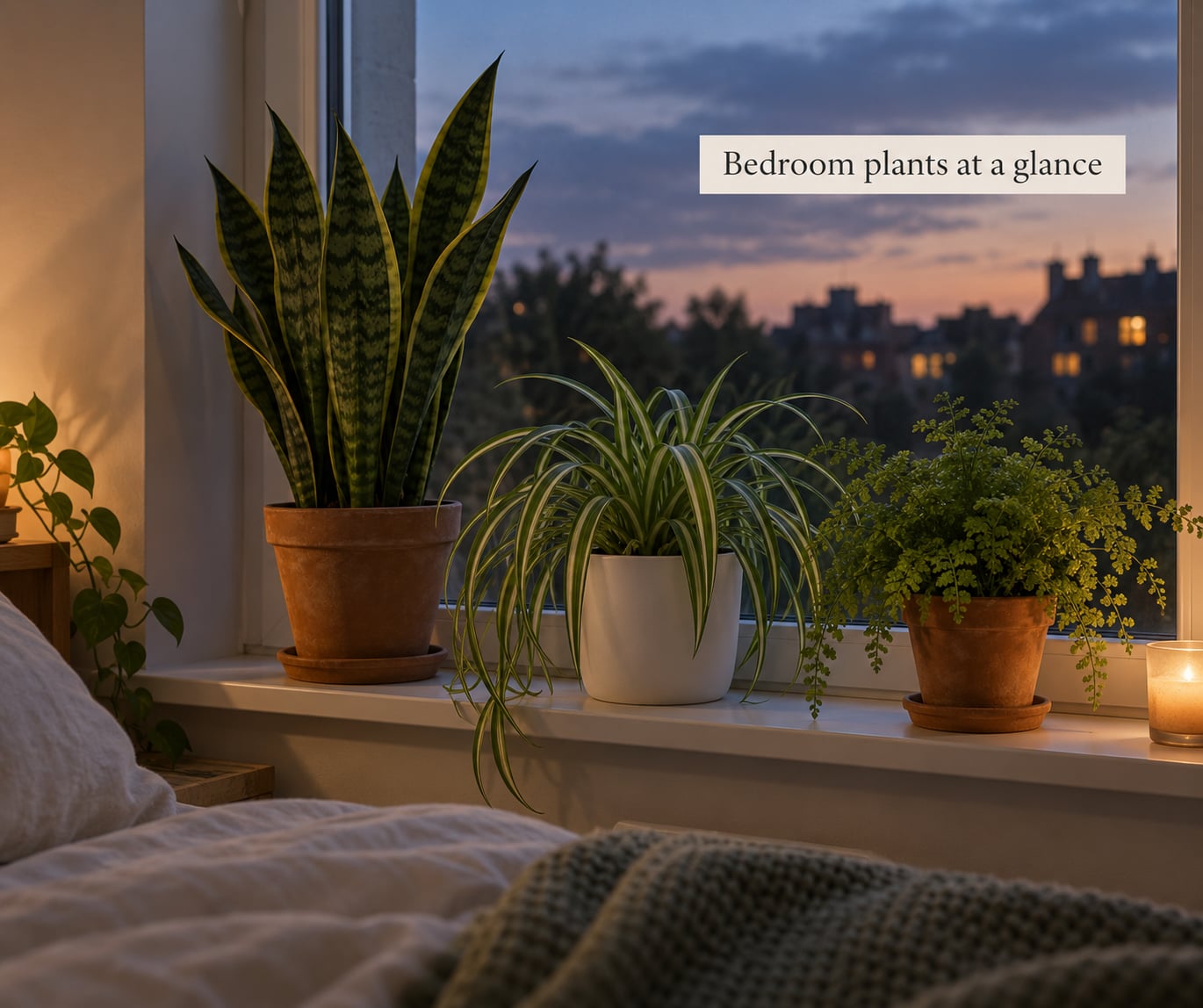
The table below uses CAM status, light needs, pet safety and upkeep so you can scan a list without reading ten profiles. Botanical names are included because common names get mixed up between nurseries.
| Plant | Night oxygen (CAM) | Light needed | Pet-safe | Upkeep |
|---|---|---|---|---|
| Snake plant (Dracaena trifasciata) | Yes | Very low to bright | No, toxic to dogs and cats | Very low |
| ZZ plant (Zamioculcas zamiifolia) | Yes | Very low to bright | No, toxic to dogs and cats | Very low |
| Aloe vera (Aloe barbadensis miller) | Yes | Bright, some direct sun | No, toxic to dogs and cats | Low |
| Spider plant (Chlorophytum comosum) | No | Medium to bright indirect | Yes, non-toxic | Low |
| Boston fern (Nephrolepis exaltata) | No | Medium indirect, humid | Yes, non-toxic | High, dislikes dry heat |
| Peacock plant and prayer plants | No | Medium indirect | Yes, non-toxic | Medium, want humidity |
| Areca palm (Dypsis lutescens) | No | Medium to bright indirect | Yes, non-toxic | Medium, wants humidity |
| Phalaenopsis orchid | Yes | Bright indirect | Yes, non-toxic | Medium, precise watering |
| Peace lily (Spathiphyllum wallisii) | No | Low to medium indirect | No, toxic to dogs and cats | Medium, wilts readily |
| Golden pothos (Epipremnum aureum) | No | Low to bright indirect | No, toxic to dogs and cats | Very low |
| Dracaena marginata | No | Medium to bright indirect | No, toxic to dogs and cats | Low |
| Bromeliads | Yes | Bright indirect | Yes, generally non-toxic | Low, short-lived bloom |
Here is the tension nobody warns you about. The three plants that tolerate the dimmest bedroom, snake plant, ZZ and aloe, are also among the most toxic to cats and dogs. If a bedroom has no pets or small children, pick for light and ignore the toxicity column. If it does, the non-toxic options above need brighter conditions and steadier watering, and that is a trade you have to make deliberately rather than by accident.
Myth versus fact on bedroom plants
| Common claim | What the evidence shows |
|---|---|
| Plants steal oxygen while you sleep | Plants respire at night and give off a trace of carbon dioxide. At normal bedroom scale the amount is immeasurably small against an adult’s oxygen use. |
| CAM plants fill the room with oxygen at night | The mechanism is real and the volume is not. Nighttime oxygen release is a by-product of a drought adaptation, not a ventilation strategy. |
| Houseplants purify your bedroom air | Leaves can absorb VOCs in a sealed chamber. A 2020 meta-analysis estimated 10 to 1,000 plants per square metre would be needed to match one natural air change per hour in a real room. |
| Any plant in a bedroom is good for you | Greenery is linked to lower stress and a calmer room. Toxicity, damp soil and pollen are the actual decision criteria. |
The belief that houseplants steal oxygen predates any real measurement of plant respiration rates. It keeps resurfacing second-hand in home design forums, and it has outlived several generations of perfectly safe houseplants.
Allergies, asthma and mould in the bedroom
This is where the honest answer gets complicated. Nearly all of the real-world concern on this question clusters around allergies, pollen and mould rather than oxygen.
Start with the distinction most people miss: the trigger is usually pollen and mould spores, not the plant’s existence. Three things produce most of it. Persistently damp potting soil grows mould. Flowering species release pollen at peak bloom. Broad, waxy leaves collect room dust and release it when disturbed, which happens constantly when a plant sits at head height.
English ivy, Hedera helix, is the species most often credited with eating mould spores in chamber studies. The honest reading is that you would need implausibly dense planting to reproduce the lab removal rate. If mould is your problem, controlling moisture in the room will do more than any plant can. Dry the source, fix the ventilation, run a HEPA purifier, then decide about the plants.
If your symptoms are reliably worse in the bedroom and worse still after watering, soil mould is the first thing to rule out. Run this test: move every plant out of the room for two weeks and water nothing. If the difference is obvious, bring them back one at a time and keep whichever ones make no difference to your symptoms. That is the compromise plan people who have been told to strip the bedroom are usually looking for, and it costs nothing to try.
If you have asthma, hay fever or a diagnosed mould allergy, follow your own clinician’s advice on this. Nothing here replaces it.
How to set up bedroom plants that stay safe
Match the plant to the light you actually have
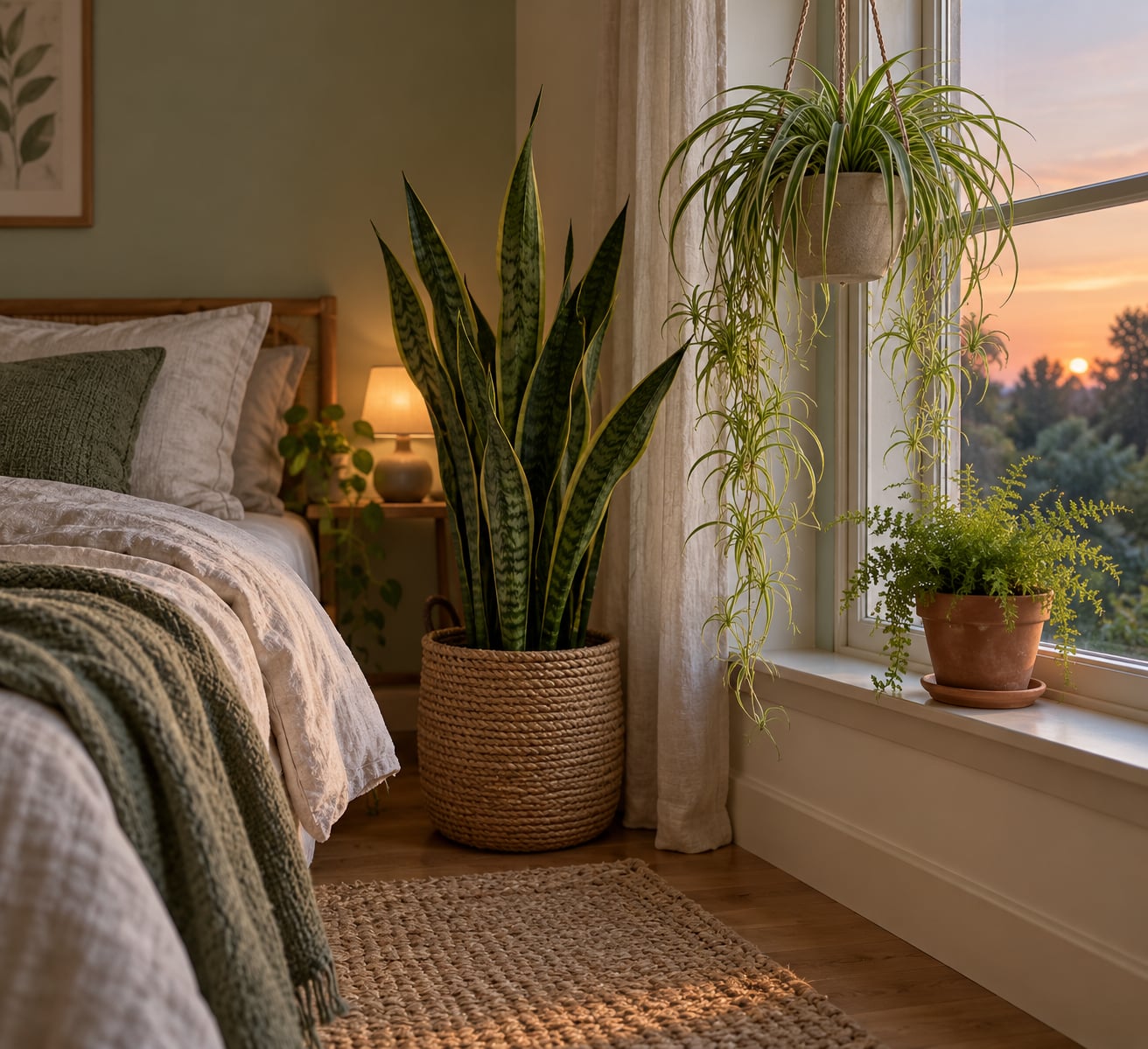
Bedrooms fall into four useful tiers. Very low light, which means you can barely read by day, suits snake plant and ZZ plant. Low indirect light, typically a north-facing window, adds pothos, peace lily and most dracaenas. Medium indirect suits spider plant, areca palm and prayer plants. Bright indirect, a metre or two back from an east or south window, suits ferns, orchids and bromeliads.
People ask whether plants survive three days without light. Most tolerate it, and CAM species hold far longer by drawing on water stored in leaves and rhizomes. Flowering plants and ferns suffer first. If the room has no window at all, a small full-spectrum grow light on a timer is the reliable fix.
Water so the soil dries out
Drainage holes matter more than anything else about the pot. Empty standing water out of the saucer after every watering, and let the top few centimetres go dry before you water again. In a bedroom, most problems are overwatering, not dryness.
Keep leaves clean and pots off the bed
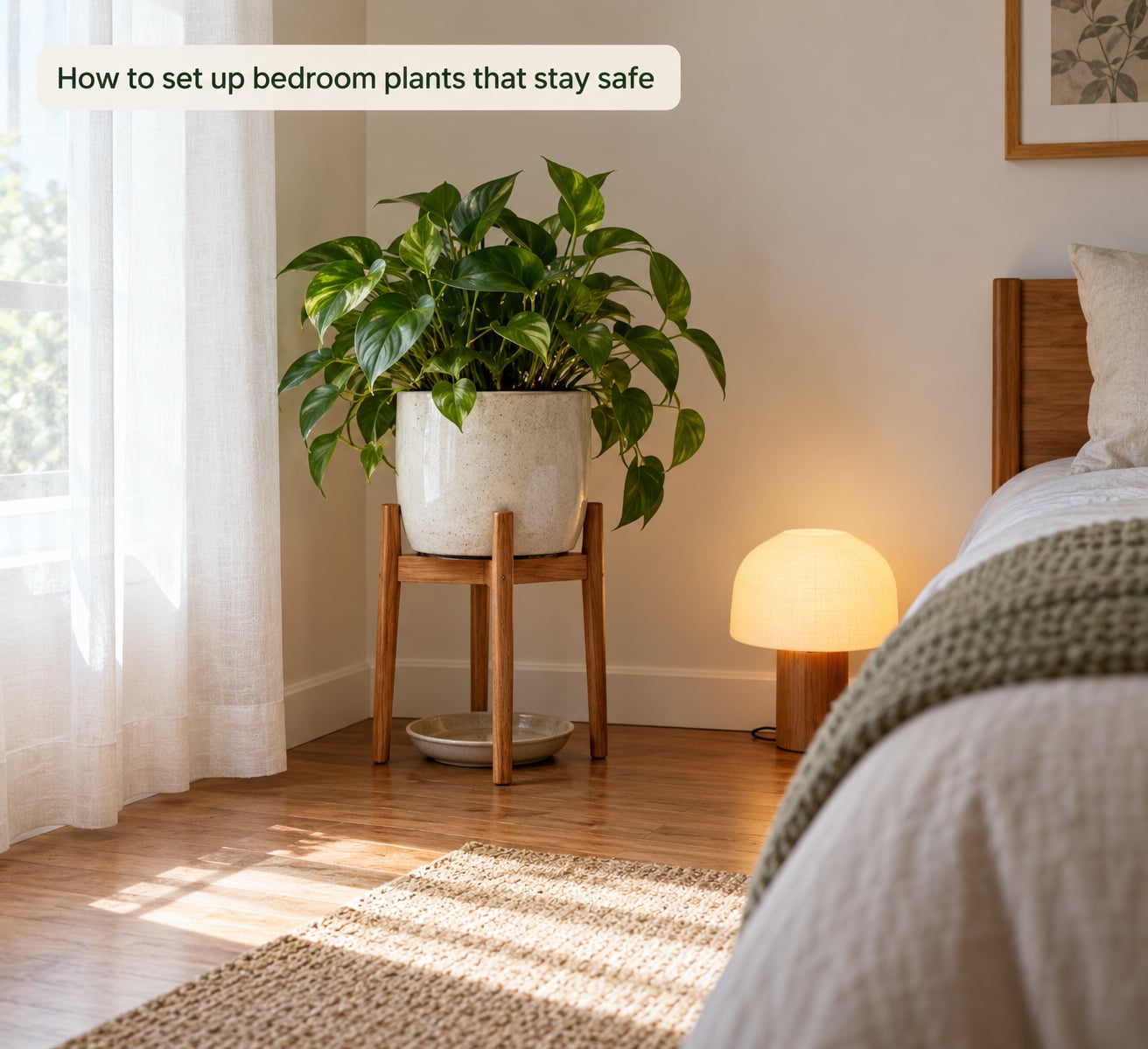
Wipe broad leaves monthly with a damp cloth. It removes dust and it stops you aerosolising it at head height. Put anything tall or trailing on a stand, a shelf outside arm’s reach, or the floor, never on a headboard where it can fall onto a sleeping person.
Pick a realistic number
Two to four plants is a sensible scale for a bedroom. Beyond that you are watering in the dark on a schedule you will not keep, which is exactly how damp soil and mould appear.
Sources and references
- Wolverton, B.C., Johnson, J.R. and Bounds, K. (1989). Interior Landscape Plants for Indoor Air Pollution Abatement. NASA Technical Memorandum. Note that results come from sealed test chambers.
- Cummings, M.P. and Waring, N.S. (2020). Potted plants and indoor air quality: a meta-analysis. Journal of Exposure Science & Environmental Epidemiology.
- ASPCA Animal Poison Control Center, toxic and non-toxic plant listings for cats and dogs.
- Missouri Botanical Garden Plant Finder and Royal Horticultural Society plant profiles for light and care requirements.
Last reviewed October 2026. Re-reviewed every 12 months; the science here is stable but toxicity listings do change.
Frequently Asked Questions
Do indoor plants give out oxygen at night?
Most do the opposite. Plants close their stomata after dark and respire, absorbing oxygen and releasing carbon dioxide. A small group using crassulacean acid metabolism, or CAM, opens its stomata at night to take in carbon dioxide and releases a little oxygen as a side effect. That covers snake plant, ZZ plant, aloe vera, bromeliads and most Phalaenopsis orchids. The mechanism is real. The volume is not.
Do all plants give out oxygen at night?
No. CAM is confined mainly to succulents and drought-adapted species. Most common houseplants, including spider plant, peace lily, pothos, dracaena, areca palm and Boston fern, are not CAM and respire like everything else after dark. In a normal bedroom the difference between these two groups is far too small to measure.
What plants should not be in your bedroom?
Four groups. Toxic species such as peace lily, pothos, dracaena, aloe vera, ZZ and snake plant if cats, dogs or small children have access. Flowering or pollen-shedding plants if you have hay fever. Anything trailing from above a sleeping surface, including a headboard shelf. And very dense planting in a small closed room, which can push humidity past the range where mould grows on walls and textiles.
Why are my allergies worse in my bedroom?
Usually soil mould and dust rather than the plant itself. Damp potting soil that never dries is the most common source, followed by dust held on broad waxy leaves and pollen from flowering species. Try moving every plant out for two weeks without watering anything. If symptoms settle, reintroduce plants one at a time and keep only the ones that make no difference.
Can houseplants actually make you sick?
Rarely, and usually through mould rather than the plant. Persistently wet soil, blocked drainage and standing water in saucers all encourage fungal growth in the pot. Some people also react to soil particles and to plant-derived dust. Severe or persistent symptoms deserve a conversation with your doctor or allergist rather than an internet article.
Is it healthy to sleep with plants in your bedroom?
For most people, yes. Studies link indoor greenery to lower stress and a calmer room, and plants release moisture through transpiration. The measurable air-quality effect in a normal bedroom is modest, so treat plants as a comfort and design feature. Match the species to your light, water only when soil has dried, and wipe leaves monthly.
Conclusion
Are plants in the bedroom safe at night? For almost everyone, yes, and the reason is arithmetic rather than opinion: a plant’s night-time respiration is a negligible fraction of one sleeping adult’s oxygen use. Start by checking the two things that actually cause trouble. Confirm nobody in the room can chew a toxic species, then let the soil dry fully between waterings. Everything else is a design choice.