Houseplant leaves develop brown spots because the tissue has died, and something killed it. That something is usually overwatering, harsh light, mineral salt build-up, pests or a leaf spot disease, and the colour alone tells you almost nothing. Diagnose it by reading three things instead: how the spot feels, where it sits on the leaf, and whether it is still spreading.
One honest warning before we start. Brown patches never turn green again. The useful question is not whether a damaged leaf heals but whether new leaves come out clean, because that tells you whether your routine is fixed.
Table of Contents
- Why Houseplant Leaves Have Brown Spots: Quick Diagnosis
- What Do Different Brown Spot Patterns Mean?
- How to Tell the Eight Common Causes Apart
- 1. Overwatering and Poor Drainage
- 2. Underwatering and Dry Air
- 3. Sunburn, Heat Stress and Cold Damage
- 4. Mineral Salts and Fertiliser Burn
- 5. Pests and Their Residue
- 6. Fungal and Bacterial Leaf Spot
- 7. Physical and Environmental Injury
- 8. Aging or an Old Existing Spot
- How to Check Your Houseplant Step by Step
- How to Prevent Brown Spots Returning
- Frequently Asked Questions
- Can houseplant leaves recover from brown spots?
- Should I cut off a leaf with brown spots?
- How do I tell brown spots from a fungal leaf spot?
- Is it safe to mist a plant with brown spots?
- Why do new leaves have brown spots as they unfurl?
- When should a plant with brown spots be discarded?
Why Houseplant Leaves Have Brown Spots: Quick Diagnosis
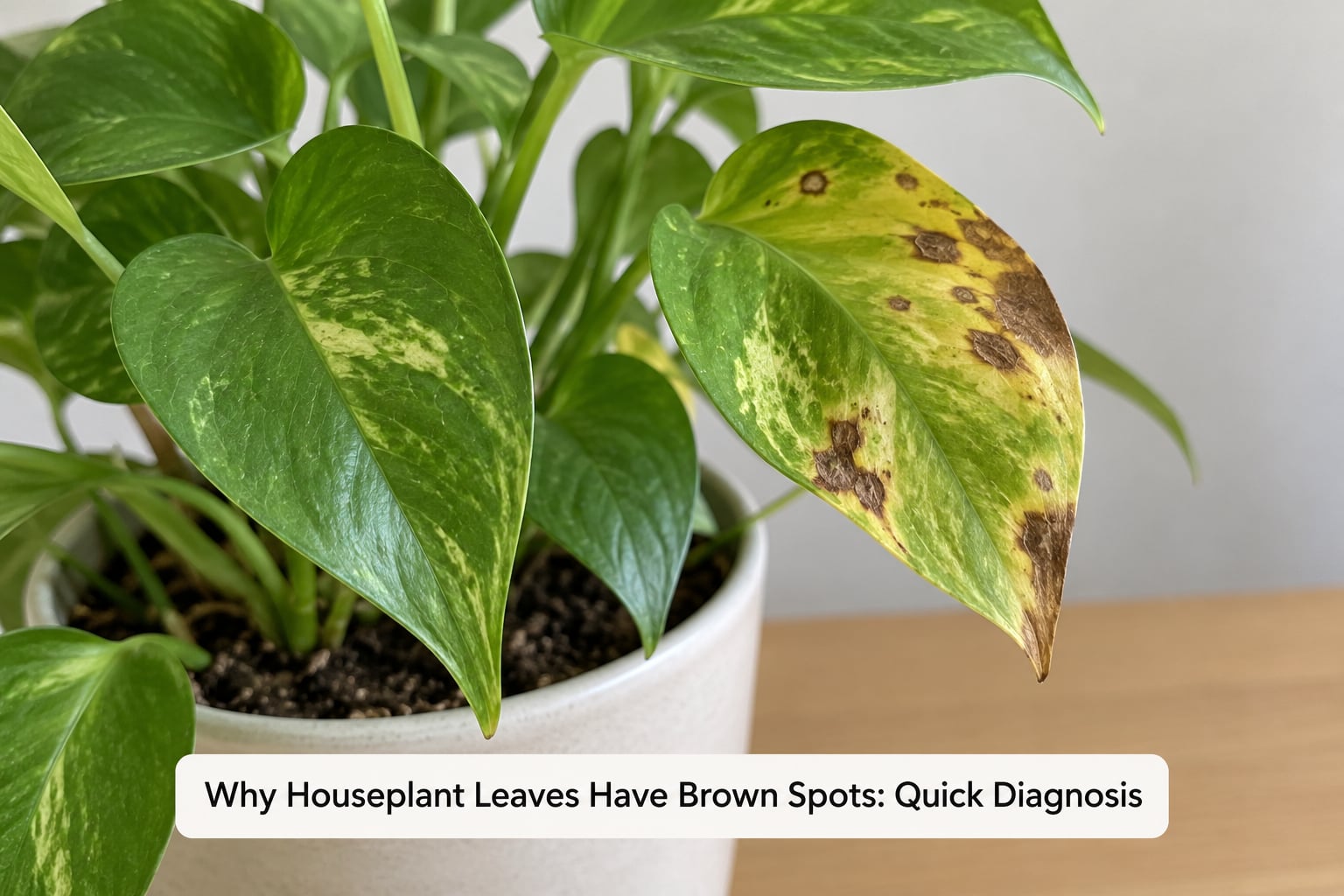
This table is the fastest read. Match what you are holding in your hand against the left column, then check the right one.
| What you see | Feel and location | Likely cause | First check |
|---|---|---|---|
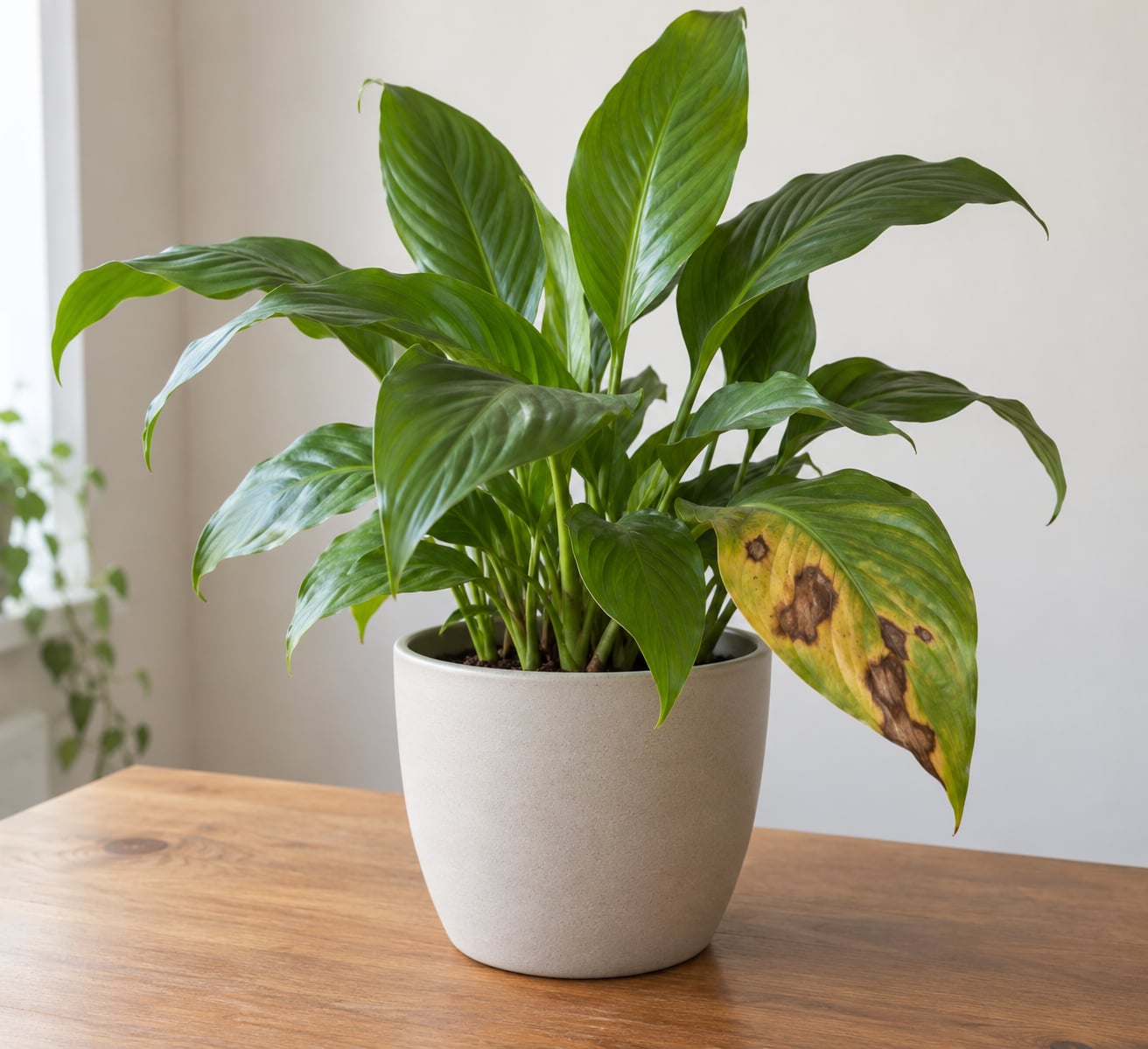
| Soft, dark brown patch, often starting at the edge or between veins | Soggy or water-soaked, oldest lowest leaves first | Overwatering and root rot | Push a finger 2 inches into the soil |
| Dry brown tip or thin crisp margin | Papery, on leaves furthest from the window | Dry air, low humidity, inconsistent watering | Check for a humidifier or dry radiator nearby |
| Bleached, sharply defined patch | Flat and papery, only on the window-facing side | Sunburn or heat off a hot pane | Note how many hours of direct sun the plant gets |
| Brown spot ringed by a yellow halo | Spreading, sometimes with concentric rings | Fungal leaf spot such as Septoria or anthracnose | Look for new spots on neighbouring leaves |
| Raised corky bumps that feel like sand grains | On the underside of leaves, often after heavy watering | Edema, from roots drinking faster than leaves transpire | Cut back on watering frequency |
| Many tiny pale dots, fine webbing or sticky residue | Mostly on new growth and leaf undersides | Spider mites, thrips or scale | Tap a leaf over white paper |
If your plant came home from a shop and spotted within two or three weeks, the usual explanation is acclimation stress plus whatever watering schedule you adopted straight away. Greenhouse plants are grown warm, wet and evenly watered, then dropped into a cooler, drier room.
What Do Different Brown Spot Patterns Mean?
Three readings separate most cases. Texture tells you about water or light. Location tells you about the plant’s systems. Spread tells you whether you are dealing with old damage or something active.
Texture is the fastest clue. Soggy spots point to excess water or a soft infection. Papery, dry spots point to light, heat or dry air. Greasy-looking spots with a soft water-soaked edge usually mean cold water hit the leaf or a bacterial infection is at work. Raised and corky is different again, and that is edema rather than leaf spot.
Location narrows it further. Damage on the window-facing side usually means light. Damage on the oldest, lowest leaves points at the roots, because that is where a plant sends problems first. Scattered spots with no pattern lean towards disease or pests.
Spread is the tiebreaker. Mark a spot with a pen or take a photo today, then look again after three days. An active problem adds new spots and reaches new growth. Old damage stays exactly where it was.
| Symptom | Where it shows | Usual cause | What it needs |
|---|---|---|---|
| Brown spots in the middle of the blade | Any leaf, scattered | Fungal or bacterial leaf spot, pest feeding | Remove affected leaves, improve airflow, check for pests |
| Brown tips and thin crisp margins | Tips and edges of many leaves | Dry air, hard water, salt build-up, inconsistent watering | Even watering, humidity, flush the potting mix |
| Whole leaves yellowing then dropping | Oldest leaves first | Overwatering or a nutrient shortage | Correct the watering rhythm before feeding anything |
Brown tips and brown spots are genuinely different problems, and they have different fixes. Tips mean the plant ran out of water or picked up too many minerals. Discs of dead tissue in the middle of a leaf mean something landed on it, bit it or infected it.
How to Tell the Eight Common Causes Apart
Work through these in order, cheapest test first. Most brown spot cases I see are one of the first four, so start there before buying anything.
1. Overwatering and Poor Drainage
This is the leading cause of brown spots on houseplant leaves, and it is almost always driven by a fixed schedule. Watering every Sunday regardless of the soil is how most indoor plants get hurt.
Roots sitting in wet soil stop taking up water and start rotting. The plant wilts anyway because its damaged roots cannot move moisture, so you water again, and the cycle tightens. Leaves show soft, dark brown patches with yellowing around them, usually on the oldest, lowest leaves.
A single dry blemish does not fit here. Overwatering produces soft, spreading, wet-looking damage on several leaves, not one crisp mark. Check by pushing a finger 2 inches into the soil. If it comes out damp, that is your answer.
What to change first: check that the pot has a drainage hole, and empty any water sitting in a saucer or cachepot. Let the top inch or two of potting mix dry before the next drink.
2. Underwatering and Dry Air
Dry problems look different from wet ones. You get crisp brown edges, curling leaf margins and brittle texture rather than soft patches, and it usually shows up during hot or dry weather or when a radiator is running nearby.
Low humidity alone rarely spots a healthy plant, but it combines with wet foliage and poor airflow to set up disease. People r/plantclinic answerers consistently point out that a plant snapping back after a drink is far better evidence than any schedule, and that waiting for the soil to dry or for slight droop beats any fixed day of the week.
Group plants together and stand them on a tray of pebbles and water, or run a humidifier nearby. Aim for somewhere around 40 to 60 percent relative humidity in the room.
3. Sunburn, Heat Stress and Cold Damage
Sunburn makes bleached, papery patches with fairly sharp edges, and it appears only on the side of the plant facing the light. Heat off a hot window pane in summer can look similar even without direct sun, particularly on leaves pressed against the glass.
Cold damage arrives soft and dark instead. Chilling from an open exterior door or a draughty sill, cold tap water splashed onto a leaf, or a plant carried home in freezing weather all produce water-soaked patches that later turn brown. Several forum threads trace straight back to a plant moved from shade into six to eight hours of spring sun.
Acclimate instead of relocating suddenly. Move plants back a foot or two from a south or west window, and keep them off cold glass in winter.
4. Mineral Salts and Fertiliser Burn
Salt problems announce themselves with a white crust on the soil surface or the pot rim, plus repeated tip browning that never quite goes away. Spots that appear within days of feeding point the same way.
Hard tap water keeps depositing minerals the plant cannot use, and repeated fertiliser without a flush stacks up. Both burn the leaf margins first, then the tissue between them.
Flush the pot with two to three times its volume of plain water, let it drain fully, and hold off on feeding for a few weeks. Use filtered or rain water if the crust returns quickly.
5. Pests and Their Residue
Pests damage leaves and leave evidence. Spider mites spin fine webbing between stems and leaves and cause tiny pale stippling that turns brown. Thrips speckle new growth with small brown scars and leave black flecks in their waste. Scale insects look like small brown or pale bumps stuck to veins and stems that scrape off with a fingernail.
Sticky residue on leaves or the floor underneath is usually honeydew, which points to mealybugs, scale or aphids. Turn the leaf over. Many plant clinic threads name thrips and armored scale as the culprits behind small brown spotting on new growth, with insecticidal soap or dabbing alcohol on a cotton swab as the usual follow-up.
Isolate the plant first so nothing next to it gets the same problem, then wipe, rinse and treat consistently for several weeks rather than once.
6. Fungal and Bacterial Leaf Spot
This is the one people panic about, and it deserves a clear read. Fungal leaf spots, most often Septoria, Alternaria or anthracnose, look like round brown discs with concentric rings, sometimes ringed by a yellow halo. Bacterial spots, including Pseudomonas and Xanthomonas, look water-soaked, feel greasy and often have a yellow halo that has no rings.
Experienced growers consistently read a yellow ring around a spot as fungal. That halo shows the pathogen is still active in the tissue, and the spots will keep appearing on new leaves if nothing changes.
Remove affected leaves with clean scissors wiped in alcohol between cuts. Bag the debris and bin it rather than composting. Water at the soil line, not over the foliage, and increase air movement so wet leaves dry faster. A labelled copper fungicide or a chlorothalonil product can slow a bad case, and always follow the label.
7. Physical and Environmental Injury
Plants get hurt by contact more often than people expect. A leaf pressed against a wet pot or a windowsill holds moisture against the tissue, and it dies there. Water sitting on the foliage after a spray, a humidifier running too close, or an aerosol or leaf shine product landing on a leaf will each leave spots that look like disease and are not.
Sudden swings count too. A plant carried from a humid bathroom to a dry, draughty hallway in an afternoon will often drop or spot within a week. That is acclimation stress, and it settles if you keep conditions steadier.
8. Aging or an Old Existing Spot
Not every spot means the plant is unwell. Leaves get bruised against the pot, scratched during repotting or damaged by a neighbour’s expanding leaf, and that tissue scars and stays brown forever.
The tell is time. A spot that was there three days ago and has not grown is history. A spot that has spread, or that has been joined by two new ones, is a live problem. I also judge plants by their newest leaf, since a clean new leaf is the clearest evidence that the current routine is working.
One old spot per leaf is cosmetic. A plant with several leaves dropping and no clean growth underneath is not.
How to Check Your Houseplant Step by Step
This takes about a minute and settles most cases.
- Isolate the plant. Move it away from its neighbours if the spots are spreading or you suspect pests.
- Look at the top and the underside of a leaf. Check for webbing, sticky residue, scale bumps, tiny moving specks and any yellow halo.
- Press a finger 2 inches into the soil. Wet means water. Bone dry means drought. Moist means look elsewhere.
- Check drainage and roots. Confirm the pot has a hole, then slide the plant out and look for dark, soft or sour-smelling roots.
- Review what changed. Watering frequency, a new fertiliser, a new window position, a repot or a new plant nearby all count.
- Photograph and wait three days. Compare. New spots mean active damage; unchanged spots mean old damage.
If the plant still has no clean new growth after a month of corrected care and the spots keep arriving, a university extension service or plant diagnostic clinic can look at a leaf sample and identify the pathogen. That is far more reliable than guessing at fungicides.
How to Prevent Brown Spots Returning
Prevention is mostly consistency. Water based on soil moisture rather than the calendar, and let the top inch or two dry for most tropical houseplants before you water again.
Match the pot to the plant. A container too large holds wet soil the roots never use, and one too small dries out within a day. Every pot needs a drainage hole.
Water at the soil and empty any saucer after ten minutes, because standing water breeds root rot and fungus. Overhead watering leaves foliage wet overnight, which is exactly what fungal spores want.
Acclimate plants to new light positions gradually, especially in spring and summer. Feed lightly during the growing season and flush the pot occasionally so salts do not accumulate.
Keep air moving and rooms within a normal household humidity band. Quarantine new plants for two to three weeks in a separate room before they join the rest, and keep them out of direct sun while they settle.
One habit worth dropping: misting. Forum posters describe it constantly as a cure, but it does not raise humidity around the plant for long, it can spread fungal spores, and misting leaves in sunlight burns holes in them.
Frequently Asked Questions
Can houseplant leaves recover from brown spots?
No. Brown patches are dead tissue, so they will never turn green again. Recovery happens on new growth instead. Judge your plant by whether the newest leaf comes out clean, which usually takes four to eight weeks after you correct the cause.
Should I cut off a leaf with brown spots?
Remove it when spots are spreading, when a yellow halo is present, or when a heavily affected leaf is pulling on the plant. Leave it if the spot is old, dry and isolated, since a healthy leaf still photosynthesises. Wipe your scissors in alcohol between cuts and bag the debris for the bin rather than the compost heap.
How do I tell brown spots from a fungal leaf spot?
Read texture, pattern and movement. Sunburn spots are dry, papery, sharply defined and only on the window-facing side, and they stop appearing once light is corrected. Fungal spots carry concentric rings or a yellow halo, feel slightly greasy or water-soaked, and keep appearing on new leaves while the plant is untreated.
Is it safe to mist a plant with brown spots?
Usually not. Misting does little for real humidity, leaves wet surfaces that fungal spores thrive on, and burns leaf tissue into holes when sprayed in direct sun. If your plant is in a very dry room, a humidifier or a pebble tray gives far better results without wetting the foliage.
Why do new leaves have brown spots as they unfurl?
Tissue damaged while the leaf was still forming cannot repair itself, so the damage opens up as the leaf expands. Usual culprits are pests feeding on tender growth, thrips in particular, a cold splash or draught on a young leaf, and a sudden move into stronger light. Check new growth for insects before you blame the water.
When should a plant with brown spots be discarded?
Discard it when stems or the crown are soft or collapsing, most of the foliage has dropped and no new growth appears, or a bacterial infection has taken most of the leaves with no healthy growth left to carry the plant. Dispose of the soil and pot rather than reusing them, since the pathogen survives in the mix.
Start with the soil and the watering rhythm, since that settles the majority of cases. Check a finger 2 inches down, look at the underside of a leaf for pests, and give the plant three days to show you whether anything new appears.
That last review was done in October 2026. If your plant came straight from a shop, treat the first month as an adjustment period rather than a sign anything is wrong.