Yes, you can use tap water for houseplants — for the large majority of them, straight from the tap is fine and costs nothing. The exceptions are specific: very hard water, a chloramine-treated supply, and a short list of fussy tropicals that show damage quickly. Missouri Botanical Garden treats tap water, well water and rainwater as equally usable once warmed to room temperature, and most plant problems blamed on water turn out to be watering habits instead.
That is the whole argument in three sentences. The rest of this guide is about telling which side of that line your plants sit on.
Table of Contents
- Tap Water and Houseplants at a Glance
- Can You Use Tap Water on Most Houseplants?
- When tap water is fine
- When tap water causes problems
- What Problems Can Tap Water Cause?
- Chlorine, and why chloramine is different
- Hard water and limescale
- Fluoride and alkaline pH
- Water temperature
- How Do You Know If Your Tap Water Is Safe for Plants?
- Which Houseplants Are Most Sensitive to Tap Water?
- React quickly to hard or treated water
- Happy with almost anything
- How to Use Tap Water More Safely
- Should You Use Bottled, Filtered, or Rain Water Instead?
- How to Tell Whether Your Plant Likes Its Water
- Frequently Asked Questions
- Which plants do not like tap water?
- How long does it take for tap water to be safe for plants?
- What type of water is best for houseplants?
- Why are my indoor plants getting brown on their tips?
- Does overwatering cause brown leaf tips?
- Is it safe to water houseplants with hard water?
- Conclusion
Tap Water and Houseplants at a Glance
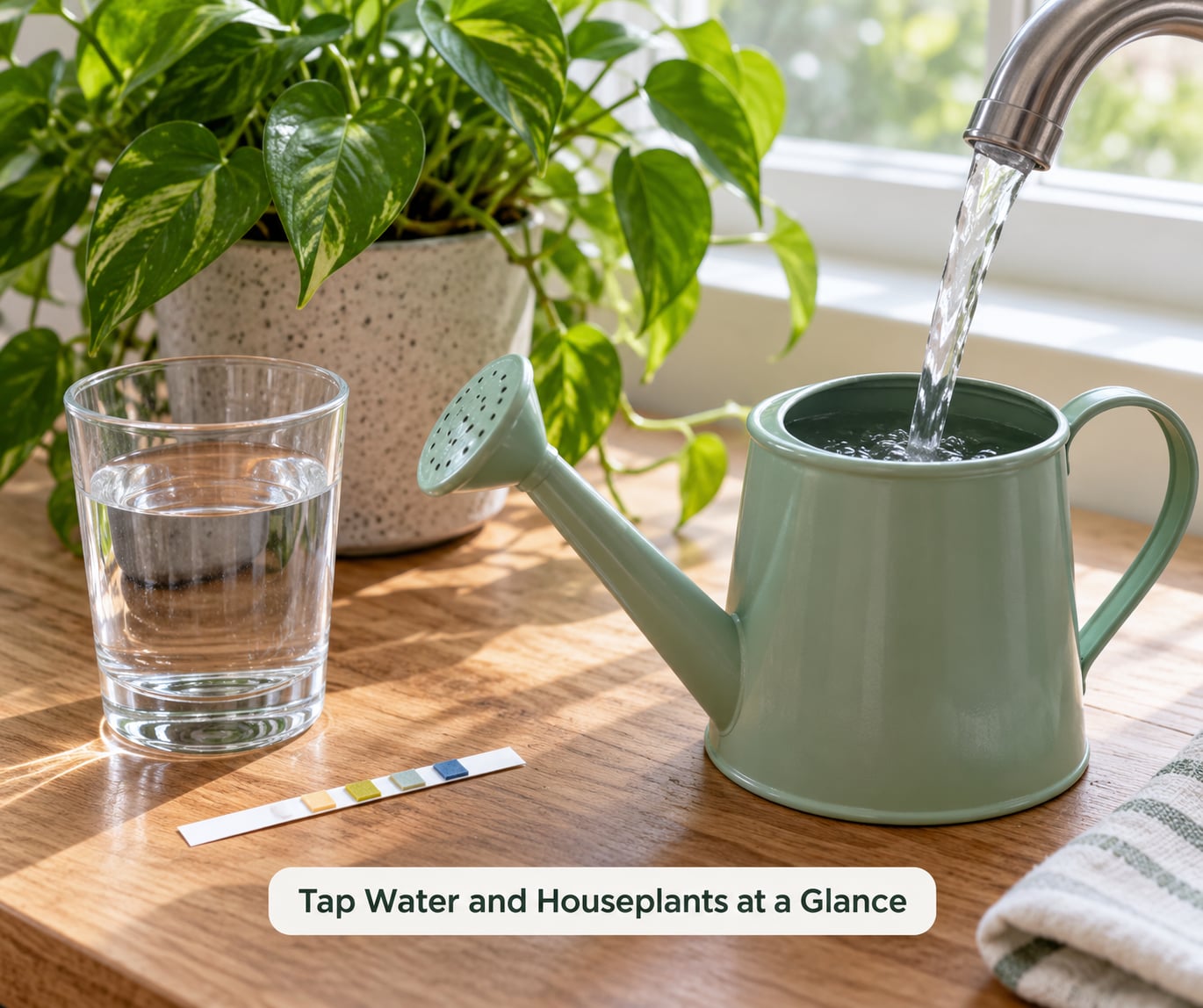
Here is the short version. Almost every household water supply carries at least one thing that bothers some plants, and none of it is a problem for every plant.
| Water concern | What it does | Who notices it |
|---|---|---|
| Chlorine disinfectant | Burns fine root tips at high doses; most drains handle it | New growth on tender plants, freshly repotted specimens |
| Chloramine | Bonds to organic matter and does not evaporate off | Anyone whose utility has switched systems — resting water does nothing here |
| Calcium and magnesium (hard water) | Builds up in potting mix and on pot rims as limescale | Calathea, maranta, ferns, orchids, fiddle leaf figs |
| Fluoride and alkaline pH | Accumulates at leaf tips; high pH locks out iron | Long, narrow leaves that brown first at the point |
| Cold water | Shocks roots on tropicals, stalls uptake for hours | Anything tropical in a cold room |
| Sodium from a water softener | Builds salt in the root zone; no visible crust | Anyone on a softened supply, especially succulents |
Only one of those rows is a genuine emergency, and even it is not. Damage from water quality is slow and cumulative, which means you have time to check rather than guess.
Can You Use Tap Water on Most Houseplants?
The honest answer is yes. A pothos, snake plant, ZZ plant, monstera or most succulents will not notice what you water them with, and the calcium and magnesium in tap water are real plant nutrients rather than purely contaminants.
Long-standing advice on plant forums is simply that if your tap water is safe to drink, it is safe for your plants. That remains a good working rule. Where it needs qualifying is when the water carries a lot of dissolved mineral, when the disinfectant is chloramine, or when the plant is one that reacts fast.
When tap water is fine
- Tolerant plants: pothos, snake plant, ZZ plant, monstera, philodendron, spider plant, most cacti and succulents
- Soil that drains freely and gets watered thoroughly rather than misted
- Water brought to room temperature first
- A supply with moderate hardness and no visible salt ring on the pot
When tap water causes problems
- Very hard water, usually in older homes or dry regions, leaving a white crust on soil and pot rims
- Plants that show browning at the leaf point within weeks of a change in watering routine
- Carnivorous plants, orchids, and acid-loving species in alkaline water
- Any pot that has never been flushed, so minerals accumulate with each watering
Notice the pattern. Water quality matters most when the growing conditions are already marginal, and least when drainage is sharp and the pot is watered properly.
What Problems Can Tap Water Cause?
Chlorine, and why chloramine is different
Utilities disinfect tap water with chlorine or chloramine. Chlorine is volatile: it rises out of water given time and an open surface, which is exactly why leaving water out overnight works.
Chloramine is a chlorine molecule bound to ammonia, and it does not evaporate the same way. Water left open overnight will still carry it, and neither boiling nor standing removes it. If your utility uses chloramine, the “let it sit overnight” advice is useless and you need a filter or a conditioner that targets it.
Hard water and limescale
Hardness comes from dissolved calcium and magnesium. Those minerals accumulate in the potting mix and crystallise on terracotta rims and saucers, which is the white crust you can scrape off with a fingernail.
In a pot, the same minerals coat the root surface and reduce the soil’s ability to hold what the plant needs. Growers in hard-water areas describe exactly this sequence: mineral buildup on roots, browning leaves, and a slow decline. The white ring is the visible clue; it is never harmless, just slow.
Fluoride and alkaline pH
Fluoride is added to many municipal supplies for dental reasons. It concentrates at leaf tips rather than distributing through the leaf, which is why tip browning is the classic symptom rather than general yellowing.
Tap water also tends to sit near neutral to alkaline, often around pH 6.5 to 8.5, while most houseplants prefer something closer to 5.5 to 6.5 in their growing medium. Alkaline water raises mix pH over time, and iron and manganese get locked out, so leaves pale even when you are feeding correctly. This is the same chemistry that makes acid-loving plants and carnivorous species struggle.
Water temperature
Cold water shocks roots. Room-temperature water is the safe default, and Missouri Botanical Garden explicitly makes that condition for tap, well, rainwater and even melted snow. Hotter than roughly 120F and you risk damaging root tissue rather than helping it.
How Do You Know If Your Tap Water Is Safe for Plants?
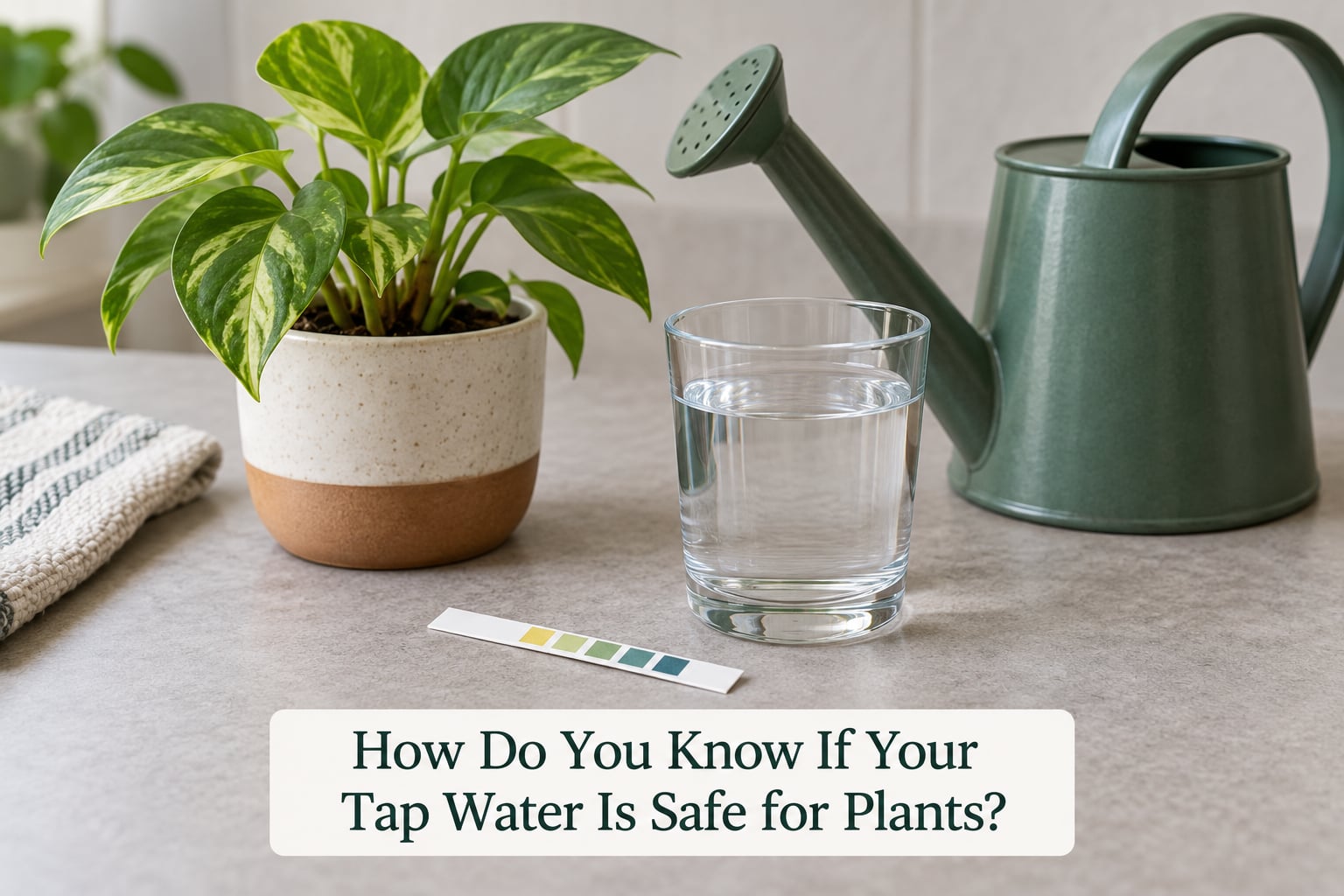
Nobody on the internet can see your plumbing, but you can answer this in about ten minutes. Work down the list and stop when you find the cause.
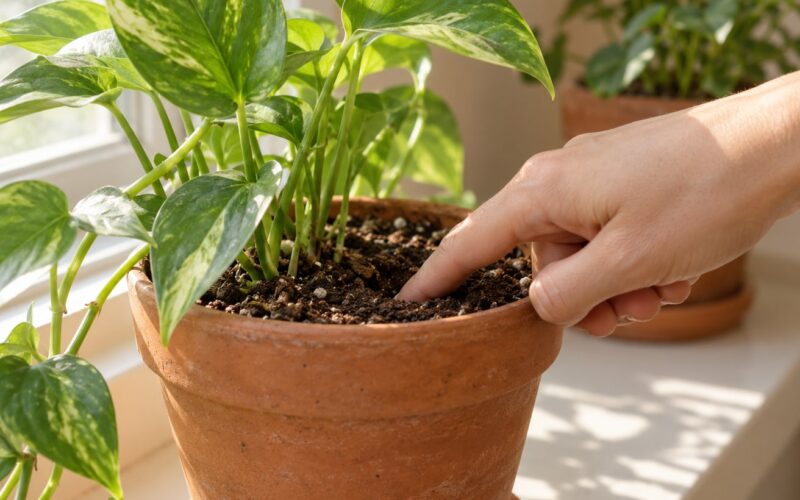
- Look at the pots first. A white, chalky ring on the soil surface or the rim of a terracotta pot is mineral residue, and no other cause looks like it. This is the fastest check there is.
- Call your water utility or check its annual water quality report. Search for “hardness” or “chloramine” on the PDF. Most utilities publish total hardness in grains per gallon and state which disinfectant they use. Above roughly 7 grains per gallon counts as hard by US standards, and around 85 percent of US households fall somewhere in the hard range.
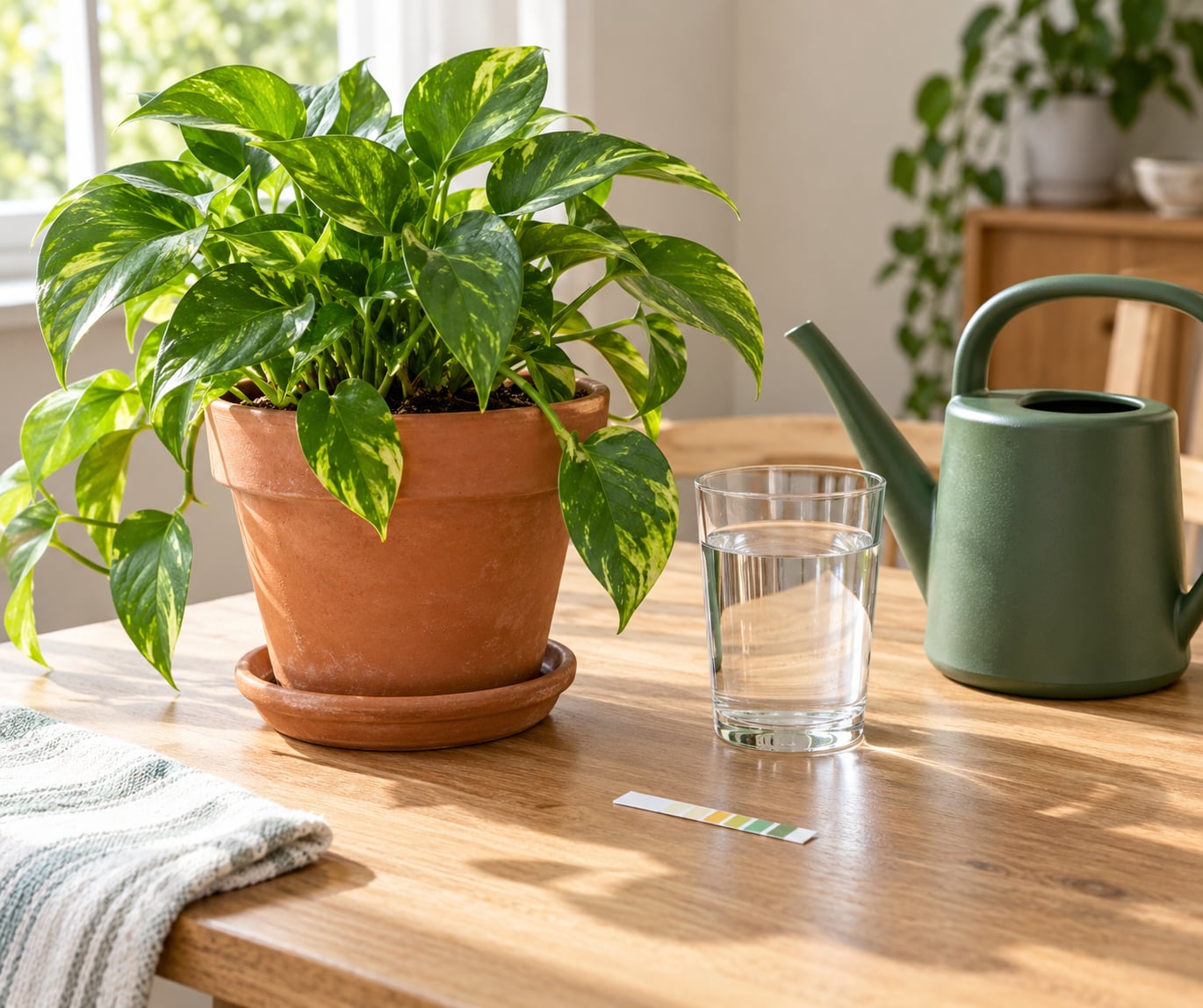
- Use a water-hardness test strip. These are cheap strips that colour-match against a chart and give a grains-per-gallon reading in seconds. If you plan to buy one tool for your plants, buy this.
- Use a pH strip or TDS meter if you want more detail. A TDS meter reads total dissolved solids in parts per million, which covers minerals plus anything else dissolved. Tap water commonly lands somewhere in the range of roughly 100 to 300 ppm; hard water reads well above that.
- Read the plant, not just the water. Crisp browning at the tip and margin, a gritty pot rim, or a plant that stalls for weeks after otherwise normal care are all signals.
- Check for recent plumbing work. After a new main line, a heater replacement or copper repairs, run the cold tap for a few minutes. New pipes can briefly produce water with different chemistry, and old copper lines can pick up metals.
If the water smells like a swimming pool or bleach, it is heavily chlorinated. If it smells faintly of fish or musty damp, it may be chloraminated — a good hint that standing water will not help you.
Which Houseplants Are Most Sensitive to Tap Water?
Sensitivity tracks with two things: how thin the leaf is and how much of the plant’s care depends on stable moisture and slightly acidic soil.
React quickly to hard or treated water
- Calathea and prayer plant (maranta) — the classic tip-burners, and the first plants to show it in a hard region
- Boston fern and other ferns, which want soft, slightly acidic conditions
- Peace lily, sensitive to both minerals and any drop in humidity
- Spider plant, long narrow leaves that mark tip damage visibly
- Fiddle leaf fig, unforgiving of hard water and inconsistent moisture
- Carnivorous plants such as Venus flytraps and pitcher plants, which need low-mineral water and cannot tolerate fertilizer in it
Happy with almost anything
- Pothos, heartleaf philodendron and most vines
- Snake plant and ZZ plant, both drought-tolerant and mineral-tolerant
- Monstera and most aroids in a free-draining mix
- Cacti and succulents, which prefer to dry fully between waterings anyway
Orchids sit somewhere in the middle. Their roots are thin and prone to salt crusts in a plain potting medium, but they are usually grown in bark that drains fast and gets flushed often, which keeps the problem in check.
How to Use Tap Water More Safely
Most of these take seconds. The order matters less than doing several of them consistently.
- Match the temperature to the room. Let water stand until it is not cold in the hand. On a cold windowsill this takes an hour; in a warm room it takes fifteen minutes.
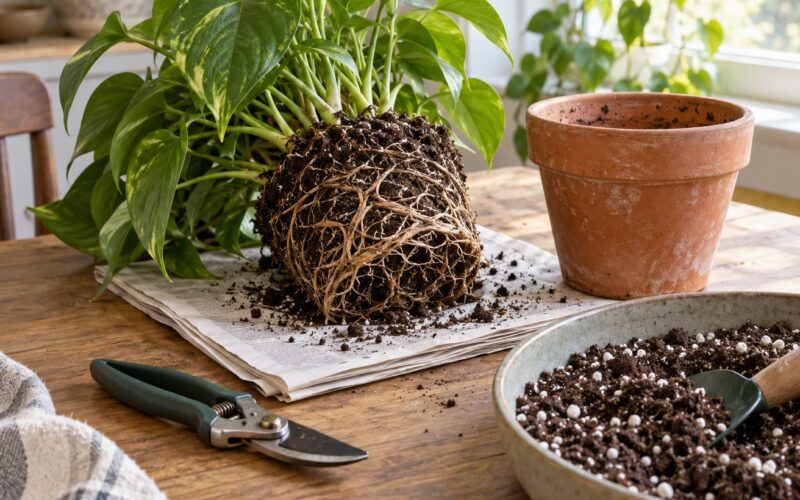
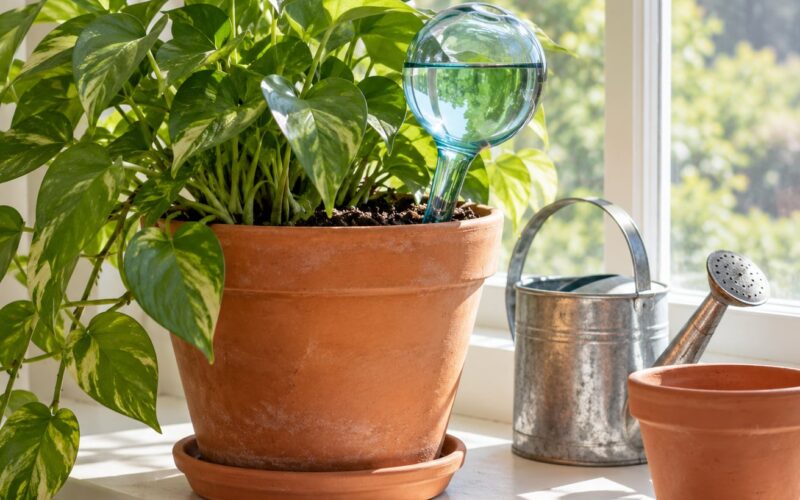
- Water thoroughly, then drain. Water until it runs out of the bottom, wait a minute, then empty the saucer. A full flush pushes accumulated salts out of the pot instead of letting them sit there.
- Let water sit overnight for chlorine only. Wide-mouthed, uncovered, at room temperature. This is the routine most plant guides recommend, and it works on chlorine systems. Skip it if you are on chloramine and use a filter instead.
- Boil for the same purpose. Fifteen to twenty minutes of boiling drives off chlorine, then cool it to room temperature before it touches roots.
- Add a water conditioner or a small amount of ascorbic acid powder. Aquarium dechlorinators bind chlorine and chloramine and are cheap. Use the dose for a few gallons rather than a full sink of water.
- Use a carbon filter jug if it is a recurring problem. Activated or catalytic carbon removes chlorine, chloramine and much of the odour. It does not meaningfully reduce hardness.
Two habits worth skipping entirely: adjusting pH with baking soda, which raises it rather than lowering it, and chasing a neutraliser for plants you have never seen react. Both add complexity for nothing.
Should You Use Bottled, Filtered, or Rain Water Instead?
Alternatives are worth it when you have a specific problem, not as a default upgrade. Each one trades something away.
| Water source | Chlorine | Minerals | Good for | Watch out for |
|---|---|---|---|---|
| Tap, straight | Present | Depends on region | Tolerant plants, mixed collections | Tip burn and limescale in hard areas |
| Tap, rested 24h | Reduced if chlorine | Unchanged | Chlorine systems, routine use | Does nothing for hardness or chloramine |
| Rainwater | None | Very low, plus nitrate dust | Acid-loving and tropical plants | Storage, mosquitoes, roof contaminants |
| Filtered jug or pitcher | Largely removed | Partly reduced | Chlorine or chloramine, everyday use | Cartridges need replacing on schedule |
| Distilled | None | Almost none | Carnivorous plants, orchids, salt-sensitive species | Cost, hauling, and no calcium or magnesium at all |
| Reverse osmosis | Removed | Roughly 92 to 99 percent removed | Whole-home problems, mixed collections | Very stripping, wasteful, no beneficial minerals |
| Softened | Present | Sodium instead of calcium | Nothing, really | Sodium builds up in the root zone over time |
Rainwater is the most genuinely useful alternative. It is naturally soft, naturally slightly acidic, and free if you can collect it, and it removes the need for any of the chlorine discussion. If you are in an apartment without a garden, a car-wash runoff bucket or a clean lidded bin outdoors does the same job.
Distilled water is excellent for the handful of plants that need near-zero minerals, and a poor default for everything else. It arrives with no calcium or magnesium at all, so it removes what tap water quietly supplied. Use it where the plant demands it rather than as a habit.
Avoid softened water. Ion-exchange softeners swap calcium and magnesium for sodium, and sodium accumulates in potting mix with no visible crust to warn you it is happening.
How to Tell Whether Your Plant Likes Its Water
Change one thing at a time, then give it three to four weeks. New growth is the honest signal: old damage will not reverse, but the next leaf tells you what the plant thinks of the change.
Helpful signs after a switch: new leaves come in without brown tips, a stalled plant pushes a leaf, an edge-burned calathea unfurls cleanly, or the white crust stops returning after a flush.
Watch for the opposite, too. Sudden yellowing across many leaves after a change usually points at the medium drying out faster than before, which happens when you switch from hard tap water to distilled or reverse osmosis water.
And check the usual suspects before blaming the water. Brown tips show up with underwatering, dry air, fertilizer applied to dry soil, and salts from over-feeding. Low light causes yellowing. Compacted soil and blocked drainage cause rot. Water quality is one cause among several, and it is the one most likely to be blamed for something else.
Frequently Asked Questions
Which plants do not like tap water?
Calathea, maranta prayer plants, Boston ferns, peace lilies, spider plants, fiddle leaf figs, orchids and carnivorous species react fastest to hard or treated water. Signs include brown leaf tips, crisp margins and a white crust on the soil or pot rim. Tolerant plants such as pothos, snake plants, ZZ plants and monstera rarely show problems from tap water.
How long does it take for tap water to be safe for plants?
Leaving water out uncovered at room temperature for 24 hours is enough to let chlorine dissipate. That method does nothing about hardness or salts, and it does not work at all on a chloramine system, where the disinfectant stays bound. For chloramine or heavy mineral content, use a carbon filter, a dechlorinating conditioner or rainwater instead.
What type of water is best for houseplants?
For most collections, room-temperature tap water is perfectly good. Rainwater is the best all-round upgrade because it is naturally soft and slightly acidic. Distilled or reverse osmosis water suits carnivorous plants, orchids and salt-sensitive species, but used everywhere it strips out the calcium and magnesium tap water supplies. Choose based on a specific symptom rather than habit.
Why are my indoor plants getting brown on their tips?
Tip browning has several causes and water quality is only one of them. Fluoride concentrates at the leaf point, and hard water leaves mineral residue. But underwatering, dry air, fertilizer applied to dry soil and over-feeding all produce the same symptom. Check the soil moisture, the humidity and the pot rim before changing your water source.
Does overwatering cause brown leaf tips?
Overwatering more often causes yellowing, soft leaves and root rot than crisp brown tips. Tips usually turn brown when the plant is too dry, the air is too dry, or the roots are damaged enough to stop supplying the leaf point. Waterlogged soil is still a common trigger, because damaged roots cannot move water even when there is plenty of it in the pot.
Is it safe to water houseplants with hard water?
Yes, for tolerant plants, though you will see white limescale on pot rims and the soil surface over time. Sensitive tropicals such as calathea, maranta and ferns suffer more in hard regions. Water them thoroughly and empty the saucer so minerals leave the pot, and consider rainwater or a filtered jug for those plants specifically.
Conclusion
Tap water is fine for houseplants, and treating it as poison sends people on expensive errands they do not need. Water it at room temperature, flush the pot properly, empty the saucer, and most collections never need to think about it again.
Your first action should be observation, not a shopping trip. Look at the soil surface and pot rim for a white crust, check your utility’s hardness report, and note which plants have browning at the tip. If nothing shows, keep pouring. If something does, change the water for those specific plants — rainwater or a carbon-filtered jug — and give it a month to show you the answer.