Houseplants drop leaves for one reason above all others: something changed and the plant decided it could not afford to keep every leaf. Watering, light, temperature, roots, pests and relocation all trigger this, and the leaves that go first are usually the oldest and least efficient ones. Leaf drop is a symptom rather than a diagnosis, so the fix depends entirely on finding which change caused it.
Most cases come down to four things — water, light, roots, or a plant that has just been moved. Work through those in order and you will usually have an answer within ten minutes. This guide covers the causes in the order they are worth checking, how to tell them apart by looking at the soil and the leaves, and what to do about each one.
The single biggest mistake is changing three things at once and then not knowing which one helped. Diagnose first, fix one variable, then give the plant room to show you what it thinks.
Table of Contents
- Houseplant Leaf Drop Causes and Fixes: Start With the Pattern
- What Are the Most Common Causes of Houseplant Leaf Drop?
- Overwatering and root rot
- Underwatering and hydrophobic soil
- Low light
- A sudden increase in light
- Temperature swings and drafts
- Low humidity
- Rootbound or exhausted substrate
- Nutrient problems and fertilizer salts
- Pests
- Acclimation, transport and repot shock
- How to Tell Whether Your Plant Is Overwatered or Underwatered
- How to Fix Leaf Drop from Watering Problems
- What Light, Humidity, and Temperature Changes Cause
- Too little light
- Too much light, suddenly
- Dry air
- Cold glass and hot vents
- How to Fix Leaf Drop Caused by Soil, Roots, and Nutrients
- How to inspect roots
- Fixing root rot
- Fixing a rootbound or exhausted plant
- Nutrients, salts and water quality
- How to Check for Pests and Plant-Specific Stress
- A 7-Day Houseplant Recovery Plan
- When Leaf Drop Is Normal and When You Should Be Concerned
- Frequently Asked Questions
- Why do leaves keep falling after I fixed the problem?
- How long does it take a houseplant to recover from leaf drop?
- Will the dropped leaves grow back?
- Should I cut off droopy or yellow leaves?
- Can a plant recover after losing all its leaves?
- Should I repot a plant that is losing leaves?
- Conclusion
Houseplant Leaf Drop Causes and Fixes: Start With the Pattern
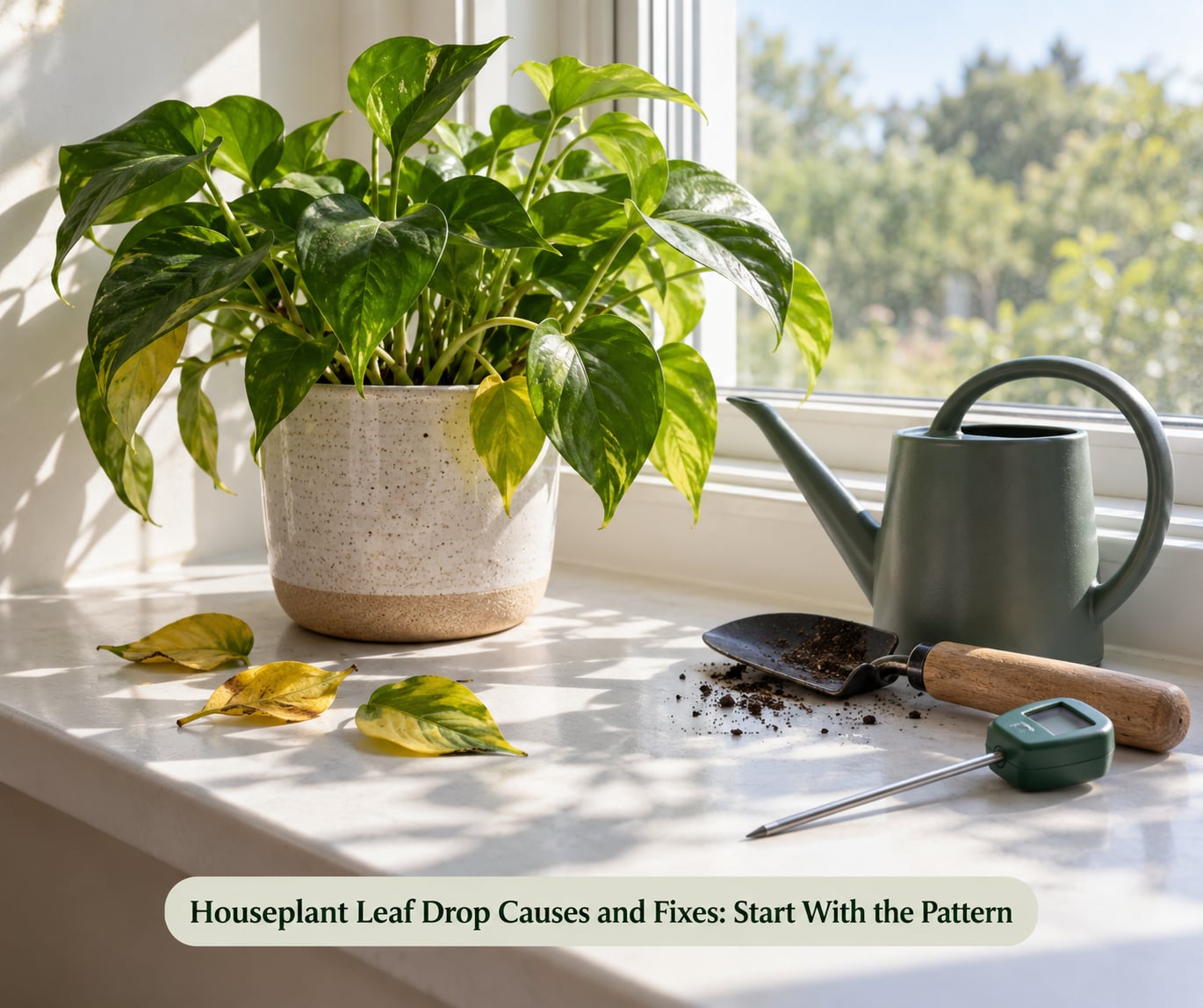
Before you buy anything or change anything, look at what is actually falling. Three questions narrow it down fast: which leaves are going, how fast are they going, and is the soil wet or dry.
Which leaves. Older leaves at the bottom going first is one pattern. New growth at the top dropping, or a sudden shower of perfectly green leaves, is a different pattern entirely. Green leaves falling fast usually point at a sudden change — cold, a move, a wet root zone — rather than a slow nutrient problem.
How fast. One or two old leaves over a couple of months is normal turnover. Ten leaves in a week means something is actively wrong right now.
Soil state. Press a finger two or three centimetres into the top of the mix. Soggy, sour-smelling soil is one chapter; bone-dry soil that water rolls straight off is another.
Then check the four changeable things in order: water, light, roots, position. Temperature and pests follow once you have ruled those out, because they are the slower-moving culprits.
What Are the Most Common Causes of Houseplant Leaf Drop?
Ten causes account for almost every dropping houseplant. Each one leaves a slightly different signature on the leaves, which is how you tell them apart without guessing.
Overwatering and root rot
Soggy soil that stays wet for days, a pot that feels heavy and unpleasant to lift, yellow leaves that feel soft rather than crisp, and a faint sour or swampy smell from the soil. Root rot is what overwatering leads to: waterlogged soil goes oxygen-starved, roots turn soft and dark, and a plant whose roots are rotting cannot hold water — which is why an overwatered plant still looks thirsty.
Underwatering and hydrophobic soil
The opposite signature. Lightweight pot, dry crumbly mix, leaves that curl inward or go crisp at the edges, and a plant that perks up visibly within an hour of a deep watering. Old or peat-heavy mixes also become hydrophobic, meaning they shed water instead of absorbing it — you water, a few dark wet spots appear at the top, and the bottom of the root ball stays dry.
Low light
Plants stretch toward a window, stems get long and bare between leaves, leaves stay small and pale, and the lowest shaded leaves go first. This is slow, quiet leaf drop that people often blame on watering.
A sudden increase in light
The opposite move is just as damaging. A plant moved from a dim corner to full sun, or exposed to an unshaded southern or western window in high summer, develops bleached or papery patches that turn brown and crisp, then drop.
Temperature swings and drafts
A plant on a windowsill in winter sits against glass that drops to near freezing after dark, and right next to a radiator or heating vent in the other months. Chilling makes leaves drop green and fast, often days after the cold night itself. Drafts from an air conditioning vent or a door that opens all day do the same thing more gently.
Low humidity
Dry indoor air, especially in winter, shows up first as brown, crispy leaf tips and edges. In plants that are already marginal — prayer plants, calatheas, ferns — tip browning progresses into leaf loss.
Rootbound or exhausted substrate
Roots circling the surface or poking out of the drainage hole, water running straight through without soaking in, growth that has stalled, and a plant that dries out within two days of watering. Old mix also breaks down, holds less water, and stops feeding the plant.
Nutrient problems and fertilizer salts
Consistently pale, small leaves point to hunger. Brown, crispy leaf edges after fertilising point the other way — salt build-up in the soil, often made worse by watering with hard tap water repeatedly.
Pests
Fine webbing under leaves, cottony white tufts in the leaf joints, hard brown bumps along stems, sticky residue on leaves, tiny flying gnats around the soil, or silvery streaks and black specks. Spider mites and thrips are the ones that cause leaf drop while staying effectively invisible from a normal distance.
Acclimation, transport and repot shock
A new plant that sheds leaves in its first two to four weeks indoors is usually normal. Repotting, moving to a new window, or an unseasonal move from a greenhouse all trigger the same response, especially in Ficus benjamina, which is notoriously dramatic about it.
Here is the same information as a lookup table. Find your symptom, then read the cause and check that one thing first.
| What you see | Likely cause | Check this first |
|---|---|---|
| Soft yellow leaves, heavy pot, sour smell | Overwatering, early root rot | Soil moisture and root colour |
| Crisp curled leaves, light pot, dry mix | Underwatering | Weight of the pot and soil at 3 cm |
| Green leaves falling fast, no yellowing | Cold shock, sudden move, wet roots | Last 72 hours of temperature and placement |
| Brown crispy tips only | Low humidity or water minerals | Humidity reading and watering water |
| Bleached patches then crisp brown | Sudden strong light | Hours of direct sun per day |
| Long bare stems, small pale leaves | Low light | Distance from the nearest window |
| Drop 3-4 days after watering | Overwatered roots absorbing badly | Roots — colour and smell |
| Fine webbing, stippled pale dots | Spider mites | Leaf undersides with a torch |
| Drop within a month of arriving or repotting | Acclimation stress | Light, water and humidity consistency |
| One or two old leaves over months | Normal ageing | Nothing — this needs no action |
How to Tell Whether Your Plant Is Overwatered or Underwatered
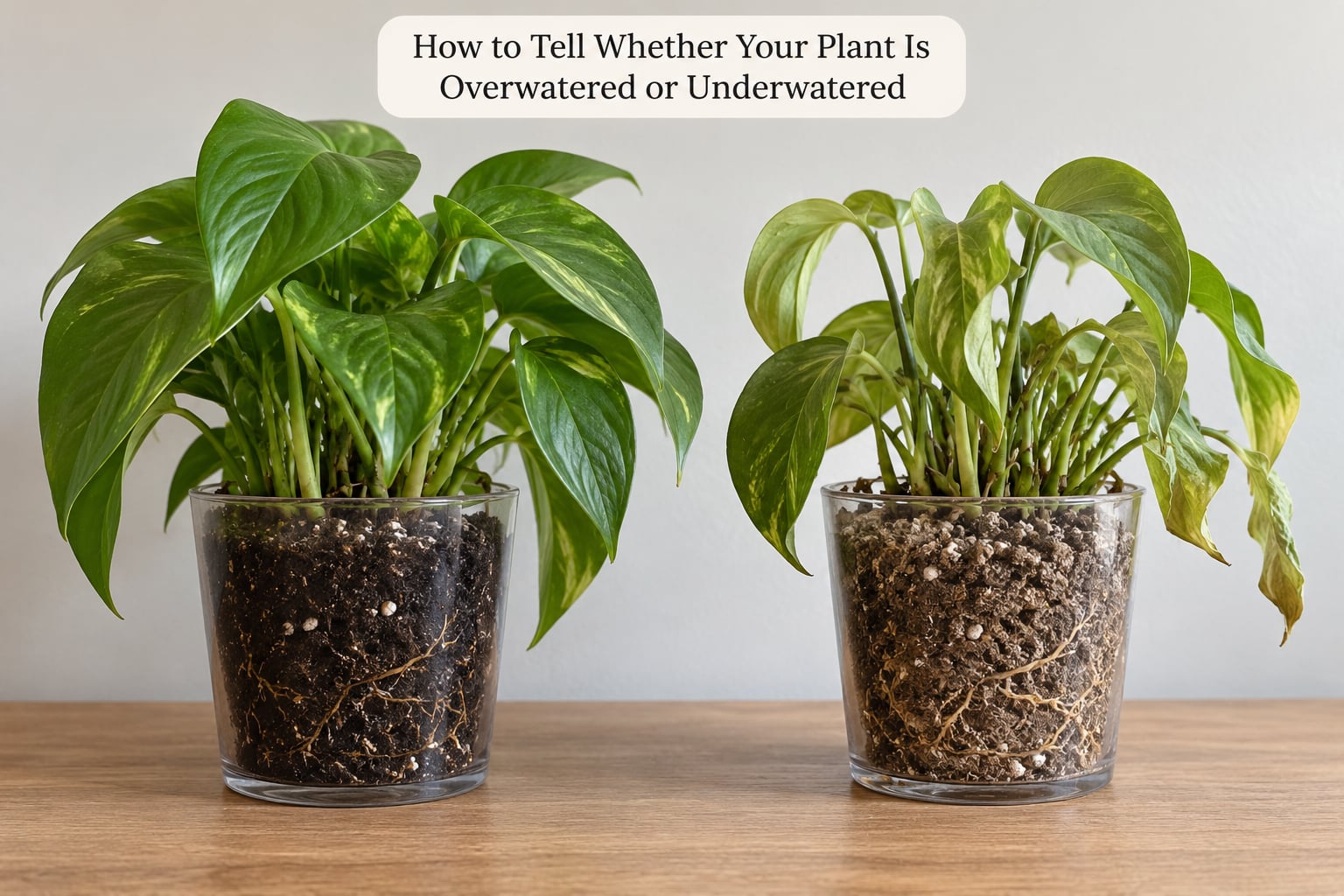
Both problems yellow leaves and both make plants look sad, so guessing from foliage alone is how people water a dying plant to death. Six physical checks separate them, and the soil test takes five seconds.
Soil moisture. Push a finger or a wooden chopstick two to three centimetres down. Wet, cool, and clumping is overwatered. Bone-dry, dusty, and loose is underwatered.
Pot weight. Lift it. A pot that feels heavy for its size is holding too much water. If it feels like it weighs nothing, the plant needs water now.
Leaf texture. Overwatered leaves go soft, limp, and yellow, sometimes with a translucent patch near the stem. Underwatered leaves crisp, curl, and go dull and matte.
Smell. Put your nose near the soil. Sour, swampy, or rotting smells mean saturated soil and root rot. Normal potting mix smells faintly of earth and nothing more.
Drainage. Water and watch. If it runs out of the bottom within seconds and never wets the top layer, the mix is hydrophobic and the roots are still dry. If nothing comes out and the pot is sitting in a wet saucer or cachepot, drainage is blocked.
Roots. The only way to know for certain. Slide the plant out and look: healthy roots are firm, pale cream to tan, and smell earthy. Rotten roots are dark brown or black, soft or slimy, and may fall apart in your fingers.
| Check | Overwatered | Underwatered |
|---|---|---|
| Soil at 3 cm | Wet, cool, clumps together | Dry, dusty, loose |
| Pot weight | Heavy | Surprisingly light |
| Leaf feel | Soft, limp, translucent patches | Crisp, curled, brittle edges |
| Smell | Sour or swampy | Faintly earthy or nothing |
| Drainage | None, or standing water in saucer | Runs through in seconds |
| Roots | Dark, soft, slimy, bad smell | Firm, cream to tan, earthy smell |
| Speed of recovery after watering | No improvement | Perks up within an hour or two |
How to Fix Leaf Drop from Watering Problems
If the plant is overwatered, fix it in this order. Move it out of any cachepot or saucer holding water, check that the drainage holes are actually open, and if the soil is genuinely sodden, slide the plant out, let the root ball sit on newspaper for 20 to 30 minutes, then repot into fresh airy mix a size down. Do not fertilise a stressed plant.
Then change the habit. Test the soil instead of following a weekly schedule, water thoroughly until it runs out of the bottom, empty the saucer after ten minutes, and let the top 2 to 5 centimetres dry depending on the plant type before watering again.
Flush salt and mineral build-up every couple of months by running water through the pot for a full minute and letting it drain completely.
If the plant is underwatered, water slowly and deeply so the whole root ball wets, not just the surface. For a hydrophobic mix, put the pot in a tub of room-temperature water for 30 minutes so the substrate rehydrates rather than repelling water, then drain it fully. Cut back on frequency only once the plant has recovered, and skip the next watering if the soil is still damp, which is how overcorrection starts.
What Light, Humidity, and Temperature Changes Cause
Plants adjust to their surroundings gradually, and leaf drop happens when the surroundings change faster than they can. Every one of these factors is about stability rather than any single ideal number.
Too little light
Below roughly 500 lux, a plant stores less energy than it spends and starts sacrificing leaves. Signs are long internodes, small pale leaves, and a lean toward the window. Fix it by moving the plant closer, removing obstructions, cleaning dusty glass, and adding a full-spectrum LED grow light on a timer for 12 to 14 hours a day if a window will not do it.
Too much light, suddenly
Move a shaded plant into direct sun and the leaf tissue cooks before it can acclimate. Bleached, papery patches turn brown and crisp within days. Introduce stronger light over two to three weeks instead of all at once, and sheer a curtain to diffuse harsh midday sun.
Dry air
Most homes sit well below the 40 to 60 percent relative humidity range that most tropical houseplants prefer, and heating season makes it worse. A hygrometer costs very little and removes the guesswork. Group plants together, keep them away from radiators, or run a humidifier. Misting helps briefly but raises wetness on leaves long enough to invite fungal spots, so treat it as a short-term comfort rather than a fix.
Cold glass and hot vents
Keep plants away from single-glazed windows in winter, and 30 centimetres or more above a radiator or beside a heating vent. Target a steady 18 to 25 degrees Celsius through the day and night, and avoid the afternoon swings created by a plant sitting in direct sun next to a cold pane. An air conditioning vent pointed at a plant is a slow, steady leaf-dropper.
How to Fix Leaf Drop Caused by Soil, Roots, and Nutrients
When watering checks out and the environment is stable, the root zone is the next place to look. This is the stage that requires taking the plant out of its pot.
How to inspect roots
Slide the plant out of the pot and hold the root ball. Firm, cream to pale tan roots with a earthy smell are healthy. Roots that are dark brown or black, soft or slimy, skinned off easily, or smell swampy are rotting. Roots circling densely around the outside, growing through the drainage hole, or matted into a solid mass mean the plant is rootbound.
Fixing root rot
Cut away every soft, dark, or falling-away root with a clean blade. Repot into a pot one size smaller with drainage holes and a fresh, airy mix — a combination of coco coir or peat with perlite or pumice holds air and drains water. Water sparingly until new growth appears, and keep humidity up around the plant while the root system rebuilds. Rotted roots do not regrow, so this is a slow repair measured in months.
Fixing a rootbound or exhausted plant
Rootbound plants get repotted one size up, never more, because a pot with too much wet soil around a small root ball is a fresh case of root rot. Before repotting a plant that is actively dropping leaves, weigh whether it needs repotting at all right now: if the roots are rotten, the repot is the treatment, and if the roots are healthy and it just moved recently, wait and let it settle first.
Refresh spent mix by loosening the top few centimetres and replacing it, or repot every two to three years depending on growth rate.
Nutrients, salts and water quality
Feed a growing plant during active growth only, at half the strength printed on the label, every four to six weeks. Never fertilise a dry root ball or a plant recovering from a move. Skip feeding entirely if you just repotted — fresh mix usually carries enough.
Repeated watering with hard tap water leaves mineral deposits that show up as brown crispy tips and can progress to leaf drop. If that is your pattern, switch to filtered or rain water, or flush the pot monthly. An accumulation of salts around the root zone can also lock out nutrients, so a thorough flush is a reasonable first step whenever leaf edges go brown after feeding.
How to Check for Pests and Plant-Specific Stress
Pests cause leaf drop by draining sap or feeding on leaf tissue, and the damage often shows before the pests do. Check every plant every couple of weeks, especially the undersides.
- Spider mites: fine webbing in leaf axils, pale stippled dots on leaves, leaves dulling and dropping. Hold a leaf under a bright light and tap it over white paper — moving specks mean mites.
- Mealybugs: cottony white tufts in leaf joints and along midribs, sometimes hidden inside a furled leaf.
- Scale insects: hard brown or tan bumps stuck to stems and leaf veins that do not brush off.
- Thrips: silvery streaks on leaves with tiny black specks of waste, and distortion of new growth.
- Aphids: clusters of soft green, black, or grey insects on new shoots, with sticky honeydew residue and sometimes sooty mould on the leaves below.
- Fungus gnats: small grey flies rising from the soil surface, usually a sign of consistently wet topsoil.
Isolate the plant first, then treat the whole plant rather than just the visible insects. Insecticidal soap or horticultural oil, sprayed to runoff on leaf undersides and repeated every five to seven days for three or four rounds, covers most of the list. A soil-drench insecticide handles fungus gnats. Sticky traps near the window help with flying adults.
Sometimes the cause is the plant’s own history rather than anything currently wrong with it.
- Acclimation: a plant bought from a greenhouse, shipped in a box, or moved from a humid nursery into a dry living room loses leaves for two to four weeks while it adjusts. Keep light, water and humidity steady and resist the urge to repot.
- Repot and handling shock: disturbed roots and torn roots both trigger drop. Do not repot a plant that has just been moved, and keep it out of drafts while it settles.
- Seasonal change: fewer daylight hours in autumn slow growth, and some plants shed leaves then quite normally.
- Dormancy: caladium, oxalis, amorphophallus and stephania die back completely each year. A ZZ plant can drop every leaf and regrow from its rhizomes.
A 7-Day Houseplant Recovery Plan
Leaves that have already been shed are not coming back. What you are watching for is new growth, and what you need to avoid is making things worse while you wait.
Day 1. Document everything. Photograph the plant and its soil, note which leaves are affected and where, and list everything that changed in the last month — location, watering routine, light, temperature, repot, move, or new plant.
Day 2. Inspect the leaves properly. Look under them with a light. Check stems and the soil surface for pests, webbing, sticky residue, or gnats. Trim off only fully dead leaves with clean scissors; leave anything yellow but still attached, because the plant will reabsorb nutrients from it.
Day 3. Test the soil at 3 cm and lift the pot. Do not water yet.
Day 4. Check the roots. Slide the plant out and compare against the root description above. Correcting the root zone is usually more valuable than any change above it.
Day 5. Fix one issue — the most likely one. Water properly, repot, treat pests, or move the plant to better light. One change at a time is what makes the next week informative.
Day 6. Stabilise the environment. Hold temperature and humidity steady, remove it from any draft, and leave it alone.
Day 7. Re-check the soil and reassess. Expect fewer new dropped leaves by now if the diagnosis was right.
Mild stress — a move, a dry-out, a cold night — usually stabilises within one to three weeks. Root rot, severe light damage, or a rootbound plant that has not been repotted can take four to eight weeks or longer before new growth appears. Growth should be visible within six to eight weeks once conditions are right.
Leaves often keep falling for a week or more after you fix the cause, and that is expected. Abscission is a controlled process: the plant forms a separation layer at the base of the leaf, sealed off by a hormone shift that happens when the trigger is removed, not when it begins. Leaves already committed to dropping will finish the process on their own schedule. Judge success by new growth and by the drop rate slowing, not by the fact that a leaf hit the soil today.
When Leaf Drop Is Normal and When You Should Be Concerned
Some leaf loss is part of being a plant. An indoor plant replaces old leaves as it grows, and losing one or two at the bottom over a couple of months is nothing to act on. Yellowing of a single lower leaf, followed by its departure, sits in the same category.
Reach for the diagnosis when drop speeds up, spreads to several stems, or hits the newest growth. These are the red flags:
- More than a few leaves in a week, or a sudden shower of green leaves.
- Soft, mushy stems, or a stem that bends rather than staying firm.
- Sour or swampy smell from the soil.
- Brown, spreading patches on leaves, or fuzzy grey growth on the soil.
- Visible pests, webbing, or sticky residue.
- No new growth anywhere after eight weeks of corrected care.
- Roots that are dark, soft, or falling apart.
Plant type changes the baseline. Some plants look alarming while being entirely fine, and others look fine while quietly declining.
| Plant type | Usually normal | Red flag |
|---|---|---|
| Ficus, including Ficus benjamina | Moderate drop after a move or change of season | Dozens of leaves at once, especially green ones |
| Aroids — Monstera, Philodendron, Anthurium | One old leaf at a time at the base | Several leaves per week with soft stems |
| Prayer plants — Calathea, Goeppertia, Maranta | Frequent single leaves curling and crisping at edges | Rapid collapse of many leaves, soil staying wet |
| Citrus, including calamondin | Some winter leaf drop as light shortens | Loss of many leaves plus no new flush in spring |
| Succulents — Echeveria, Crassula, Aloe | Papery, dry lower leaves | Soft, translucent leaves, mushy stem |
| Phalaenopsis orchids | One lower leaf going yellow slowly | Several leaves fast from the crown, or a soft crown |
| Ferns — Nephrolepis, Adiantum | Occasional browning frond tips | Whole fronds collapsing, soil bone-dry |
| Palms — Chamaedorea, Dypsis, Areca | Lower fronds yellowing after a move | Tip burn spreading over many fronds |
Two situations end in different ways. A plant that drops every leaf but keeps firm, green stems and healthy roots is often fine — succulents and ZZ plants do this routinely and regrow from the base. A plant with soft brown stems, black mushy roots, or a collapsing crown is finished. Repotting a plant that is already gone just spreads the rot into fresh soil, and cutting a bare, brittle stem will not produce new growth from nothing.
Frequently Asked Questions
Why do leaves keep falling after I fixed the problem?
Leaves already committed to dropping finish their separation layer on their own schedule, which can take a week or two after the cause is corrected. Abscission is triggered by the stress itself, and sealing the layer takes time. Judge success by new growth and by the drop rate slowing, not by whether a leaf hit the soil today.
How long does it take a houseplant to recover from leaf drop?
Mild stress such as a move, a dry-out, or a cold night usually stabilises within one to three weeks. Root rot, severe light scorch, or a long-neglected rootbound plant can take four to eight weeks before you see new growth. If conditions are corrected, expect visible growth within six to eight weeks.
Will the dropped leaves grow back?
No. Once a leaf has separated and fallen, that stem node does not regrow a leaf, though most nodes produce new growth from the tip or from the soil line. A plant that has lost many leaves can look bare for months while it rebuilds, as long as stems stay firm and roots are healthy.
Should I cut off droopy or yellow leaves?
Cut only leaves that are fully dead and brown, since the plant pulls nutrients from dying tissue. Leave leaves that are yellow but still attached and let the plant finish with them. Never pull attached leaves, because tearing the abscission zone can wound the stem and open a path for rot.
Can a plant recover after losing all its leaves?
Often yes, if the stems are firm and the roots are healthy. Succulents, ZZ plants, and some aroids routinely drop everything and regrow from the base or rhizome. Plants with soft brown stems, black mushy roots, or a rotted crown will not recover, and repotting one only spreads the rot into fresh soil.
Should I repot a plant that is losing leaves?
Repot only if the roots tell you to — dark, soft, smelly roots mean root rot and the repot is the treatment, while densely circling roots mean it is rootbound. If roots are healthy and the plant was moved recently, wait. Repotting a stressed plant adds a second shock while it is still recovering from the first.
Conclusion
Start with the soil and the pattern: which leaves are going, how fast, and whether the mix is wet or dry. Check the roots before you change anything above the soil, because root problems explain more leaf drop than watering schedules ever will. Then correct one variable, hold the environment steady, and judge the result by new growth over the following weeks rather than by the leaves already on the floor.
Consistency beats intensity here. Stable light, watering decided by soil condition rather than by the calendar, drainage that empties, and temperature that does not swing are what keep a plant steady long after the current episode is over.