Resin planters outlast plastic planters outdoors, usually by two to three times in full sun, and a good poly resin pot can hold its shape and colour for a decade where a cheap moulded plastic pot starts chalking and splitting after two or four seasons. The catch is that “resin” on a label covers at least three different materials with very different lifespans, so the honest answer to plastic vs resin planters which lasts longer depends on what you are actually buying.
Plastic still wins on weight, cost and portability. If you are moving a pot up three flights of stairs every spring, plastic is hard to argue with.
Table of Contents
- Plastic vs Resin Planters Which Lasts Longer at a Glance
- Are resin planters better than plastic?
- How Long Do Plastic and Resin Planters Last?
- What type of planter lasts the longest?
- Plastic vs Resin: Material and Construction
- Which Material Handles Sun, Rain and Frost Better?
- Drainage, Weight and Root Health
- How to check drainage before you buy
- Appearance, Maintenance and Repair
- Cost, Environmental Impact and Availability
- Which Should You Choose?
- What to check before you buy
- How to extend the life of a planter you already own
- Frequently Asked Questions
- Are resin planters better than plastic?
- How long do resin planters last outdoors?
- Do resin planters crack in cold weather?
- Can I grow vegetables in a resin planter?
- What planter material lasts the longest outdoors?
Plastic vs Resin Planters Which Lasts Longer at a Glance
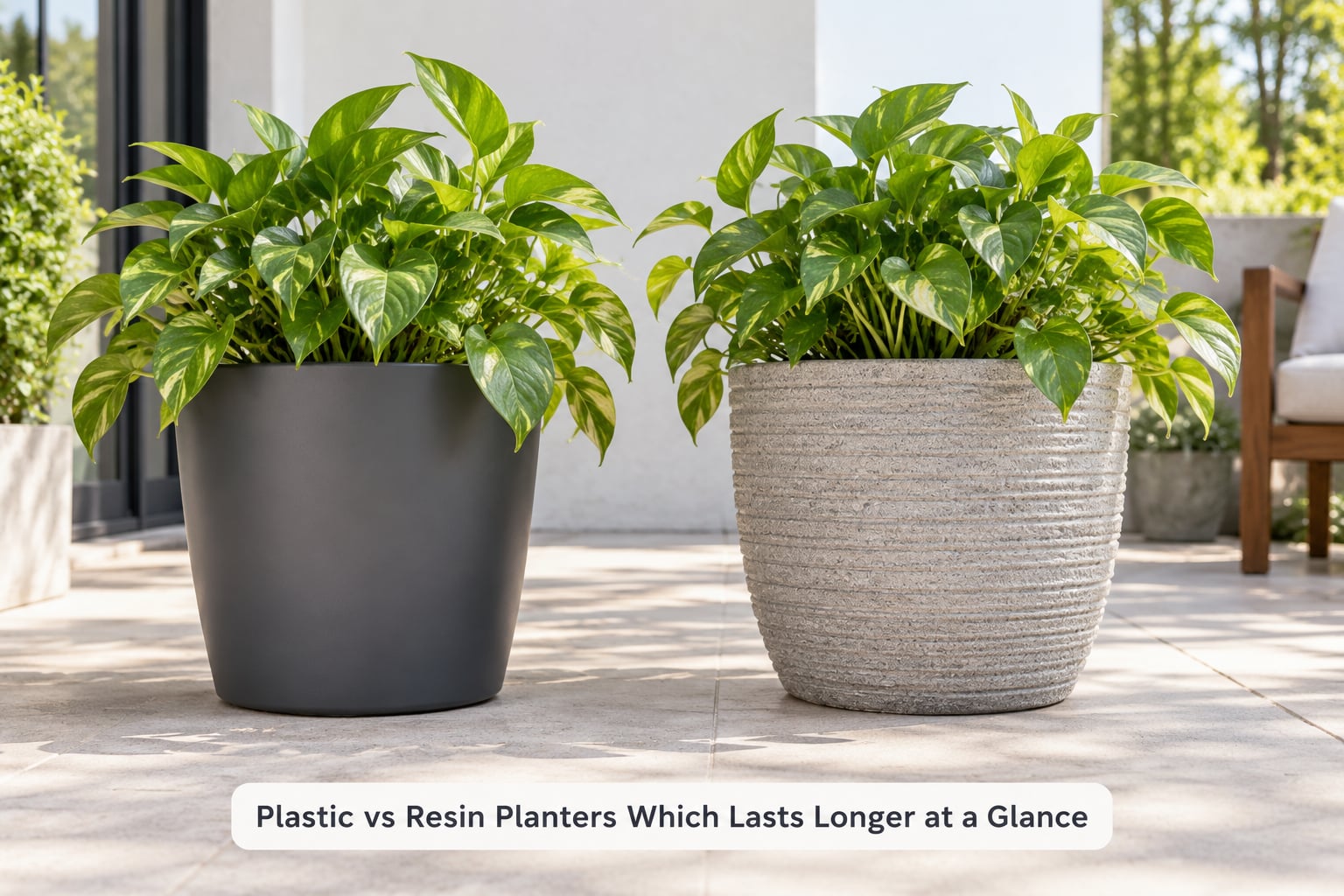
The table below compares the two materials on the criteria that decide real service life outdoors. Lifespan figures are typical ranges reported by growers and manufacturers, not guarantees, and they shift with sun exposure, wall thickness and how well the pot drains.
| Criterion | Plastic planter | Resin planter |
|---|---|---|
| Typical lifespan in full sun | Often 2 to 4 seasons before fading and cracking | Commonly 8 to 15 years in a quality UV-stabilised grade |
| Lifespan indoors or under cover | Many years, fading slowly | Effectively indefinite indoors |
| UV fading | Fast; colour goes chalky and grey | Slow, especially with pigment through the wall |
| Cracking and brittleness | Common after repeated hot days and cold nights | Stable, but can split if dropped or frozen while saturated |
| Weight | Light enough to lift with one hand full | Heavier; stone-filled composites noticeably so |
| Cost per year of use | Low upfront, poor once replaced three or four times | Higher upfront, cheap once amortised over a decade |
| Moisture retention | Non-porous, holds moisture well | Non-porous, holds moisture well |
| Frost behaviour | Tolerates light frost, can shatter below freezing | More dimensionally stable, still not freeze-proof |
| Breakage on impact | Cheap pots shatter, quality pots dent | Resists dropping, but a stone-filled pot can crack |
| Best for | Balconies, rentals, indoor use, seasonal rotation | Exposed patios, terraces, statement planters, coastal sites |
Are resin planters better than plastic?
For a fixed pot that stays outside year round, yes, a UV-stabilised resin planter is better. It holds colour, resists the brittleness that splits plastic after a few seasons, and looks respectable in a place you actually sit. Plastic is better when weight and price decide the outcome, such as a rooftop balcony with a load limit or a renter who may move in autumn.
How Long Do Plastic and Resin Planters Last?
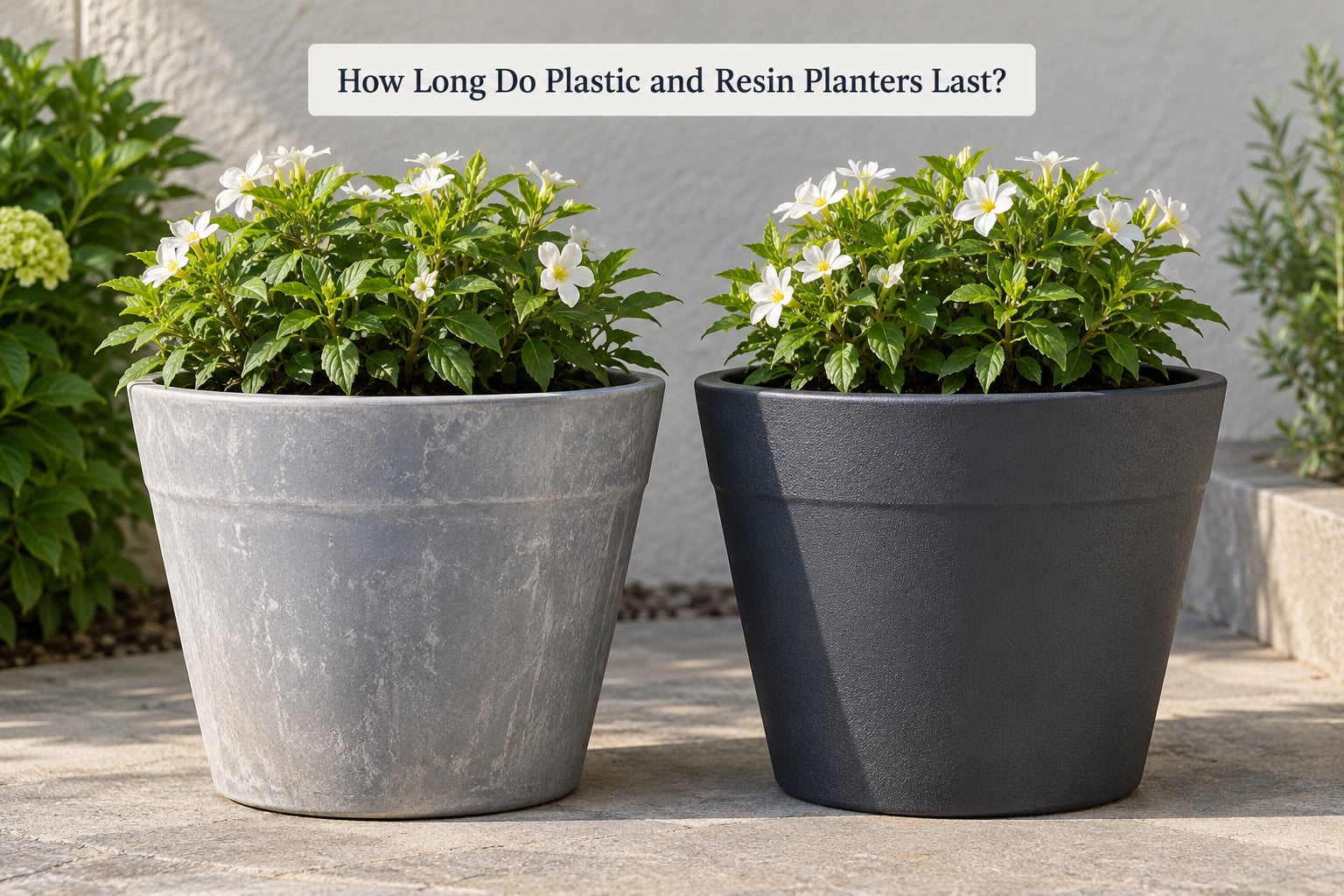
Most cheap plastic pots fade visibly in the first summer, go brittle by the second, and split somewhere in the third. That matches what people describe in gardening forums, where cheap plastic pots are reported cracking after one to three summers of full sun and ending up in the bin. The failure is chemical rather than mechanical, which is why it happens even to pots that are never dropped, stacked or knocked.
Ultraviolet radiation breaks the polymer chains in the plastic. The surface loses pigment, starts to chalk, then the material stiffens. Each hot day and cold night adds thermal cycling, and stiff plus brittle equals a crack. Once a crack appears, the wall holds water instead of shedding it, and the crack grows from the inside out.
Exposure changes the number a lot. Indoors, a plastic pot can look fine for years because it never sees UV. Under a covered porch, both materials stretch out considerably. In open sun on a south or west wall, plastic drops to a few seasons while resin holds on. Coastal salt air adds another stress, and so does a pot that sits in a saucer full of water through the winter.
So the direct answer to plastic vs resin planters which lasts longer comes down to exposure. Indoors, either one will do. Outdoors in full sun, resin wins, often by a wide margin.
What type of planter lasts the longest?
Ranked by real outdoor service life: fibreglass-reinforced composite first, with many pot makers rating them at ten or more seasons in full sun. Stone-filled composites such as ficonstone come next. Quality poly resin sits below that, usually good for eight to fifteen years. Plastic occupies the bottom of the list for exposed positions, and terracotta and glazed ceramic are in their own category, cracking or spalling in freeze-thaw zones rather than fading.
Plastic vs Resin: Material and Construction
Planters sold as plastic are usually polypropylene or polyethylene, and both can be good garden materials. Polypropylene is tougher and more UV resistant, which is why it turns up in long-lasting grow bags and vertical planters, while polyethylene is the softer, more flexible option found in cheap nursery pots. The resin identification code stamped on the bottom tells you which you have, and it is worth reading.
Codes 2 for HDPE, 4 for LDPE and 5 for PP are the garden and food-friendly grades. Codes 1, 3, 6 and 7 are the ones to keep away from edible container gardens, because 6 and 7 in particular can shed additives as they break down. The 2016 Ecology Center study that found phthalates in 75 percent of sampled PVC garden hoses is the standard reference on why this matters. A pot marked 1 or 3 and sold for food growing is a reason to look elsewhere.
Resin planters are built differently. Cheaper ones are injection moulded or rotation moulded from the same polypropylenes with a UV inhibitor and pigment mixed in. Better ones are cast polyurethane, or reinforced with fibreglass in a mould. Stone-filled composites mix crushed stone into the resin, which raises density, adds weight and improves the look, and also makes the pot heavier to lift and more likely to crack if it lands on an edge.
Construction matters as much as the label. Wall thickness is the single best quality signal you can judge in a shop, and a thin-walled pot will split long before a thick one. Seams, mould lines, a flat base and drainage holes moulded into the floor rather than drilled afterwards all point to a better-made pot. Recycled content in the wall is not automatically worse, but a pot made mostly of regrind will have uneven thickness.
Which Material Handles Sun, Rain and Frost Better?
Sun is the decider, and it is where the two diverge most. A UV-stabilised resin pot keeps its pigment through the wall, so as the surface erodes you still see colour underneath. A pigmented plastic pot behaves the same way in principle, but commercial plastic pots are often thin and lightly stabilised, so they chalk visibly within a season or two. Unstabilised plastic fades fastest of all.
Rain and standing moisture are less about the material and more about the pot. Neither plastic nor resin is porous, so a pot with no drainage hole holds water against the root ball and can freeze solid. Resin is more dimensionally stable outdoors, meaning it is less likely to warp out of round or split at the seam as it wicks and dries repeatedly, but a resin pot with bad drainage will kill the plant just as efficiently as a plastic one.
Frost and temperature changes are the honest weak point for resin. The claim that resin never cracks is a marketing line. Saturated resin that freezes expands, and a stone-filled or cast pot can split along a seam or at the point of impact. In cold-winter areas, USDA hardiness zones and the local freeze-thaw pattern matter more than the material name. Growers in places like r/ArizonaGardening consistently report fibreglass as the best performer in extreme heat, and the same composite is usually the safest bet in cold too.
In short, plastic vs resin planters which lasts longer comes down to UV stability for sun, and to drainage and construction for rain and frost. Resin holds up better against UV, and neither material saves you from a blocked drainage hole.
Drainage, Weight and Root Health
Both materials are non-porous, which is convenient: potting mix dries at a predictable rate and you control watering precisely. It also means excess water has nowhere to go except out of the holes. Too large a pot relative to the root ball is a common cause of root rot in resin planters, because the mix stays wet long after the plant has used what it needs.
Weight is where plastic takes the decision. A large resin or stone-filled planter can weigh enough to exceed a balcony load limit or to be genuinely unsafe in wind, since a toppling pot is dangerous to whatever is below it. Plastic can be carried up stairs by one person, repositioned before a storm and rearranged in an afternoon.
Insulation is the quiet advantage of thicker, heavier pots. A dense resin wall buffers root-zone temperature swings, which protects roots in a hot south-facing patio far more than a thin plastic wall does.
How to check drainage before you buy
Look at the base first. Multiple holes of decent size are better than three pinpricks, and holes moulded into the floor sit level with the pot, while drilled holes often leave a burr and a lip. Pour water in and watch whether it drains evenly across the whole base rather than pooling in one corner. Finally, lift it. If it feels hollow and light for its size, expect thin walls.
Appearance, Maintenance and Repair
Colour retention is where the two diverge visually. Quality resin holds a deep, even colour for years, and textured resin can convincingly mimic stone or aged concrete, which is the reason most people move to it. Plastic that has been in the sun long enough usually reads as a faded imitation of its original colour, and the surface develops a chalky, dusty film that wipes away and comes back.
Cleaning is easy for both. A hose and a stiff brush handle most grime, and both materials tolerate mild detergent. Staining from tannins in potting mix or hard-water deposits sit on the surface, and a stiff brush works on resin, while a soft sponge is kinder to a chalked plastic pot. Scratches are permanent on both, but on plastic they tend to go pale and cloudy, which reads as damage, while on a textured resin pot they blend into the finish.
Repair is where the honest difference shows. A small split in plastic can be bridged with epoxy and will often outlast the pot. A resin pot with a cracked seam or a chipped corner is usually a write-off, and that is the moment people regret owning a heavy planter. Full replacement is usually cheaper than repair, which is a good reason to buy a lighter pot you can actually move.
Cost, Environmental Impact and Availability
Broadly, mass-market plastic sits at the cheap end and heavier resin and stone-filled composites sit well above it, with fibreglass in between depending on size. Exact figures move around, so judge on cost per year instead. A cheap plastic pot replaced four times in a decade costs more in the end than one quality resin pot, and it also means four trips to the store and four trips to the tip.
Shipping weight feeds into that. Plastic arrives cheap to move; dense resin and stone-filled pots cost more to transport for the same size, which is part of why the price gap exists at all. Local availability skews the same way, with simple plastic pots stocked everywhere and large resin planters more often ordered in.
Environmentally, the picture is mostly about volume of waste. A polypropylene or polyethylene pot is technically recyclable, and code 2, 4 and 5 items are commonly accepted at household recycling facilities, though many curbside programmes reject rigid plant pots. Cheap planters fail early and go to landfill or yard waste, which undoes any recycling upside. A resin planter that lasts fifteen years displaces several plastic ones, and durability is the more meaningful environmental argument here than any claim about the material itself.
Which Should You Choose?
Choose resin for exposed outdoor planters, terraces, balconies that can take the weight, coastal locations and any project where you would rather not buy the pot twice. Choose plastic for lightweight movable pots, indoor use, temporary installations and tight budgets.
A few specifics help. Under about 30 cm, plastic is usually fine anywhere except full sun, because the wall is thin and heats fast. Above that size, or anywhere in open sun, spend on resin. On a balcony with a load limit, measure before you buy and favour resin only where the weight fits.
Match the pot to the climate. In hot, intense sun, lighter colours absorb less heat and a fibreglass composite handles the load. In cold-winter areas, drainage and frost tolerance decide more than the label. In coastal air, skip painted metal and heavily coated finishes, and pick a pigmented resin in a solid colour.
What to check before you buy
- Material disclosure. A printed code, a sticker or a spec sheet on the box. A pot with no stated material is usually the pot you replace soonest.
- Wall thickness. Lift it and tap it. Thin walls flex and sound hollow; thick ones feel solid and sit flat.
- UV stabilisation. Look for wording like UV-stabilised, UV-resistant or outdoor-rated. Absent that, assume a short life in full sun.
- Drainage holes. Several holes moulded into the base, not three pinpricks.
- Weight you can manage. Lift it as if it were full of wet soil, because that is how you will move it.
- Colour. A light colour in full sun absorbs less heat through the wall.
How to extend the life of a planter you already own
- Relocate in high summer. Moving a full pot is hard, so plan ahead and shift light colours to morning sun rather than west afternoon sun.
- Sleeve or shade. A purpose-made planter cover or a light shade cloth over a pot in peak summer slows fading measurably.
- Keep the drainage clear. Clear the holes and empty the saucer twice a season, and never leave a pot standing in a tray of water.
- Never drag a full pot. Lift it, or slide it on a board. Scuffs along the base become cracks in a brittle wall.
- Wax or seal a chalked plastic pot. A plastic-safe sealer slows further surface erosion, though it will not restore lost colour.
If you already own a plastic pot you want to keep, shade it in high summer, clear the drainage holes twice a season, avoid dragging it while it is full, and use a light-coloured pot or a sleeve for anything that sits in direct sun for years. Most cheap plastic pots that get treated that way make it past four seasons, and some make it past eight.
Frequently Asked Questions
Are resin planters better than plastic?
For a pot that stays outside year round, yes. A UV-stabilised resin planter holds its colour and resists the brittleness that splits cheap plastic after two to four seasons, and it usually looks acceptable in a space you actually sit in. Plastic wins on weight and cost, so it is still the right choice for a lightweight movable pot, a rental, or a balcony with a load limit.
How long do resin planters last outdoors?
A quality poly resin or cast resin planter typically runs 8 to 15 years in a typical outdoor position, and some last longer. Full sun, blocked drainage and repeated freeze-thaw cycles shorten that. Fibreglass-reinforced resin is the longer-lasting option, with many makers rating ten or more seasons in direct sun. Cheap unpigmented plastic pots, for comparison, often give up after two to four.
Do resin planters crack in cold weather?
They can, and the marketing rarely mentions it. Resin is more dimensionally stable than plastic, so it resists splitting from ordinary thermal cycling, but a pot that is saturated when it freezes expands and a seam or corner can give way. Keep drainage clear, lift pots off a wet patio in hard frost, and stone-filled composites are the least forgiving because the mineral fill makes cracking more likely.
Can I grow vegetables in a resin planter?
Yes, provided you know what the pot is made from. Check the resin identification code on the base and look for 2 for HDPE, 4 for LDPE or 5 for PP, which are the grades suited to food contact. Avoid pots marked 1 or 3, and be cautious with 6 and 7 for edibles. For a vegetable bed you plan to keep for a decade, a fibre-reinforced resin planter with drainage holes is the safer pick.
What planter material lasts the longest outdoors?
Fibreglass-reinforced composite lasts longest, commonly 10 or more seasons in full sun, followed by stone-filled composites such as ficonstone and then quality poly resin at roughly 8 to 15 years. Plastic comes next for exposed positions. Below those sit terracotta and glazed ceramic, which do not fade but crack and spall in freeze-thaw climates, and concrete, which outlasts nearly everything but is impractical above a certain size.
So the short version of plastic vs resin planters which lasts longer is resin, in any position that gets real sun. Match the pot to the job, check the wall and the drainage before you buy, and either one will give you years more than it would otherwise.