The best light for growing plants indoors is a full-spectrum white LED fixture that sits 6 to 18 inches above the foliage and runs 12 to 16 hours a day. The trick is matching its output to your plants and your room rather than buying the brightest lamp you can find. That is the whole job of learning how to choose grow lights for houseplants, and it takes about ten minutes of measuring.
I keep plants in a north-facing flat and a shelf that no window has ever touched. The second shelf is why I got interested in this at all: the first lamp I bought was bright enough to read a book by, and every plant leaning toward it told me I had overshot. A light you can dim beats a light you cannot.
Below is the decision order I use. Audit what light you already have, sort your plants by appetite, pick the fixture format that fits the space, then apply a numeric floor to the spec sheet. Skip ahead and you will end up with a lamp that scorches your succulents or does nothing for a fiddle leaf fig.
Table of Contents
- Quick Guide: Grow Lights for Houseplants
- What Kind of Light Do Houseplants Need?
- Run a two-minute shadow test
- Grow lights for houseplants by plant group
- Which Light Spectrum Is Best for Houseplants?
- How Bright Should a Grow Light Be?
- How Do You Choose a Light for the Right Coverage?
- Do Smart Controls and Dimmers Make a Difference?
- What Should You Look for in a Grow Light Fixture?
- How to Set Up and Use the Light Safely
- Frequently Asked Questions
- How many watts should a grow light be for houseplants?
- Should I leave a grow light on all day?
- How far above my plants should the grow light be?
- Can I use a grow light with natural sunlight?
- Are LED grow lights safe for indoor use?
- Do I need a full-spectrum grow light for houseplants?
- Conclusion
Quick Guide: Grow Lights for Houseplants
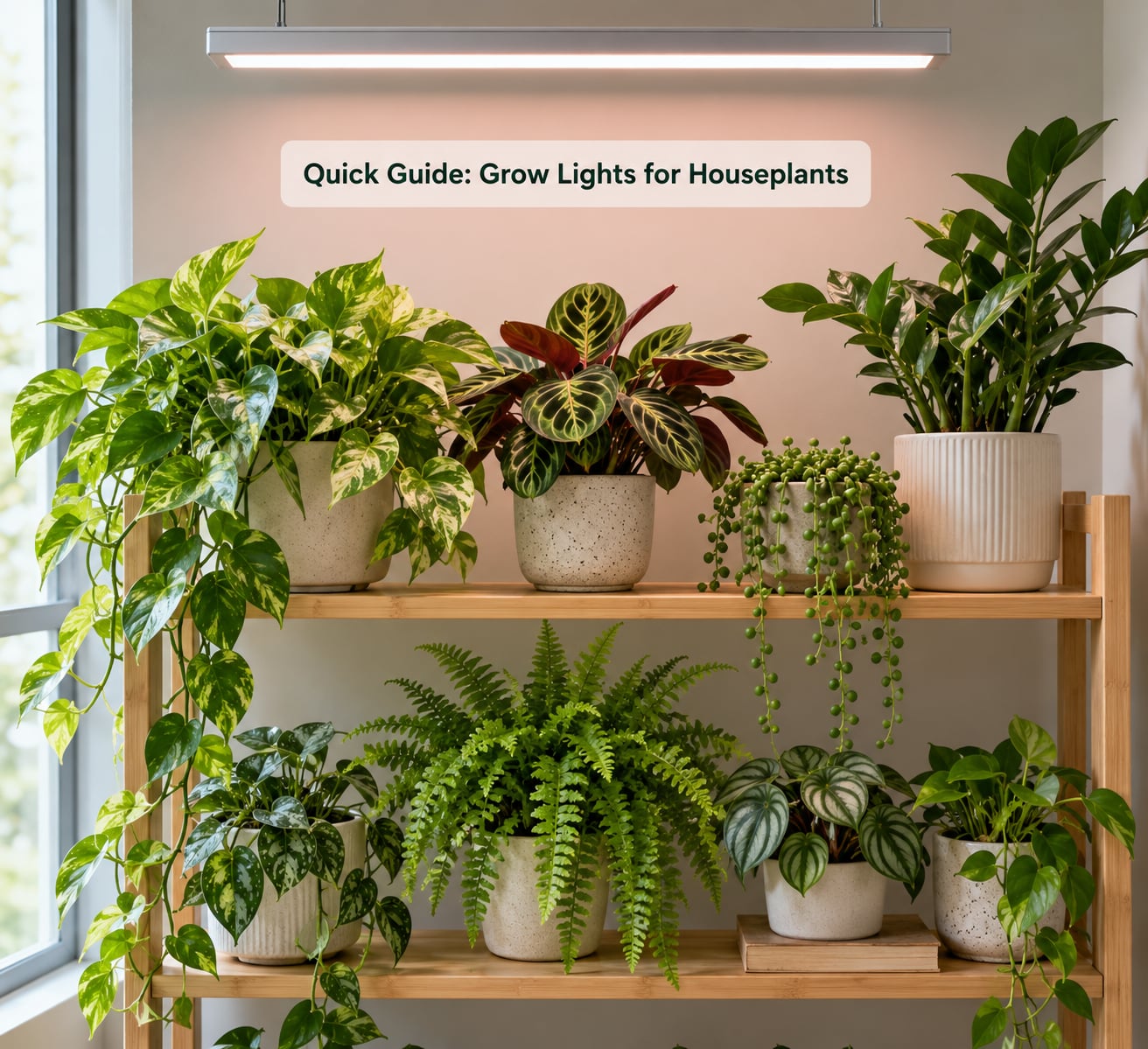
Seven factors decide whether a grow light works in your home. This table is the short version; the sections below expand each one with numbers you can act on.
| Factor | What to decide | Rule of thumb |
|---|---|---|
| Plant group | How much light the species wants | Low, medium or bright indirect, plus a priority rating |
| Light type | LED, fluorescent, HPS or household lamp | Full-spectrum LED for almost every home |
| Spectrum | Blue, red or a full blend | 400 to 700 nm, colour temperature 5000K to 6500K |
| Brightness | Output at the leaves | 300 to 800 lumens per square foot of growing area |
| Coverage | Footprint versus plant bed | Match the stated coverage area to the space, then add margin |
| Heat and safety | Surface heat, cord, damp-room rating | LED runs coolest; check the IP rating for a bathroom |
| Controls | Timer, dimmer, app | A timer is the only control you truly need |
If you remember one row, make it the last one. Almost every plant problem attributed to the wrong lamp is actually a scheduling problem, and a timer costs a fraction of what a fixture with app control does.
What Kind of Light Do Houseplants Need?
Houseplants need light in the 400 to 700 nanometre range, and almost nothing else they receive matters as much. That range is the part of the spectrum chlorophyll absorbs, and it is why a plant can sit in a bright room and still be starving next to a south window. Brightness to your eyes and useful light to a leaf are not the same measurement.
Start with the window, not the lamp. A south-facing window in mid-latitudes gives several times more usable light than a north-facing one, and light falls off fast as you move back into the room: a plant 10 feet from a window may be receiving a fraction of what sits on the sill. Seasonal swing is huge too, which is why the same fiddle leaf fig that thrives in July sulks by February.
Run a two-minute shadow test
Hold your hand flat above the plant at midday and look at the shadow. A soft, fuzzy-edged shadow means low light. A defined but not sharp shadow means bright indirect, the sweet spot for most foliage plants. A sharp shadow with dark gaps between your fingers means direct sun, which only sun-loving species want for long stretches.
If you want numbers, a light meter or a phone lux-meter app will do it. Rough bands worth knowing: 50 to 500 lux is low, 500 to 2,500 lux is medium, and 2,500 lux upward is bright. A north window often lands in the low band, which is exactly where a grow light earns its place.
Grow lights for houseplants by plant group
Map each plant to a group before you shop. The priority column tells you where a lamp changes the outcome most, and the hours column is a starting point you adjust after two weeks of watching the plant.
| Plant | Light appetite | Grow light priority | Suggested hours |
|---|---|---|---|
| Snake plant | Low to medium | Low | 8 to 10 |
| ZZ plant | Low to medium | Low | 8 to 10 |
| Pothos | Medium, tolerates low | Medium | 10 to 12 |
| Peace lily | Low to medium | Medium | 10 to 12 |
| Calathea and prayer plants | Medium indirect | High | 12 to 14 |
| Ferns | Medium indirect | High | 12 to 14 |
| Monstera | Bright indirect | High | 12 to 14 |
| Fiddle leaf fig | Bright indirect | High | 12 to 16 |
| Bird of paradise and citrus | Bright, some direct | High | 14 to 16 |
| Herbs on a kitchen shelf | Bright | High | 14 to 16 |
| Succulents and cacti | Bright, some direct | Medium, use a timer | 12 to 14 |
| Moth orchids | Medium indirect | Medium | 12 to 14 |
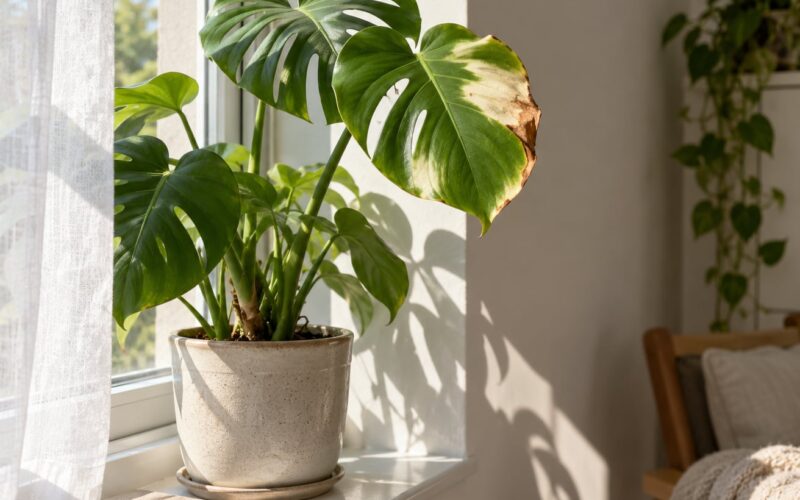
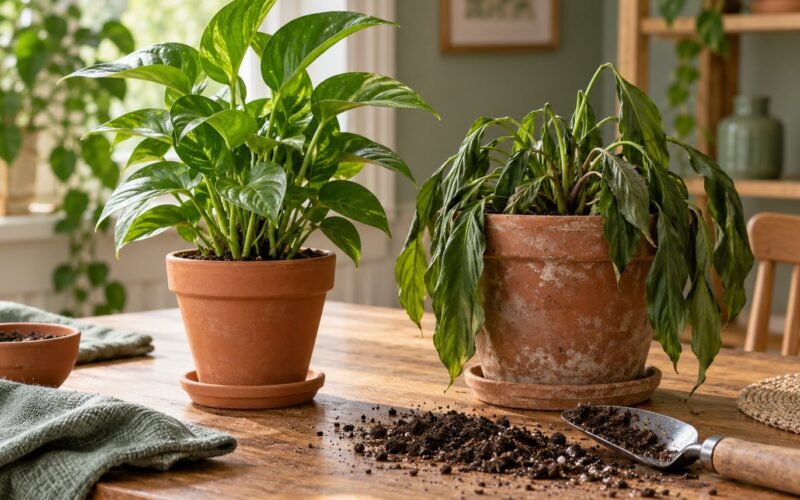
Two failure modes sit at opposite ends. A plant starved of light stretches, leans, drops its lower leaves and grows thin pale new growth. A plant given too much shows bleached patches or brown crisp edges near the light, known as leaf scorch, and the damage does not grow back.
Which Light Spectrum Is Best for Houseplants?
Full-spectrum white LED is the best spectrum for houseplants because it delivers the whole usable range in one fixture and looks like ordinary room lighting. Purplish fixtures, often called blurple, mix intense blue and red the same way, so they work about as well on a plant — they just look like equipment, not decor.
Here is what is actually happening. Chlorophyll, the pigment in every leaf, comes in two main forms and absorbs best in two bands: blue light roughly 420 to 490 nanometres and red light roughly 600 to 700 nanometres. Blue drives leaf and stem growth and keeps plants compact. Red supports flowering and fruiting. Yellow and green light is mostly reflected, which is why a plant looks green to you in the first place, and why a fixture that emits only those wavelengths is largely wasting electricity.
Colour temperature tells you how white a white light looks, not how much blue or red it hides. A grow light in the 5000K to 6500K range reads as daylight white and is the common choice; 3000K to 4000K fixtures look warmer and grow succulents well, since many cacti come from high-sun habitats. CRI, or colour rendering index, tells you how true the light looks to your eye. It matters for seeing subtle variegation and leaf colour, but it does not feed the plant.
A light meter held near a leaf tells you intensity. It does not tell you spectrum. Those are separate numbers, and a listing that gives you only one of them has skipped half the picture.
How Bright Should a Grow Light Be?
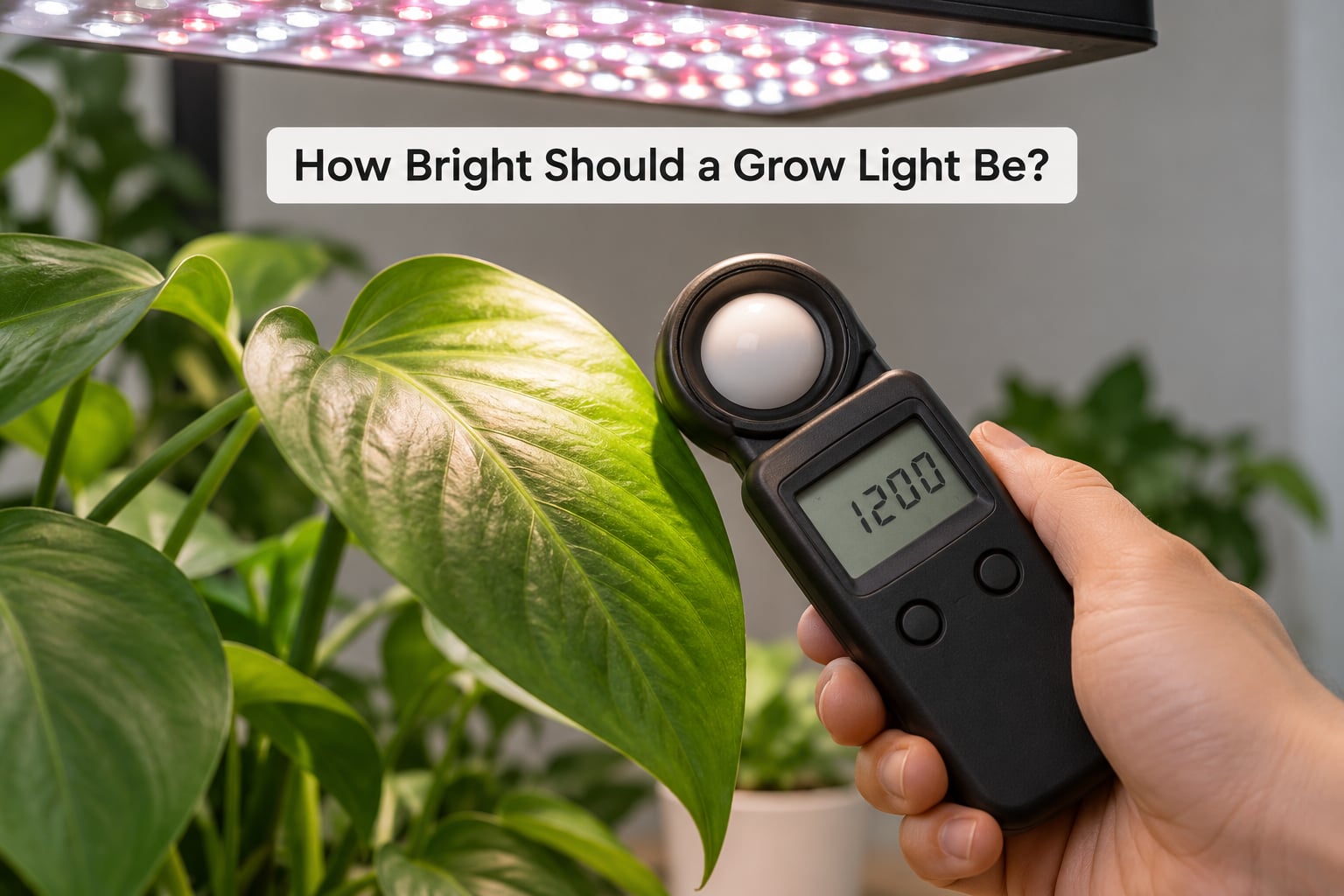
Lumens are for humans and PPFD is for plants. That single line settles most of the confusion on a product page. If the listing quotes lumens, treat it as a rough proxy; if it quotes PPFD in micromoles per square metre per second, you are reading the number that actually describes photosynthesis.
| Spec | What it measures | Matters for plants? | Target |
|---|---|---|---|
| Lumens | Total light output perceived by the human eye | Partly | 300 to 800 lumens per square foot of growing area |
| Lux | Light falling on a surface per human eye weighting | Partly | Medium indirect sits around 500 to 2,500 lux |
| PAR | The 400 to 700 nm range plants use | Yes | Whole range, no compromise |
| PPFD | Photosynthetic photon flux density, micromoles per square metre per second | Yes, most relevant | Low-light plants 100 to 250, bright light 300 to 600+ |
| DLI | Total light delivered across a day, PPFD multiplied by hours | Yes | 4 to 8 mol for foliage plants, 12 to 20 for seedlings |
| Watts | Electricity drawn, which sets your power bill | No, not directly | Do not compare brightness across bulb types by wattage |
| Lumens per watt | Efficiency of the fixture | Indirectly | Higher is better for a given output |
| Kelvin | How white the light appears | Only as a spectrum hint | 5000K to 6500K, or 3000K to 4000K for succulents |
| Beam angle | Spread of light from the fixture | Yes | 90 degrees or wider for shelves, narrower for a single plant |
| IP rating | Resistance to dust and water ingress | Safety only | IP44 or better for a bathroom |
Watage is the number people fixate on and the one that means least. A 60W incandescent bulb and a 60W LED are not the same lamp, and two lamps of equal watts can differ several-fold in output. The pragmatic shortcut most houseplant growers use is 300 to 800 lumens per square foot of canopy area: a 12-inch pot needs the low end, a shelf of foliage plants needs the middle, seedlings need the top.
Distance changes intensity fast. Doubling the gap from the fixture roughly quarters what reaches the leaves, which is why moving a lamp from 24 inches to 8 inches matters more than buying a bigger fixture. Move closer before you upgrade.
One more number worth having: a 60W bulb running 8 hours a day uses about 175 kilowatt-hours a year. That is your entire running cost, and it is small enough that electricity rarely decides the purchase.
How Do You Choose a Light for the Right Coverage?
Choose coverage by multiplying your growing area by the lumens-per-square-foot target, then divide by the fixture’s stated output. Whatever number comes out, round up to the next fixture and leave about 30 percent margin, because light falls off toward the edges of any beam.
The complaint that comes up most often in plant forums is that one lamp cannot light a whole shelf. It is usually correct. A bar fixture specified for a 24 inch footprint delivers a bright centre and dim ends, so plants at the edges lean inward and the middle ones scorch. Three cheap bulbs in a clip fixture beat one expensive bar when you have plants of different heights.
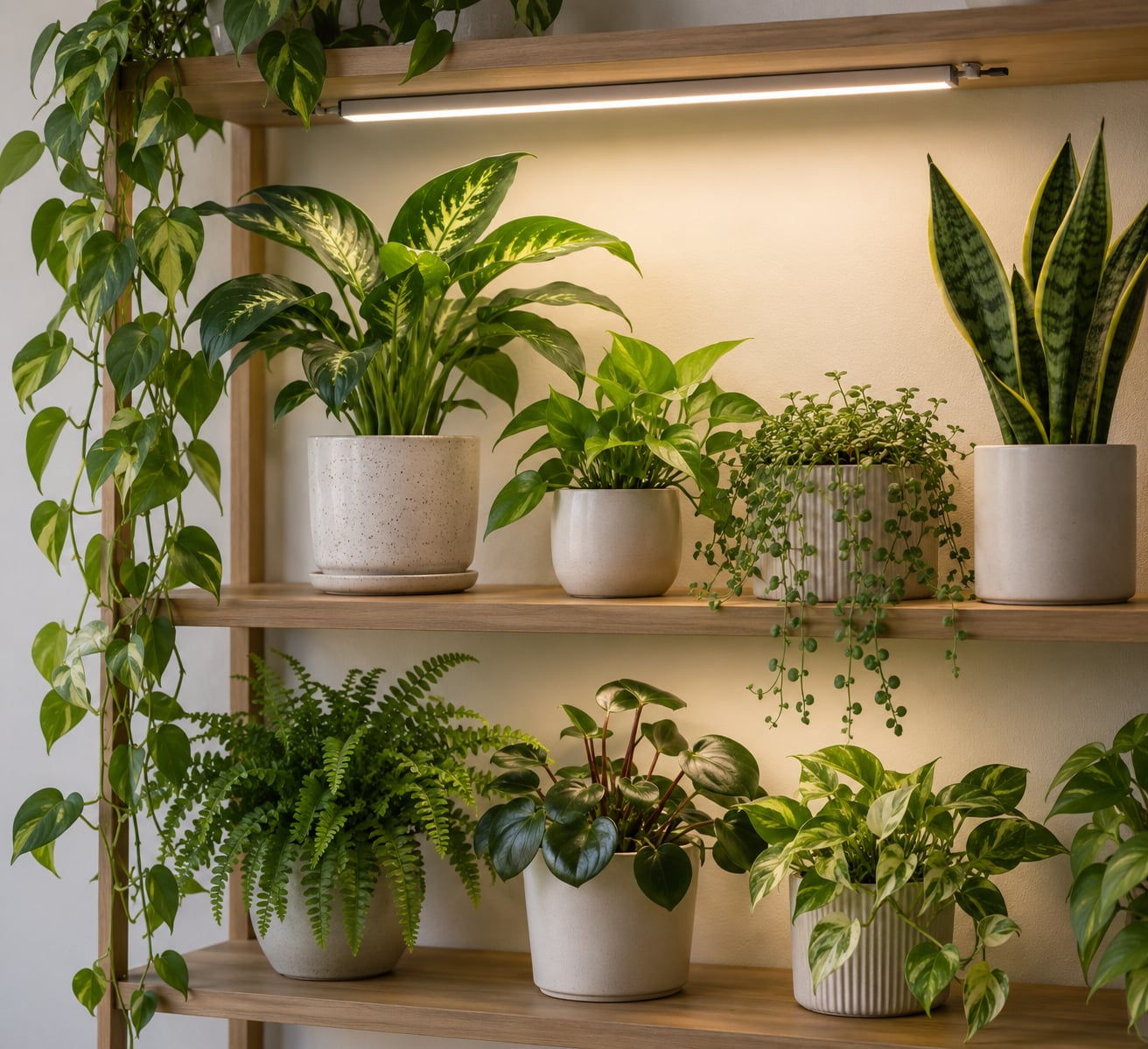
Worked examples for three setups. A two-plant sill needs roughly 1 square foot of canopy, so aim for a fixture delivering 300 to 800 lumens across that area, mounted 12 to 18 inches above the tallest leaves. A propagation station with cuttings under a clear dome wants more even, lower light, so an under-shelf bar running close and long suits it better than a pendant. A twelve-plant corner at 4 square feet needs a listed coverage area of at least 5 square feet, and usually two fixtures plus a monthly pot rotation.
Rotating pots is free coverage. Once a month, turn each pot a quarter turn so every plant gets the bright zone at some point in the month. It costs nothing and it fixes most lopsided growth on a crowded shelf.
Do Smart Controls and Dimmers Make a Difference?
A timer matters more than any other control, because plants need a dark period and humans forget. Every other feature is a refinement. Set 12 to 16 hours on, 8 or more hours of darkness, and leave it alone.
Dimmers are the second most useful thing on the list. They let you match one fixture to plants of different intensities instead of separating them across rooms, and they let you bring a light up in winter and back down in spring without moving a single pot.
Colour temperature switches, typically 3000K to 6500K in three steps, matter mainly for mixed collections where succulents and ferns share a shelf. App control is where I would spend least. A smart plug or a cheap plug-in timer does the same scheduling job, and the phone app adds a screen to look at rather than light on a leaf.
One caution: dimming usually means a lower setting on the driver, which can shift colour slightly and occasionally introduces flicker. Flicker is worth watching if you sit close to the fixture for hours, since a visible strobe at a desk is genuinely uncomfortable.
What Should You Look for in a Grow Light Fixture?
Look for a full-spectrum LED with a stated coverage area, a dimmer, a clear mounting method and a safety mark. Those four things get you a working fixture. Everything else is preference, and the majority of forum confusion comes from shoppers reading marketing lines instead of the spec block.
- Full-spectrum LED with the 400 to 700 nm range stated, not just the word “full spectrum”.
- A quoted coverage area in inches, so you can check it against your own space before buying.
- A mounting method that suits the spot: adjustable height, clamp, under-shelf bar or pendant with a cord long enough.
- Safety certification for electrical use in your country, plus an IP rating if the light lives anywhere damp.
- A replaceable driver or bulb rather than a sealed unit, so one failed part does not end the fixture.
- A dimmer, either on the fixture or through the wall.
- Stated heat output and any clearance requirement above foliage. LEDs run coolest, so clearance matters less than with older lamps.
- A warranty of at least a year, which is a decent proxy for whether the manufacturer expects the part to last.
Ignore four things in particular. Wattage quoted as a brightness claim tells you nothing about output. Purple colour is not a premium feature. “Sunlight equivalent” comparisons are usually inflated by a factor of two or more. And a lumen figure with no coverage area attached is unusable, because it tells you nothing about what lands on your plants.
Community threads on r/houseplants and r/IndoorPlants keep coming back to a few recurring names, with SANSI and Barrina described as cheap and effective and HLG praised but priced higher. That sentiment changes with each product cycle, so treat the spec floor above as the durable test and the brand names as a starting point only.
On aesthetics, which matters more than most guides admit: white and warm-white blends disappear into a room, blurple announces itself, and matte black or white finishes blend with most shelf hardware. Where the cord runs matters as much as the colour, and a cord channel along the back of a shelf solves that in an afternoon.
How to Set Up and Use the Light Safely
Set the light on a timer, mount it 6 to 18 inches above the highest leaves, and check it at the end of the first week. That interval matters: light stress usually shows as bleached or crisping patches rather than wilting, so you want to catch it while a plant can still recover.
- Mount first, then power. Fit the bracket or clamp with the fixture unpowered, and follow the manufacturer’s clearance instructions exactly.
- Set the schedule. Twelve to sixteen hours on, starting at the same time each day. Eight or more hours of uninterrupted darkness matters.
- Check the temperature at the leaves after an hour on. Warm is fine, hot is not. If leaves are uncomfortable to hold, move the fixture up.
- Rotate pots monthly so coverage even-out compensates for beam falloff.
- Keep water away from the fixture and do not hang it over an open watering can or a humidifier.
Eye safety is mostly common sense. Look at the lamp rather than straight into it, especially a bare bulb, and keep a reasonable distance when working near a fixture. In a bathroom or damp utility room, check for an IP44 rating or better before you mount anything. For electrical work beyond plugging a lamp into a socket, use a qualified electrician.
Watch the watering. A plant under a grow light uses more water than the same plant in a dim corner, and over-watering is the commonest casualty of the first winter under a lamp. Check the soil rather than the calendar.
Frequently Asked Questions
How many watts should a grow light be for houseplants?
Watts tell you electricity used, not brightness, so do not compare lamps by wattage across types. Use 300 to 800 lumens per square foot of growing area as the practical target for houseplants: a single 12 inch pot sits at the low end, a shelf of foliage plants in the middle, and seedlings near the top. If the listing gives PPFD in micromoles, use that instead and aim for 100 to 250 for low light plants and 300 to 600 for bright light species.
Should I leave a grow light on all day?
No. Running a grow light around the clock gives plants no dark period and most species respond badly to it, with weak growth and failed flowering in the long run. Twelve to sixteen hours on with at least eight hours of unbroken darkness is the usual range for houseplants, and 14 to 16 hours suits seedlings and light-hungry plants. Put the schedule on a plug-in timer so it stays the same on weekends.
How far above my plants should the grow light be?
Six to 18 inches above the foliage is the working range for full-spectrum LED fixtures, with taller plants closer to the upper end and seedlings at the lower end. Fluorescent tubes sit further away, around 12 to 15 inches, and older incandescent lamps need roughly 24 inches because they run hot. Intensity falls off quickly with distance, so raising the lamp is a real loss of light rather than a safety margin.
Can I use a grow light with natural sunlight?
Yes, and it is usually the best setup. Place the fixture to supplement a window rather than duplicate it, for example above a shelf 6 to 10 feet from a bright window, and leave it on a timer for the hours the window gives you nothing. If you also get direct sun, watch the midday window: combined light can push a light-loving plant into leaf scorch, so dim the lamp or add a timer cutoff.
Are LED grow lights safe for indoor use?
Yes, for normal use in a dry room. LEDs run far cooler than fluorescent or high-pressure sodium lamps, last longer and contain no mercury, so the main household concerns are electrical certification and heat. Buy a fixture certified for your country, keep water away from it, use an IP44 rating or better in a bathroom, and have a qualified electrician handle anything beyond plugging in a lamp. For electrical work, follow the manufacturer’s instructions.
Do I need a full-spectrum grow light for houseplants?
For most homes, yes. A full-spectrum fixture covering 400 to 700 nanometres in white light is the simplest choice because it supplies the blue and red bands plants use and still looks like ordinary room lighting. Purplish red-and-blue fixtures work about as well on the plant itself but look like equipment in a living space. Whatever spectrum you pick, the deciding factors remain brightness at the leaves, distance, hours and coverage.
Conclusion
Choosing grow lights for houseplants comes down to four steps, in this order. Identify your plant group and how much light it wants. Measure the space, then audit the light you already have with a shadow test. Pick a full-spectrum white LED whose stated coverage area fits that space with margin, and size it to 300 to 800 lumens per square foot.
Then set it 6 to 18 inches above the foliage, run it 12 to 16 hours a day on a timer, and give the plants two weeks to respond before you change anything. Water by soil, not by habit. Most problems people blame on the lamp turn out to be distance, hours or coverage, and all three are free to fix.