Short answer: a pebble tray does raise humidity, but only by a few percentage points and only within a few inches of the water. It is a local damp zone around one plant, not a way to humidify a room. Whether it is worth setting up depends entirely on what you are trying to fix.
That is the honest version of an answer that gets argued about constantly, because some care blogs sell the tray and others call it a myth. Both camps are describing the same physics and measuring different things. Here is what the tray does, what the numbers say, how to build one if you want it, and what to reach for when the air in your whole room is the problem.
Table of Contents
- Pebble Tray for Humidity: Does It Work?
- How Does a Pebble Tray Increase Humidity?
- Pebble Tray for Humidity: Setup Steps
- What Pebble Trays Can and Cannot Do
- How to Maintain a Pebble Tray Without Mold or Salt Buildup
- Which Plants Benefit Most From Local Humidity?
- When to Use a Humidifier Instead
- Frequently Asked Questions
- Do pebble trays really work for humidity?
- How much humidity does a pebble tray add?
- Should the pot sit directly in the water?
- How often should I change the water in a pebble tray?
- Are pebble trays better than a humidifier?
- Can pebble trays cause mold or damage plant roots?
- Conclusion: Start With the Smallest Useful Setup
Pebble Tray for Humidity: Does It Work?
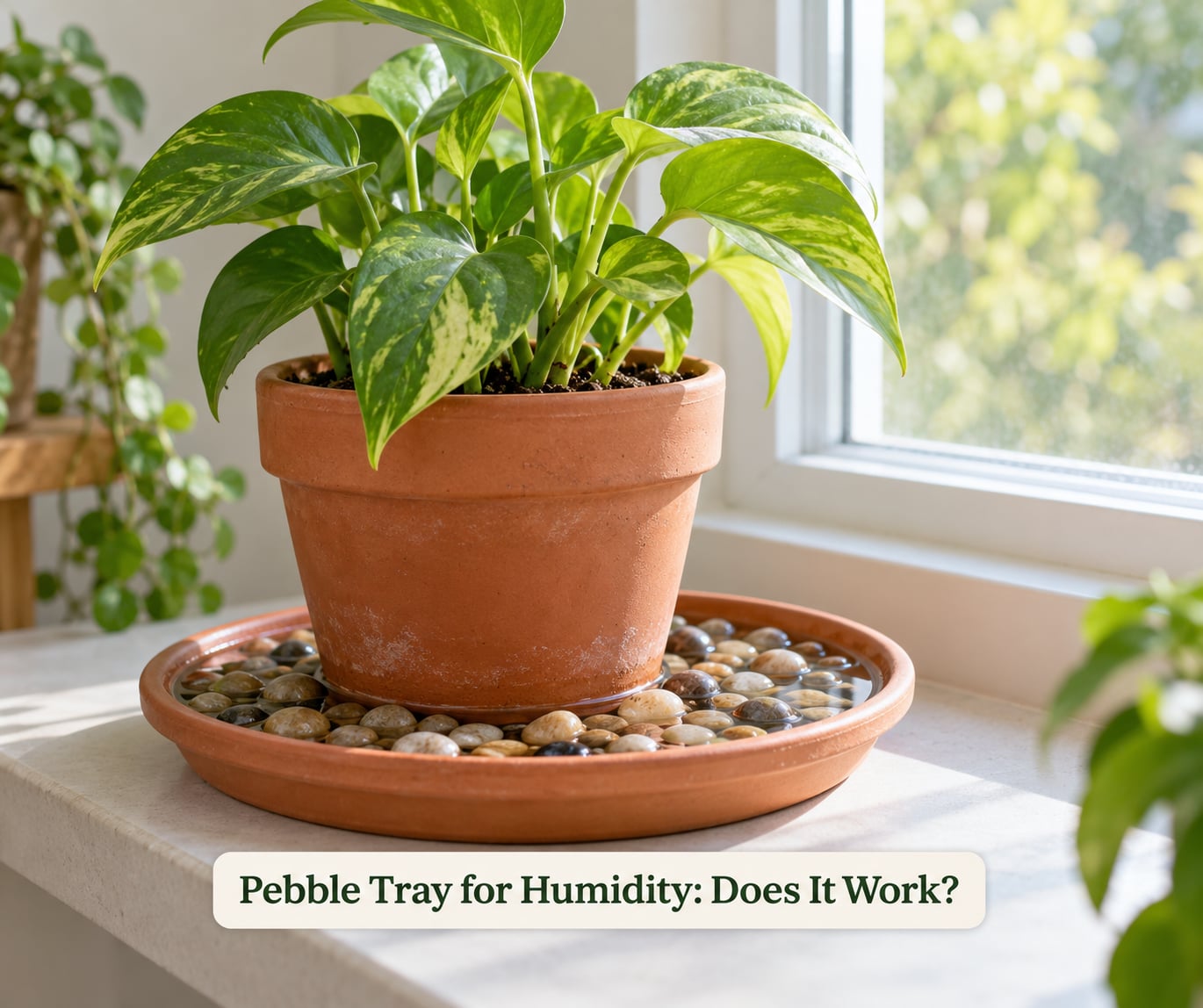
It works, weakly and locally. Water resting on a tray of pebbles evaporates into the air directly above it, and that air is measurably more humid than the rest of the room. The effect runs out fast with distance and fast with airflow.
The figures that get quoted most often come from orchid growers who have measured pebble trays for decades. Their numbers are roughly three percentage points of relative humidity at an inch and a half above the pebbles, two points at four inches, and no measurable difference at a foot. Growers reporting their own measurements tend to land in the same place: in an open room a tray lifts humidity a few percent for about an inch and a half before it diffuses away.
The short verdict
- What it does: adds a damp microclimate in the pocket of air between the tray surface and the foliage sitting just above it.
- How much: a few percentage points of relative humidity at pebble level, tapering to nothing within a foot.
- Where it works: one plant at a time, in a still corner of a room, on a tray deep enough that water sits below the pebble line.
- Whether to bother: for one or two humidity-loving plants, yes. For a whole collection or a genuinely dry room, no.
So a pebble tray for humidity does it work? Yes, in the way a damp cloth on a radiator works. It changes the air immediately around the plant and then stops. If your calathea is browning at the tips because the whole flat is at 25% humidity, the tray is treating a symptom at a scale of inches, and the scale is wrong.
There is one more thing worth knowing before you decide. A tray is usually added at the same time as other care changes. People move a plant off a radiator, start checking the soil properly, water more consistently, and then notice improvement and credit the pebbles. For a struggling plant, fixing the watering habit probably did most of the work.
How Does a Pebble Tray Increase Humidity?
Water sitting in a tray evaporates. That vapour joins the air directly above it, and because that air is a tiny volume, the relative humidity inside it climbs. Relative humidity is just the amount of water vapour in air relative to how much the air could hold at that temperature, so warm air can hold more moisture than cool air before it feels saturated.
Two forces take the moisture away. Molecules of vapour mix into the surrounding air by diffusion, and any movement in the room sweeps the damp layer away entirely. A ceiling fan, a draught from a window or a radiator pushing warm air upward destroys the effect in minutes. A still corner keeps it longer.
That contrast explains why the tray can feel like it works and fail a hygrometer at the same time. Read a sensor right on the pebbles and you will see a real lift. Read one a metre away and the number is the same as everywhere else in the room. The tray changed the air, just not the room.
| Where you measure | What changes | Why |
|---|---|---|
| Just above the water line | A few percentage points higher than room average | Vapour is produced there and has nowhere to go |
| Leaf level of a small plant on the tray | One to two points, sometimes within noise | Most of the damp layer sits below the leaves |
| Mid-canopy of a tall plant | Usually nothing measurable | The leaves are too far from the water surface |
| A metre away in the same room | Nothing measurable | The room volume is enormous next to the tray |
| Next to a fan, radiator outlet or open window | Nothing measurable | Moving air removes the moist layer faster than it forms |
The scale argument is worth sitting with. A generous tray holds a thin film of water across maybe the area of a dinner plate. A heated living room holds tens of thousands of litres of air. There is no arithmetic in which the tray wins.
This is also why an enclosed cabinet or terrarium does something a tray cannot. Glass walls stop the sideways diffusion that erases the effect, so the humid air stays inside and the plant keeps breathing it.
Pebble Tray for Humidity: Setup Steps
Build it this way and the local effect is as good as it gets. Get the water line wrong and you trade a small humidity gain for a root-rot risk.
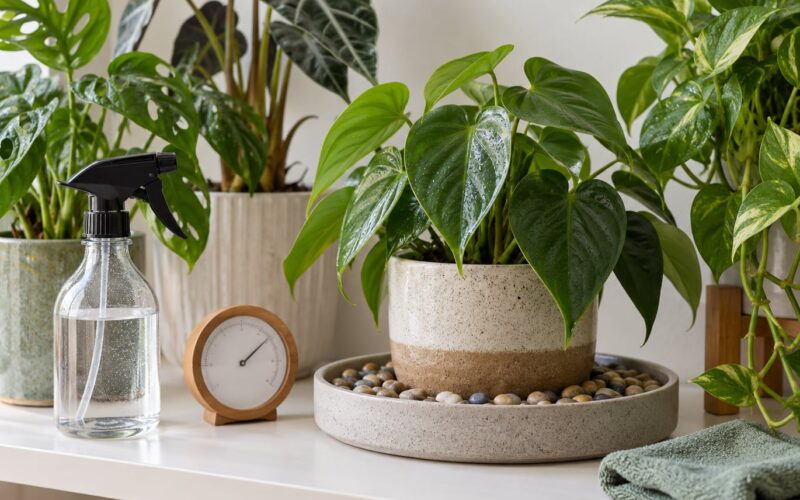
- Choose a tray one to two inches deeper than the pot base sits. A plant pot needs to sit above the water, never in it. A shallow saucer works for a small pot; a top-heavy plant in a big pot needs a deeper tray or a pot feet layer underneath.
- Pick your pebbles. River rock, glass, clay pebbles and coloured decorative gravel all work. Anything porous holds water permanently and grows algae faster.
- Fill to a depth of about half an inch to an inch. Enough that water sits between and just below the tops of the stones.
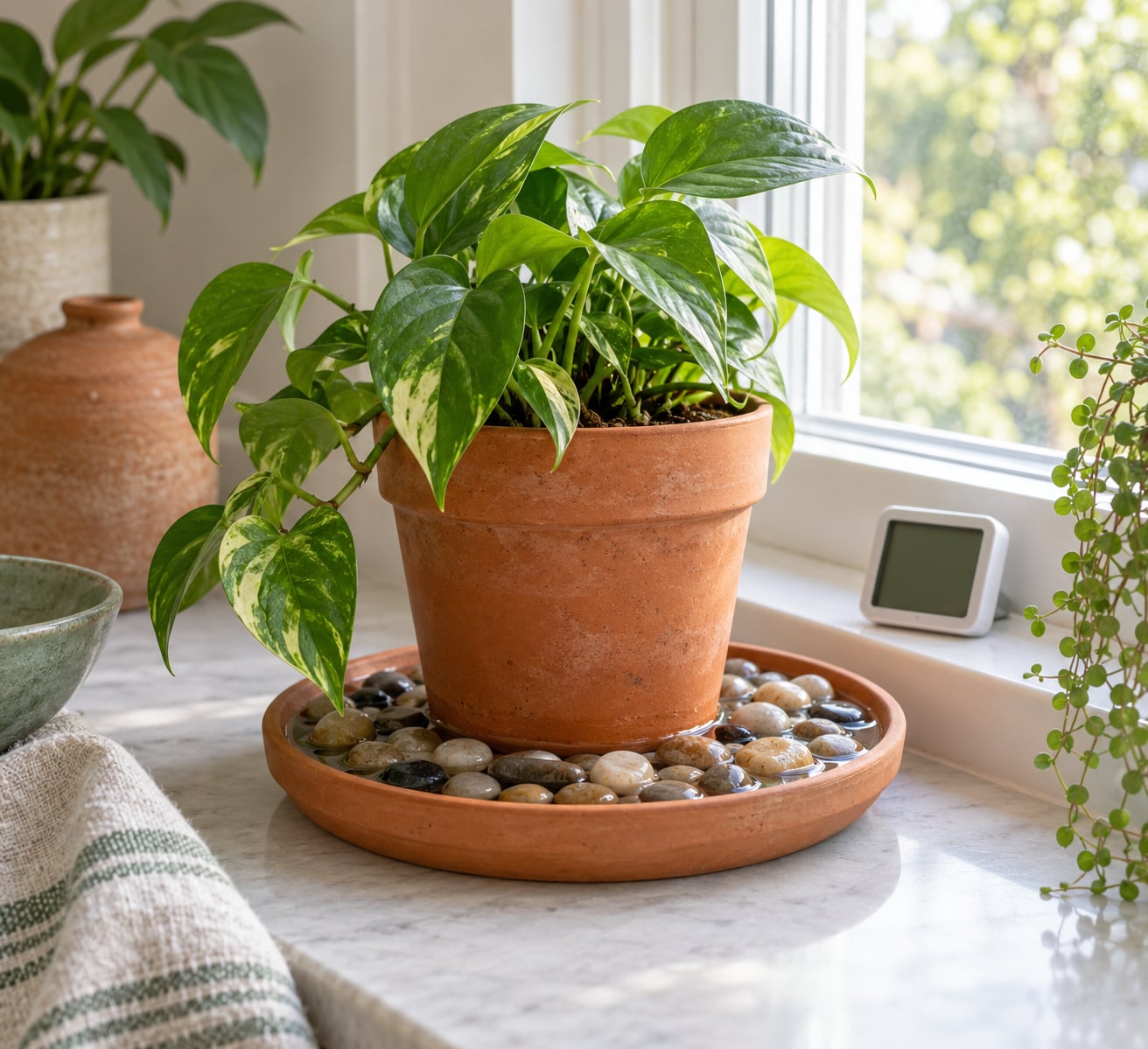
- Add water until it reaches just under the pebble line. If you can see water pooling above the stones, drain it back. Pebbles touching standing water are how trays swamp roots.
- Set the pot on top, ideally on pot feet or a few extra pebbles, so the drainage hole is never submerged and air can reach the pot base.
- Place the tray somewhere still and off the floor, away from radiators, vents, fans and draughty windowsills. A shelf or a cabinet nook with the door mostly shut works better than a busy shelf edge.
- Check it weekly. Top up when the stones look dry. The tray should never be bone dry for days, and it should never hold a pool of water.
The success check is not a promised percentage. It is whether the air right around the leaves stays slightly damp, whether condensation appears briefly on the inner leaves early in the morning, and whether the plant’s soil dries at the same rate as it did before. A small digital hygrometer costs little and settles the argument in a day.
| Pebble material | Porosity | Evaporation | Notes |
|---|---|---|---|
| River rock | Low | Steady | Heavy, stable, easy to find, cleans well |
| Glass stones | None | Steady | Holds no moisture, shows off the water, needs regular skimming of dust |
| Clay pebbles (LECA) | High | Slightly faster while dry | Absorbs water, keeps the base damp, must be rinsed before use |
| Coloured decorative gravel | Low | Steady | Cheap and attractive; dyes can stain a saucer over time |
Whatever you choose, run the tray under the tap when it is new. Dust and packing residue will coat the surface and you will get one week of poor evaporation before you work out why nothing is happening.
What Pebble Trays Can and Cannot Do
A pebble tray is worth having for a narrow set of reasons. It stabilises a top-heavy pot in a shallow cachepot. It catches drainage water so it does not soak into a windowsill or stain a table. It gives a propagating cutting a moist base to sit in. And it adds a slightly damp layer of air around the lower leaves of a plant that likes steady moisture.
Here is what it cannot do. It cannot raise the humidity of a room by enough to matter, because the room is far too large for a tray of water to influence. It cannot work in moving air, which rules out most open-plan living spaces with a fan running. It cannot help a hanging plant at all, since the foliage is above and away from the water.
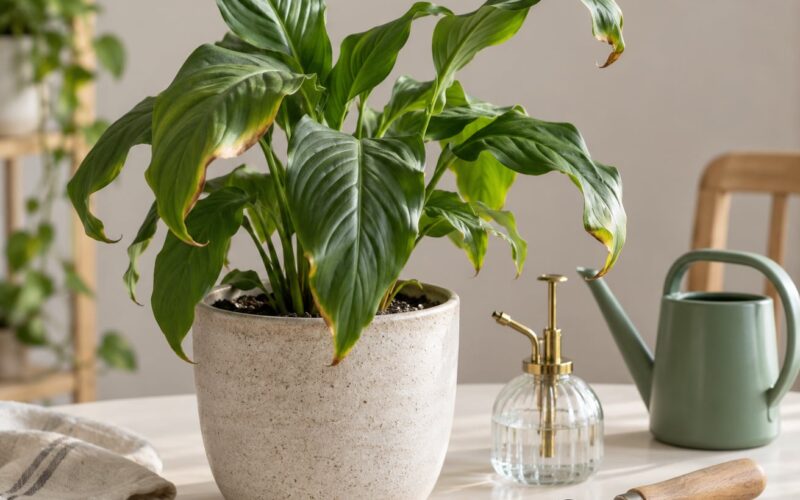
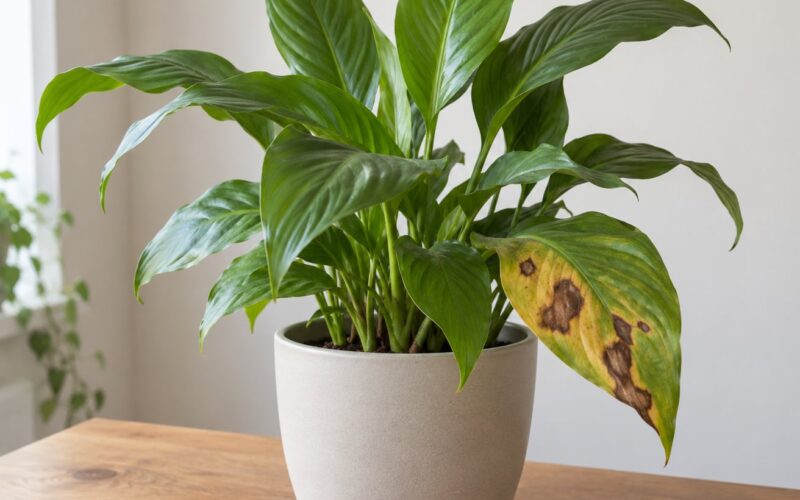
It also cannot fix brown leaf tips. On most houseplants that symptom is overwatering, inconsistent watering, fertiliser salt buildup in the soil, or sensitivity to fluoride and chloramines in tap water. Low humidity is real and it does cause crisp edges on ferns and calatheas, but it is one cause among several and not the default explanation.
Then there are the costs people forget. A permanently wet tray grows algae, and algae in a wet tray attracts fungus gnats. Water sitting against a pot base can keep the root zone saturated and invite root rot, which kills plants that otherwise would have been perfectly happy. Hard water leaves white mineral crust on the pebbles and, over months, on the pot rim.
The tray also fails quietly. Water evaporates overnight in a heated room, and by the time you look the stones are dry. That is the most common complaint about them: the setup works, then nobody tops it up. The general view among growers is roughly what you would expect — the tray earns its place as a tidy way to catch drainage water and hold a pot steady, not as a humidity upgrade.
How to Maintain a Pebble Tray Without Mold or Salt Buildup
Maintenance is about six minutes a month and it is what separates a tray that helps from a tray that becomes a science experiment.
- Top up weekly in winter, every three to four days in summer, or whenever the stones lose their wet look. Heated rooms drive off water faster.
- Change the water completely every two to three weeks. Empty it, rinse the tray and stones, and refill. Static water goes stale and starts smelling before it looks bad.
- Keep the water below the pebble line every single time. A dry tray is better than a flooded one.
- Scrub the stones when you change the water and drop any that have gone slimy or green.
- Use filtered or left-out water if you see white crust forming. Let tap water stand overnight and pour off the top, or run it through a filter, and the mineral build-up slows right down.
- Watch for gnats. Small flies circling a consistently wet tray mean you are topping up too often or too generously. Cut back and let the surface dry slightly between refills.
Remove the tray entirely if you cannot keep it consistently moist, if algae keeps coming back, or if the plant is showing the early signs of root rot. An empty decorative saucer under the pot does most of the useful work anyway, and it removes the fungal nursery.
Clean the tray properly when you do it: take the stones out, wash them in soapy water, rinse well, and scrub the tray. Algae spores are stubborn, and a rinse with cold water alone rarely clears them.
Which Plants Benefit Most From Local Humidity?
Plants that like tropical conditions tolerate a small, steady damp zone around their lower leaves. Ferns are the clearest case, because their fronds are thin and they lose water quickly. Calatheas and marantas come next, and their telltale crispy edges are the reason people look for trays in the first place. Fittonias, nerve plants, are dramatic about it, with visibly limp leaves at midday and a dramatic recovery by evening.
Orchids do well with a tray for a different reason. Moth orchids push new roots and new flower spikes in a humid, stable pocket, and the tray keeps the air around the crown and aerial roots from drying out. Carnivorous plants appreciate consistent local moisture too, though they should never stand in the tray water, which is usually too rich for them.
Grouping several of these plants together does more for the same effort than separate trays, because the leaves share the moisture each plant gives off. A terrarium or a glazed cabinet is the version of this idea with the diffusion problem solved.
Not every plant wants it. Succulents and cacti will object to the extra humidity near their base, especially with cool nights. Mediterranean herbs and most cacti prefer dry air. Anything already prone to root rot should not sit on a wet tray at all, because the tray removes the last bit of drying margin the pot had.
A pebble tray is also no substitute for drainage, correct watering frequency, moving air, and knowing what your particular species wants. It is one variable among about eight, and it is the smallest one.
When to Use a Humidifier Instead

If your reading says the whole room is dry, no arrangement of trays will fix it. You are trying to change the volume, so you need something that changes the volume. Ranked by how much of the problem they actually solve, here is where each method lands.
| Method | Measured effect | Where the effect happens | Effort and risk |
|---|---|---|---|
| Cool-mist humidifier | Raises room humidity measurably | Whole room | Constant upkeep, clean weekly, watch for mineral dust and over-humidifying |
| Enclosed cabinet or terrarium | Large, stable increase | Inside the enclosure | Needs light and ventilation management, no airflow means mold risk |
| Grouping plants together | A few points in the shared canopy | The clump | Free, no equipment, needs some airflow to stay healthy |
| Moving plants off radiators and draughty sills | Often several points, and steadier | The plant’s location | Free, and fixes a real cause |
| Bathroom or kitchen placement | Varies by how much the room is used | One room | Free, but light and temperature swings can suit some plants and hurt others |
| Pebble tray | A few points, inches above the stones | One plant | Weekly topping, water changes, algae and gnat risk |
| Misting | Brief, wet leaves not air | Leaf surface | Ineffective for lasting humidity, can encourage leaf spotting and fungal growth |
Use a hygrometer to decide, not a guess. Put one at plant height in the room for a day. Below around 40% for most of the day means the room itself is the problem, and you need a humidifier or a grouping strategy. If the room sits at a reasonable level and only one plant struggles, the tray, the watering pattern or the light is the more likely culprit.
Use a humidifier when your collection is large enough that per-plant solutions stop making sense. Several growers running that calculation land on the same answer: a handful of trays is fine, thirty trays is a lot of weekly maintenance for an effect you will never notice, and one humidifier looking after the whole shelf wins.
Then there is the simple option. A plant mister in the sink once a week costs almost nothing and keeps dust off leaves. It does not raise humidity and nobody serious claims otherwise, but for a plant you water by hand anyway, the ten seconds of attention beats a permanent wet tray.
And check your watering before you spend anything on air. Push a finger two inches into the soil, feel the weight of the pot, and see whether you are watering on a schedule instead of on the plant. More brown tips are caused by wet compost and salt buildup than by dry air.
Frequently Asked Questions
Do pebble trays really work for humidity?
They work locally and weakly. Water evaporating from the tray raises relative humidity in the pocket of air just above the pebbles, by roughly a few percentage points. That effect fades with distance, so it is gone by about a foot, and any airflow removes it in minutes. A tray is useful for one plant in a still corner of a room. It does nothing for the humidity level of the room itself.
How much humidity does a pebble tray add?
Most measurements converge on a few percentage points. Long-running orchid grower tests report about three percent higher relative humidity an inch and a half above the pebbles, two percent at four inches, and nothing measurable at a foot. Those figures apply to a tray with water just below the pebble line, sitting in still air. Moving air, a heating vent or a wide tray surface spreads the same water over a bigger volume and lowers the effect further.
Should the pot sit directly in the water?
No. The pot base must stay above the waterline, ideally raised on pot feet or on a deeper layer of pebbles. Contact between the pot base and standing water keeps the root zone saturated and is the most common way a pebble tray causes root rot. The pebbles should be damp, not submerged, and the water should reach no higher than just below their tops. If you can see water sitting above the stones, pour some out.
How often should I change the water in a pebble tray?
Top up whenever the stones look dry, which is usually weekly in a heated room and every few days in summer. Change it completely every two to three weeks: empty the tray, rinse it and the stones, scrub off any green film, then refill. Stale standing water goes slimy and starts to smell, and algae in a damp tray attracts fungus gnats. If your tray needs refilling more often than that, you are adding too much water.
Are pebble trays better than a humidifier?
For a whole room or a large collection, a humidifier wins clearly. It raises the humidity everywhere rather than in a pocket around one pot, and it works even when air is moving. A pebble tray makes more sense for one or two humidity-loving plants you want to keep in a still spot, and it costs nothing to run. Grouping plants together is a good middle option that needs no equipment, though it still requires some airflow around the leaves.
Can pebble trays cause mold or damage plant roots?
Yes, if the tray is left permanently wet or flooded. Constant moisture encourages algae, which attracts fungus gnats, and water held against the pot base keeps the compost waterlogged, which invites root rot. That damage is often invisible until the plant wilts despite wet soil. Keep the water below the pebble line, change it every two to three weeks, and remove the tray entirely if you cannot top it up regularly or if you keep seeing gnats around it.
Conclusion: Start With the Smallest Useful Setup
A pebble tray does work, right up to the point where it does not matter. It adds a damp pocket around one plant, worth a few percentage points near the stones, and nothing a metre away.
So start with the smallest useful step. Put a hygrometer at plant height in the room for a day and see what the number actually is. If the room is dry, group your humidity-loving plants together, move them off radiators, and run a humidifier if the reading stays low. If the room is fine and one plant is struggling, add a shallow clean tray, keep the water below the pebble line, and water the plant properly. Checking the soil will do more for brown tips than anything you can float in a saucer.