A vertical garden irrigation system is a small piped network that carries water from one source — a tap, a timer-controlled valve, or a reservoir — through tubing and drip emitters to every planter in a wall, tower or tiered shelf. It replaces a daily hand-watering job with scheduled delivery aimed at each root zone.
It exists because vertical planters behave badly on their own. A shallow pocket of potting mix with an exposed surface area several times its volume, sitting in moving air and often against a sun-warmed wall, loses moisture far faster than a ground-level pot does. Left alone, the top of the wall browns out and the bottom stays wet enough to rot roots.
Most people searching “vertical garden irrigation system how it works” want three things: what the parts are called, where the water goes at each step, and how to size something for their own wall. Those are the questions this answers, indoors and out.
Table of Contents
- What Is a Vertical Garden Irrigation System?
- How Does a Vertical Garden Irrigation System Work?
- Vertical Garden Irrigation System: Main Parts and Functions
- How Does a Vertical Garden Irrigation System Reach Every Planting Pocket?
- Gravity-Fed or Pumped Irrigation: Which Does It Need?
- How Do Controllers and Sensors Prevent Overwatering?
- What System Works Indoors and Outdoors?
- How to Size the Reservoir, Lines, and Emitters
- Why Is Drainage as Important as Water Delivery?
- How to Choose the Right System for a New Vertical Garden
- What Problems Usually Cause Uneven Watering?
- Frequently Asked Questions
- Does every vertical garden need an automatic irrigation system?
- How often should a vertical garden irrigation system water plants?
- Do I need moisture sensors and a smart controller?
- Can multiple plants share the same irrigation line or emitter?
- How much maintenance does a vertical garden irrigation system need?
- Start With the Growing Requirements
What Is a Vertical Garden Irrigation System?
It is any arrangement that delivers water to planters stacked or wall-mounted above normal container height, without a person carrying a can up a ladder.
That rules out the simplest category, hand watering, and it rules out one drip line stretched across a row of ground-level pots. What it does not rule out is plumbing-free delivery: a self-watering planter with a reservoir and a wicking column moves water to the root zone on its own, with no timer and no pipe at all.
Every vertical garden irrigation system, from a battery timer and a bag of drip kits to a plumbed commercial green wall, does four jobs:
- Source. Where water comes from, and whether it is on mains pressure, stored, or harvested rain.
- Distribution. Tubing that reaches every zone of the structure at usable pressure.
- Delivery. An emitter or dripper that releases a controlled volume where the roots are.
- Scheduling. Something deciding when water runs, for how long, and when to stop.
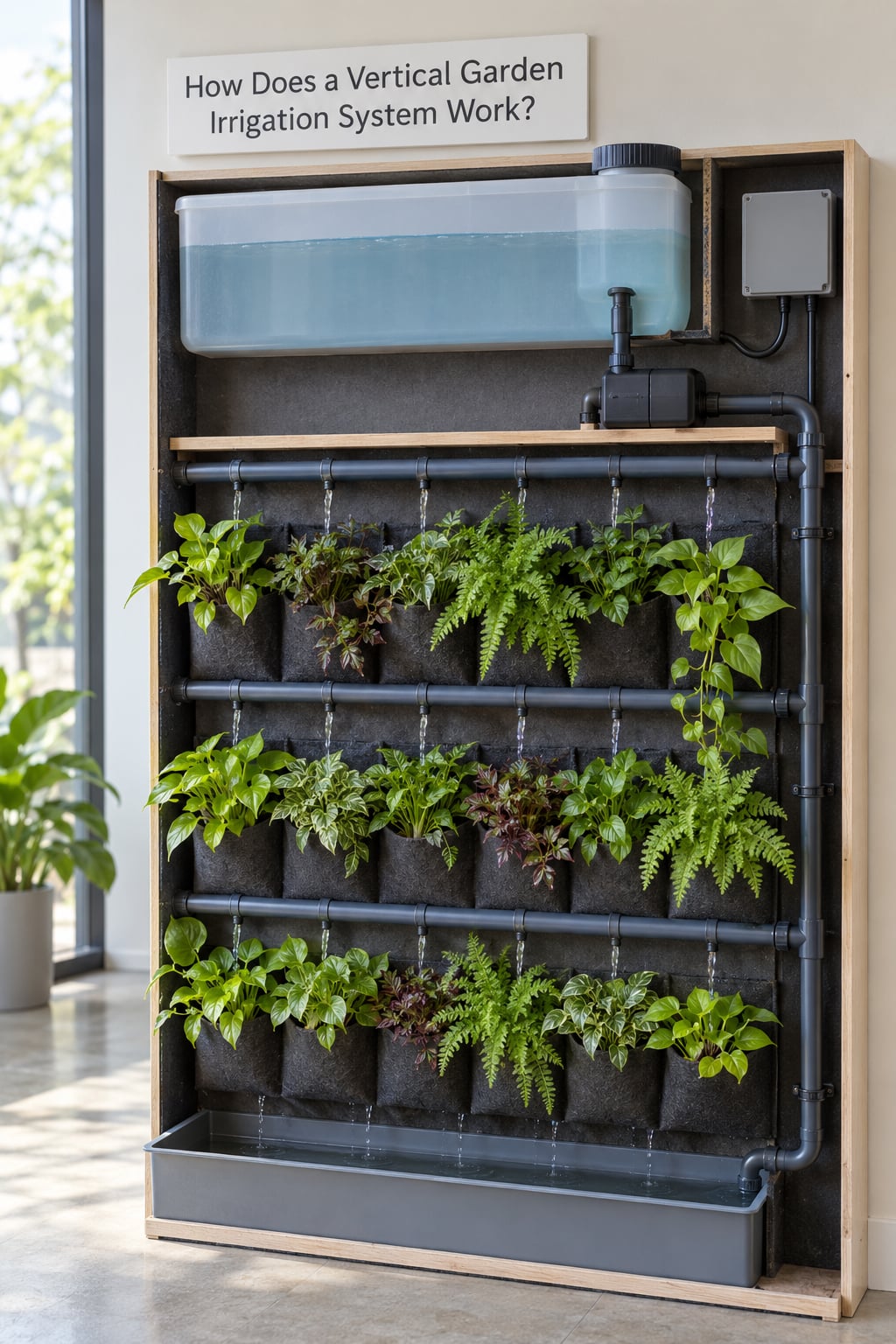
The route of water is the same in every case. It leaves the source, passes through whatever valve or timer controls it, is regulated to a working pressure, travels along a main line, branches into thinner micro-tubing runs, and exits at emitters positioned over or inside each planter. Whatever the growing medium cannot hold drains to the bottom and leaves the system.
The trouble in a vertical layout is that last part. Water is always trying to fall, and a wall gives it somewhere to fall toward.
How Does a Vertical Garden Irrigation System Work?
The operating cycle runs in a fixed order, and once you can name each stage you can diagnose almost any fault from the symptom.
- Supply. A mains tap, a wall-mounted valve, or a stored reservoir. Mains pressure is roughly 40 to 60 psi in most homes; a reservoir is usually open to atmosphere and effectively zero pressure until a pump is added.
- Isolation and timing. A backflow preventer sits close to the tap so nothing in the irrigation line can siphon back into drinking water. Downstream of it, a mechanical or battery timer opens the line on a schedule; a powered controller replaces the timer and can add sensors.
- Regulation. A pressure regulator drops working pressure to the range the tubing and emitters are rated for. Most drip hardware runs around 20 to 30 psi. Without regulation, household pressure tends to pop fittings and push far more water out than intended.
- Filtration. A screen or disc filter catches sand, scale and rust flakes before they reach narrow internal passages.
- Main line. Larger-diameter hose carries water along the structure, usually at the base or the top depending on the architecture.
- Branch lines. Smaller micro-tubing, commonly one-quarter inch, splits off the main line to serve a zone. On tall walls this is usually done in two or three separate zones rather than one long run.
- Emitters. A dripper or micro-sprinkler at the end of each run releases a set volume per hour — commonly 1 or 2 gallons per hour for a pocket of herbs or lettuce, more for a shallow-rooted strawberry pocket.
- Growing medium. Potting mix, substrate or foam panel spreads the incoming water into the root zone instead of letting it channel straight down the inside wall of the pocket.
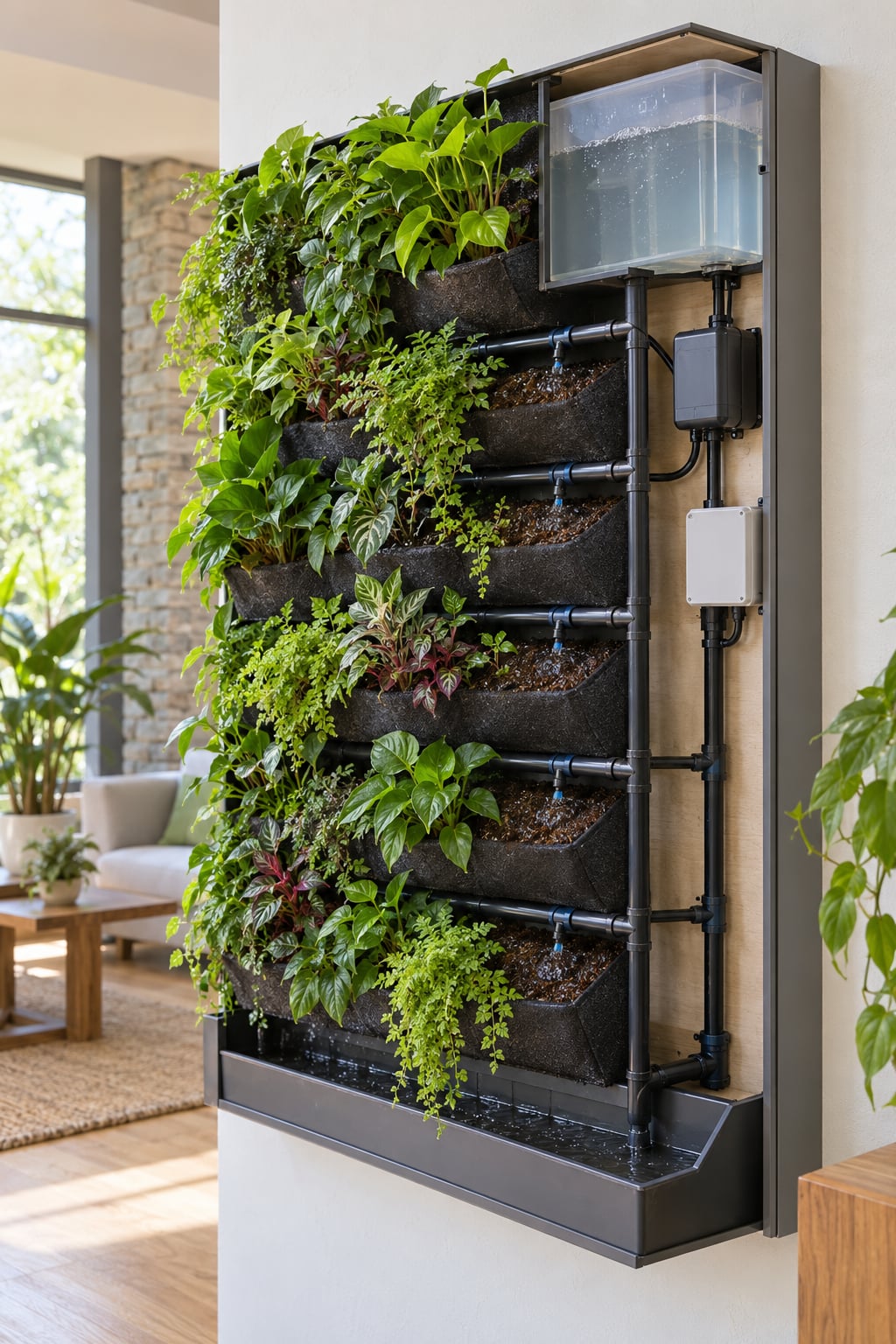
- Drainage and return. Surplus water leaves through holes in the pocket or channel, travels to a collection tray, and either runs to a drain or is recirculated to a reservoir.
A cycle-and-soak pattern is common on walls: a short run, a pause while the medium absorbs, then a second short run. One long run on a dry wall mostly produces runoff down the front of the planter rather than wetting the roots.
Vertical Garden Irrigation System: Main Parts and Functions
These are the components a vertical garden irrigation system uses, what each one does, and what a fault in it looks like from the soil side.
| Component | Function | Typical placement | Signs of a fault |
|---|---|---|---|
| Water source | Supplies mains or stored water | Tap, wall valve, or reservoir tank | Dry top pockets, empty reservoir, no flow anywhere |
| Backflow preventer | Stops irrigation water siphoning into drinking supply | Immediately after the tap | Must be present regardless; retrofit on any new line |
| Pump | Adds pressure when the source is a reservoir or a low mains line | Below or beside the reservoir | Weak output from every emitter, audible strain |
| Controller or timer | Decides when the line opens and for how long | Dry location near the supply, or mains-powered | Whole system runs or never runs; schedule lost after power cut |
| Filter | Traps sediment before it reaches small passages | After the regulator, before the main line | Gradually falling output, visible grit or algae |
| Pressure regulator | Holds line pressure at the emitters’ rated working range | Upstream of the main line | Bursting fittings at high flow, drips from misfit joints |
| Main line | Carries water along the structure | Base of a wall, spine of a tower | Kinks, splits at bends, sun-softened tubing |
| Micro-tubing | Delivers water to individual pockets | Clipped or weighted along each row | Empty runs, biofilm on the inside, rodent damage |
| Emitter or dripper | Releases a set volume at the root zone | One or more per planter | No output when pinched off, hard white crust from mineral deposit |
| Sensors | Feed real conditions back to the controller | In the medium, on the supply, or on the wall | System ignores rain, or runs constantly in dry weather |
| Growing medium | Holds water in the root zone and spreads it | Filling every pocket | Water channels down one side and leaves the root ball dry |
| Drainage tray or channel | Collects and carries away surplus water | Base of each column or the whole wall | Standing water, overflow staining, saturated lower pockets |
How Does a Vertical Garden Irrigation System Reach Every Planting Pocket?
Even distribution comes down to four things: how the flow divides, how long the run is, how the emitters are spaced, and whether each pocket can drain freely.
Flow division is done with zone valves or tees. A wall with 24 pockets might run as two zones of 12 rather than one zone of 24, because a longer zone means more pressure loss along the way and a longer total run time before the tail end gets its water. Shorter zones also mean you can stagger start times, which matters once you get to the scheduling below.
Line length matters because friction and elevation both eat pressure. Friction loss grows with the length of the run and with the volume of water moving through it. Elevation works the other way in a vertical garden: if water has to climb to reach the top of a wall, it arrives at lower pressure unless a pump or a gravity-fed reservoir above the planting does the lifting.
Emitter spacing is a plant decision, not a plumbing one. One dripper per pocket suits a lettuce or herb planting. A strawberry or tomato pocket wants two or three, spread apart, because the root ball is wider than the planter. Practitioners on r/Irrigation generally favour point-source emitters over a continuous looped dripline, partly because a loop flushes poorly and collects sediment at its low point.
Free drainage per pocket is the part people skip. An emitter that discharges faster than the medium can absorb sends water straight to the tray, and the pocket reads as dry while water runs down the wall face. If a pocket is dry, look at its drainage first and its emitter second.
One misconception comes up constantly on drip forums: an emitter does not know what plant it is feeding. A 1 gallon per hour dripper delivers about 1 gallon per hour whether it waters a thyme pocket, a fern pocket or a strawberry pocket. Equal volume, by design. Variation comes from choosing different flow rates, adding more emitters, or watering on more than one cycle.
Gravity-Fed or Pumped Irrigation: Which Does It Need?
A gravity-fed system has no pump because gravity does the work, which means the water source has to sit higher than the planting it serves.
| Approach | Operating principle | Suits | Limitations |
|---|---|---|---|
| Gravity-fed | Open reservoir above the planting; water falls through tubing to emitters | Tower planters, balcony setups, sites with no mains tap | Head is limited to the height difference, so tall runs deliver weakly; reservoir must be refilled and covered against mosquitoes |
| Low-pressure pump | A small pump pushes reservoir water through the line to a regulated pressure | Long walls, recirculating systems, towers fed from a base tank | Adds electricity, noise and a failure point; needs a dry-run risk plan |
| Timed boost or mains-fed | Mains pressure, regulated down, opened by a controller | Walls with a nearby tap, commercial installations | Requires a backflow preventer and a safe electrical supply near the controller |
Gravity feeding is the quiet favourite for a balcony tower, because a 20-liter reservoir above the top pocket can feed everything below it with no power at all. What you get is a flow rate set by the height difference, not by a setting you control, so the practical move is to size the emitters for low head rather than assuming a rated output.
Where mains power is involved, have pumps, controllers and any fixed wiring installed and connected to the manufacturer’s specifications by a qualified professional. That covers the electrical work, the bonding, and the backflow assembly, which is often required to be inspected. The tubing runs and the emitter placement are ordinary gardening work; the controller and pump connections are not.
How Do Controllers and Sensors Prevent Overwatering?
Overwatering comes from two directions: watering when the medium is already wet, and applying more water than the medium can hold. Controllers address the first, sensors address both, and only measurement closes the loop.
A basic timer is open-loop. It runs at set times on set days and knows nothing about what happened. Set it too long in summer and you drown the bottom of the wall; leave it on the winter schedule and you keep irrigating a system that is already wet from rain.
A soil moisture sensor is the cheapest real improvement. A probe in the medium reports resistance, and the controller starts or skips a cycle based on that reading. It is a genuine feedback loop, and it will hold a wall steadier through a heat wave than any fixed schedule.
A rain or weather sensor stops cycles when rainfall has already done the work, which matters more on an exposed exterior wall than on a balcony under an overhang. Flow sensors and leak detection sit on the supply side: instead of asking what the soil needs, they measure what is actually moving through the line and shut down when the numbers are wrong.
Here is the honest limit of each device. A moisture sensor tells you about the one medium it is buried in. A pocket of shallow herbs six inches away can be at a different moisture level, especially in a wall with mixed plants. A rain sensor reports on the site, not on your wall, and a shaded balcony can stay dry through a downpour. Flow sensors catch leaks and blockages but cannot tell an under-watered plant from a well-watered one. Smart controllers using evapotranspiration data give a better schedule on average, but they still cannot see the pocket that dried out three days early.
What System Works Indoors and Outdoors?
Indoor, balcony and exterior green walls fail in different ways, and the ratings do not transfer between them.
An indoor living wall under grow lights runs a predictable cycle, so a small reservoir with a timed pump or a mains-fed drip line is usually enough. Watch for mineral crust on foliage from misting-type micro-sprinklers, and for a reservoir going stagnant in a room with no airflow.
A balcony sits somewhere in between. It gets more light and more wind than an interior wall, but it is usually close enough to a tap for mains feeding, and it has no frost concern in most climates.
An exterior green wall is the hard case. It faces rain, wind, summer heat and freezing, and it holds a saturated weight on a wall fixing. Controllers need an outdoor-rated enclosure or a weatherproof location, tubing needs UV-stable material or a sleeve, metal parts need corrosion resistance, and the whole line has to be drained or protected before the first freeze. An indoor-rated kit is not an outdoor kit, whatever the label on the box says.
How to Size the Reservoir, Lines, and Emitters
Work from daily demand rather than from the total volume of the wall. A workable method, with numbers:
- Estimate the wetted area. Measure the actual surface of growing medium exposed to air, not the footprint of the wall. Call it A square feet.
- Estimate peak daily demand. A shallow, exposed, sunlit wall in summer typically needs on the order of 1 to 2 inches of water per day across that wetted area. In a container, that converts to roughly 0.6 to 1.3 gallons per square foot per day at peak.
- Multiply for plant load. Dense, leafy, shallow-rooted plantings drink at the high end. Herbs and succulents sit at the low end.
- Size emitters to match. Multiply peak daily volume by the watering days per week to get weekly volume, divide by seven for daily volume, then divide by the watering window in hours. Sum the result across all zones to get the total flow rate the system must deliver, and check that it stays within the tubing and regulator rating.
- Give the reservoir usable storage. Multiply daily demand by the number of consecutive days you expect to be away, then add 20 to 30 percent for evaporation and for the volume trapped in the lines.
- Split into zones. Keep each zone short enough to deliver at a stable pressure and to finish inside one watering window.
A worked example. Take a 6 square foot balcony wall of mixed herbs and strawberries at peak summer, watering every day in a 20-minute morning window. At the midpoint of the range that is about 0.9 gallons per square foot per day, so roughly 5.4 gallons a day for the wall. Over 20 minutes, the system needs to move 16.2 gallons, or about 49 gallons per hour. A hundred 1 gallon per hour emitters would nominally cover it, so in practice you would run two or three zones rather than one, each with 30 to 50 emitters, and repeat the cycle once the medium is soaked.
Use this as a first pass and a conversation starter with a supplier. Manufacturer flow rates and the project’s own specifications take precedence, and pocket volume and medium density change real demand more than any rule of thumb.
On total water use, an extension service will generally find hand-watering a container wall wastes a large share of what you pour on, because a lot of it evaporates or runs off the drainage hole. Getting that water to the root zone instead is where the saving comes from, not from using less water overall.
Why Is Drainage as Important as Water Delivery?
Every vertical garden irrigation system has a second, less glamorous job: getting rid of the water the medium could not use.
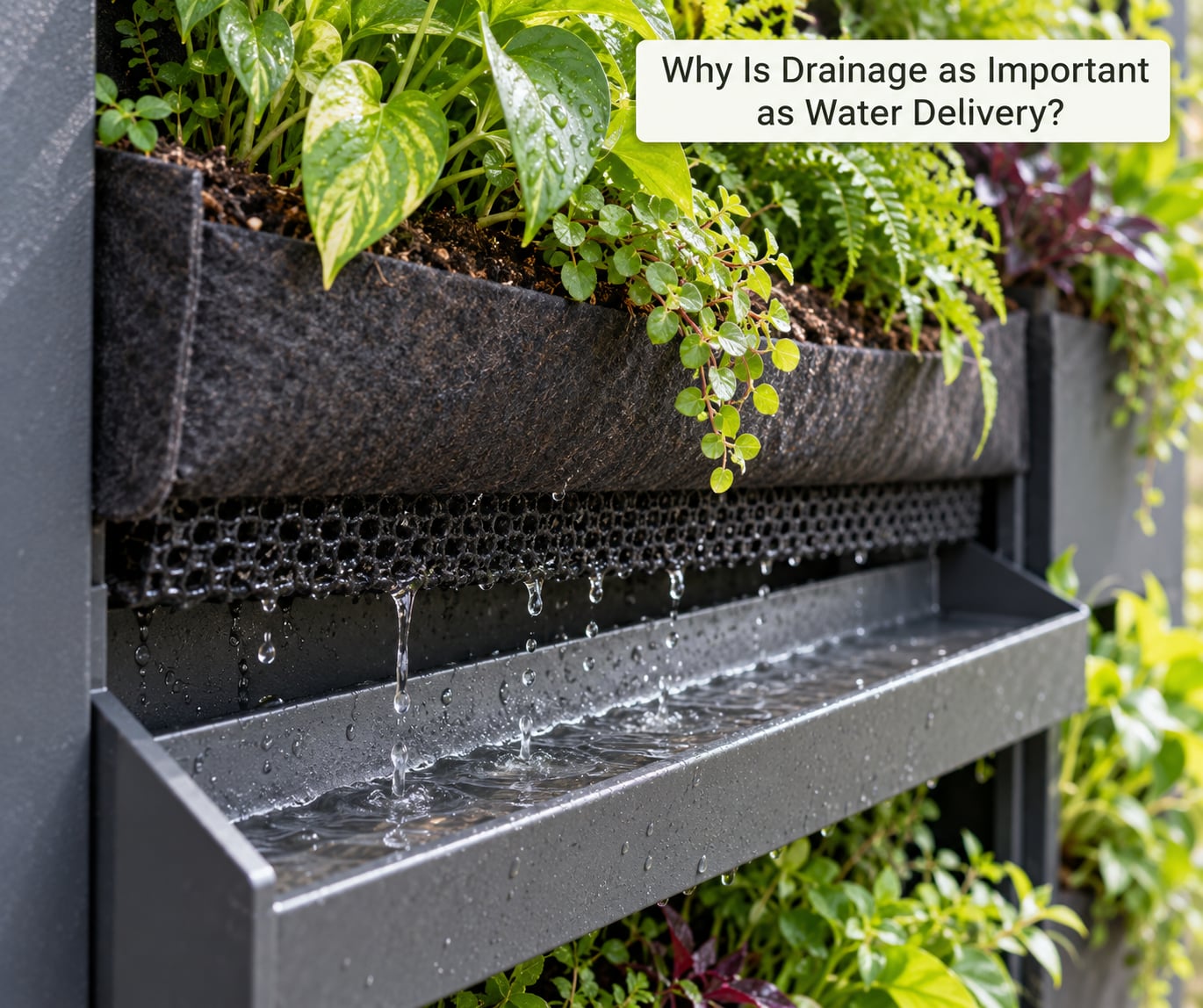
The route is straightforward. A pocket fills, surplus water leaves through a hole in its base or edge, passes into a drainage mat or channel behind or below it, runs to a tray at the bottom of that column, and leaves the structure either to a drain or back to a reservoir.
Standing water in that path causes the real damage. Saturated medium excludes air, roots suffocate, and the pathogens that cause root rot move in. Water held against timber or a wall finish causes its own class of problem, and the weight adds up: saturated medium is roughly twice as heavy as dry, and a hanging rail or wall anchor has to carry the mature, wet version of every planter it holds.
Four details keep drainage reliable. A waterproof liner behind the medium stops moisture reaching the wall structure. A drainage mat or channel keeps pockets from channeling all their water to one side. An inspection point at the base lets you see what the system is actually returning — if the tray is dry during a cycle, the water is going somewhere else, usually down the front. And backflow prevention at the supply stops the whole network siphoning when pressure drops.
How to Choose the Right System for a New Vertical Garden
Choose in this order. Each answer narrows the options, and picking equipment first tends to leave you with a wall the plumbing cannot serve.
- Structure type. A tower with a central column takes a riser or a top-fed cascade naturally. A wall of shallow pockets wants individual emitters and short zones. A tiered shelf can often be served by one horizontal drip line per tier. A living wall with a shared media panel has its own built-in distribution and needs a steady, low-flow delivery rather than point emitters.
- Orientation. A south- or west-facing wall in full sun is a high-demand site; a shaded north wall is low. This single fact changes the sizing more than any component choice.
- Plants. Group by water need before you group by position. Mixed thirsty and drought-tolerant plantings on one shared line is the most common reason a wall fails, and no emitter setting fixes it.
- Climate and exposure. Wind at a balcony edge can dry a wall faster than sun does, and an exposed wall loses moisture on every cold windy night.
- Maintenance access. Can you reach every emitter and every zone valve with a ladder or a stool, and can you see the base tray? A system you cannot inspect is a system you will not maintain.
- Water supply. Mains tap, a stored reservoir, or harvested water. Each dictates pressure and pump decisions before anything else.
- Power and noise. A mains-fed controller needs a safe electrical supply, which rules out many balconies. A battery timer needs no power but no sensors. A pump adds audible noise, which matters indoors and in apartments.
- Design and building requirements. Public and commercial installations may need an inspection, a backflow device that a plumber signs off on, and documentation.
Any of these that touches fixed wiring, a pump on mains power, or a structural fixing into masonry belongs with a qualified irrigation or electrical professional. So does a wall whose anchors are carrying more than the system rating allows.
What Problems Usually Cause Uneven Watering?
Start from the pattern you can see. Dry top and wet bottom is the classic vertical failure, and it has a short list of causes.
| Symptom | Likely cause | What to check |
|---|---|---|
| Top pockets dry, bottom pockets wet | One long zone instead of several; no controller at all; top of wall shaded differently from the base | Split the run into two or three zones and check the sun exposure of each row before changing hardware |
| Whole bottom section waterlogged | Run time too long for the medium; poor drainage in the base trays | Shorten the run, split into cycles with a soak pause, confirm the trays actually drain |
| One pocket dry while its neighbours are fine | Clogged or missing emitter; pocket drain blocked; medium channelling | Open that emitter by hand, check the hole at the pocket base, feel where the water actually lands |
| Weak output everywhere | Low supply pressure, kinked tubing, filter loading, too many emitters on one line | Test pressure at the far end of the run, walk the line for kinks, rinse the filter, count emitters per zone |
| Water pooling on the wall face | Emitter discharging faster than the medium absorbs, or the pocket has no drainage hole | Reduce output, add a second shorter cycle, check the pocket base |
| Visible leak near the base or a fitting | Sun-softened tubing, over-tightened compression fitting, freeze damage | Replace the length rather than re-tightening; note where on the run it sits, since that tells you about pressure |
| Noisy pump or a pump that runs continuously | Air lock in the reservoir, blocked filter, closed valve, low water level | Refill and bleed the line, clean the filter, confirm valves are open. Leave pump and controller housings closed and call a professional |
| Water drains straight through, medium stays dry | Medium too coarse or hydrophobic, or an inner liner bag holding water away from roots | Repot that pocket with a wettable, water-retentive mix and a drainage hole that spreads water |
| System runs but plants decline, yellow leaves | Root rot from constant moisture, or salt buildup from repeated shallow watering | Check moisture below the surface before adding water; flush the medium with a longer, slower cycle |
Flush the lines at least once a season and whenever output drops. Biofilm and mineral scale matter more in vertical runs because water sits still in the tubing between cycles, and a line that cannot be flushed properly will keep degrading.
Frequently Asked Questions
Does every vertical garden need an automatic irrigation system?
No. A small tower with a self-watering reservoir and wicking columns, or a shelf of a few pots you can reach by hand, needs no fixed plumbing at all. Automatic irrigation earns its place when the structure is too high or too large to water reliably by hand, or when nobody can water it daily through a growing season. The usual trigger is a wall above head height, more than about a dozen pockets, or any balcony where you travel.
How often should a vertical garden irrigation system water plants?
Set the schedule by demand and verify it by hand. In peak summer a sunlit wall of shallow pockets may need water daily, sometimes twice daily, while a shaded wall might manage every second or third day. Check by pushing a finger two to three inches into the medium or by lifting a pocket and judging its weight. Add a moisture sensor so the controller can shorten cycles as the season changes instead of you re-setting a timer every month.
Do I need moisture sensors and a smart controller?
They help, but they are not the first thing to buy. Get the water delivery itself right first: correct working pressure, an emitter sized to each pocket, short zones, and a controller set to the plants you actually grew. Once that is stable, one moisture probe per zone removes most overwatering, because it stops cycles when the medium is already wet. A phone app adds convenience rather than accuracy. No sensor can see a pocket that dried out faster than the rest of the wall.
Can multiple plants share the same irrigation line or emitter?
Sharing a line is normal, since a whole row usually runs off one branch of micro-tubing. Sharing a single emitter is a poor idea, because that emitter delivers one fixed volume regardless of what is growing. Two plants sharing a dripper split that volume between them, and neither gets a reliable share. Either give each pocket its own emitter, or share one dripper across several pockets of the same species with the same water need and accept that you are committing to treating them identically.
How much maintenance does a vertical garden irrigation system need?
More than the marketing suggests. Budget a few minutes a week to run a cycle and look at the base tray, monthly to flush the lines and check every emitter by hand, and a seasonal pass to clean the filter, re-tape any clips, and check fittings where tubing was bent around a corner. Indoors that is genuinely light. Outdoors expect more: sun-softened tubing, mineral crust on emitters, and freeze damage are all normal maintenance items, and winterization means draining or protecting the lines before the first freeze.
Start With the Growing Requirements
The first useful move is a map, not a shopping list. Write down which plants sit in which row, how long each one gets in direct sun, and roughly how thirsty each is. Mark the pockets that face the wall and the ones that catch the edge of the balcony, because those dry at different rates.
Everything in a vertical garden irrigation system follows from that map. Emitter flow rates, zone count, run length, reservoir size, and whether you need a pump at all are all answers to how much water, where, and from which direction. Choose the plants and the exposure first, then size the hardware to match.
Two things matter more than any component choice. The medium has to be able to absorb water at the rate your emitters deliver it, and every pocket has to drain freely when it cannot. Get those right and the rest of the system is straightforward plumbing; get them wrong and no controller or sensor will rescue the wall.
Once the map is done, put the plumbing and any fixed electrical work in the hands of a qualified professional, and keep the emitters, zone scheduling and seasonal checks as the part you own.