Metal planters pros and cons for plants boil down to two properties: metal moves heat and moisture faster than plastic or terracotta, and it outlasts both by decades. That makes metal the toughest choice for patios, balconies, entryways and large architectural planting. The trade-off is a root zone that heats up fast in full sun, plus rust, staining and a weight that stops you moving the pot once it is planted.
I have replanted the same corner twice over the years, swapping a plastic pot for a galvanized one and back again, and the difference was never the plant. It was the watering schedule. Metal dries faster in July and holds temperature longer at night. Choose it when you want a container that stays put and takes a beating. Choose something else when your plants want damp soil, mild roots and a pot you can carry to the other side of the deck.
Updated for October 2026.
Table of Contents
- Metal Planters Pros and Cons at a Glance
- What Are the Main Benefits of Metal Planters?
- What Are the Main Drawbacks for Plants?
- How Metal Type Changes Plant Performance
- Galvanized steel
- Corten or weathering steel
- Powder-coated mild steel
- Aluminum
- Stainless steel
- Metal Planters Pros and Cons for Plants, Day to Day
- Do Metal Planters Get Too Hot for Roots?
- Do Metal Planters Need Drainage?
- How Do You Choose the Right Metal Planter for a Plant?
- Match the volume to the root system
- Think about where the roots like to sit
- Read the exposure, honestly
- Check rain and drying against your schedule
- Decide on wind and weight
- Match the style and the finish
- Indoor or outdoor changes the spec
- Metal Planters Compared With Other Planter Materials
- How to Care for Metal Planters
- Frequently Asked Questions
- Are metal planters good for indoor plants?
- Will a metal planter rust outside?
- Can metal planters crack in cold weather?
- Do metal planters get too hot for plant roots?
- Should metal planters have drainage holes?
- Are metal planters better than terracotta for outdoor plants?
- Conclusion
Metal Planters Pros and Cons at a Glance
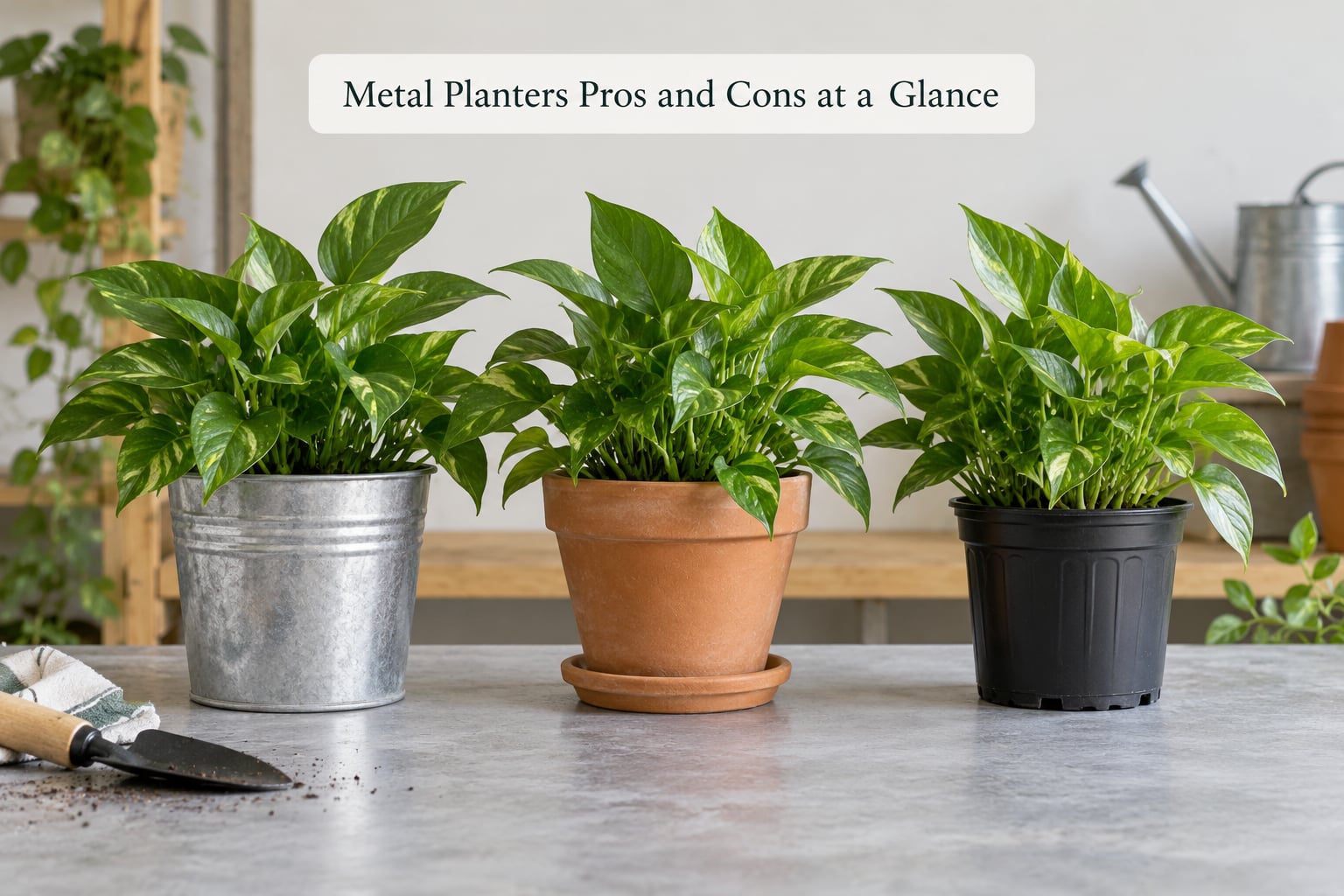
Here is the short version before the detail. Every row below applies to metal containers generally; the finish changes the details but not the direction.
| Factor | How metal behaves | Watch out for |
|---|---|---|
| Drainage | Any container needs holes; metal is rigid, so holes stay round and do not close up | Watering through a hole rings indoor floors and shelves |
| Soil temperature | Conducts sun straight into the root zone, so soil swings further than in plastic | Full-sun dark pots can cook roots in hot weather |
| Weight | Steel is heavy, which stops wind tipping and stops you rearranging | Plan for two people or a dolly on anything over about 20 gallons |
| Durability | Will not chip or crack; seams and welds outlast terracotta and resin | Thin steel dents, and coatings scratch at the base |
| Corrosion risk | Galvanized, Corten and powder-coated finishes all resist corrosion well | Uncoated or cheap steel stains concrete, decking and fabric in year one |
| Maintenance | Annual rinse, occasional touch-up, no replacement parts needed | Salt and fertilizer residue dulls the surface if left |
| Design fit | Clean lines, modular sizes, wide range of colour and patina | Industrial look does not suit cottage or rustic planting |
What Are the Main Benefits of Metal Planters?
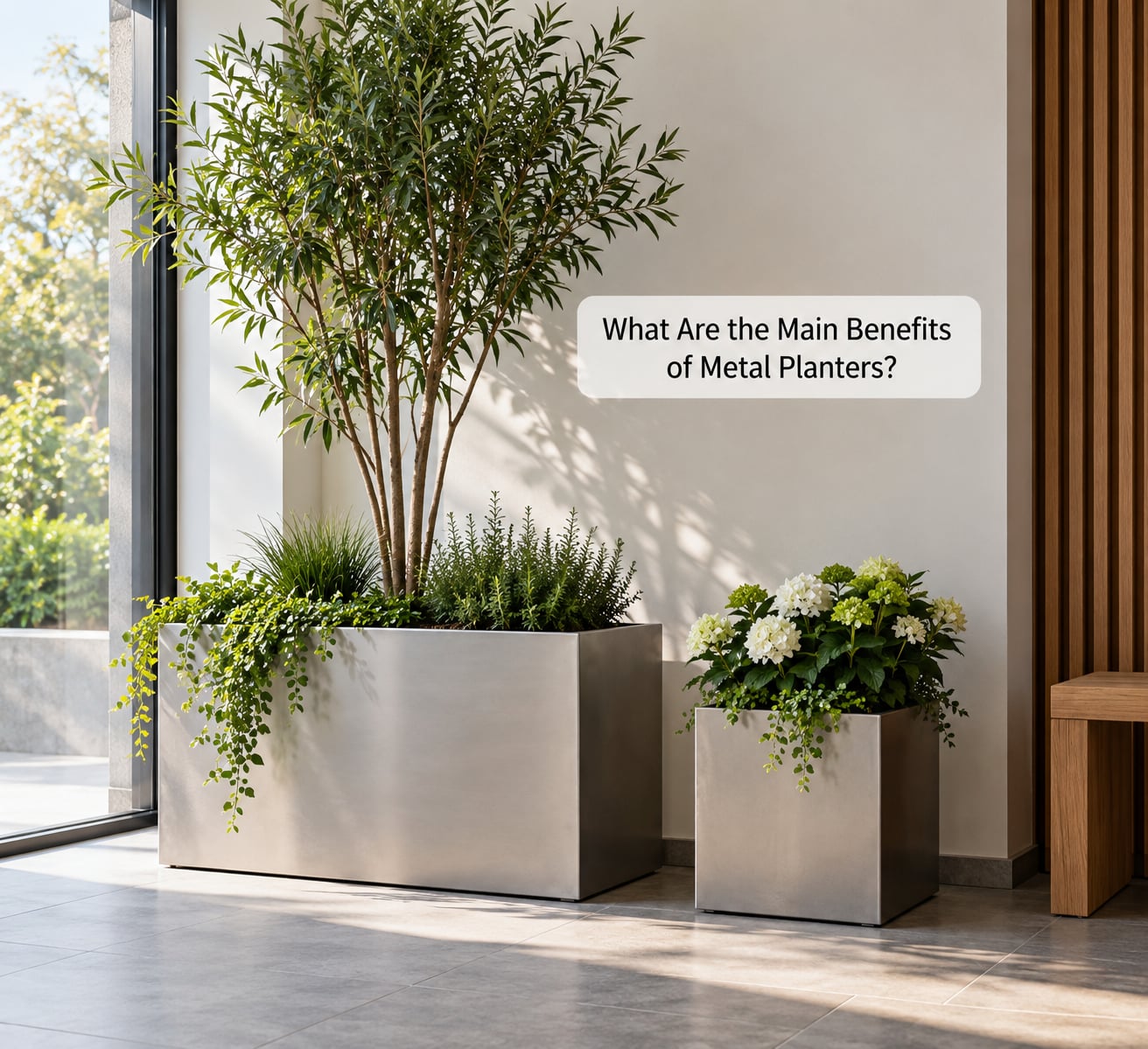
Metal wins on longevity, stability and the ability to hold large volumes of soil. A 30-inch steel planter can carry a small tree or a mass of ornamental grasses that plastic would never support without doubling up the wall thickness.
- They do not crack or shatter. Terracotta breaks from a frost or a dropped pot. A steel container can be dragged across gravel and still look fine.
- Large capacity in a slim wall. Metal sheet is thin relative to how much soil it holds, so you get more root volume for a narrow footprint. That is why it works for entry planters and rooftop boxes.
- Weight as a feature. On a balcony or rooftop, a filled steel pot is genuinely useful. Gardeners repeatedly note it is the reason they stayed with metal, while the same people regret not adding casters sooner.
- A predictable surface. Powder-coated and painted finishes keep colour for years without the algae and lime staining terracotta collects, and they wipe clean.
- Weather resistance in the right finish. Galvanized and Corten planters sit outside through winter weather without splitting or swelling, which is exactly where wooden boxes start to rot at the joints.
- Recyclable at end of life. Steel and aluminum are among the most recycled materials there is, and Corten needs no chemical protection to keep its finish.
- Modular sizing. Manufacturers produce matching cylinders, cubes and rectangular troughs, so a balcony run of three pots lines up.
What Are the Main Drawbacks for Plants?
The honest answer to what the downsides of metal planters are comes down to four things: heat, moisture loss, corrosion on cheaper steel, and weight. None of them is a dealbreaker, and each one has a fix that costs nothing.
- Heat transfer to roots. Dark steel in direct sun pushes soil temperature well above ambient, and root damage shows up as wilting that does not recover in the evening.
- Faster drying. Metal walls pull moisture out of the root ball at the edges. In a hot, dry or windy spot that means watering daily, and daily watering on a balcony is not realistic for most people.
- Rust on uncoated or cheap steel. Ordinary mild steel has no protection. Rust runoff stains concrete, composite decking and fabric, usually in the first season.
- Weight and immobility. Soil is roughly twice the weight of the empty pot. Planter weight is a safety feature and a moving-day problem at the same time.
- Weight damage. Dropping a filled steel planter can dent the side permanently. It will not shatter the way terracotta does, but the dent stays.
- Lost components. Liner inserts, matching lids, casters and irrigation fittings are sold separately and are harder to replace than a plastic saucer.
- No breathability at the roots. Metal is waterproof, which is useful until you assume it drains. Water sitting in the base is the fast route to root rot.
How Metal Type Changes Plant Performance
All metal is not the same metal, and the finish decides how the container behaves over five years rather than five weeks. Here are the ones you will actually meet.
Galvanized steel
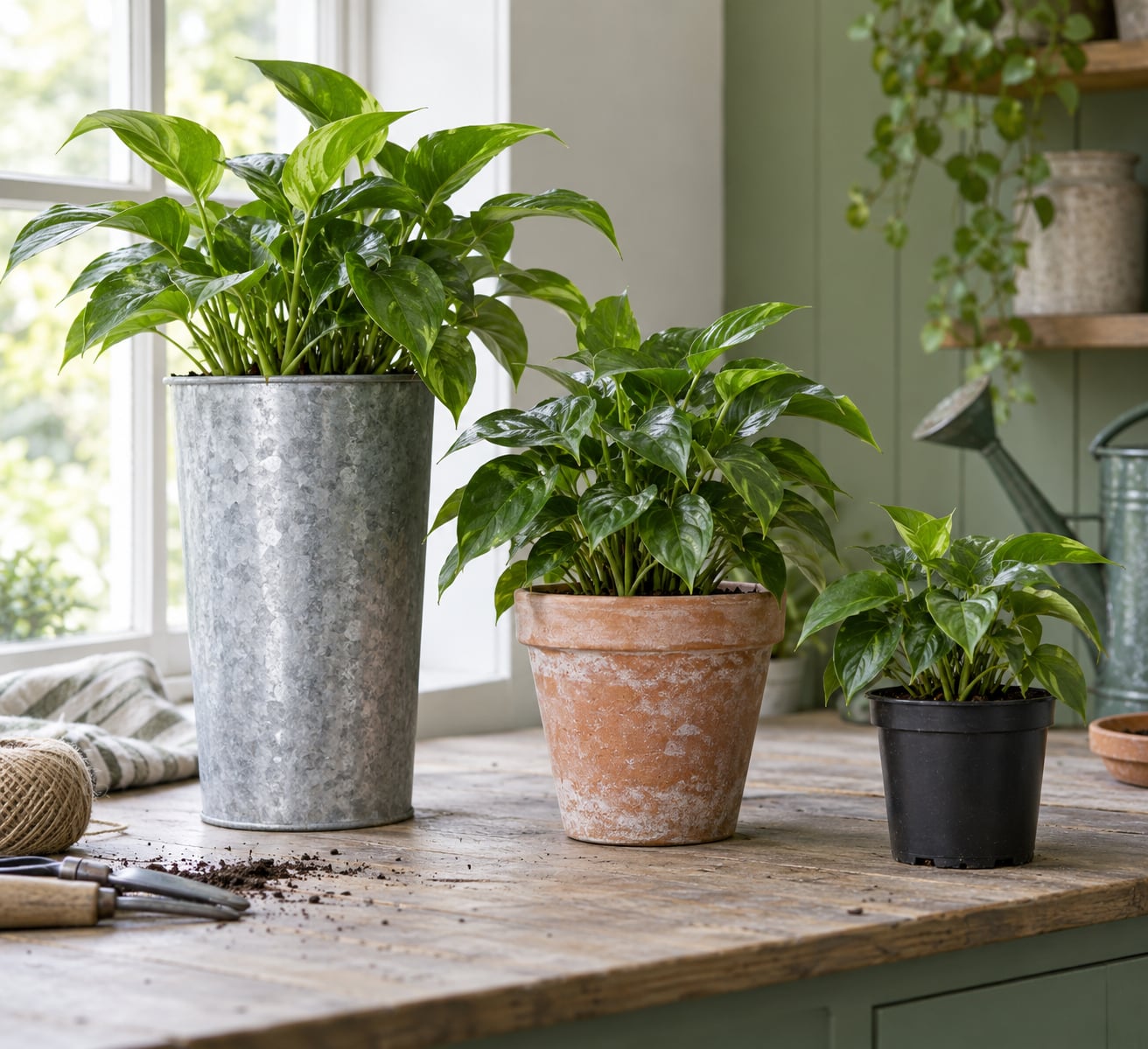
A zinc coating over mild steel, giving the familiar spangled grey finish. It handles rain and splashes well for many seasons before the zinc slowly wears through at the base. It is the workhorse choice for raised beds and utility planters, and the most common starting point for people building their own.
Corten or weathering steel
A low-alloy steel that forms its own stable oxide layer and stops corroding once that patina sets. It is designed to rust on the surface and then stop. It suits exposed outdoor planting and architectural use, but expect dark orange runoff staining nearby surfaces in the first year or two. Galvanizing and Corten are not interchangeable, which is a question that comes up constantly in gardening forums.
Powder-coated mild steel
Steel with a baked-on dry powder finish in a wide range of colours. This is the cleanest look and the easiest to wipe down. The weakness is mechanical: a chip at the base exposes bare metal and that spot will start to bloom. Look for a thicker gauge and a coating applied to both inside and outside.
Aluminum
Light for a metal, corrosion resistant with no coating needed, and easy to move. It is the pick for rooftop and balcony planting where weight is the binding constraint. It conducts heat well and dents more easily than steel, so it lives indoors or on a sheltered terrace rather than in a busy entryway.
Stainless steel
The most expensive and the least reactive. Used for visible indoor containers and food-adjacent planting, where the surface must not mark. Nothing about its plant performance differs much from other metal; you are paying for the finish.
Metal Planters Pros and Cons for Plants, Day to Day
Stacked up for everyday use, the subtype matters less than three numbers: how much sun the pot gets, how wet you want to keep it, and whether you can still move it next spring. Get those right and the finish mostly determines how it looks in year five.
Do Metal Planters Get Too Hot for Roots?
Yes, sometimes. Metal is a good conductor, so a dark steel wall in direct sun heats quickly and passes that heat straight into the soil. The effect is strongest in a black or dark grey pot, in a hot dry climate, and in a pot sitting on a paved or concrete surface that bounces heat back up. Gardeners in temperate zones often report no issue at all, which is why the answer has to be conditional rather than a flat warning.
What to do about it, in the order I would try things:
- Change the position first. Afternoon shade does more than any other fix and costs nothing. West-facing walls are the worst spot by a wide margin.
- Double-pot it. Put a plastic nursery pot inside the metal shell, leaving a finger of air around it. This is the most repeated recommendation in gardening forums and it solves drainage and root temperature in one move.
- Line it. A plastic pot liner or a bubble-insulation sleeve inside the shell breaks the conductive path to the roots.
- Water deeper and less often. A slow, full soak on the morning side of the day cools the profile and avoids the daily splash cycle.
- Pick tolerant plants. succulents, herbs, ornamental grasses and drought-tolerant perennials shrug off short heat spikes. Leafy vegetables and ferns do not.
Do Metal Planters Need Drainage?
Yes, always. A metal wall will not let excess water out, and the assumption that metal is a well-drained material because it feels solid sends people straight into root rot. Check the base before you buy: a planter with no hole, or one sealed by a removable plug you leave in, is a deco pot rather than a growing pot.
A few practical checks:
- Hole size and count. Several holes spread across the base beat one large hole in a long trough, because water sits along the bottom edge otherwise.
- Drilling your own. Metal is the easiest container material to modify. Use a metal-rated hole saw, work on a scrap sheet, deburr the edge with sandpaper and coat the cut so bare steel does not start rusting from the inside.
- Saucers. Indoors, use a saucer and empty it. Outdoors, set the pot on feet or a stand so water drains clear of the base.
- Skip the gravel layer. A gravel bed at the bottom of a container does not improve drainage. It takes up root volume and, in practice, keeps the perched water table higher.
- Water-retaining liners. Coir or fabric liners slow drying in a hot metal shell. They work, but only if you are prepared to check moisture more often.
How Do You Choose the Right Metal Planter for a Plant?
Work through these in order. The material is the last decision, not the first.
Match the volume to the root system
Give a plant a container with a little room to spare rather than one it will outgrow in a season. Crossing up doubles as root pruning, but doing it constantly costs the plant energy. Note the mature size of a shrub before you buy the pot for it, because moving a filled steel trough is the part nobody enjoys.
Think about where the roots like to sit
Shallow, fibrous root systems and plants that resent disturbance do well with a wider, shallower container. Deep taproots want depth. Neither preference is served by a small, deep standard pot.
Read the exposure, honestly
Count hours of direct sun and note whether heat comes off a wall or a paved surface. The plant’s tolerance for a hot root zone matters more here than in any other material, because metal lets you do less to hide it.
Check rain and drying against your schedule
Small metal pots under a roof overhang dry out faster than the same pot in plastic. Be honest about how often you will actually water in the hottest weeks, and choose a larger volume or a liner if the answer is fewer than every other day.
Decide on wind and weight
A tall planter on an exposed corner or a high balcony needs ballast. Steel gives you that for free. If you want to move it, check whether casters are available before you buy, because retrofitting them into a filled planter is unpleasant work.
Match the style and the finish
Contemporary and industrial planting suits powder-coated colour and Corten patina. Cottage planting suits wood and terracotta far better. Spending effort on a finish that fights the garden around it tends to end in regret.
Indoor or outdoor changes the spec
Indoors, prioritize a matched saucer, a liner pot and a finish that will not mark shelves. Outdoors, prioritize drainage, gauge and corrosion resistance.
Metal Planters Compared With Other Planter Materials
Metal sits between plastic and concrete in almost every column. It keeps more heat than plastic and less moisture than terracotta, and it lasts longer than both.
| Criterion | Metal | Plastic | Terracotta | Wood | Concrete |
|---|---|---|---|---|---|
| Moisture retention | Low to medium, dries fastest | High | Low, wicks and breathes | Medium | High |
| Root-zone temperature | Widest swings, hot in sun | Warm but insulated | Moderate, evaporative cooling | Moderate, insulating | Cool and steady |
| Weight when filled | Heavy | Light | Heavy | Medium to heavy | Very heavy |
| Lifespan | Decades with a good finish | Cracks and fades in sun | Cracks, salts and frost damage | Rot at joints if unsealed | Decades, can crack |
| Corrosion or marking | Rust if unfinished | None, but UV fading | White salt bloom, staining | Weathering grey, possible mold | Efflorescence, rust marks from steel |
| Maintenance | Rinse yearly, touch up chips | Wash occasionally | Scrub salts, replace cracks | Oil or stain every year or two | Pressure wash, patch cracks |
| Appearance | Modern, industrial, patina | Moulded and cheap-looking | Warm, handmade | Natural, ages well | Monolithic, architectural |
| Best for | Large pots, rooftops, exposed sites | Balconies, herbs, budget | Dry, Mediterranean planting | Vegetable beds and borders | Very large permanent planters |
The healthiest container for vegetables is usually the one you can keep evenly moist. That points to plastic or fiberglass for a hot balcony, wood for a raised bed, and metal only with a liner or a shade position.
How to Care for Metal Planters
Metal is low maintenance, not zero maintenance. A ten-minute routine twice a year prevents almost every complaint people have about the material.
Keep drainage clear. Peat, root debris and fertilizer crust block the holes of a metal pot faster than most people expect. Lift the pot, tip out the top inch and check that water runs through freely at the start of each season.
Clean the surface. Salt, fertilizer and algae dull powder coat and stain stainless. Wipe the outside with water and a mild detergent, and rinse the inside before repotting. Skip abrasive pads, which scratch the finish.
Watch the base, not the top. Rust appears first where water sits, at drainage holes, foot plates and seam edges. Sand the spot back, then touch it with a matching metal primer and paint. Caught in year one it takes minutes.
Protect surfaces underneath. Put a saucer or a mat under a Corten or uncoated steel planter for its first seasons. Rust runoff is the reason some buyers regret the finish, and it is entirely preventable.
Manage heat and cold together. Move shaded pots closer to shelter before a heat wave, and leave the soil slightly drier in winter, since cold wet soil in a metal pot kills roots faster than cold dry soil.
Frequently Asked Questions
Are metal planters good for indoor plants?
Yes, and they suit low-light interiors well because they hold shape, stack neatly and wipe clean. Use a planter with a matched saucer and a drainage hole, or set a plastic nursery pot inside the metal shell to protect the shelf. Check underneath a stainless or galvanized pot early on, because a slow leak marks wood faster than people expect.
Will a metal planter rust outside?
It depends entirely on the finish. Galvanized steel and Corten are designed to resist corrosion, and powder-coated steel resists it until the coating is chipped. Plain mild steel with no coating will rust, usually starting at drainage holes and seams. Whichever you have, put a saucer or mat underneath for the first season or two so runoff never reaches decking or concrete.
Can metal planters crack in cold weather?
Metal does not crack the way terracotta or plastic does, and frost will not split it. What can happen is seam weeping where a weld has been ground through, or a shallow dent if water froze in a thin wall and expanded. The bigger winter risk is not the pot, it is a plant sitting in cold wet soil with no insulation, which is where root loss usually comes from.
Do metal planters get too hot for plant roots?
They can, especially in a dark pot in direct afternoon sun on a hot day, because metal conducts heat straight into the soil. Cooler climates and lighter colours rarely cause a problem. If yours is running hot, move it into afternoon shade or nest a plastic nursery pot inside the shell, leaving a finger of air around it. Water deeply in the morning rather than in small daily splashes.
Should metal planters have drainage holes?
Yes. Metal is waterproof, so excess water has no way out except through holes, and a sealed pot leads to root rot faster than a plastic one. Several holes spread across the base work better than a single hole in a long trough. Metal is also the easiest material to modify yourself, since a metal-rated hole saw cuts it cleanly and the cut edge can be primed against rust.
Are metal planters better than terracotta for outdoor plants?
For long-term outdoor use, usually. Metal will not crack, chips or grow the white salt bloom terracotta develops, and it holds larger volumes of soil without a bulky wall. Terracotta wins on moisture retention and evaporative cooling, which makes it better for herbs and Mediterranean planting in full sun. Choose metal if you want permanence, and terracotta if you want a root zone that stays naturally cooler and damper.
Conclusion
Metal planters suit anyone who wants a container that stays put, holds a real volume of soil and survives years of weather without cracking. The conditions that call for caution are the same every time: a dark container in hard afternoon sun, a plant that wants constantly damp soil, and a spot you may want to rearrange next season.
Start with three decisions in order. Pick the volume the mature plant needs, check that the pot drains, and match the finish to the exposure. Heat and weight stop being problems the moment those three are right, and the metal planters pros and cons for plants come down to planning around them rather than avoiding the material.