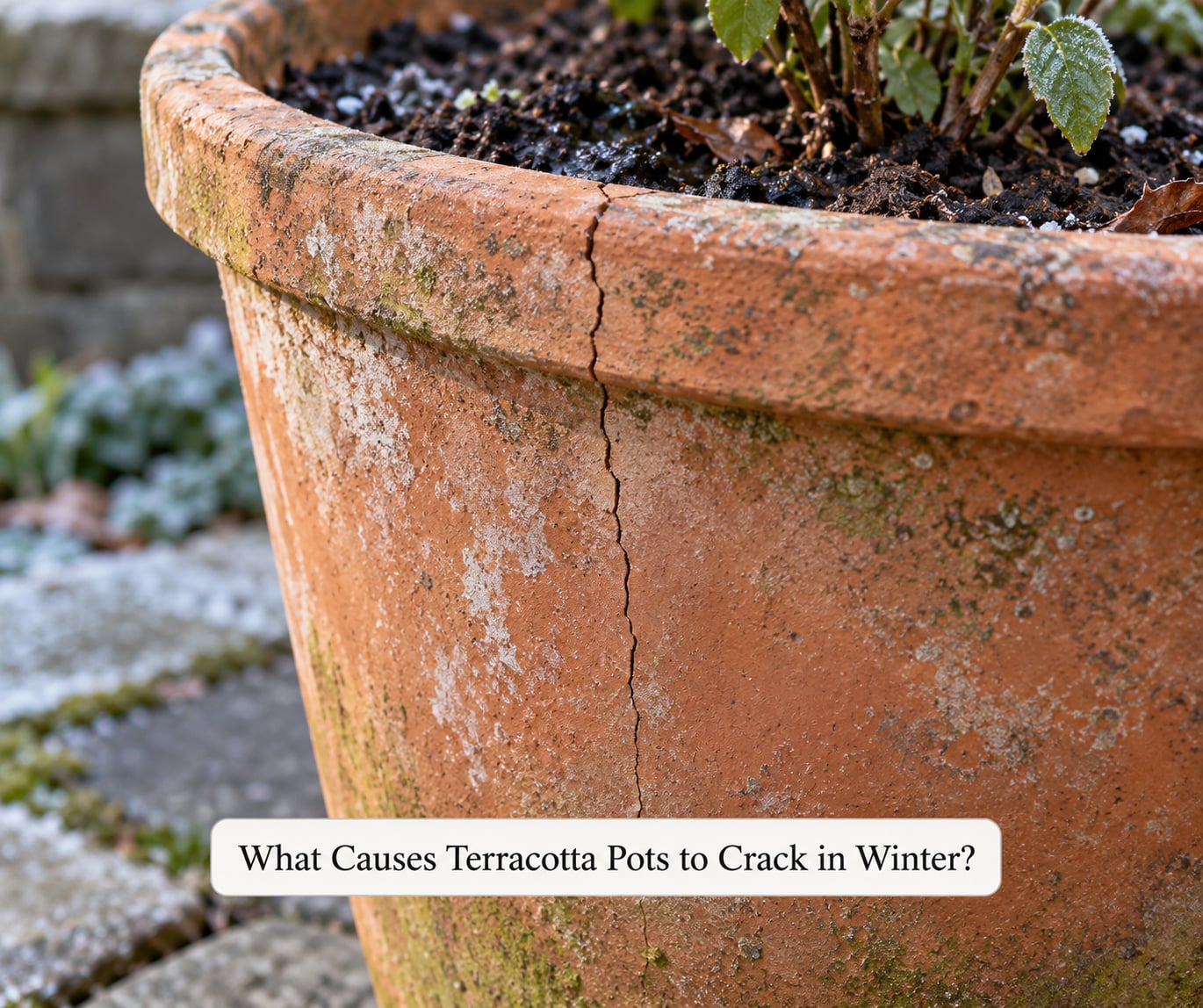
Terracotta pots crack in winter because unglazed clay is porous, so autumn rain and melting snow soak straight into the pot wall. That water freezes, expands by roughly 9%, and pushes outward from inside the clay until the pot splits. Understanding why terracotta pots crack in winter matters because almost every one of those splits is preventable, and the fix depends on which of the six causes you find.
A hairline fissure in a cheap pot is a different animal from a large planter splitting into two pieces overnight. The first usually means thin walls and a cold snap. The second almost always means standing water, saturated soil, or a pot that was left full through several freeze-thaw cycles.
Most of the advice I see online jumps straight to prevention without explaining the mechanism, which is exactly backwards. Once you know what is pushing on the clay, you can stop it. The physics come first here, then the six causes, then what to do in autumn and what to do with a pot that is already cracked.
Updated for 2026, and relevant whether you are in USDA zone 4 or zone 9, because freeze-thaw damage is not only a northern problem.
Table of Contents
- What Causes Terracotta Pots to Crack in Winter?
- How Freeze-Thaw Expansion Damages Terracotta
- What happens step by step
- How to tell a hairline crack from a structural one
- Why Terracotta Pots Crack in Winter: 6 Common Causes
- 1. Freeze-thaw cycling, not just a single hard freeze
- 2. Saturated soil and a wet root ball
- 3. Unsuitable or blocked drainage
- 4. Thin or low-quality clay
- 5. Impact and movement
- 6. Placement on cold or uneven surfaces
- How to Prevent Winter Cracking
- What “frost-proof” actually means
- When it is genuinely too cold to leave a pot out
- What to Do When a Terracotta Pot Cracks
- How long do terracotta pots last?
- Which Terracotta Pots Are Best for Cold Climates?
- Frequently Asked Questions
- Do all terracotta pots crack in the winter?
- Can a terracotta pot be repaired after cracking?
- Does glazing a terracotta pot prevent winter cracking?
- Should terracotta pots be brought indoors during winter?
- How can I tell whether a crack in a terracotta pot is serious?
- Do drainage holes really reduce winter cracking?
- Conclusion: Start With Drainage and Cold Protection
What Causes Terracotta Pots to Crack in Winter?
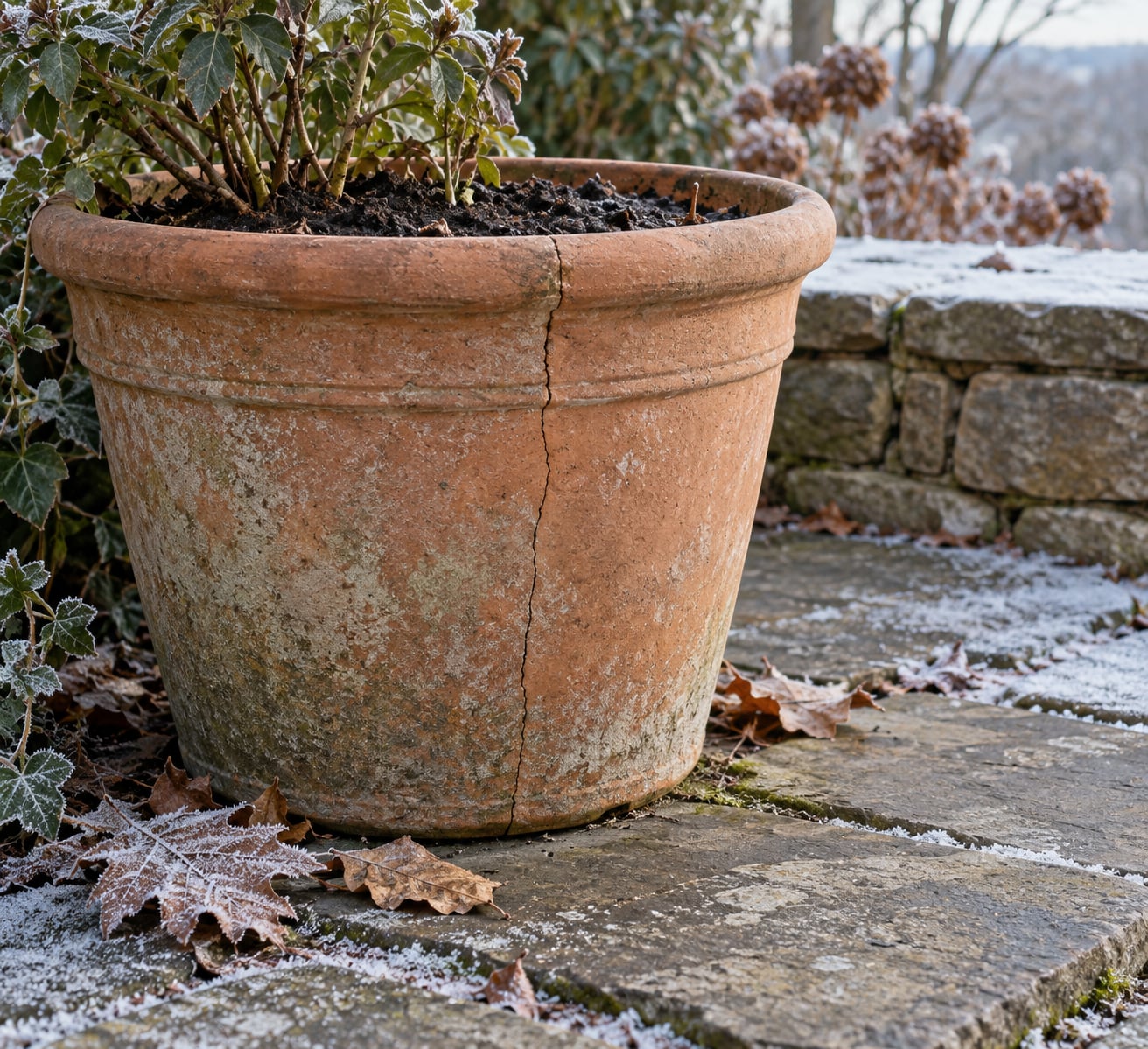
Terracotta is fired clay with an open pore structure, which is what lets air reach the roots and water drain from the soil. The same pores act as a sponge during autumn and winter. Moisture moves in by capillary action, saturates the wall, and when temperatures drop below freezing that internal water turns to ice. Ice takes up about 9% more volume than the water it came from, and the clay has no room to give, so the pressure opens cracks along the rim, the base, or the weakest seam.
The important detail most people miss: it does not take a deep freeze. A single night that dips a few degrees below freezing, repeated a dozen times, does more damage than one cold snap at minus 15. Every cycle wets the clay, freezes it, thaws it, and lets it take up fresh water again. A freeze-thaw cycle is simply that wet-freeze-thaw loop, and the loop is what kills pots, not the temperature at the bottom of it.
Glazed terracotta behaves differently. A fired glaze seals the outer surface, so far less water enters the wall, which is why glazed pots usually outlast unglazed ones in the same spot. They are not immune, though. A glaze only covers the outside, and any chip, crack, or unfazed base leaves the clay body exposed, so frost damage usually begins exactly where the glaze is missing.
How Freeze-Thaw Expansion Damages Terracotta
What happens step by step
Step one is absorption. Rain, snowmelt, and watering move into the pores of the clay from the outside, and water also moves from wet soil through the pot wall and out through the surface. A pot sitting in a wet saucer keeps this process running all winter long.
Step two is freezing. Once the wall is saturated and the air temperature drops below freezing, the water inside the pores starts forming ice crystals. The clay body cools and contracts at the same time, which puts the wall under two opposing stresses at once.
Step three is pressure. The ice needs more room than the water had, and the surrounding clay resists. Pressure builds from the inside of the wall outward, highest where the wall is thin, where the shape changes direction, or where the clay is already weak.
Step four is thawing, and this is where fines turn to dust. As the ice melts, the water has nowhere clean to go, so it leaves mineral deposits behind in the pores. Each cycle leaves the wall slightly more porous and slightly more brittle, which is why a pot that survived one winter often fails in the second or third.
How to tell a hairline crack from a structural one
A hairline crack is a surface fissure, often a single line a fraction of a millimetre wide. It shows as a dark line, sometimes damp or weeping in cold weather, and it usually does not move when you set the pot down. A structural crack runs through the full wall thickness. The pot rocks on its base, you can see daylight through it, the rim no longer forms a circle, or a piece drops off entirely. Salt deposits and flaking on the surface are the classic frost signature, because dissolved minerals in the water precipitate as it dries through the clay.
| Where the crack appears | What it usually points to |
|---|---|
| Base, usually a full circle or a line near the bottom | Standing water, a saturated root ball, or a pot resting on frozen wet ground |
| Rim or lip | Impact damage, thin clay at the thinnest point, or a frost crack that started in a chip |
| Side wall, often vertical | Thermal shock from warm sun then hard frost, or freeze expansion in a thin wall |
| Around the drainage hole | Constant saturation and water sitting in the base of the pot |
Why Terracotta Pots Crack in Winter: 6 Common Causes
1. Freeze-thaw cycling, not just a single hard freeze
This is the headline cause and the one people notice only after the fact. A pot that is repeatedly soaked, frozen, thawed, and soaked again builds internal pressure cycle after cycle, and the damage compounds. Mild-winter regions hit this more often than cold ones. A week of nights just below freezing in a damp autumn does more to a patio of terracotta than a single two-week cold snap in a dry region, because the clay never fully dries out in between.
One reader on the allotment4all forum described the pattern plainly: the terracotta absorbs moisture, the moisture freezes, the ice expands, and the pot cracks. That same thread is full of pots that failed in ordinary British winters, not extreme ones.
2. Saturated soil and a wet root ball
Soil holds far more water than the pot wall does, so a planted pot is a bigger expansion chamber than an empty one. That is why gardeners report losing filled containers while the same pot stored empty survived. Waterlogged compost also expands when it freezes, and it expands in every direction at once, pressing outward on the wall from the inside while the wall is already being pushed from the pores.
On Reddit’s r/gardening, overwintering threads repeat the same conclusion: containers left full through a cold winter crack, and the losses are heavier than people expect. One poster counted a stack of clay pots lost in a single season after leaving them out.
3. Unsuitable or blocked drainage
A drainage hole is not a suggestion. Without one, the pot holds water that has nowhere to go, the root zone stays saturated, and the bottom of the wall is permanently wet. Blocked holes are worse than none because water collects in the base where you cannot see it. Saucers add a second problem: many gardeners fill a saucer in the morning and forget it, and that standing water is what the pot soaks up through its base and lower wall overnight.
Drainage holes help, but they only help if they are clear and the pot is not sitting in water. Elevation matters too. A pot resting flat on paving or a frozen deck draws water up from the surface and keeps its base damp all season.
4. Thin or low-quality clay
Wall thickness is the single biggest quality variable between two pots that look identical on a shelf. A thin, fast-fired pot from a bargain bin has less material to distribute the internal pressure, and it tends to be more porous, so it takes up more water. Gardeners on r/gardening note that hairline cracks in new pots are normal for cheap ones precisely because water seeps into them and splits the wall at freezing temperatures.
Cheap does not mean faulty, and a hairline line on a brand-new pot is not always a manufacturing defect. It is a signal about the build quality and the climate you are asking it to survive. A planter from a bonsai supplier, or any pot with visibly thick walls, has far more margin.
5. Impact and movement
Winter is when planters get knocked. Moving a frozen pot to a garage, dragging it off a patio, or bumping it with a wheelbarrow can shatter it outright, because frozen clay and frozen soil lose almost all their give. Even unfrozen, a full terracotta pot is far heavier than it looks, and a pot that has been sitting on a tiled edge all season can shift as the soil settles and drop onto a hard corner.
Impact damage looks different from frost damage. It usually shows as a clean break or a chip at a rim, concentrated at a point of contact, and it often happens without any cold involved at all.
6. Placement on cold or uneven surfaces
Where a pot sits changes how much cold it takes. A pot against a south-facing wall bakes in the afternoon sun and then takes a frost the same night, and that swing is thermal shock: the wall expands in the sun, contracts hard at night, and something eventually gives. A pot on a metal surface, a concrete slab, or exposed paving sits in the coldest microclimate on the patio, well below the temperature your local forecast reports for the garden a few metres away.
Thermal shock is why a pot can crack in a place that never officially records a frost. A sheltered corner near the house, out of wind and away from afternoon sun, is meaningfully warmer than an exposed terrace edge, and that difference is often enough to save a pot in a mild climate.
How to Prevent Winter Cracking
Prevention is mostly about controlling water and controlling temperature swings, and both are cheap. Work through this list in autumn, before the first cold nights, not in January.
Empty the pots. Remove all growing media, wash out the soil, and let the clay dry completely. An empty dry pot can handle a hard frost far better than a full one, and it also removes the pest and disease carryover that would otherwise sit in storage until spring. Scrub with warm soapy water and let it dry fully before storing.
Store them somewhere sheltered. An unheated garage, shed, basement, or enclosed porch is fine. You do not need heat, you need protection from rain and from repeated temperature cycling. Do not stack heavy pots inside one another, since a dropped pot or a shifting stack is a fast way to lose several at once. Cardboard or foam dividers help if space is tight.
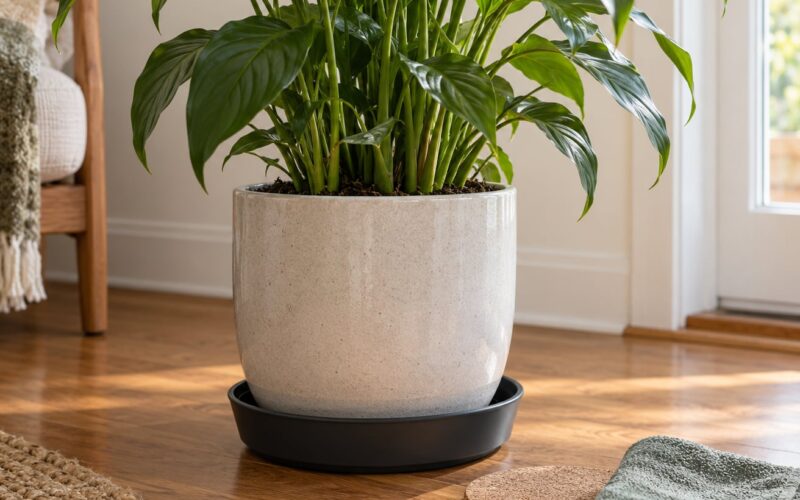
Keep water out of the saucers. This is the one I would put at the top of any list. Empty saucers after every watering, and never leave a pot standing in a full saucer through a cold night.
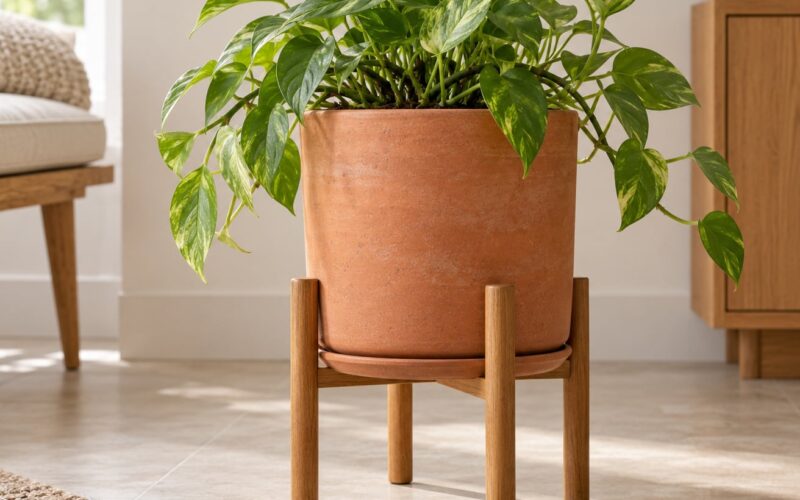
Clear the drainage holes and lift the pot off the ground. Pot risers, bricks, or a plant stand let water drain away and stop the base from drawing moisture out of cold wet paving. Check holes before the first freeze, not after.
Insulate what you cannot move. Wrap large planters in bubble wrap, burlap, or old blankets, and tie the wrap with twine so it stays put in wind. A layer of straw packed around the pot and covered with mulch works nearly as well, and burying the pot to its rim in mulch is a well-established rural method. Small pots can be nested inside a foam cooler or a wooden box packed with straw.
Move vulnerable pots to a sheltered spot. A wall on the lee side of the house, a covered porch, or next to a doorway is warmer than the middle of an open patio. Keep them away from the west and south walls that bake in afternoon sun, because the swing is what causes thermal shock.
Cut back watering in autumn. Let the soil dry between waterings rather than keeping it evenly moist, and stop watering entirely once growth slows. Every watering in late autumn is a few more days of moisture the clay has to absorb.
Consider a sealer if the pot must stay outside. A penetrating terracotta sealer reduces how much water the wall takes up, which reduces the pressure available to crack it. It is a genuine help for an exposed unglazed pot, and it is not a fix for anything already damaged. Seal a pot before it goes outside for the winter, not after a crack appears.
What “frost-proof” actually means
There is no such thing as a frost-proof terracotta pot. Glazed and thicker-walled pots survive more cycles, and some are more honestly described as frost-resistant, but the material is the same. As a Houzz discussion put it, even pots sold as frost proof will crack if they sit out all winter in the right conditions. Read the label as a relative improvement, never as a guarantee.
When it is genuinely too cold to leave a pot out
If your local winters regularly drop below freezing, unglazed terracotta left full and unsheltered is a gamble every year. Protection matters most in zones 3 through 6, where repeated cycles are the norm, but driving rain and a humid microclimate cause the same failures in zones 7 and 8. Zones 9 and 10 rarely see frost damage; there, cracking is nearly always impact, thermal shock, or a pot that was moved while frozen.
What to Do When a Terracotta Pot Cracks
Start by saving the plant. Slide the root ball out sideways rather than lifting it by the rim, and set it in a bucket, a plastic pot, or directly into a new container. Roots are far more recoverable than a pot.
Then work out whether the pot is still safe to use. A hairline crack on the side of a pot with no structural movement is a repair job. A split base, a rim that no longer closes into a circle, or a pot that rocks or falls apart in your hand is finished.
Repair only what is genuinely minor. For a hairline crack, a two-part epoxy rated for ceramic or stone, worked into a clean, dry, roughened groove, will hold a decorative pot together for seasons. Keep the repaired pot out of heavy use and never use glue of unknown type on a pot that will hold edibles or a plant you intend to eat from. Silicone-based sealants and flex seal work for sealing a porous surface, but they are not structural and will not hold a split pot together.
For anything structural, replace it. A pot that fails once will fail again, and a patched split base tends to let soil wash out before the next winter. When you replace, use the loss to buy up: a thicker wall, a glazed exterior, or a different material for that exact spot on the patio.
How long do terracotta pots last?
Unprotected in a freezing climate, expect a few winters rather than decades. The first frost season usually leaves hairline marks, the second turns those into flaking and surface crazing, and the third is when a pot with a compromised wall finally splits. A thick-walled or glazed pot in a sheltered position, emptied and stored each winter, can last as long as you own the house.
Which Terracotta Pots Are Best for Cold Climates?
The comparison below is the practical part. Porosity is the driver of risk, so the material that absorbs least is the one that survives most winters in place.
| Material | Absorbs water? | Freeze-thaw risk | Winter strategy |
|---|---|---|---|
| Unglazed terracotta | Yes, heavily | High | Empty, or insulate and shelter; lift off paving |
| Glazed terracotta | Little, except on chips and the base | Medium | Shelter from the north; avoid thermal shock |
| Thick-walled or high-fired clay | Moderately | Medium to low | Keep dry, store filled-free over winter |
| Plastic | No | Low, but root balls still freeze and split them | Can stay out; protect the plant, not just the pot |
| Fiberglass or resin | No | Low | Can stay out, though thin ones can crack if dropped while frozen |
| Concrete or stone | Slightly, if unsealed | Low | Can stay out; seal for appearance and durability |
| Metal | No | Very low for the pot, but roots freeze hard | Can stay out; insulate the soil, not the container |
Among terracotta specifically, choose thick walls and a glazed exterior if the pot has to stay on the patio through winter. Anything sold as frost-resistant is worth a look; anything sold as frost-proof deserves scepticism.
One last note from the forums worth repeating, because it comes up constantly: doing everything right and still losing a pot is normal. A single badly timed frost, a pot that got watered the evening before a freeze, or a heavy pot knocked while frozen is enough. Protection raises your odds; it does not remove the risk.
Frequently Asked Questions
Do all terracotta pots crack in the winter?
No. Unglazed terracotta filled with soil and left exposed is the highest risk, while thick-walled, glazed, or empty dry pots are much safer. Freeze-thaw cycles do most of the damage, not a single cold snap, so a pot in a damp mild-winter climate can fail without ever hitting a severe freeze. Pots stored indoors over winter rarely crack at all.
Can a terracotta pot be repaired after cracking?
Only if the crack is minor. A hairline surface fissure can be filled with a two-part epoxy rated for ceramic, which usually holds a decorative pot together for several seasons. A split base, a rim that no longer closes into a circle, or a pot that rocks or falls apart is structural and cannot be repaired reliably. Never use an unidentified glue on a pot holding edible plants.
Does glazing a terracotta pot prevent winter cracking?
It reduces the risk but does not remove it. A fired glaze seals the outer surface, so far less water enters the wall and there is less internal ice to expand. The clay body underneath is unchanged, and any chip, scratch, or unfazed base leaves it exposed. Frost cracks in glazed pots almost always start where the glaze is missing.
Should terracotta pots be brought indoors during winter?
Bring them in if you can. An empty, clean, completely dry pot stored in a garage, shed, or enclosed porch will outlast one left outside in most climates. Leave them out only when the pot is too heavy to move safely, and then insulate it with bubble wrap, burlap, or straw and keep it off cold, wet ground. Never move a frozen pot; let it thaw first.
How can I tell whether a crack in a terracotta pot is serious?
Press the crack gently and look at the whole shape. A serious crack runs the full wall thickness, lets light through, leaves the rim uneven, or makes the pot rock on its base. A hairline crack stays the same when you set the pot down and shows as a dark or damp line, sometimes with white salt deposits. Flaking and surface crazing point to repeated frost damage rather than a single impact.
Do drainage holes really reduce winter cracking?
They help a great deal. A clear drainage hole lets water leave the pot instead of saturating the base and sitting where it will freeze and expand. Holes only work if they are unblocked and the pot is lifted off the ground, so check them and empty any saucer before the first freeze. A pot with no hole, or one standing in water, is the worst case for winter cracking.
Conclusion: Start With Drainage and Cold Protection
Why terracotta pots crack in winter comes down to water and cold meeting inside a porous wall. Start with the two cheapest fixes: empty the pot and get water out of the saucer. Then lift pots off cold, wet paving, clear the drainage holes, and wrap or move anything you cannot dry out before the first freeze.
If a pot is already split, take the plant out sideways, replace the container, and look at why it failed. A replacement with thicker walls and a glazed exterior, or simply a different material for that spot on the patio, is a better answer than glue.