A planter is not frost proof unless its entire construction, drainage system and installation can handle repeated freeze-thaw cycles. The material matters most, but wall thickness, hole size, soil volume and where the pot sits decide whether it survives winter. Here is what to check before you buy one.
Cold alone rarely breaks a pot. Water does. Moisture held in the walls of a container, or water standing in a drainage hole, freezes, expands by about nine percent, and pushes outward from the inside until the pot splits. That single mechanism explains almost every shattered planter I have seen on a patio in March.
Most guides stop at the material. If you are searching for what to look for in frost proof planters, material is only the first of seven things worth checking, and it is the one most often dressed up in marketing copy.
Table of Contents
- What to look for in frost proof planters before you buy
- Which planter materials handle freezing temperatures?
- Material comparison for freezing climates
- Which material suits your hardiness zone?
- How thick and strong should an outdoor planter be?
- What drainage details matter for frost proof planters?
- How do planter size and weight affect winter performance?
- How do you match a planter to your climate and plants?
- What should you check before buying or installing one?
- What to look for on a frost proof planter label
- Three in-store tests worth doing
- The installation mistakes that undo a good pot
- How do you protect a suitable planter during winter?
- Frequently Asked Questions
- Are fiberglass planters better than concrete for frost climates?
- Do frost proof planters still need drainage holes?
- Can terracotta or ceramic planters stay outside in freezing weather?
- Should I use an insulating liner inside an outdoor planter?
- How do I know if a planter is genuinely freeze resistant?
- What size planter protects plants from cold better?
- Conclusion: Choose for the Whole Winter Cycle
What to look for in frost proof planters before you buy
- A material that does not absorb water into its walls. Fiberglass, high-density polyethylene, resin and fiberstone are non-porous. Unglazed terracotta and unglazed ceramic are not, which is the whole argument against clay in a freezing climate.
- Wall thickness of at least 1 inch. For terracotta or concrete, look for 1.5 to 2 inches. Thin walls have almost no structural margin when frozen soil presses outward on them.
- Drainage holes at least dime-sized, clear of soil crust and never blocked by a saucer or a stone.
- A reinforced rim and a solid base. Rims are where large pots usually fail first, and a thin base cracks under a heavy wet root ball.
- A stated freeze rating, not just the word frost proof. A temperature number or a cycle count means more than an adjective.
- UV stability. Thin plastic that has been on a sunny balcony all summer becomes brittle, and brittle plastic shatters instead of flexing in the cold.
- A weight you can live with. If you cannot get the pot to an unheated garage on your own before the first freeze, plan to leave it in place instead and choose accordingly.
One note on terminology, because it causes more bad purchases than anything else. Frost-resistant usually means the material survives ordinary cold. Frost-proof is almost never a tested engineering claim, and freeze-proof appears on plenty of pots that fail the first January. Read the label as a hint, not a warranty.
Which planter materials handle freezing temperatures?
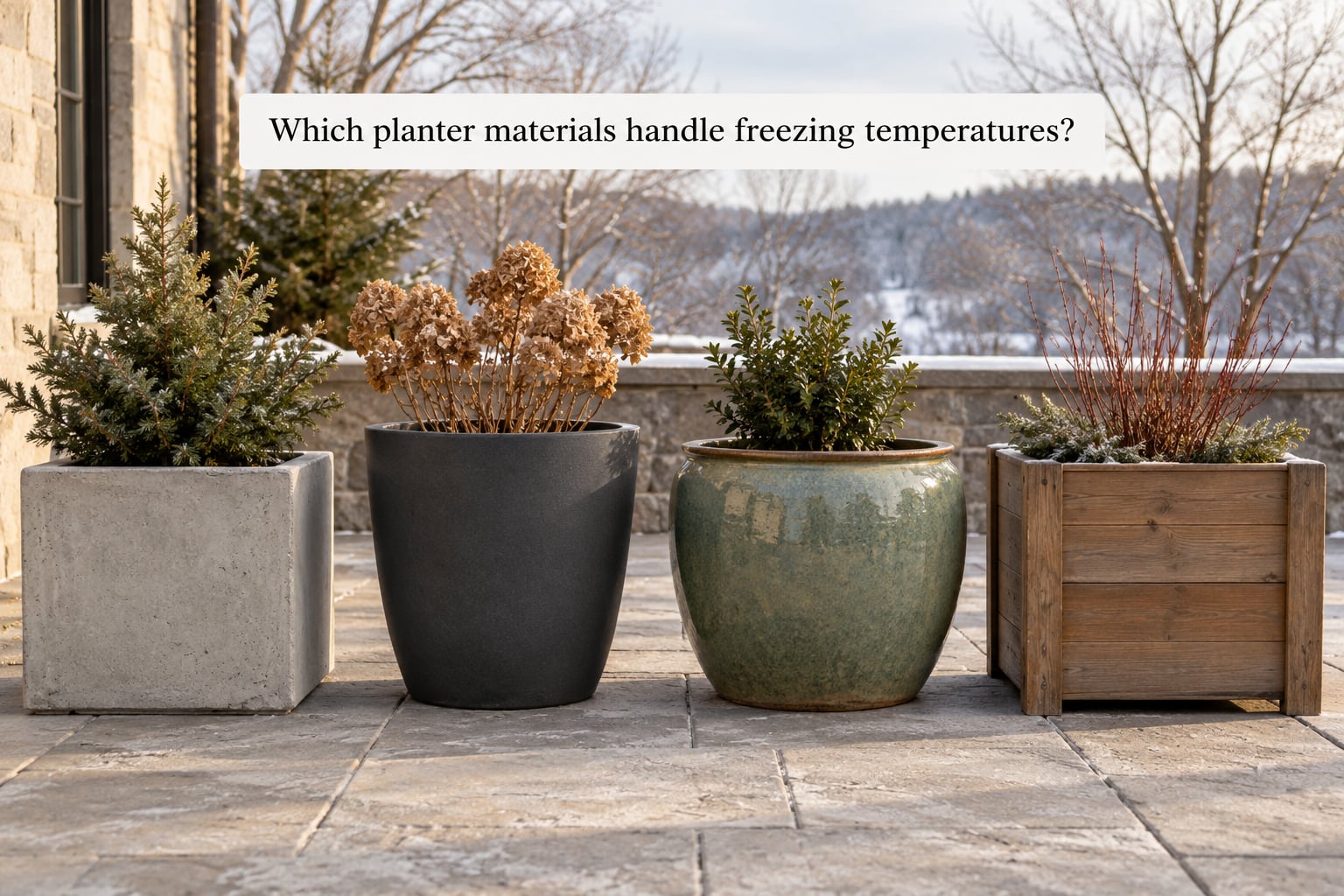
No material is automatically safe. Each one fails in a different way, and the failure mode matters more than the label.
- Fiberglass. Non-porous and slightly flexible, so it expands and contracts with the soil instead of resisting it. Experienced forum users on Houzz and r/GardeningUK reach for it first for durability, and the same threads note the price gap against terracotta.
- Fiberstone and fiberclay. A composite of stone powder and resin. Warmer to the touch than concrete and lighter, though it can crack along the rim if it is dropped on a hard surface.
- High-density polyethylene and resin. Cheap, light, and completely non-porous. The catch is wall thickness and UV quality, so buy thick-walled pots rather than thin moulded ones.
- Concrete. Excellent thermal mass, so roots stay warmer through a cold snap, and heavy enough to resist wind. Long-term users on Houzz report cement and concrete flaking over the years, which usually means it was never sealed.
- Glazed ceramic. The glaze makes it non-porous, but the clay body underneath is not reinforced the way a fiberglass planter is, and a glazed pot can still craze and split.
- Unglazed terracotta. Porous by design, so it takes on water through the walls. It also wicks moisture away from the soil, which helps plants in heat and hurts them in a freeze.
- Metal. Galvanised steel and aluminium conduct cold straight to the root ball, so they need a liner. They will not crack, which is their one advantage.
Material comparison for freezing climates
| Material | Freeze-thaw behaviour | Root insulation | Weight | Relative cost | Best for |
|---|---|---|---|---|---|
| Fiberglass | Flexes rather than cracks | Low | Light | Higher | Balconies, rooftops, anything you must move |
| Fiberstone or fiberclay | Good, if the rim is reinforced | Moderate | Medium | Medium | Patios where weight is not an issue |
| HDPE and resin | Good, if the wall is thick | Low | Very light | Low | Renters, renter-friendly container gardens |
| Concrete | Good once cured and sealed | High | Heavy | Medium | Zones 3 to 5, exposed north and west sides |
| Glazed ceramic | Moderate | Moderate | Heavy | High | Entryways and sheltered porches |
| Unglazed terracotta | Poor, absorbs water | Low | Heavy | Low | Sheltered spots in mild zones only |
| Metal | Will not crack | Very low | Medium | Medium | Modern planters with a liner |
Which material suits your hardiness zone?
| USDA zone | What to use | What to avoid leaving outside |
|---|---|---|
| 3 to 4 | Concrete or fiberglass, thick walls, sealed | Unglazed terracotta, thin resin, unglazed ceramic |
| 5 to 6 | Fiberglass, fiberstone, well-sealed concrete | Thin plastic, large unglazed clay pots |
| 7 and warmer | Most materials work, exposure decides | Thin terracotta in exposed north-facing corners |
How thick and strong should an outdoor planter be?
One inch of wall is a reasonable floor for a general-purpose frost proof planter. For unglazed terracotta or concrete, aim for 1.5 to 2 inches, because those materials carry the freeze-thaw stress rather than flexing through it.
Run a hand along the rim. A thin, sharp edge that flexes when you press it is the first thing to fail, usually right where you lift the pot. Reinforced rims and thicker bases matter more on large planters, where a heavy wet root ball acts as a lever.
Frozen soil is a live force, not a static weight. As water in the soil freezes it expands roughly nine percent, and it does that against the inside of the wall. A thin or porous container cracks because it cannot move. Evergreens are the worst case, since a root ball that thaws and refreezes repeatedly punishes the pot hardest.
What drainage details matter for frost proof planters?
Drainage holes are the single most overlooked feature in a frost proof planter. Unglazed terracotta absorbs water through its walls; a pot with no drainage also traps water that freezes and splits the base from the inside out.
Check three things. Holes should be at least dime-sized, they should run through the base and not just the sides, and they should be clear right now, not clear in April. A hole crusted with soil is a dam, and the water it holds is the thing that breaks the pot.
Decorative cachepots are the usual trap. A glazed or painted pot with no holes looks better and is far cheaper, so the standard workaround is a plastic nursery pot inside it, raised on gravel so water can drain into a saucer you empty yourself.
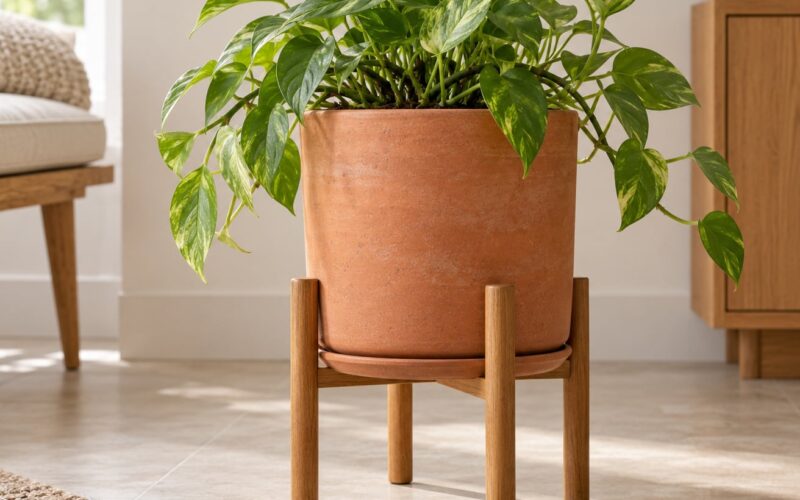
Raised bases matter too. Pot feet, bricks or a purpose-made stand lift the pot so water can escape downward instead of pooling underneath and freezing against the base.
How do planter size and weight affect winter performance?
A bigger pot holds more soil, and soil is the best insulator a root ball has. When a freeze arrives, the temperature at the centre of a large soil mass changes far more slowly than the air around it. If you have to pick between a wide shallow bowl and a tall deep pot for the same plant, pick the deep one.
The trade-off is weight. Larger planters are more vulnerable to wind, and a saturated 24-inch pot on an exposed rooftop or high-rise balcony is a tip-over risk, not just a frost risk. Wide bases and low centres of gravity solve more of that than any material choice.
Weight also decides your strategy. A concrete pot you cannot lift alone is a pot you will leave outside, so it has to be genuinely frost rated. A lightweight fiberglass pot you can move in ten seconds changes the whole plan, because moving it indoors beats every material on this list.
How do you match a planter to your climate and plants?
Start with your USDA hardiness zone and your local average first and last frost dates, then work outward to exposure. A full-sun south-facing patio in zone 5 is a kinder microclimate than an exposed north side of the same house, and the same pot can do well in one and fail in the other.
Then match the planter to the plant, because the three plant categories have completely different winter requirements.
- Cold-hardy perennials such as mums, ornamental kale, heuchera and most shrubs can stay in place in a properly rated container, as long as the pot drains and the root ball is not sitting in water.
- Tender plants such as tropicals, most herbs, citrus in cold zones and anything you bought for a patio that will not survive, belong in a pot you can move to an unheated garage, a bright basement or indoors.
- Winter-dormant plants benefit from an insulating layer over the soil surface, not over the foliage, since covering leaves can trap rot.
That leads to the three-way decision. Leave it in place if the planter is rated and the plant is hardy. Move it to an unheated garage if the plant is semi-hardy and the container is too heavy to carry far. Bring it inside if the plant is tender, and give it the brightest window you have. Forum users ask this question constantly, and the honest answer is that a frost resistant pot has no value if you were always going to move the plant anyway.
What should you check before buying or installing one?
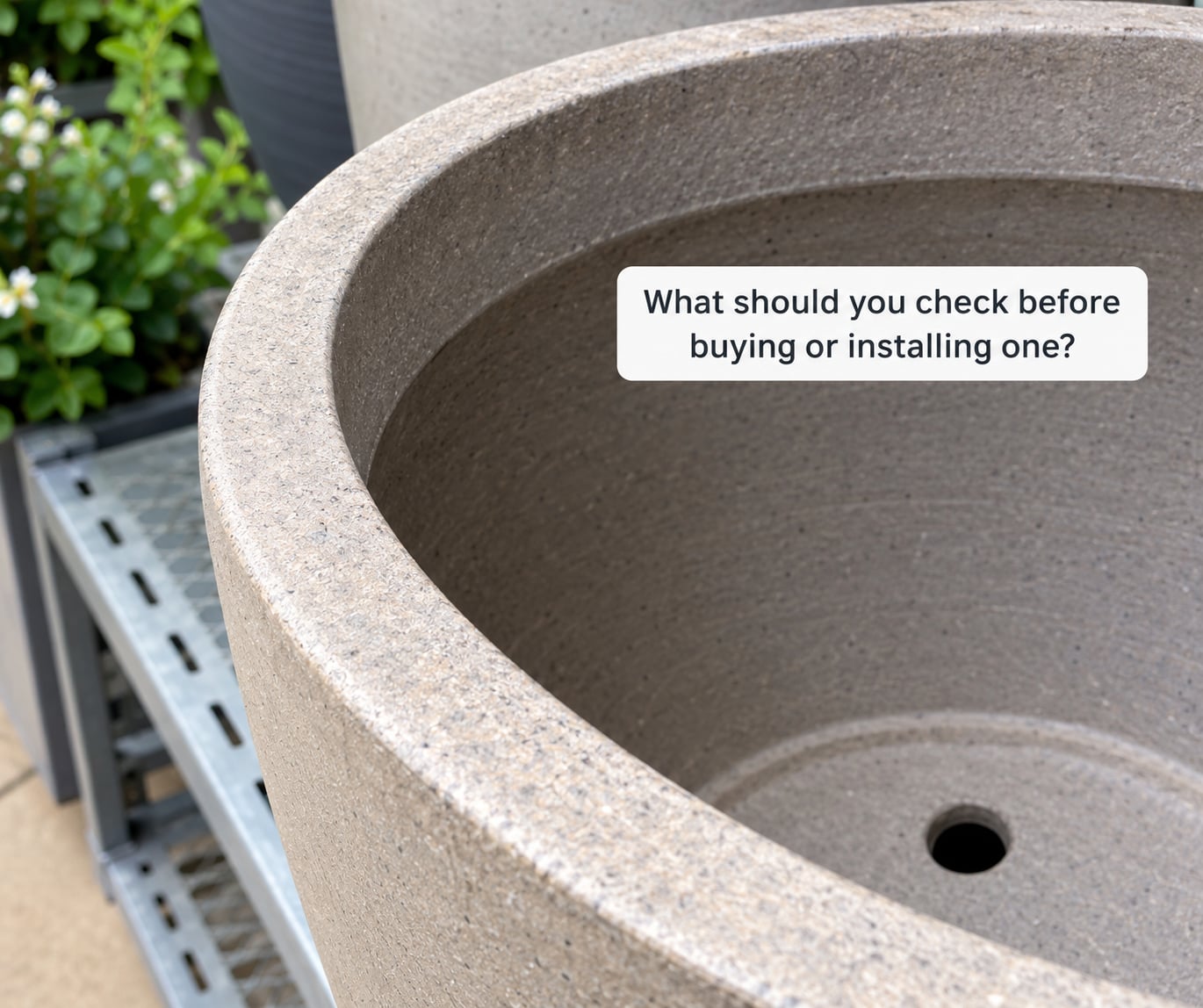
Ten minutes of checking in the aisle saves a cracked pot in March. Work through these in order.
- Manufacturer specifications: material, wall thickness, stated freeze rating, weight when empty and when planted.
- Freeze-thaw testing: a cycle count or a temperature figure, not a marketing adjective.
- Drainage: hole diameter, number of holes, and whether the base is solid or vented.
- Dimensions: check the pot against the mature size of the plant, and against the spot where it will stand.
- UV and moisture resistance, especially for resin and plastic.
- Warranty, and whether replacement parts exist for a cracked rim.
- Assembly: most large planters arrive as two or three pieces with a base that needs levelling.
- Placement: sun, wind, and whether a wall can shelter the pot overnight.
What to look for on a frost proof planter label
Labels use three different words and only one of them is meaningful. Frost-resistant usually describes a material that tolerates ordinary cold. Freeze-proof is a marketing flourish with no test behind it in most cases. A number, such as a temperature or a number of cycles survived, tells you the pot was actually put through something. When only adjectives are available, treat the pot as frost-tolerant and protect it in winter rather than trusting the word on the box.
Three in-store tests worth doing
Soak test: run water into the pot and watch how fast it leaves the base. A pot that holds water instead of passing it through is a decorative pot, not a growing pot. Tap test: knock a knuckle on the side and then the rim. A thin pot sounds hollow and flat, a thick one gives a lower, duller note. Thickness test: look at the rim edge in profile and count against a ruler if you have one. Most thin pots are well under half an inch, and no label will tell you that.
The installation mistakes that undo a good pot
Setting a planter directly on frozen or wet ground, blocking the holes with a decorative tray, or pushing a pot into a corner where meltwater collects against it. Level the base, keep the holes open, and leave an inch of clearance under the pot so air can move underneath.
How do you protect a suitable planter during winter?
Four steps, in this order, make the biggest difference.
- Go bigger before winter. If the plant is not yet at full size, pot it up one size in autumn so the root ball has more soil around it going into the cold.
- Elevate. Put the pot on pot feet, bricks or a stand so water drains clear of the base instead of freezing against it.
- Mulch 3 to 5 inches over the soil surface, leaving the plant stems clear. This cuts wind chill at the root zone more than any wrap you can buy.
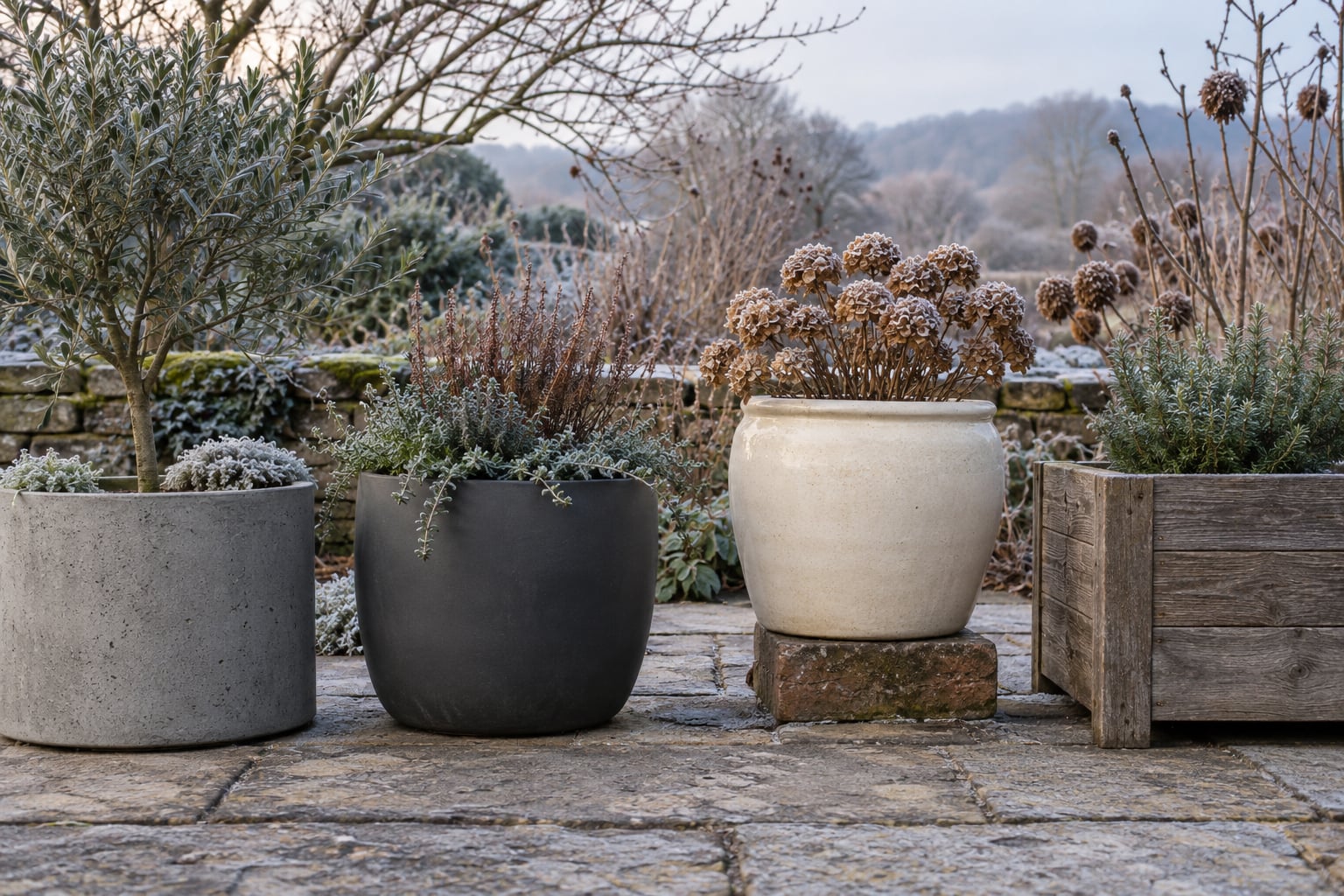
- Group and shelter. Push pots together and set them against a south-facing wall. Clustered pots share warmth, and a wall breaks the wind that drives the fastest temperature swings.
None of this rescues a pot that was never right for the job. An insulating liner helps a lightweight resin container in a mild zone, but a liner inside a thin terracotta pot on a north side of a house in zone 4 is a delay, not a fix. If you are reaching for more than two of these measures, the better decision is a different container.
Frequently Asked Questions
Are fiberglass planters better than concrete for frost climates?
For freeze-thaw survival, usually yes. Fiberglass is non-porous and slightly flexible, so it moves with the soil as it freezes instead of resisting it. Concrete has better thermal mass and holds root-zone temperatures steadier, but it can spall over the years if it is never sealed, and it is far too heavy to move quickly. Choose concrete for zones 3 to 5 where the pot stays put, and fiberglass on balconies and rooftops where weight and wind decide everything.
Do frost proof planters still need drainage holes?
Yes, and this is where frost proof marketing tends to go quiet. Drainage holes stop the planter holding water that would freeze and expand from the inside, and they stop root rot during the wet months before the ground freezes. Holes should be at least dime-sized and must never be blocked by a saucer. If you have a decorative pot with no holes, nest a plastic nursery pot inside it on gravel and empty the saucer yourself.
Can terracotta or ceramic planters stay outside in freezing weather?
Only with care, and not in every zone. Unglazed terracotta absorbs water through its walls, and that water freezes and expands, cracking the pot from the inside. Glazed ceramic is less porous but the clay body is unreinforced. If you keep them outside, use walls at least 1.5 inches thick, empty standing water, elevate the pot and mulch the surface. In zones 3 and 4, move them to an unheated garage instead.
Should I use an insulating liner inside an outdoor planter?
Sometimes, and mostly in mild-to-cold zones rather than deep winter. A liner helps a lightweight resin or metal container hold root-zone heat longer, and it stops a thin pot wicking moisture straight out of the soil. Leave a gap between liner and pot wall so water can move, and keep the drainage path open. A liner will not save a thin unglazed terracotta pot in a hard freeze, and it adds a layer to work around when you water.
How do I know if a planter is genuinely freeze resistant?
Look for a number rather than an adjective. A stated temperature or a count of freeze-thaw cycles survived means the pot was tested. Frost-resistant describes a material property, while frost-proof and freeze-proof are usually marketing language with no standard behind them. In the aisle, tap the wall and the rim, check the rim thickness in profile and run water through the drainage holes. No label replaces those three checks.
What size planter protects plants from cold better?
A deeper one. Soil is the best insulator a root ball has, and the temperature at the centre of a large soil mass changes far more slowly than the air around it. Between a wide shallow bowl and a tall deep pot holding the same volume, choose the deep pot. Big planters carry their own risks, though, so use a wide base, group pots together and keep them out of exposed corners where wind drives the fastest swings.
Conclusion: Choose for the Whole Winter Cycle
Start with the planter itself: a non-porous or flexible material, walls at least an inch thick, open drainage holes and a base that is not sitting in water. Then size it for the plant and for your zone, and check the freeze rating before you commit.
Material alone does not carry a pot through winter. Porosity, thickness, drainage, soil volume and placement decide it together, and the difference between a pot that survives March and one in a skip is usually one of those five things.