Metal does not automatically cook plant roots, but a dark or thin-walled container sitting in full sun can push the root-zone temperature well above the surrounding air. The risk climbs when three things line up: direct sun, a small volume of soil, and a growing medium that dries out fast. Get the answer in 40 seconds, then read on for what actually drives the heat.
Table of Contents
- Do Metal Pots Get Too Hot for Roots?
- How Metal Changes the Temperature Inside a Pot
- How Hot Is Too Hot for Plant Roots?
- Which Plants Are Most at Risk?
- Sun Exposure, Wind and Other Risk Factors
- Do metal pots get too hot for roots in full sun?
- How to Keep Roots Cool in Metal Pots
- How do you keep roots cool in a metal pot?
- How to Tell When Roots Are Stressed by Heat
- Do Insulated Liners and Cachepots Work?
- Metal Pots Indoors, on Patios and in Sunny Windows
- Frequently Asked Questions
- How hot does a metal pot get in the sun?
- Should I put a plastic liner inside a metal planter?
- Is a dark-colored metal pot hotter than a light-colored one?
- Can metal pots be used for herbs and vegetables?
- How often should I water plants in hot metal pots?
- Conclusion
Do Metal Pots Get Too Hot for Roots?
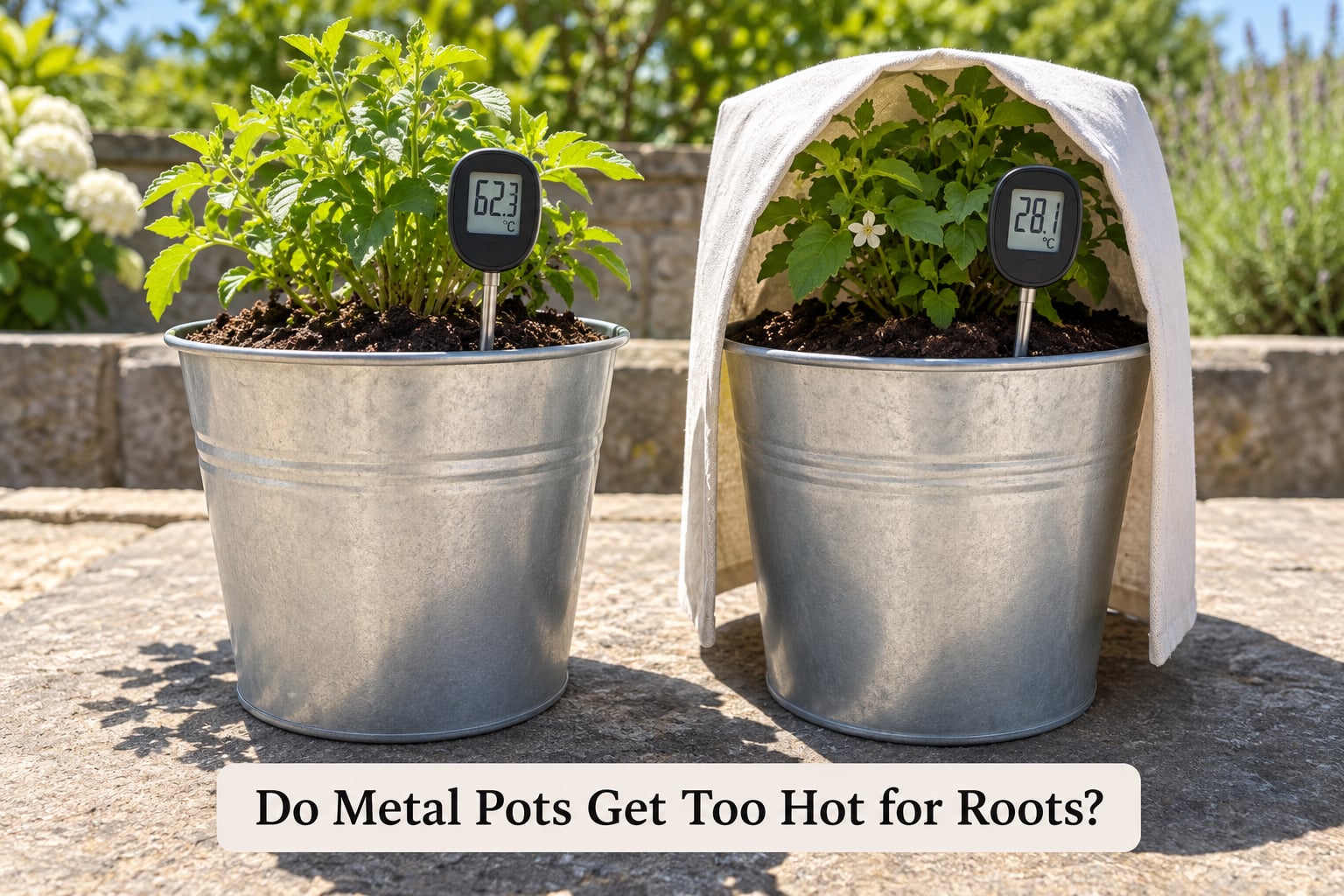
Yes, in the right conditions. Metal conducts solar heat through its walls straight into the growing medium, and the soil touching those walls can run noticeably warmer than the soil in the middle. In a wide raised bed with deep soil and steady moisture, that difference usually stays harmless. In a shallow metal pot sitting on a south-facing patio, it does not.
So the honest answer to do metal pots get too hot for roots is that the material is one variable among four. Pot size, sun exposure, moisture and plant type together decide whether a metal container is a good home or a slow cooker.
Three conditions create most of the trouble I see:
- Full sun on the container itself. A wall facing the sun gets far more energy than one in shade, and metal passes that energy inward instead of storing it.
- Little soil volume. Small pots hold less water and less buffered soil, so they swing temperature faster than a deep bed.
- A dry or shallow medium. Moisture is the plant’s cooling system. Dry mix means no evaporative buffering and no transport of water to the outer roots.
None of that means metal is a bad material. It warms faster in spring than wood or plastic, which is a genuine advantage if you are planting early. The trouble shows up in peak summer heat, in a pot that is too small for the plant.
How Metal Changes the Temperature Inside a Pot
Two different properties are often confused here. Conductivity is how quickly heat moves through a material. Thermal mass is how much energy a material can hold before its temperature changes much. Steel and aluminium are excellent conductors. Concrete and thick terracotta are poor conductors but hold a lot of heat.
A thin metal wall has almost no thermal mass, so it takes the temperature of whatever is touching it almost instantly, then hands that heat straight to the soil. A thick stone wall takes longer to heat up, then releases that stored heat back to the soil all afternoon. Both end up warm. The metal gets there faster and follows the sun more closely.
The sequence usually runs like this:
- Sunlight strikes the exposed metal wall and raises its surface temperature.
- The wall conducts that energy inward, centimeter by centimeter, into the soil touching it.
- Moisture in that outer layer begins to evaporate, which briefly cools it and slows the climb.
- Once the mix dries, evaporation stops and the soil temperature keeps rising toward the wall temperature.
- Moist soil at the center, buffered by volume, lags well behind the outer layer.
This is why do metal pots get too hot for roots is not really a question about the metal. It is a question about how much sun hits the wall and how much water is left in the soil to absorb the energy. A pot that is watered properly and shaded at the wall can stay perfectly workable on a day that would otherwise stress the same pot in a different position.
One widely cited bed test measured the difference directly. Air temperature and soil temperature at the center of the bed both read 89 F, while the soil touching the steel edge ran roughly 8 F warmer. That is the whole problem in one number: the center of your pot is usually fine while the ring of roots nearest the wall is not.
How Hot Is Too Hot for Plant Roots?
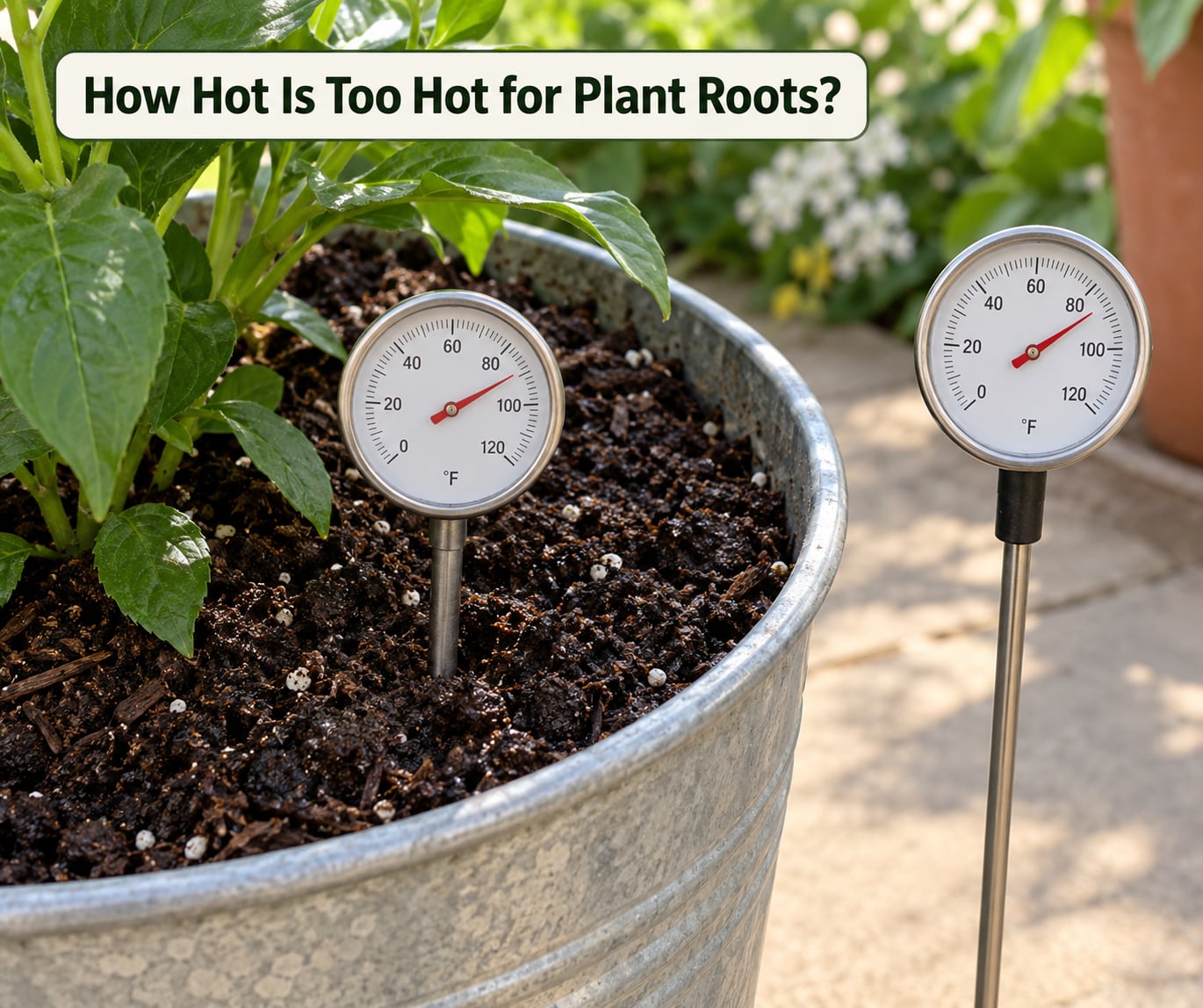
Approximate ranges, because tolerance varies by species and by how long the heat lasts. Growers discussing pots in hot weather on the Dave’s Garden specialty gardening forum commonly cite root function being critically affected around 95 F, with root and plant death occurring somewhere near 115 to 120 F. Treat these as signposts, not a diagnosis.
| Root-zone temperature | What it usually means | What to do |
|---|---|---|
| Below about 85 F | Comfortable for most container plants | Nothing. This is a good working range. |
| About 85 to 90 F | Warm. Tropicals and many herbs are happy, cool-season crops slow down | Watch moisture. Keep watering on a normal schedule. |
| About 90 to 95 F | Stress begins. Water and nutrient uptake drop, fine roots start to suffer | Add mulch, increase watering frequency, shade the wall. |
| About 95 to 110 F | High risk if sustained. Root death starts at the outer wall and moves inward | Shade, insulate, or move the container out of the sun. |
| About 115 to 120 F | Near-lethal for most roots | Act now. Roots may not recover even once the pot cools. |
Three different temperatures get confused constantly, and they are not interchangeable. Air temperature is what a weather app reports. Surface temperature is what the metal wall reads to the touch, and it can sit well above air temperature on a sunny day. Root-zone temperature is what a probe in the soil reads, and that is the only one your plants actually experience.
That is also why touching the pot is not a test. Your hand registers the wall, not the soil, and your hand has no idea how long that temperature lasts or how deep the root mass sits. A soil thermometer costs less than a lunch and settles the question in a minute.
Which Plants Are Most at Risk?
Grouping plants by sensitivity is more useful than naming winners, because tolerance depends on the pot, the position and the season as much as the species.
Use extra caution with:
- Fine-rooted and shallow-rooted plants. Many ferns, orchids and woodland perennials have dense root systems close to the surface, right where the wall is hottest.
- Leafy vegetables and herbs. Lettuce, spinach, cilantro, parsley and basil wilt fast when root function slows. Cilantro bolts early in heat anyway, so a hot wall shortens the harvest window.
- Young plants and freshly repotted specimens. New root balls have not yet spread into the container, so they depend entirely on the outer layer where the heat is.
- Moisture-dependent indoor plants. Ferns, calatheas, peace lilies and prayer plants suffer when the mix dries and the root ball warms at the same time.
Plants that usually cope better in a hot metal container, all else equal:
- Drought-tolerant ornamentals such as sedum, echeveria, snake plant, agave and most rosemary, which are adapted to heat and dry cycles.
- Warm-season vegetables planted in a roomy container, including peppers, tomatoes and eggplant, once the weather has settled.
- Herbs that like dry feet, including thyme, oregano and sage.
Plenty of growers in warm climates report success with metal beds, and some on r/vegetablegardening run them through full summer with heat-tolerant crops. The pattern behind those successes is the same one I would predict: bigger containers, a sensible crop choice, and accepting a heavier watering routine.
Sun Exposure, Wind and Other Risk Factors
Do metal pots get too hot for roots in full sun?
Yes, and full sun is the single largest factor you control. South- and west-facing positions receive the longest, most direct exposure, while east-facing spots get gentle morning sun and recover before the hottest part of the day. A metal pot on a west wall in midsummer behaves very differently from the same pot six feet away in open air.
Reflected heat sneaks up on people. Masonry walls, pale paving, stucco and glass all bounce sunlight back onto a container, and a pot tucked into a sunny corner can receive energy from two directions. So can a pot sitting directly on concrete or a dark deck, which conducts heat upward into the base.
Wind cuts both ways. Moving air cools the leaf surface, which reduces transpiration, but it also dries the container faster. That is why wind-exposed metal pots in a rooftop or balcony setting often need water twice as often as the same pot tucked behind a parapet.
Other contributors worth noting:
- Dark finishes. A black or dark charcoal pot absorbs more solar energy than a pale or reflective one. Color matters more for a dark coated pot than for bare steel, which reflects a good deal of light.
- Thin gauge. Light-gauge sheet responds almost instantly to sun. Heavier steel is slower but stores more energy for later.
- Shallow soil depth. Ten inches of soil buffers far better than four inches. This is the variable most articles skip, and it is usually the one that matters most.
- Limited airflow. Containers pushed together into a tight block trap hot air between the walls.
Size deserves its own emphasis. A large metal container holds a much bigger thermal mass of buffered soil, so a hot day moves the center temperature less. Doubling soil volume does more for root survival than any liner you can buy.
How to Keep Roots Cool in Metal Pots
Work down this list in order of impact. The first two do most of the work.
- Give the plant more soil. Move it to a larger container if you can. Extra soil volume is passive cooling that costs nothing after the initial potting.
- Reduce direct sun on the wall. Move the pot to morning-only sun, or drape 30 to 50 percent shade cloth over it during the hottest hours. A light-colored sleeve or wrap on the sun-facing side helps a lot.
- Mulch the surface evenly. Two to three inches of organic mulch shades the top of the mix and cuts evaporation, which keeps the root ball cooler and cuts your watering bill.
- Use a moisture-retentive but well-aerated mix. Add compost or coconut coir to a potting base, and keep bark, perlite or pumice in the blend. Hold more water without going waterlogged.
- Water correctly, not constantly. Deep, less frequent watering soaks the whole root ball and pulls heat out of the soil. A daily splash wets the top only and leaves the outer roots in dry, hot mix.
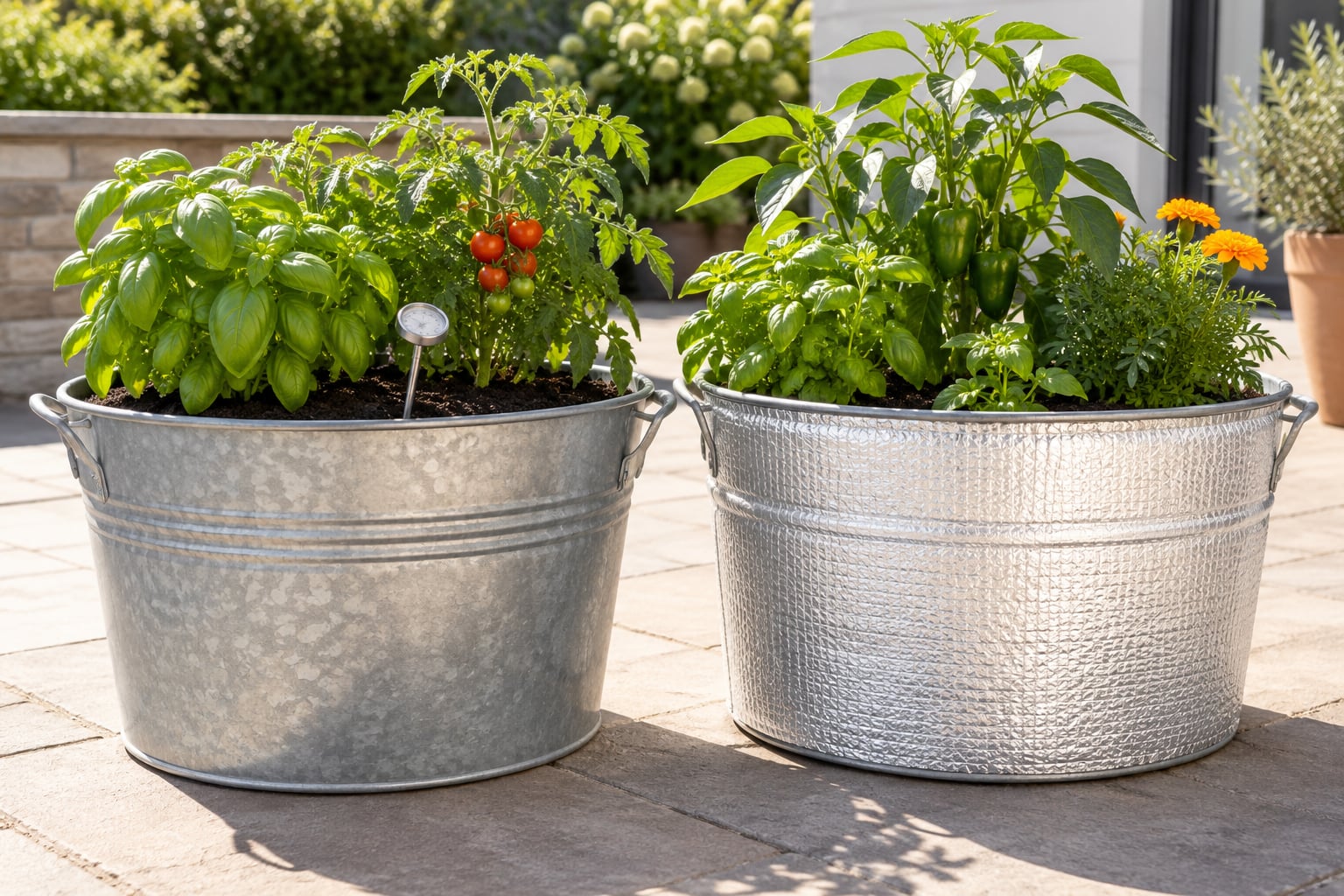
- Insulate with an air gap. A pot-within-a-pot setup, or a fitted liner that does not touch the wall, works because trapped air is a poor conductor. Direct contact destroys most of the benefit.
- Keep airflow between containers. Space them apart so hot air can escape instead of pooling against the walls.
- Monitor the root zone. Push a soil thermometer into the mix near the wall at the hottest point of the day, and let the reading set your watering rhythm.
How do you keep roots cool in a metal pot?
A short routine beats any single product. Here is the one I use on my own balcony containers through a July heat wave.
Morning: check the mix two inches down, near the wall. If it is damp, water lightly. If it is dry, water thoroughly until it runs out of the drainage holes, then top-dress with mulch.
Midday: slide shade cloth or a light-colored sleeve over any container in direct sun. Read the soil thermometer and note the number.
Late afternoon: water anything that dried out during the day. A thorough soak cools the root zone far more effectively than several small splashes.
Weekly: check whether the outer root ring, the soil against the wall, is noticeably warmer than the center. If it is, the pot is too small or too exposed, and no watering schedule will fully fix it.
How to Tell When Roots Are Stressed by Heat
Heat stress in containers usually shows up in the foliage first, and it looks a lot like thirst. That is what makes it easy to misdiagnose. If you water twice and the plant wilts again by noon, the problem is probably not water supply alone.
| Symptom | Likely cause | What to change |
|---|---|---|
| Wilting that returns the same day, even after watering | Root function impaired by heat, so water cannot move up the plant | Shade the wall, mulch, and check the root-zone temperature |
| Scorched or crisp leaf edges | Transpiration demand exceeds what the roots can supply | More frequent deep watering, and afternoon shade |
| Slowed or stalled growth in peak summer | Roots are alive but inefficient at taking up water and nutrients | Expect slower growth, and avoid heavy fertilizing |
| Dry outer ring but damp center | Heat has dried the soil against the wall while the center holds moisture | Water slowly and deeply; add a liner to slow the drying |
| Yellowing, soft growth near the base, sour smell | Overwatering into a non-porous metal pot, leading to root rot | Check drainage holes, cut watering back, improve the mix |
If you suspect root damage rather than a temporary slump, slide the plant out and look. Healthy roots are firm and pale. Brown, mushy, sloughing roots mean the damage is already done, and the plant will need fresh mix and a cooler position to recover.
Do Insulated Liners and Cachepots Work?
They work, and they are the right answer for a metal pot you cannot move. The principle is an air gap. Insulation only performs if there is a pocket of trapped air between the hot wall and the soil, and a liner pressed flat against the metal does very little.
| Option | How well it handles heat | What to watch |
|---|---|---|
| Bare metal, dark finish | Highest heat load at the wall | Needs shade, mulch and more frequent watering |
| Painted or powder-coated metal | Better than bare dark metal, mostly through color | Coating can chip and rust at contact points |
| Light-colored cachepot | Reflects sunlight and buffers short peaks | Must still allow drainage; can trap moisture |
| Fitted insulating liner | Good, when an air gap is preserved | Poor fit or a tight liner reduces the benefit |
| Pot within a pot, standing on feet | Best of the options, because air surrounds the inner pot | Watch for standing water and splash-back onto the outer shell |
| Double-wall metal planter | Built for this problem, with a permanent air space | Runs cool in spring too, which some plants miss |
Two cautions. A non-porous metal container holds water far longer than terracotta, so check that drainage holes are open and that water can actually leave the bottom. And a liner that traps moisture against the wall can create the opposite problem, a soggy root ball in a pot that never dries.
On materials, galvanized steel raises a fair question for edible crops because zinc can move into acidic soil. Forum growers often note that plants will be long gone before meaningful levels accumulate, which is true for neutral soil. If you grow blueberries or other acid-loving crops, use a liner or a different container rather than relying on that argument.
Metal Pots Indoors, on Patios and in Sunny Windows
Indoors, the question mostly disappears. No direct sun means no solar load, and room temperatures sit in a range roots handle easily. A metal planter near a bright window can pick up some gain, but it is a fraction of what an outdoor wall absorbs in summer. Indoors, the reasons to choose metal, weight, drainage, cleanability and a look that suits the room, outweigh heat entirely.
Windows are the exception. Glass transmits short-wave radiation straight through, and the area around a south-facing window can behave like a greenhouse. A metal pot on a sunny sill can still cook its outer roots, and the pot’s metal will pull heat back into the room after sunset.
On patios and balconies, the rules from above apply in full. On rooftops, expect faster drying from wind and stronger reflected heat from surrounding buildings. In courtyards with limited airflow, expect the opposite problem: heat that has nowhere to go.
Adjust watering frequency to conditions, but do it thoughtfully. More frequent watering keeps the root ball alive and cool, yet constantly saturated soil in a sealed metal pot leads straight to root rot. Aim for moist, not wet, and check rather than assume. In my own containers, a slow pour twice a week in a heat wave beats a splash every morning, because the long soak hydrates the whole root ball and carries heat away with it.
Frequently Asked Questions
How hot does a metal pot get in the sun?
A bare metal wall in direct sun can run well above the air temperature, and soil touching that wall takes on much of the heat. In one published bed test, air and soil center both read 89 F while the soil at the steel edge was about 8 F warmer. Actual readings vary with shade, wall color, moisture and pot size, so measure your own pot with a soil thermometer.
Should I put a plastic liner inside a metal planter?
A liner helps, but only if it leaves an air gap between itself and the metal wall. Plastic pressed flat against the wall loses most of the insulating effect, and a liner that traps moisture against the steel can create soggy conditions and root rot. Keep drainage open at the bottom, and remember that a pot-within-a-pot setup on small feet insulates better than a tight liner.
Is a dark-colored metal pot hotter than a light-colored one?
Usually yes, because a dark finish absorbs more solar energy than a pale or reflective one. The gap narrows with bare or stainless steel, which reflects a good deal of light regardless of finish. Color is one factor rather than the whole story: wall thickness, whether the wall faces the sun, pot size and how wet the mix is all move the root-zone reading as well.
Can metal pots be used for herbs and vegetables?
Yes, with attention to size and crop choice. Warm-season crops such as peppers, tomatoes and eggplant do well once the weather has settled, and thyme, oregano, sage and rosemary tolerate heat and dry cycles. Cool-season crops like lettuce, spinach and parsley struggle in a hot metal wall, so give them a larger container, afternoon shade and a mulch layer.
How often should I water plants in hot metal pots?
Check rather than follow a fixed schedule. Push a finger or a probe two inches down near the wall during the hottest part of the day, and water deeply when the mix reads dry. In peak summer this may be every two or three days, or daily for a small pot on a west-facing patio. Water thoroughly and let excess drain, since waterlogged roots in a non-porous pot bring their own problems.
Conclusion
Start with a reading. Push a soil thermometer into your metal pot near the wall at the hottest point of the day, and compare that number to the ranges above. Above roughly 90 F, act on the reading in this order: more soil volume, less direct sun on the wall, mulch, then liners and watering rhythm. Pot material is one part of root-zone heat management, and it is the part you can change most easily.
So if you came here asking do metal pots get too hot for roots, the answer is that they can, and you now have the measurements to find out whether yours does. Updated for 2026.