A vertical vegetable garden is any setup that grows food upward instead of outward, and on a balcony that is the difference between harvesting dinner and watching the sun hit concrete. Railing planters, wall pockets, ladder shelves, trellises, and hanging containers turn a few square feet of floor into a full season of salad greens, herbs, and climbing crops.
If you are still working out which route to take, these ten vertical vegetable garden ideas for a balcony are ordered roughly from simplest to most involved. Most people end up combining two, usually a wall system for greens and a trellis for climbers.
There are ten solid systems below, and they are not interchangeable. Some eat your wall, some hang off the rail, some take up a corner, and some need power. The right one depends on three measurable things: how many hours of direct sun your balcony actually gets, how much saturated weight the structure can carry, and how much wind reaches the railing.
Before you buy or build anything, spend one afternoon on the checks below. Gardeners on r/gardening and r/vegetablegardening repeatedly report the same three failure causes: plants in containers with no drainage, containers too shallow for the root system, and watering that never quite matched the weather.
Table of Contents
- Key takeaways
- Vertical Vegetable Garden Ideas for a Balcony at a Glance
- How to choose a vertical vegetable garden for a balcony
- 1. Use a Wall-Mounted Pocket Planter
- 2. Build a Freestanding Tiered Herb and Salad Garden
- 3. Grow Vegetables in a Vertical Trellis
- 4. Use a Stacked A-Frame Grower
- 5. Plant a Vertical Hydroponic Tower
- 6. Create a Balcony Vegetable Ladder
- 7. Hang Rail Planters from a Balcony Rail
- 8. Use Gutter or Shelf Systems Along the Railing
- 9. Combine Vertical Planters with a Small Seating Area
- 10. Try a Rotating Vertical Garden
- Frequently Asked Questions
- What vegetables can be grown in a vertical garden?
- How much weight can a balcony hold for planters?
- Can you hang a planter off a balcony railing?
- How often should I water balcony planters?
- What grows on a shady balcony?
- What are the disadvantages of vertical gardening?
- Conclusion
Key takeaways
- Match the system to the light first. Six or more hours of direct sun supports fruiting crops; three to five hours suits greens and herbs.
- Estimate saturated weight before you place anything heavy: pot plus dry mix plus water plus plants, with water counting roughly 8.3 pounds per gallon.
- Anchor every hanging and railing planter to a post or bracket, not to the horizontal rail, and never hang outward on an exposed corner.
- Give every container drainage. If your pot has no holes, drill them, or set a nursery pot inside a cachepot on a base of gravel.
- Start with herbs, lettuce, radishes, and strawberries. Move to tomatoes, beans, and cucumbers once the watering routine is second nature.
Vertical Vegetable Garden Ideas for a Balcony at a Glance
Here is the short version of all ten systems, compared on the four factors that decide whether one works in your space.
| Idea | Best for | Sun needed | Typical depth | Build effort |
|---|---|---|---|---|
| Wall-mounted pocket planter | Small footprint, no floor use | 4 to 6 hours | 6 to 8 inch pockets | Low |
| Tiered herb and salad garden | Baskets and greens, no wall | 5 to 7 hours | 6 to 10 inch | Low |
| Vertical trellis | Beans, peas, cucumbers | Full sun, 6+ hours | 12 inch minimum pot | Medium |
| Stacked A-frame grower | Corners and narrow rails | 5 to 7 hours | 7 to 9 inch troughs | Low |
| Vertical hydroponic tower | Maximum yield per square foot | 6+ hours or a grow light | Site-dependent | Medium |
| Balcony vegetable ladder | Reaching crops at several heights | 5 to 7 hours | 7 to 10 inch boxes | Medium |
| Railing planters | Using the rail perimeter | 4 to 6 hours | 7 inch troughs | Low |
| Gutter or shelf system | Long continuous runs of greens | 4 to 6 hours | 6 to 8 inch | Medium |
| Planters plus seating | Living and usable balcony | 4 to 7 hours | Mixed, 8 inch+ | Medium |
| Rotating vertical garden | Narrow balconies, side light | 4 to 8 hours | 6 to 9 inch | High |
How to choose a vertical vegetable garden for a balcony
Start by walking the balcony at three times of day and noting where the sun actually lands, not where you hope it does. Buildings across the street often cut a south-facing balcony to two hours in winter. Three hours of good light grows lettuce, chard, parsley, mint, and strawberries; six hours opens up tomatoes, peppers, beans, and cucumbers.
Next, decide which surfaces you are allowed to use. Renters are usually fine with freestanding systems and clamp-on rail hooks, and usually not fine with anything drilled into stucco or a balcony wall. Check your lease or building rules before you build, and keep drainage runoff off the balcony below your own unit.
Finally, count the weight. A 12 inch pot with a standard potting mix holds roughly 1.5 gallons of water, which is close to 12.5 pounds, plus the mix, the pot, and the plant. Five of those on one railing is a load most railings were never designed to carry, which is why idea 7 explains where to hang them properly.
1. Use a Wall-Mounted Pocket Planter
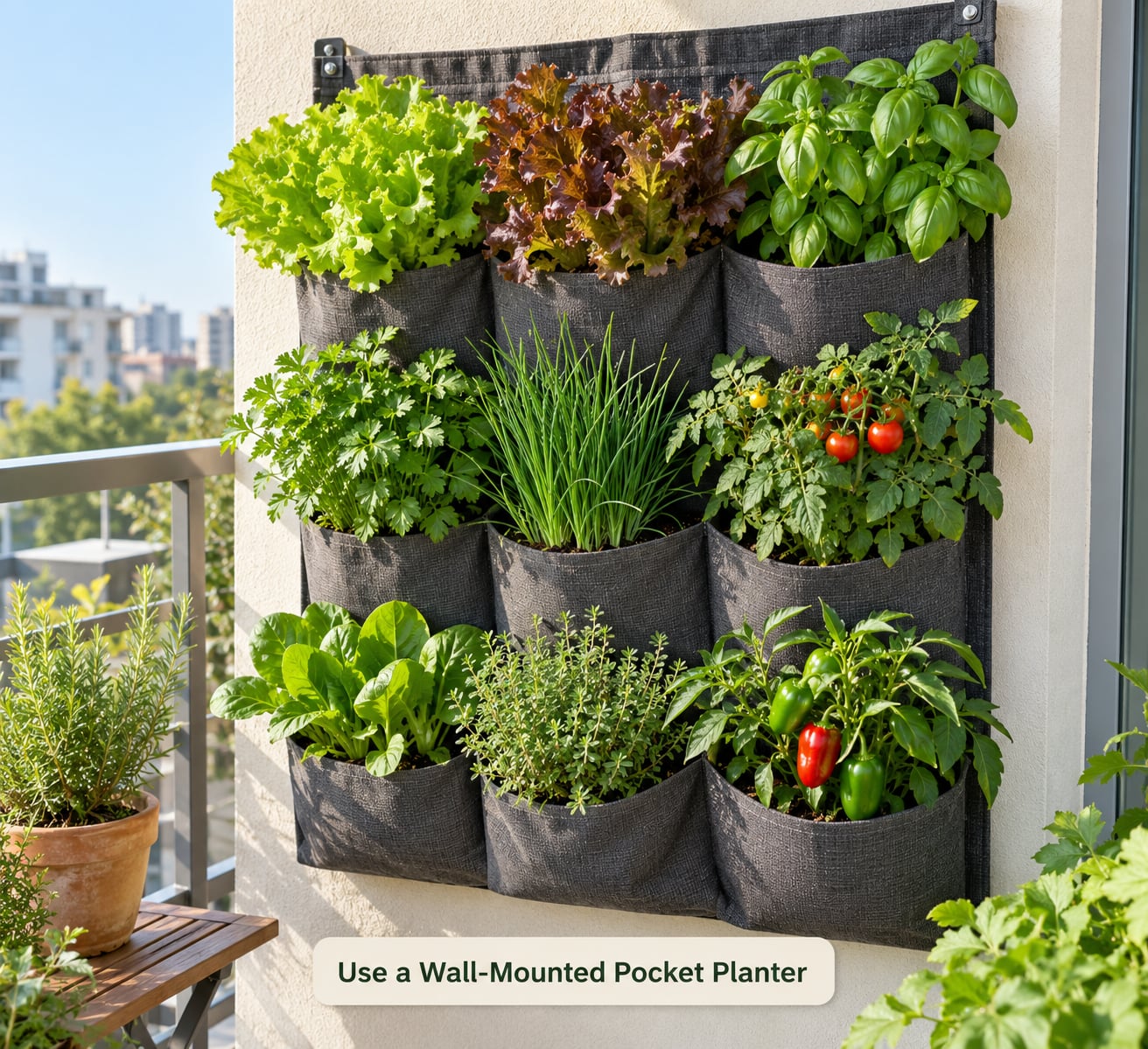
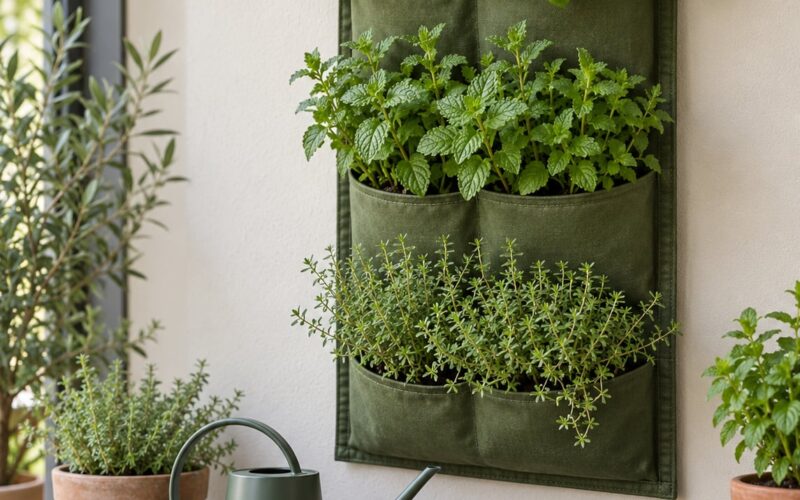
A pocket planter is the most space-efficient option on this list because it uses a wall surface that is otherwise dead space. Rigid plastic pocket systems and fabric versions both work; the fabric kind breathes better and holds moisture longer, while the rigid kind looks tidier and survives more abuse.
Fill the pockets with shallow-rooted crops: lettuce, arugula, mizuna, radishes, parsley, cilantro, chives, thyme, and strawberries. A pocket roughly 8 inches deep will handle greens and herbs happily, but it will not carry a tomato. Anything fruiting needs a 12 inch or larger container at floor level, with the plant trained upward beside the wall.
Weight is the thing to plan for. A typical fabric pocket panel with eight pockets, filled, comes in around 25 to 35 pounds, and that load is transferred to the wall through four mounting points. Mount into studs or masonry with appropriate anchors, and never rely on drywall alone. If you rent, the no-drill alternative is a floor-standing tension frame with the pocket panel hooked onto it.
Watch out for pockets at the top drying out while the bottom row stays wet. Rotate the panel a quarter turn every week or two, and water the top row first while it drains into the row below.
2. Build a Freestanding Tiered Herb and Salad Garden
A tiered or cascading planter works when you have no usable wall and no permission to touch the railing. The stepped profile lifts lower plants into light and keeps the footprint roughly square, which makes it the safest choice for a small balcony floor.
Use it for herbs and salad greens: basil, cilantro, dill, parsley, chives, oregano, lettuce, arugula, kale, and compact chard. Position tall or sprawling herbs like basil at the top tier, where they will not shade the greens below. Cascading varieties of thyme and oregano spill over the edges and look good doing it.
Every tier needs its own drainage path. Most units have drainage holes in the upper trays that empty into the tier below, and a reservoir at the base. If yours is solid-bottom, drill or add holes so the tray above does not sit in water, or you will get root rot in a few weeks.
The one real risk is tipping. Fill a tier unevenly and a tall unit can go over on a gust. Set it against a wall or railing, and add a brick or two in the base reservoir for ballast before you fill the upper trays.
3. Grow Vegetables in a Vertical Trellis
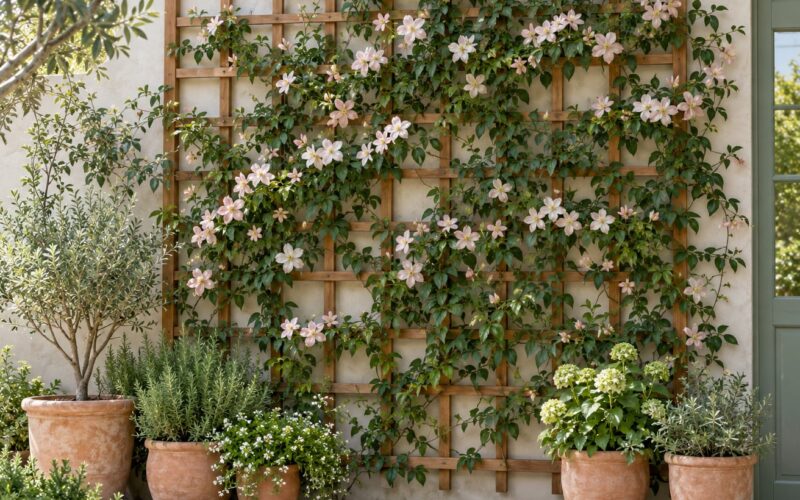
A trellis is the classic answer to the question of what grows best in a vertical garden, and it works because the crop occupies almost no floor area at all. Climbing beans, snap peas, sugar peas, cucumbers, and indeterminate tomatoes all climb if you give them something to grip, and a single 12 inch pot at the base can feed a structure six feet tall.
Pick a material that matches the crop. Slatted wood and welded wire or cattle-panel sections hold beans and peas, who need thin stems to wrap. Netting or twine is better for cucumbers, which sprawl. Keep the trellis on the sunny side of the balcony so it does not shade everything behind it.
Anchor it properly. A tall trellis in a tall pot is a sail, and balcony wind is stronger and gustier than most gardeners expect. Secure the base to the floor with a bracket or a weighted pot, tie the top of the trellis to a fixed point, and never rely on the pot alone. A-frame trellises solve the anchoring problem neatly because they stand on their own weighted feet.
Plan for reach. A tomato at the top of a six foot trellis is a real pruning problem, and that frustration comes up again and again in balcony gardening forums. Keep trellised tomatoes to four feet if you want to pinch suckers and harvest without a ladder, and put the tall beans where the pods hang at hand height.
4. Use a Stacked A-Frame Grower
An A-frame grower is two sloped planting trays meeting at a ridge, and it slides into a corner or against a railing where nothing else fits. Folding versions open for planting and watering, then fold flat for storage, which matters in a climate where the balcony is empty for half the year.
The geometry creates a short microclimate. The upper trays get the heat and the reflected light, so they suit cherry tomatoes, compact peppers, and strawberries. The lower, cooler trays suit leafy greens, parsley, and cilantro, which bolt in the heat faster than most people expect.
Fill the two long faces, and put a narrow tray or a few deep pots in the open ends for taller items. Anchor the frame to the balcony structure or wedge it into a corner where two walls meet, because an empty A-frame is stable and a full one in a gust is not.
Watch the weight distribution. The ridge concentrates mass at the top, so fill the bottom positions first and keep the heavier pots low. If your unit is plastic, count the saturated weight carefully, since a full A-frame can pass 80 pounds before you add anything.
5. Plant a Vertical Hydroponic Tower
A hydroponic tower grows an unusual amount of food in a very small footprint, and it solves the watering problem that kills most balcony containers. The root systems sit in a nutrient reservoir with a pump feeding water up through the tower, so the plants never fully dry out the way they do in a shallow pocket on a hot afternoon.
Tower systems suit leafy greens, herbs, and strawberries best. Lettuce, pak choi, kale, mizuna, basil, mint, and cilantro all perform well. Tomatoes and peppers are possible in the larger bottom sites, but they want far more root volume than a tower site provides, and fruit quality usually drops. Treat fruiting crops as a soil-pot job and the tower as the salad machine.
The routine is simple but non-negotiable. Top up the reservoir before it empties, because pumps run dry fast, and check the nutrient temperature, since a warm reservoir on a west-facing balcony loses oxygen and roots turn brown. Keep pH between 5.5 and 6.5 and soluble salts between 1.2 and 2.0 mS/cm, and change the solution every couple of weeks rather than topping it up indefinitely.
Expect to buy a grow light if the balcony is under six hours of direct sun. A tower without strong light grows thin, stretched stems and tastes like nothing, which is the most common complaint in grow tower reviews.
6. Create a Balcony Vegetable Ladder
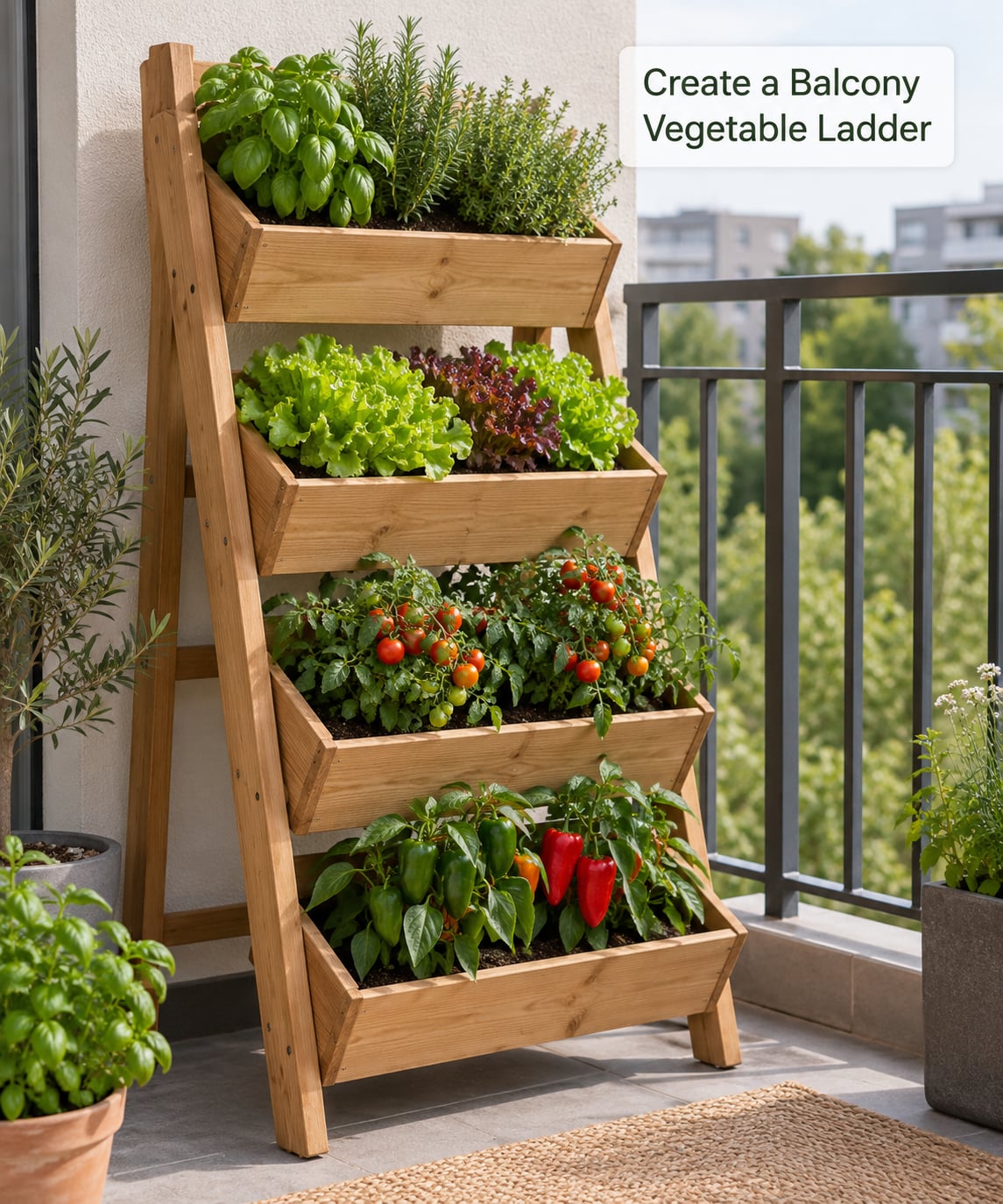
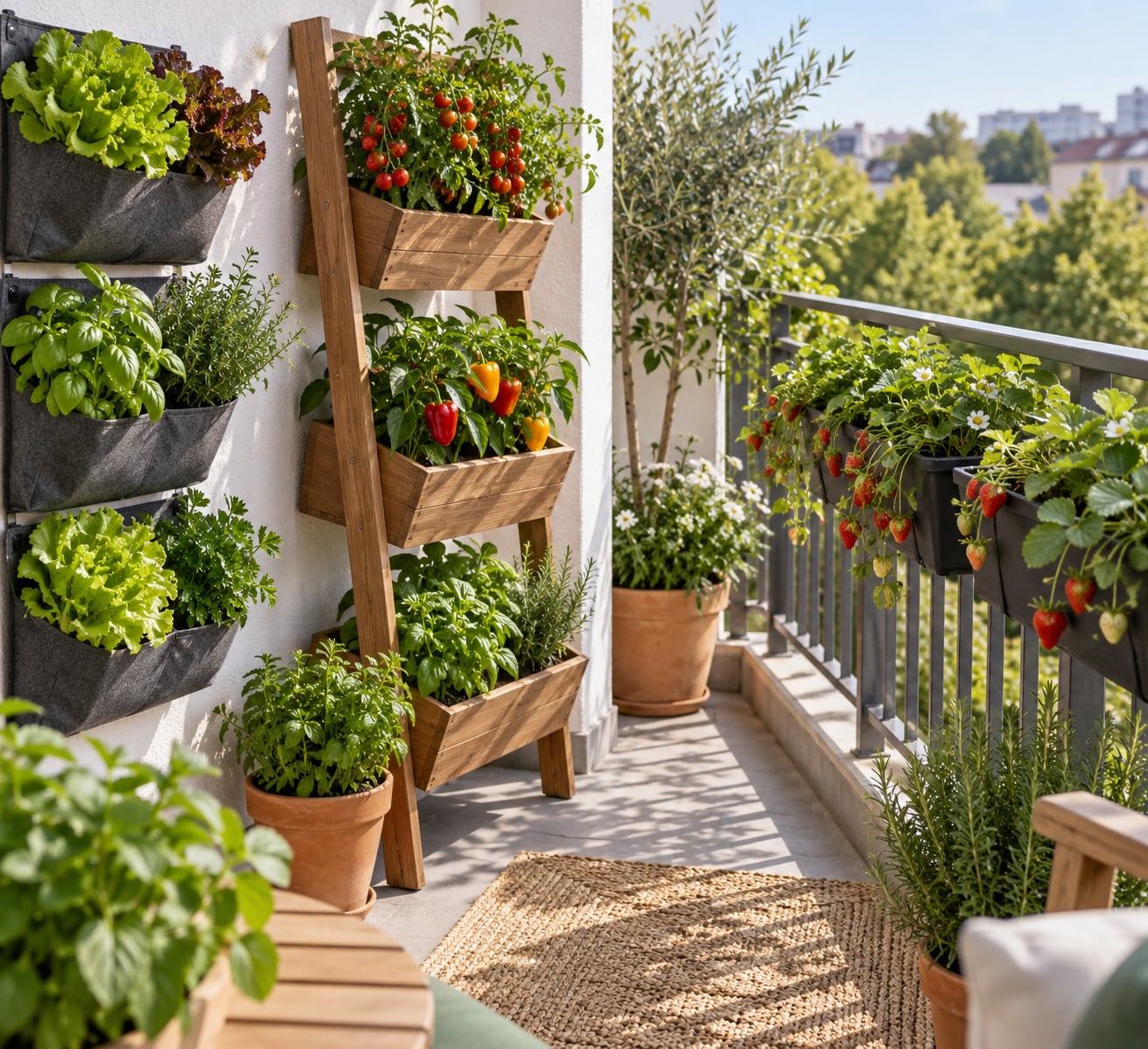
A ladder planter leans against your balcony wall or railing and carries angled planting boxes up the rungs. The sloped boxes stop soil from washing out during watering, and the stepped layout puts every crop at a different height, so you are not crouching for the bottom tray and stretching for the top one.
Assign crops by height rather than by preference. Top box: herbs, since you reach them constantly. Second box: cherry tomatoes or compact peppers, at the height where you can prune and harvest. Third box: lettuce, arugula, and kale. Bottom box: radishes, short carrots, or a trailing strawberry plant that spills toward the floor.
Set the ladder at an angle where the top leans against solid wall, not against the rail, and use a wall spacer or bracket at the top so it cannot slide. Freestanding ladder units need a foot at the base or they walk across the balcony in a strong gust.
Watch out for the weight pulling the lean. A wooden ladder frame with four 10 inch boxes of wet soil can approach 150 pounds, and that torque is what tips frames over. Keep the top box lighter than the lower ones, and check the frame for racking once the season is underway.
7. Hang Rail Planters from a Balcony Rail
Railing planters convert the balcony perimeter into growing space while leaving the entire floor and the walking path clear. This is the best option for a narrow balcony, and for anyone whose building rules prohibit wall fixings.
Hook them inside the rail, resting on the top rail, rather than hanging them on the outside face. Inside-facing planters sit in the calmer air on the sheltered side of the building, and they keep you from looking out at a wall of foliage. Use hooks that clamp to the rail or wrap around a vertical post, never planters that simply rest on the rail with their whole weight cantilevered outward.
Anchor to posts wherever you can. A 40 pound planter hanging on the middle of a horizontal rail works the balusters loose over a season, and the failure is sudden. If only horizontal rail is available, use a bracket that spans two balusters, and add a safety clip to the post on a heavy unit.
What to grow: herbs at eye level so you can pinch them without a step stool, trailing strawberries and quick greens in the corners, and lettuce in spring and fall. Keep tomatoes off the rail, because a fruiting plant in a 7 inch trough tips in a gust and the fruit spills.
Watch for the shade problem. Many rails cast a horizontal shadow band, and a rail planter sitting inside the rail may get noticeably less light than the open balcony. Move them after a few days of observation if the plants stretch.
8. Use Gutter or Shelf Systems Along the Railing
A half-pipe gutter planter or a long balcony shelf gives you a continuous run of growing space rather than a series of separate pots. Mounted along a railing, it behaves like a mini raised bed, which is a lot of productive length in a very thin profile.
Gutter systems want shallow crops: lettuce, arugula, mizuna, radishes, spinach, chives, and short herbs. Drill or clear drainage holes every 4 to 6 inches along the bottom, and slope the gutter very slightly toward one end so water moves instead of pooling. Fill it with a quality potting mix rather than garden soil, and expect to top it up each season as the mix settles.
Mount the gutter to a solid bracket at each post, not to the balusters, and add a splash guard beneath it. Balconies are multi-unit, and a steady drip onto the unit below turns a neighbor into an enemy. A tray with a lip under the gutter handles most of it.
Shelf systems have the same profile with tiers instead of length, so you can stack two or three shallow shelves and gain vertical separation. Wind is the constraint, as a long horizontal catch at head height takes a lot of force. Add end panels or a mesh back so leaves do not shred, and skip the top shelf on exposed upper-floor balconies.
9. Combine Vertical Planters with a Small Seating Area
A balcony that grows food and seats two people needs a different layout than a growing balcony alone, and the trick is to treat planting as a slim zone along one edge rather than a structure in the middle. Put the depth-heavy containers against the wall, hang the shallow stuff at rail height, and leave a clear 32 inch path from the door to the rail.
Movable planters do most of the work here. A planter on casters or a plant caddy lets you drag everything back against the wall when guests are over, then roll it out for a harvest. Herb planters placed within arm’s reach of a small table turn a seating area into a picking area, so a two-person table with a rolling herb tower beside it is the single most usable combination on this list.
Pair crops with ornamentals that share the same conditions. Swiss chard with a deep red caladium, trailing strawberries spilling over the edge of a planter beside white alyssum, curly parsley alongside lobelia, and silver-leafed sage next to dusty miller all tolerate the same watering regime and the same light.
Watch the sightlines and the load. Anything hanging or tall in a seating corner blocks conversation and catches wind in a funnel, so keep the tallest element on the wall side and the hanging pieces low and light.
10. Try a Rotating Vertical Garden
A rotating vertical garden is a tall unit on a swivel base, so you can turn it to face the sun, reach the back without stretching, and inspect the far side for pests. On a very narrow balcony, or one where the building blocks light from one direction, that rotation genuinely buys you growing hours that a fixed unit would not get.
The trade-off is mechanical complexity. Swivel towers have more joints, more bearings to seize, and a higher centre of gravity than a fixed shelf. Always turn the unit with a full reservoir, and never push it across a balcony with a hose attachment or a drink sitting on the shelf.
Control the weight, because everything you add goes up high. Put herbs and greens in the upper positions where they are light, and reserve the lower sites for the heaviest containers. If the base is a water reservoir, check the base is broad enough that a full unit will not tip, and keep the base in contact with the floor at all four points.
Honestly, a rolling vertical planter on sturdy casters gets you most of the benefit with none of the joint risk. If you have pets or small children on the balcony, choose the casters and skip the swivel.
Frequently Asked Questions
What vegetables can be grown in a vertical garden?
The best vertical crops fall into three habit groups. Climbers such as climbing beans, snap peas, cucumbers, and indeterminate tomatoes use a trellis to take almost no floor space. Trailers like strawberries, cherry tomatoes, and cascading thyme spill over planter edges without using width. Compact crops such as lettuce, arugula, radishes, kale, chives, and most herbs fit pockets, shelves, and rail boxes of 6 to 8 inches. Peppers and compact tomatoes need 12 inches of depth and a heavier pot.
How much weight can a balcony hold for planters?
Most residential balconies are engineered for people and furniture, not for concentrated load at the rail, so treat the edge as the weakest point. Estimate the saturated weight of each pot by adding the container, the dry mix, and the plants to the water, where water weighs about 8.3 pounds per gallon. A 12 inch pot holding 1.5 gallons of water is already close to 12.5 pounds before anything else goes in. Keep the heaviest loads on the floor against the wall, and check your building rules before concentrating weight at the rail.
Can you hang a planter off a balcony railing?
Yes, but hook it to a vertical post or use a bracket spanning two balusters rather than hanging the full weight on the middle of a horizontal rail. Planters on the inside of the rail are safer and get calmer air than ones hung on the outside face, where wind and the drop are both worse. Add a safety clip on anything holding more than about 30 pounds, and never hang fruiting plants on an exposed corner rail.
How often should I water balcony planters?
Check daily in summer and every two or three days in spring, then water when the top inch of mix feels dry. Elevated and wall-mounted containers dry out far faster than ground-level ones because wind passes across the whole surface. Water slowly until it runs from the drainage holes, and use a self-watering container or a simple wicking insert on south- and west-facing balconies, where a pot can need water twice in one hot afternoon.
What grows on a shady balcony?
Shade-tolerant greens handle three to five hours of sun well: lettuce, arugula, mizuna, spinach, Swiss chard, kale, parsley, cilantro, chives, mint, and New Zealand spinach. Alpine strawberries tolerate partial shade and still fruit. Avoid tomatoes, peppers, and fruiting beans in low light, since they stretch and set little fruit. If your balcony gets under three hours, add a grow light or grow herbs indoors and keep the balcony for structure and greenery.
What are the disadvantages of vertical gardening?
The real costs are water, load, and reach. Higher and wall-mounted containers dry out faster than ground-level pots, so they need more frequent watering. Weight concentrates on small footprints, which puts stress on railings, hooks, and wall anchors that were never designed for it. Upper crops also become hard to prune, harvest, and check for pests. Budgeting extra time for watering and careful anchoring covers most of the downside.
Conclusion
Start with the constraint you cannot change. If you have a sunny wall and a stable floor, a wall-mounted pocket planter with lettuce, chives, and parsley turns a bare wall into a full salad bed. If the wall is off limits, rail planters hooked to posts keep the floor clear. If your balcony is a narrow corner, a folding A-frame or a rolling ladder is the whole answer.
Then do three things before you plant: map your sun hours, estimate the saturated weight, and check your building rules. Pick easy crops first, add a trellis for climbers once the watering rhythm is settled, and expand from there. The ten vertical vegetable garden ideas for a balcony above all share one rule: the system that survives is the one you can water on a Tuesday in August.