If you are weighing a moss wall vs living wall and the deciding factor is upkeep, a preserved moss wall wins by a wide margin. It needs no watering, no feeding, no pruning and no pest control once it is on the wall. A living wall runs on a repeating cycle of irrigation checks, nutrient dosing, trimming and plant replacement, and that cycle never really ends.
Neither option is zero-effort, though. Preserved moss fades, goes brittle in dry air and needs dusting on a schedule, and it cannot be brought back once it is damaged. This guide compares both honestly, including where living wall technology has genuinely improved, so you can pick based on your room, your light and how much time you actually want to spend.
One thing to clear up before we go further: three different products get sold as a green wall, and the maintenance story changes completely depending on which one you buy.
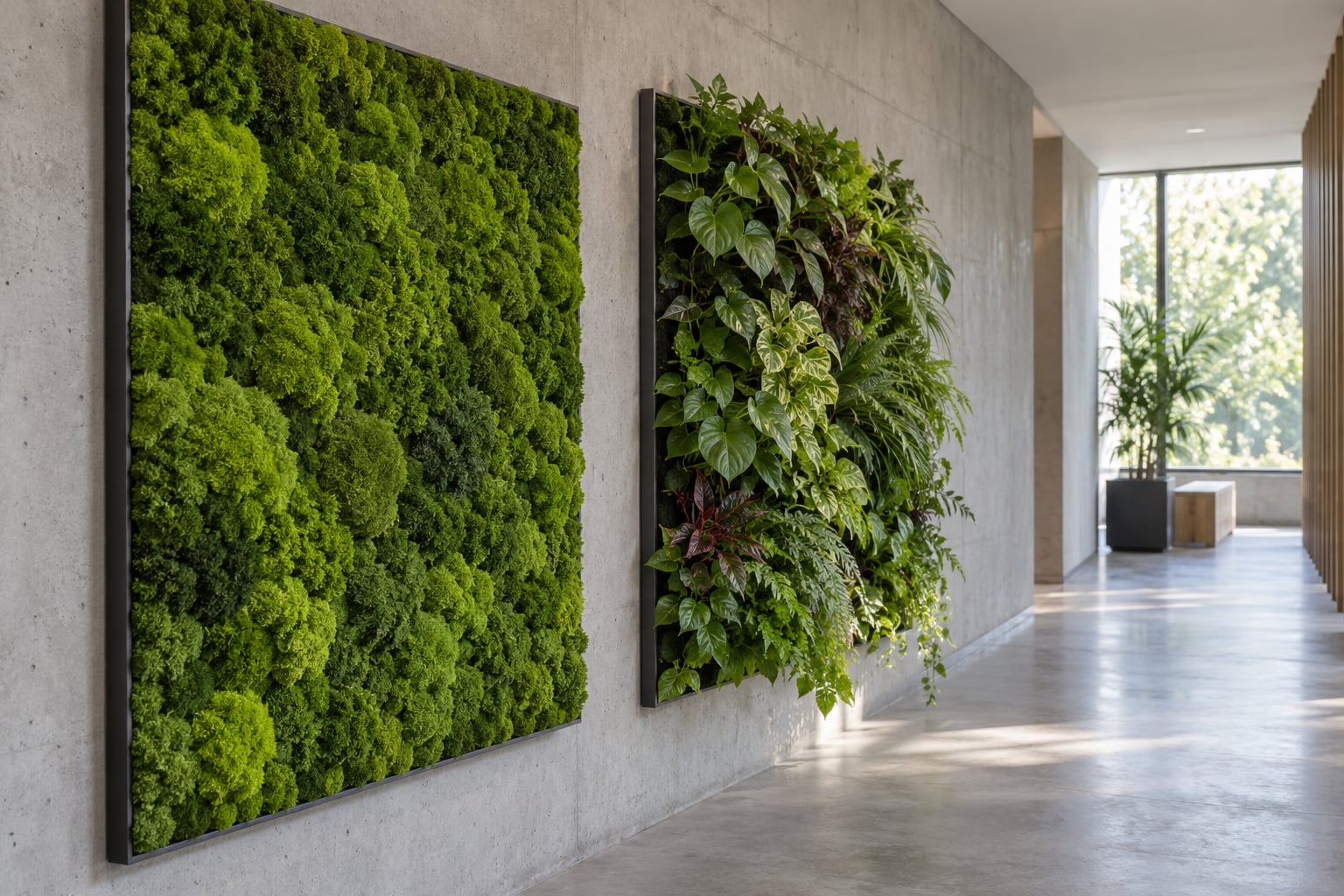
- Preserved moss wall — moss harvested and treated with a glycerin-based solution and stabilised dye. It is dead material, fixed to a backing panel. This is what almost every “moss wall” on the market is.
- Living moss wall — actual moss still alive, growing in a shallow substrate with moisture and light. It is a specialised system, not a decorative panel, and it is frequently confused with preserved moss at the point of sale.
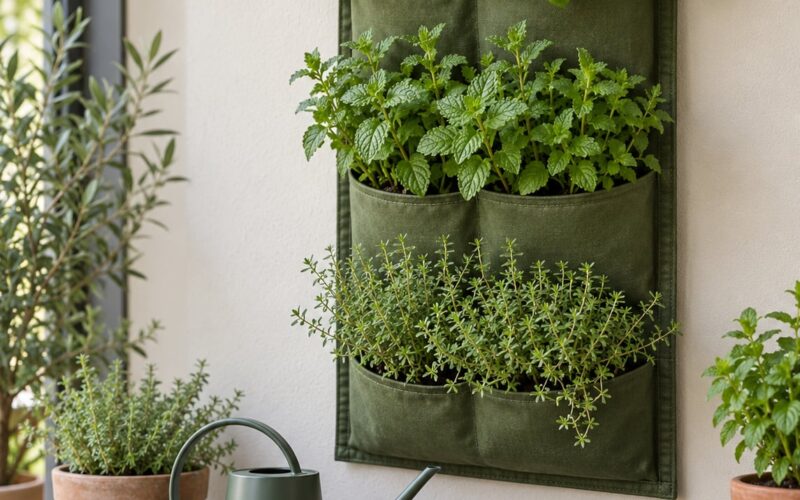
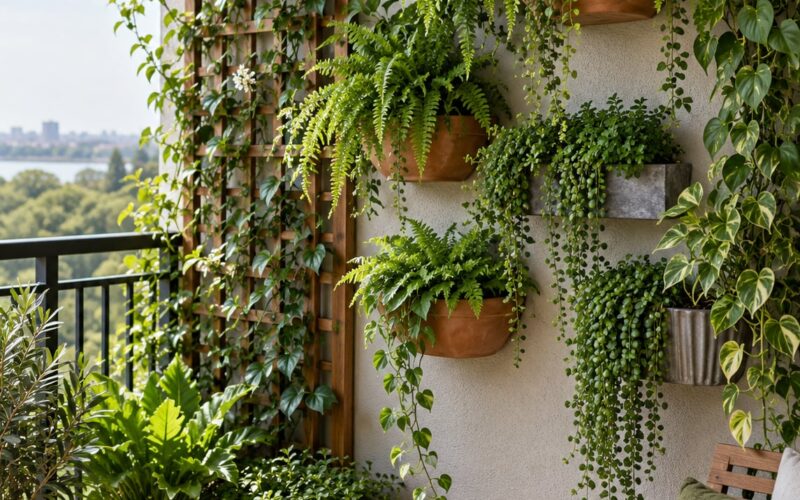
- Living plant wall — a vertical garden of ordinary plants like pothos, philodendron and ferns, held in felt pockets or mesh cassettes and fed by drip lines, a reservoir or a pump.
For this comparison, “moss wall” means preserved moss and “living wall” means a planted or living-moss system, because that is how the two are sold in interior fit-outs.
Table of Contents
- Moss Wall vs Living Wall Which Is Easier to Maintain?
- Watering and Irrigation Requirements
- Do preserved moss walls need watering?
- How often does a living wall need water?
- What about living moss specifically?
- Light, Humidity, and Plant Health
- Where preserved moss struggles
- Where living walls struggle
- Cleaning and Routine Upkeep
- How often do you dust a moss wall?
- What living wall cleaning actually involves
- Why Moss Walls Are Not Maintenance-Free Either
- How Often Each Needs Attention
- What Maintenance Actually Costs You
- Plant Replacement and Repair Needs
- Why living wall plants die
- When a moss panel needs re-tiling
- Durability and Long-Term Appearance
- Fading, bleaching and colour drift
- Which Should You Choose?
- Frequently Asked Questions
- Are moss walls easier to maintain than living walls?
- Do moss walls need water or light?
- How often does a living wall need maintenance?
- Do moss walls attract bugs?
- How long does a moss wall typically last?
Moss Wall vs Living Wall Which Is Easier to Maintain?
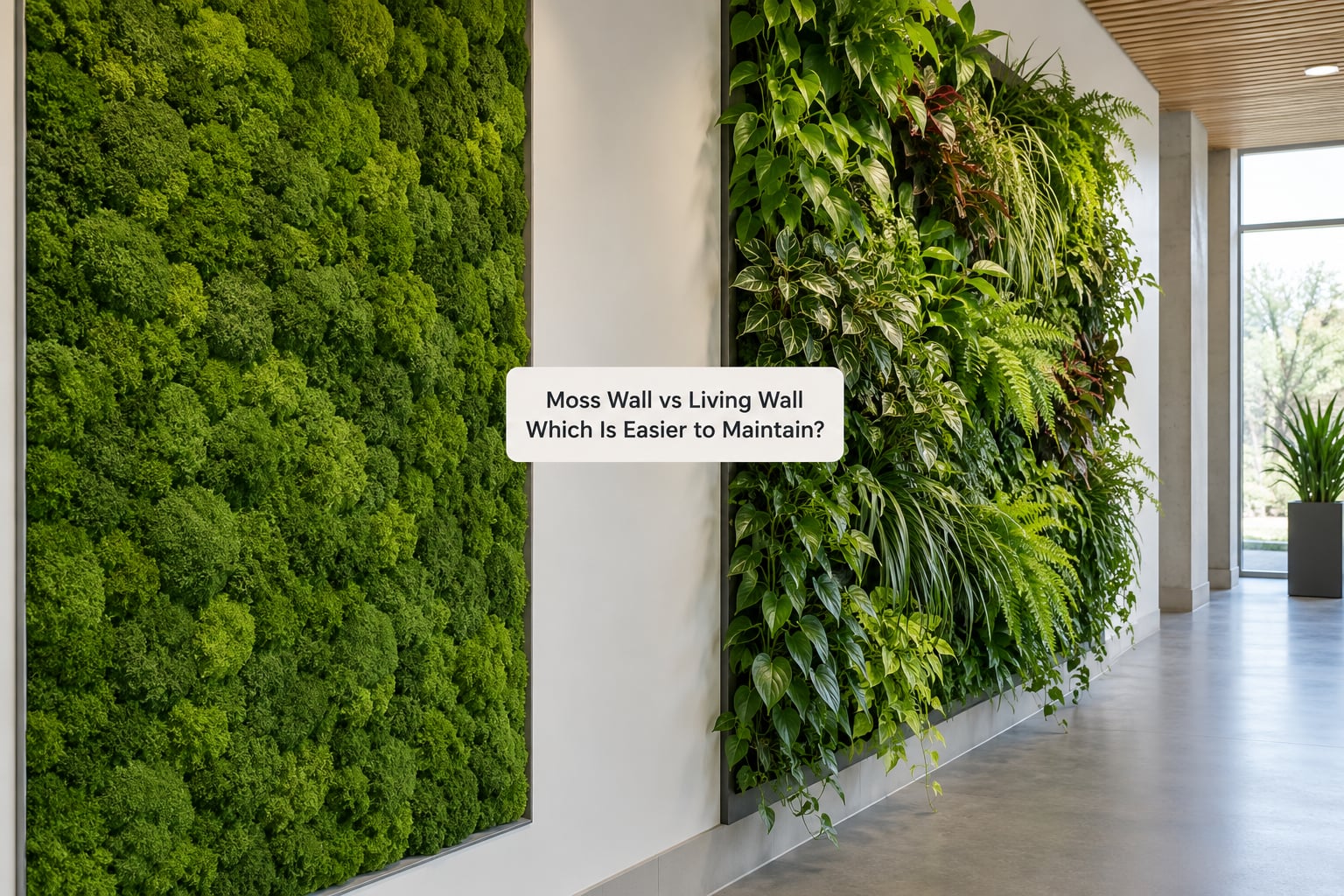
A preserved moss wall is easier to maintain. The comparison is not close, because the moss wall has no biological systems running at all, while the living wall has a watering system, a nutrient supply and hundreds of plants to keep alive. The table below is the whole argument in one place.
| Maintenance factor | Preserved moss wall | Living wall (planted) |
|---|---|---|
| Watering | None. Never wet or mist it | Weekly check at minimum; reservoirs or drip lines may run daily in bright, warm rooms |
| Light | None needed. Indirect light is fine, direct sun causes bleaching | Needs enough light to sustain growth, often supplemented with grow lights |
| Humidity | Keep it stable. Below roughly 40% relative humidity the material turns brittle and grey | Higher humidity helps most species, so this one works in your favour |
| Nutrients | None | Regular nutrient dosing, usually every few weeks in the growing season |
| Pests | None. The material is not alive, so there is nothing to attract insects | Fungus gnats, spider mites and thrips are routine visitors |
| Pruning and replacement | No pruning. Occasional re-tiling of tired sections | Trim trailing growth and swap out failing plants throughout the year |
| Equipment | None | Pump, filter, drip lines and reservoir all need servicing |
| Time per month | A few minutes of dusting, once every one to three months | Roughly one to two hours, spread across weekly and monthly tasks |
| Best location | Offices, receptions, lobbies, hotel corridors, retail fit-outs, home offices | Spaces with real daylight or a committed lighting and irrigation setup |
Read the middle rows rather than the top one. Watering is the headline difference, but the rows people forget are equipment and pests. A living wall with a pump is closer to owning a small appliance than to owning a picture frame.
Watering and Irrigation Requirements
Do preserved moss walls need watering?
No. Preserved moss has no roots, no substrate and no live cells drawing water, because the moisture in the plant was replaced with glycerin at the treatment stage. Watering it is not just unnecessary, it is damaging.
Misting is the most common piece of bad advice on this topic, and it is worth repeating the correction clearly. Spraying preserved moss wets the stabilised dye and the backing panel, and both dry unevenly. The usual result is a dull tide mark, a darker band along the bottom edge, and in some cases an odour as the treated backing holds damp. Use a soft brush or a low-suction vacuum, nothing wetter.
How often does a living wall need water?
Weekly, and daily in some conditions. Most indoor living walls run on drip lines fed by a reservoir, with a pump where the wall is tall or the water has to travel upward. A wall in a bright, warm reception area can need checking every second day in summer.
Overwatering and underwatering both kill plants, and they look different. Soggy substrate, yellowing lower leaves and a sour smell point to too much water or a blocked drain. Wilted, crisp, brown-edged leaves and dry pockets in the felt point to not enough. Drainage layers and even coverage matter more than volume.
What about living moss specifically?
Living moss needs a permanently moist substrate, bright indirect light and airflow. Retailers selling live moss for indoor use are clear that it needs moisture, the right light, ventilation, a proper backing and ongoing care. It behaves like a plant, not like a panel, so the watering answer above applies with even less tolerance for error.
Light, Humidity, and Plant Health
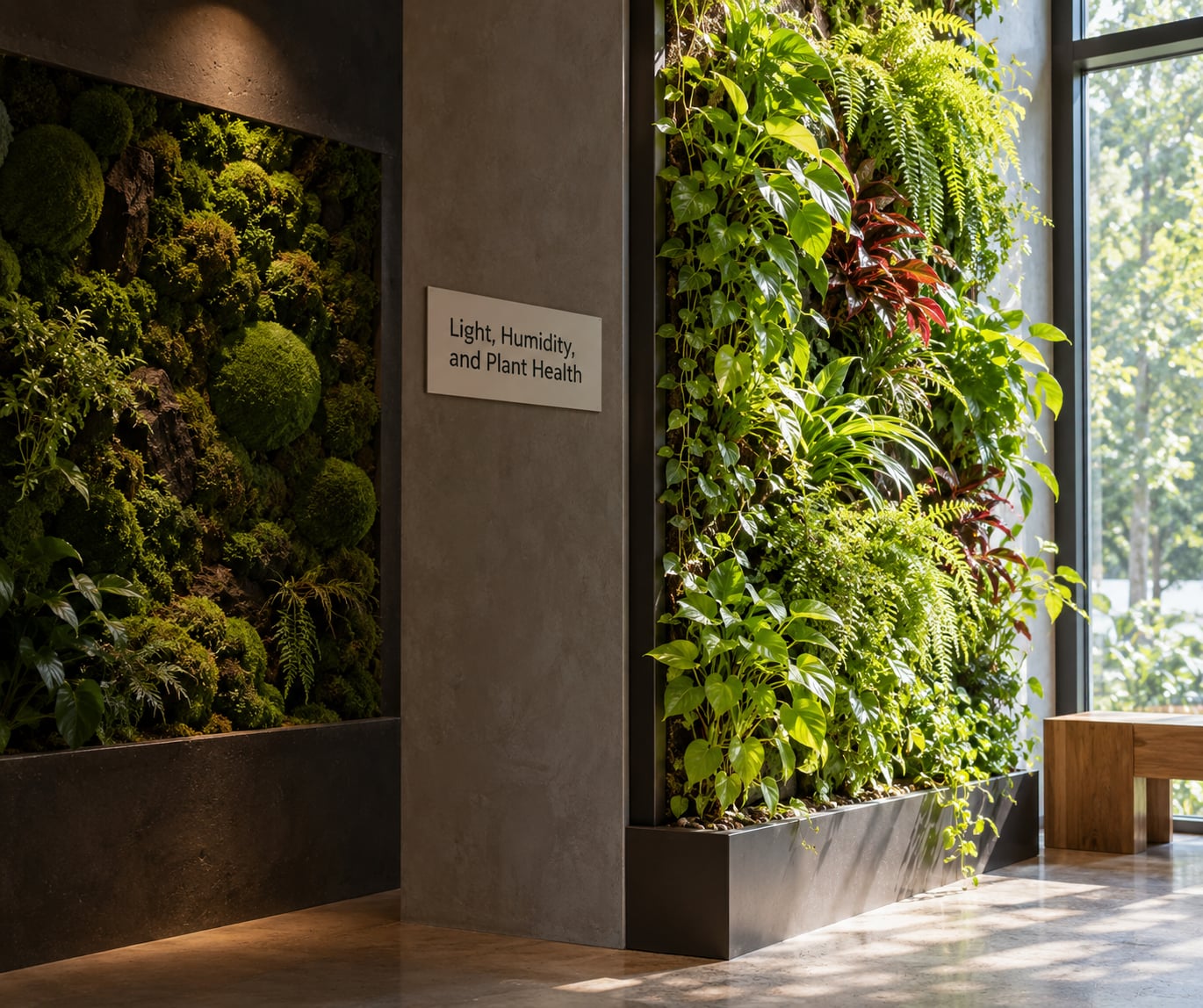
Light and humidity push the two systems in opposite directions. A preserved moss wall wants stable, moderate humidity and no direct sun. A living wall wants light to sustain photosynthesis, and most of the plant palettes that work indoors tolerate normal indoor humidity without help.
Where preserved moss struggles
Humidity is the number one environmental factor. The US EPA’s indoor guidance puts a comfortable relative humidity band around 30 to 50 percent. Below roughly 40 percent, preserved moss loses moisture, becomes brittle to the touch and fades toward grey. Radiators, HVAC diffusers pointed straight at the wall and south-facing glazing are the usual culprits, and they are all avoidable at the design stage.
Light exposure matters too. The Getty Conservation Institute’s research on the cumulative effects of light on organic materials is the reference work here: colour change in plant-based materials accumulates with total light dose, not with a single bright afternoon. A moss wall next to a window can look noticeably tired within a season, while the same wall in a corridor with no direct daylight holds its colour far longer.
Where living walls struggle
Living walls need plant selection to match the spot. Low-light species such as pothos, philodendron and some ferns tolerate dim corridors; a sun-loving mix placed there will stretch, thin out and eventually collapse. Grow lights extend the options, and they add an electrical item to maintain, but they also add hours of usable growing day.
Airflow cuts both ways. Still air encourages fungal problems in a dense planted wall, while strong air movement dries the surface and can scorch the upper leaves where the fan points directly at the wall.
Cleaning and Routine Upkeep
How often do you dust a moss wall?
Every one to three months, depending on air quality and how much foot traffic the wall sees. Hold the low suction of a vacuum about an inch away and move it across the surface, or use a very soft brush on the flatter sheet varieties. A brush gets into the dense reindeer and bun moss better; a low suction gets the loose fibres off flat sheet moss without pulling at it.
Forum users are honest that this is the part vendors skip. People who assumed preserved moss was zero-effort are often disappointed by the dusting, particularly on textured moss where the surface area is enormous. It is not a big job, but it is a real one, and it does not go away.
What living wall cleaning actually involves
More, and it is fiddly. Dead leaves and spent growth come out of the felt pockets, the wall is checked for bare or empty sections, and irrigation lines are inspected for blockage or mineral build-up. Over a year you will also want to trim growth that is shading neighbouring plants, and wipe leaves where dust has settled.
Monthly, someone should run a finger along the drip lines to confirm water is actually reaching the top of the wall, not just the bottom. A blocked emitter is the most common cause of a living wall that slowly dies from the top down.
Why Moss Walls Are Not Maintenance-Free Either
The vendor version of this story is that preserved moss is a picture you hang and forget. That is only true of a wall in the right place. The real downsides, in the order they tend to cause trouble:
- It is not alive. A preserved moss wall is a decorative treated material, not a plant. It does not photosynthesise, grow or self-repair, and it offers no verified air filtration benefit.
- It fades. Light exposure accumulates, so a panel near a window bleaches steadily over months rather than all at once.
- It goes brittle in dry air. Below roughly 40 percent relative humidity the material stiffens, loses colour and can shed fibres when you touch it.
- It needs dusting. Every one to three months, and on heavily textured moss that is a slow job, not a quick one.
- It is one-way. Faded, stained or crushed areas cannot be revived. They can only be cut out and re-tiled, or replaced.
- Placement is not optional. Radiators, air vents and direct sun will age it faster than foot traffic ever will.
So the fair statement is that a moss wall has a low, predictable maintenance load with real environmental limits. A living wall has a higher, variable load with fewer placement dead ends. Which of those two problems you can live with is the actual decision.
How Often Each Needs Attention
Frequency is where the gap becomes obvious in practice. The same wall area, checked on the same schedule, produces a very different amount of work depending on which system fills it.
| Interval | Preserved moss wall | Living wall |
|---|---|---|
| Daily | Nothing | Reservoir level and pump noise checked where the system is not self-regulating |
| Weekly | Nothing | Irrigation check, dead leaf removal, pest inspection, light and temperature check |
| Monthly | Nothing in most months | Nutrient dosing, pruning trailing growth, drip line and emitter flush, filter clean |
| Quarterly | Dust with a soft brush or low-suction vacuum | Full inspection, substrate check, replacement of failing plants, deeper clean |
| Annually | Re-tile faded or damaged sections; check humidity levels across the wall | Service the pump, review the whole plant palette, replace root-bound pockets |
Add that up and the living wall column describes roughly one to two hours of attention spread across the month, and a meaningful slice of that is skilled work rather than a quick wipe. The moss column describes a few minutes, once or twice a quarter.
What Maintenance Actually Costs You
Money is the wrong lens here, so skip the install invoice and look at where the effort lands. A preserved moss wall front-loads everything: once it is on the wall, the recurring cost is dustcloth time and the occasional re-tile. Nothing about it needs servicing.
A living wall converts a one-off install into a standing commitment. Someone has to be paid or scheduled to do the weekly work, pumps and filters need replacing on a lifespan measured in years rather than decades, and plants need buying in twice a year as a matter of course. Facilities teams often price this as a maintenance contract line, which is a fair signal of how recurring it is.
The number that should decide a residential fit-out is simpler: if nobody in the household will own the weekly watering, the living wall is being bought with money you do not have.
Plant Replacement and Repair Needs
Why living wall plants die
Usually light, water or root space, in that order. Plants placed in the wrong light conditions grow thin and weak. Irregular irrigation dries out the top of a tall wall while the base stays wet. And felt pockets have a fixed volume, so a plant that grows for a year has nowhere to put roots, which is why replacement is scheduled rather than an emergency.
Expect individual plant turnover to be a continuous, rolling process rather than a single replacement cycle. Some species last a year or more in a good spot; others need swapping within months. That is the nature of a planted system, and it is the reason living wall maintenance is usually sold with a service contract rather than handed to a facilities team.
When a moss panel needs re-tiling
Preserved moss panels are typically tiled, and a single tired section can often be lifted and re-mossed without touching the rest of the wall. Watch for fading concentrated near a vent or window, and for brittleness at the exposed edges. Damaged areas cannot be repaired, only replaced, so the useful move is patching the worst section rather than stripping the full wall.
That is a meaningful advantage over a planted wall. One failing plant in a living wall is invisible until it is obvious; one damaged patch in a moss wall announces itself immediately, which means you can fix it before it spreads.
Durability and Long-Term Appearance
Fading, bleaching and colour drift
Well-placed preserved moss holds its colour for years. Placed badly, it can look tired within a single season. The variables that decide which one you get are cumulative light dose, heat from a nearby radiator or vent, and humidity stability, in that order.
A living wall changes constantly, and that cuts both ways. Growth fills in gaps and hides the mechanics, and you get genuine seasonal variation. But the colour shifts month to month, plants come and go, and there is always a stage where part of the wall looks bare. Whether that reads as healthy and alive or as unfinished depends entirely on how closely you are looking at it.
On lifespan there is no single number worth quoting, because it varies with species, light and how the wall is maintained. The honest version is that preserved moss has a long service life and fails slowly and locally, while a living wall has no end date because it is a living thing that is being replaced by design. A wall specified for a three-year tenancy behaves very differently from one specified to look identical in year seven.
Which Should You Choose?
Choose a preserved moss wall when the wall has no natural light, when nobody will own the upkeep, or when you need the room to look finished on day one and still look finished in five years. Choose a living wall when you want changing, growing plants, when the space has real daylight or budgeted grow lights, and when there is a named person or contractor who will do the weekly watering.
A few decision rules that help:
- Rental or short-tenancy fit-out: preserved moss. Nobody wants to inherit an irrigation system in a flat.
- Reception or lobby with facilities staff: preserved moss, unless there is a maintenance contract attached to the living wall budget.
- Home office, bathroom, spa corridor: preserved moss fits well. Low light and humidity swings are exactly where it struggles least because it is not alive.
- A bright room you use every day, where you genuinely enjoy plant care: a living wall, with a low-maintenance palette and a self-watering reservoir to cut the daily effort.
The hybrid answer is often the best one for a home: a preserved moss feature wall for the visual impact, plus a handful of real plants in a shelf nearby. You get most of the biophilic benefit of a green wall without handing over a pump and a nutrient schedule. It also solves the sizing problem, since off-the-shelf panels rarely match an awkward wall dimension.
One caution before anything is hung. Weight and mounting came up repeatedly in community discussion about indoor green walls, and the concern is legitimate: a fully planted system with wet substrate is heavy, and neither option should be fixed to a wall without checking that the substrate can carry it. Ask for the weight per square foot and the mounting method in writing, and use a proper cleat or frame system rather than adhesive fixings.
Living wall technology has improved, and it is worth being fair about that. Self-watering reservoirs, lower-maintenance species bred for indoor conditions, and app-controlled irrigation have all cut the effort involved. What has not changed is the underlying biology. Something that is alive, growing vertically and fed entirely by a system needs attention every week.
Frequently Asked Questions
Are moss walls easier to maintain than living walls?
Usually, yes. A preserved moss wall needs no routine watering, pruning or feeding, while a living wall requires irrigation checks, suitable light, plant replacement and periodic cleaning. The comparison is not close on effort, though a preserved moss wall does need dusting every one to three months and stable humidity, and it cannot be revived once faded or damaged.
Do moss walls need water or light?
Preserved moss walls need neither regular watering nor natural light after installation. The moss is dead, glycerin-treated material with no roots and no substrate. Keep it away from direct moisture, excessive heat and very high humidity, because damp wets the stabilised dye and backing and leaves tide marks. Misting is the most common mistake on this topic.
How often does a living wall need maintenance?
A living wall usually needs attention every week once it is established, more often in bright or dry conditions. Typical tasks include checking that irrigation is reaching the top of the wall, pruning trailing growth, removing dead leaves, inspecting for fungus gnats, spider mites or thrips, and replacing plants that have run out of root space in their felt pockets.
Do moss walls attract bugs?
No. Preserved moss is dead, treated material with no live tissue, so there is nothing for insects to eat or lay eggs in. Living moss and planted living walls do attract pests, and fungus gnats, spider mites and thrips are the usual suspects. Treating an infestation across a full-height planted wall is one of the more difficult parts of living wall ownership.
How long does a moss wall typically last?
It depends on placement. A preserved moss wall in an interior with no direct sunlight and stable humidity can hold its colour for several years, while one beside a window or above a radiator can look tired within a season. Living walls have no end date because plants are replaced on a rolling basis, so comparison is between a long slow fade and continuous turnover.
Start by measuring the light on your wall for a day. If it sits in shadow and nobody will be doing weekly watering, a preserved moss wall is the answer and the rest of this is settled. If the wall is bright and you want the plants to actually grow, price the maintenance alongside the install, not separately from it.