To size up a planter without transplant shock, move your plant into a pot 1 to 2 inches (2.5-5 cm) wider in diameter than its current one, or 2 to 4 inches for fast growers such as Monstera, and size it from the root ball rather than the foliage. That takes about fifteen minutes of measuring and twenty minutes of repotting, and it is far easier than trying to rescue a plant you drowned in an oversized pot.
The reason people get this wrong is that plant size is not pot size. A fiddle leaf fig with a five-foot canopy can be perfectly happy in a 10-inch pot if the roots still have somewhere to go. Experienced growers tend to say the same thing: the root ball decides, not the leaves.
Below is the method I use: measure, compare, adjust, repot at the same soil level, then give the plant a quiet six weeks.
Table of Contents
- What You Need
- Step-by-Step: How to Size Up a Planter Without Transplant Shock
- 1. Identify the plant’s growth habit and mature size
- 2. Measure the current root ball and container
- 3. Choose a planter with the right volume and shape
- 4. Check drainage, material, and practical limits
- 5. Move or repot without shocking the roots
- Common Mistakes
- Frequently Asked Questions
- What size planter should I move my plant into?
- How do I know when to repot a plant into a bigger pot?
- Should I remove all the old soil when repotting?
- Why is my plant wilting after repotting?
- Can I repot a plant into the same pot?
- When is the best time of year to repot a houseplant?
- Conclusion
What You Need
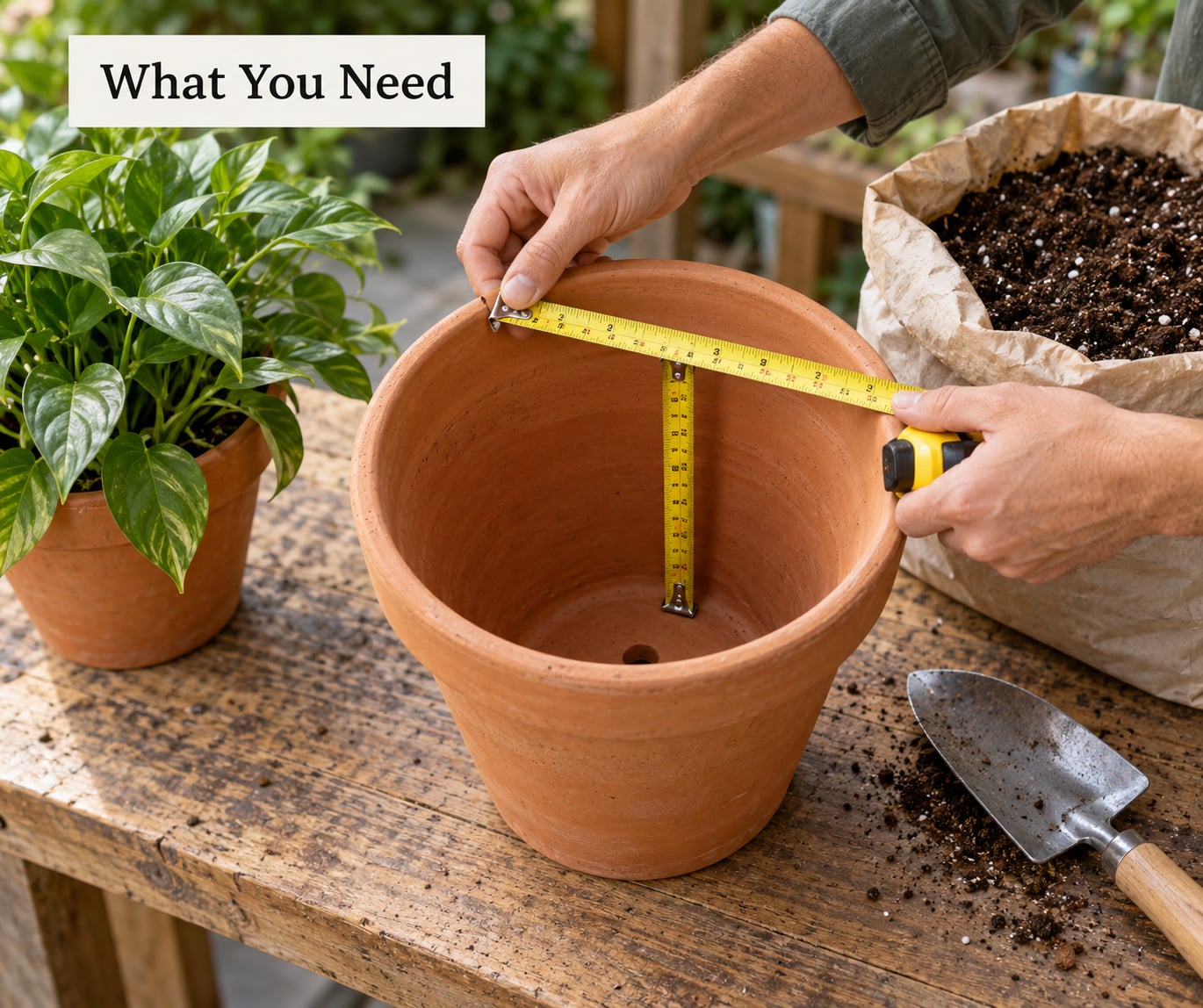
None of this is specialist equipment, and you probably already own most of it.
- The plant itself, plus its name or species. A quick search tells you whether it is a fast grower that earns a bigger jump.
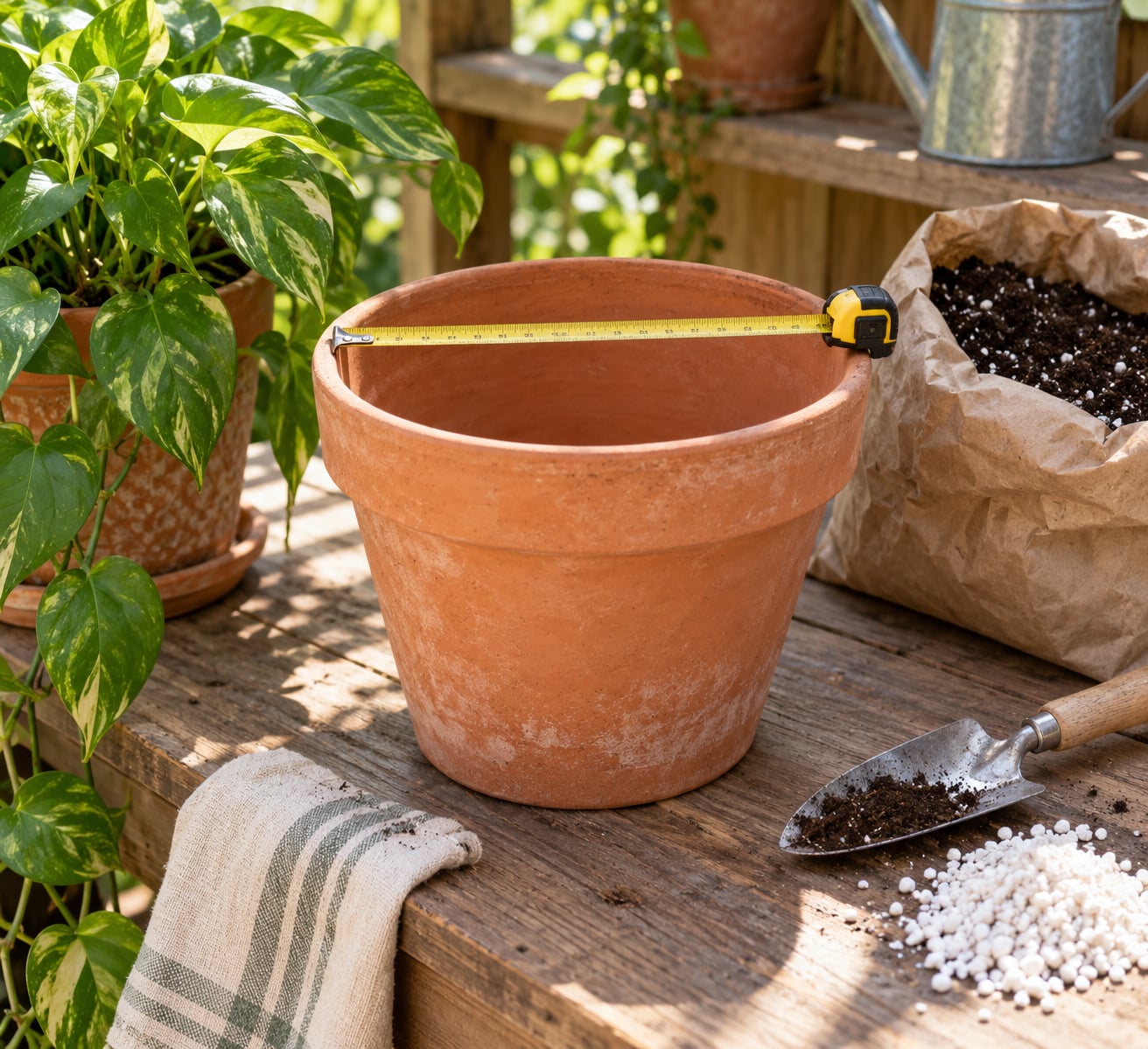
- The current container, so you can measure its inside diameter at the top rather than trusting the printed size on the side.
- A tape measure or ruler long enough to span a wide planter, or a piece of string and a pen for awkward round pots.
- Fresh potting mix suited to the plant, plus a handful of perlite or pumice if the mix holds water heavily.
- A trowel, a chopstick or a pencil for teasing apart circling roots and firming soil down the sides.
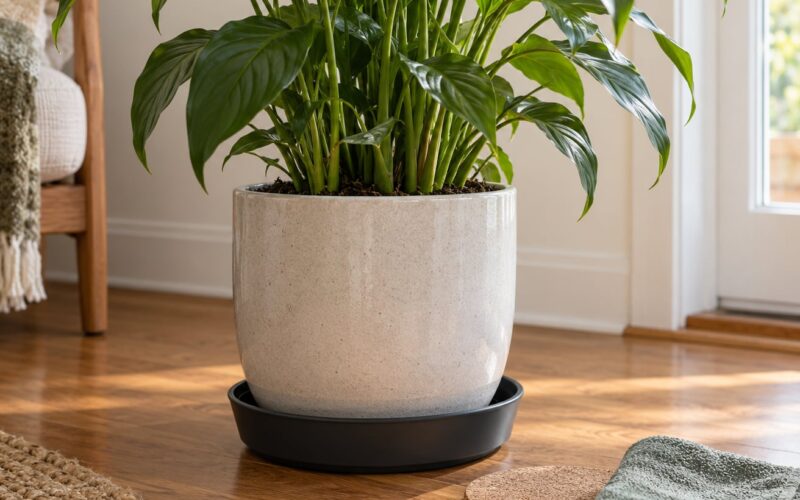
- A saucer or tray for anything that will live indoors, and an old towel if you are working outside.
Measure the current pot before you unpot anything. Diameter across the inside top is the number that matters, because that is the edge the roots will reach first.
Step-by-Step: How to Size Up a Planter Without Transplant Shock
1. Identify the plant’s growth habit and mature size
Growth habit tells you how big a jump the plant can absorb in one move. A Monstera, philodendron or pothos pushes roots hard through the season and can handle 2 to 4 inches. A snake plant, ZZ plant or African violet grows slowly and does better with barely a single inch of extra room.
Mature size matters less than you would think for sizing, and more for placement. A plant headed for six feet needs a wide, stable base eventually, but jumping straight there now just leaves a small root ball sitting in a lake of wet soil.
Some plants actively prefer a snug pot. African violets flower more reliably when their roots are slightly crowded, and you can keep one in the same container for years by root-pruning instead.
2. Measure the current root ball and container
Slide the plant out of its pot and lay it on its side. You should see a root ball roughly the shape of the container, with roots wrapping the outside and often poking through the drainage holes. That root ball, measured across its widest point, is your true starting number.
Compare it to the pot. A root ball filling the entire interior with no visible gap, roots circling densely, or a solid mat of roots at the base all mean root-bound. Growth that stalls between waterings, soil that dries out within two days, or a plant that tips over easily say the same thing.
You can check without fully unpotting: lift the pot and slide. If the root mass barely releases, or you can see white roots circling down the outside, the pot is already tight. Tip the plant out only when you are ready to repot, not as a casual inspection.
3. Choose a planter with the right volume and shape
Pot diameter drives how quickly the mix dries, and depth drives how much water sits at the bottom. For most plants, width is the safe upgrade. Depth beyond the root ball means a thick layer of soil that stays wet long after the roots have used it, which is where root rot starts.
A wider, shallower container suits plants that want to spread: herbs on a balcony, strawberries, most succulents in a bowl-shaped pot. A deeper container suits plants with a central taproot, like a large ficus or an indoor citrus tree, as long as the extra depth is modest.
Here is a jump chart that assumes a slow grower on one side and a fast grower on the other.
| Current pot diameter (inside top) | Next size, slow grower | Next size, fast grower |
|---|---|---|
| 4 in (10 cm) | 5 in (13 cm) | 6 in (15 cm) |
| 6 in (15 cm) | 7 in (18 cm) | 8 in (20 cm) |
| 8 in (20 cm) | 9 in (23 cm) | 10 in (25 cm) |
| 10 in (25 cm) | 12 in (30 cm) | 12 in (30 cm) |
| 12 in (30 cm) | 14 in (36 cm) | 16 in (40 cm) |
| 14 in (36 cm) | 16 in (40 cm) | 18 in (46 cm) |
| 16 in (40 cm) | 18 in (46 cm) | 20 in (51 cm) or split into two |
| 18 in and up | 20 in (51 cm) | Split the plant instead of jumping size |
If a plant is badly root-bound, going up two nominal sizes is fine. Anything beyond a 4-inch jump is treated as overpotting, and for a plant that has been circling its pot for two years that is a reasonable line.
4. Check drainage, material, and practical limits
Drainage is not negotiable. Every container needs at least one hole in the base, and a cache pot with a nursery pot nested inside it should have a way to drain the inner pot rather than hold water indefinitely.
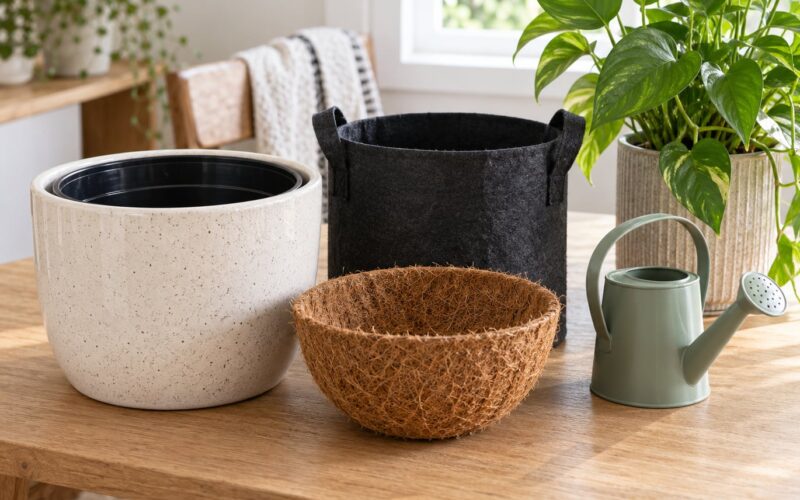
Material changes how fast the mix dries, which changes how often you water, which changes how much extra soil volume is safe.
| Material | Moisture retention | Sizing note |
|---|---|---|
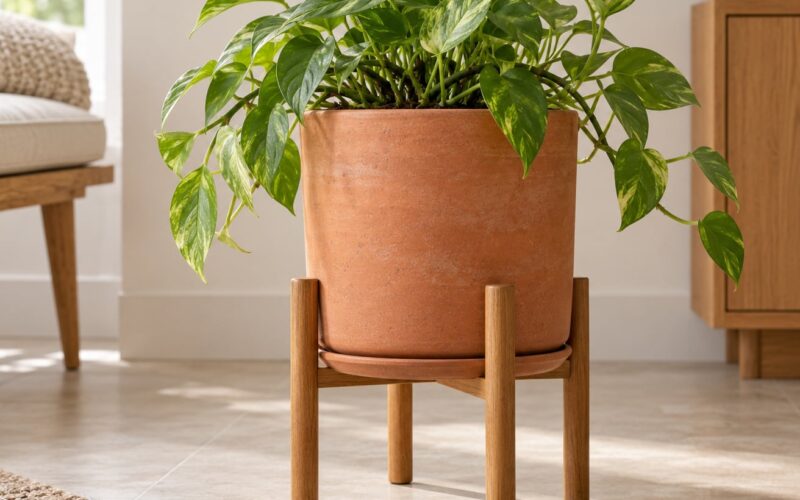
| Terracotta | Dries fastest, breathes | Safe for a slightly larger pot; check moisture more often |
| Plastic nursery pot | Retains more | Stick to the 1-inch step for slow growers |
| Glazed ceramic | Retains a lot, heavy | Go up one size only; watch weight before choosing a wide pot |
| Fabric or air pot | Air-prunes roots, dries evenly | Can take a slightly bigger step; water more often |
| Self-watering planter | Reservoir holds moisture | Size the reservoir, not the pot width; keep it about half full |
Also weigh the pot. A tall ceramic planter with a big leafy plant on top can be dangerous on a balcony, and a wide lightweight pot is better than a narrow heavy one for a top-heavy Monstera. For wind-exposed spots, a broad base beats a tall narrow column every time.
If you have a decorative planter without drainage, nest a nursery pot inside it and remove the inner pot for watering so it can drain fully.
5. Move or repot without shocking the roots
Repot in spring or early summer while the plant is pushing new growth. Avoid flowering or fruiting plants, and avoid dormancy, when roots are not healing fast. Water the plant a day or two beforehand so the root ball is moist but not soggy.
- Prepare the new pot.Check the drainage holes and, for a plastic or terracotta pot with no holes, drill one 1/2 inch from the base on the lowest side. Add a thin layer of fresh mix.
- Unpot gently.Tip the old pot at an angle and support the base of the stem. Loosen the root ball with a chopstick if it is stuck; do not yank the stem.
- Assess the roots.Rub the root ball gently between your fingers to knock off the old loose mix and see the root structure. Keep as much of it as you can.
- Tease out circling roots.Gently spread roots that wrap the bottom and sides, trimming only thick, woody, circling sections. Do not shear the whole root mass.
- Set the plant at the same depth.The top of the root ball should sit at the same height it was in the old pot, roughly an inch below the rim so watering does not wash soil over the lip.
- Backfill and settle.Add mix around the sides, rotating the pot to fill gaps. Firm it lightly; do not compact it hard.
- Water lightly, then wait.Give it enough to moisten the new mix without soaking, and hold off on fertilizer for 4 to 6 weeks.
Keep it out of direct sun for one to two weeks and skip watering until the top 2 inches (5 cm) feel dry. Some leaf drop in the first fortnight is normal and different from soft, dark, mushy stems, which mean real rot.
Planter choice by plant type is where a generic rule stops working.
| Plant | Size-up step | How often |
|---|---|---|
| Monstera | 2-4 in (5-10 cm) | About yearly in spring |
| Fiddle leaf fig | 2 in (5 cm) | Every 1-2 years |
| Pothos and philodendron | 2 in (5 cm) | When roots reach the drainage holes |
| Snake plant | 1-2 in (2.5-5 cm) | Every 2-3 years, often no rush |
| Herbs | 1-2 in wider, same depth | Each season; shallow wide pots |
| Succulents and cacti | 1-2 in (2.5-5 cm) | Every 1-2 years, gritty mix |
| African violet | Half to 1 in, often none | Only when crowded; root-prune instead |
| Outdoor container shrub | 2-4 in (5-10 cm) | Every spring before new growth |
Common Mistakes
Sizing up too much. This is the most common container mistake, and it causes root rot. A pot with a large volume of unused soil holds moisture the roots cannot use, and the mix goes sour. Fix it by staying one step up and by waiting for the plant to fill the pot before you size up again.
Sizing up too little. If you only add an inch when the plant has been root-bound for seasons, the roots will circle again within weeks. The symptom is stunted growth and soil that goes bone dry almost immediately. Move up a full step for fast growers.
Choosing the pot on looks. The nicest pot in the shop is often the biggest one, and it is rarely the right size. Pick the pot by diameter first and set it inside a decorative cover if you want the look.
Ignoring the shape of the root ball. A plant with a shallow, wide root mass dropped into a deep narrow pot ends up with air pockets and wet pockets at different depths. Match the shape of the pot to the shape of the roots.
Repotting at the wrong time. Flowering plants, fruiting plants and anything dormant should be left alone. Repot in the active growth period instead.
Overwatering right after. Fresh mix plus a disturbed root system plus a soak is how a plant ends up in shock. Water lightly, then let the top of the mix dry before the next drink.
Feeding too soon. Fertilizer on stressed roots burns them. Wait 4 to 6 weeks, then feed lightly at half strength.
Skipping the root check. If you never look at the root ball, you are guessing. Two minutes of inspection saves a year of stunted growth.
Frequently Asked Questions
What size planter should I move my plant into?
Most plants do best in a pot 1 to 2 inches (2.5-5 cm) wider in diameter than the one they are in. Fast growers such as Monstera and philodendron handle 2 to 4 inches, especially if they are already root-bound. Measure the root ball, not the plant, and add that increment to the inside top diameter of the current pot.
How do I know when to repot a plant into a bigger pot?
Look for roots circling the base or coming out of the drainage holes, growth that stalls between waterings, soil that dries within two days, or a plant that tips over easily. Slide the plant partway out of its pot and check whether the root ball fills the entire interior with no visible gap before you commit to a bigger container.
Should I remove all the old soil when repotting?
No. Keep as much of the old root ball intact as you can and only rub off the loose outer mix so you can see the roots. Stripping a plant bare damages the fine feeder roots it needs to recover. Set the root ball into the new pot and backfill around it with fresh potting mix instead.
Why is my plant wilting after repotting?
Mild drooping and a leaf or two dropping in the first week or two is normal transplant shock caused by disturbed roots and changed moisture. Hold off on fertilizer for 4 to 6 weeks, keep the plant out of direct sun for one to two weeks, and let the top 2 inches dry between waterings. Soft dark stems mean rot, not shock.
Can I repot a plant into the same pot?
Yes, if the pot has enough volume for the plant. Slide the plant out, trim the outer quarter to a third of the root ball with clean shears, and return it to the same container with fresh mix. This root-pruning method suits plants that must stay in a decorative planter and African violets that flower better when slightly snug.
When is the best time of year to repot a houseplant?
Repot in spring or early summer, during active growth, so damaged roots heal fast. Skip flowering and fruiting plants, and skip anything dormant, since roots are not repairing themselves then. Repotting in winter is possible for an emergency rescue, but expect slower recovery and be especially careful not to overwater afterward.
Conclusion
Start by sliding the plant out and measuring the root ball. From there, choose a pot only slightly larger: 1 to 2 inches for most plants, 2 to 4 inches for fast growers, and never more than one jump beyond what the roots need. Confirm the drainage holes, check that the pot is stable for the plant’s top-heavy growth, and repot during the active growing period at the same soil level. Water lightly, skip fertilizer for 4 to 6 weeks, and let the plant settle before you judge it. That is how you size up a planter without transplant shock.