Every green wall is a vertical garden, but not every vertical garden is a green wall. A green wall is an engineered system built to cover a wall in one continuous planted surface, while a vertical garden is any arrangement of separate planters, pockets or supports that grows plants upward.
That one sentence decides cost, maintenance and permanence. A planter-style vertical garden is affordable, DIY and removable. A living wall is a permanent architectural installation with irrigation, drainage and building-integrity consequences.
Searchers lump the two together constantly, and suppliers do the same, which is why answers online keep contradicting each other. This guide separates them, then walks through the practical differences that matter when you are actually building something.
Table of Contents
- Vertical Garden vs Green Wall Differences at a Glance
- What Is a Vertical Garden?
- What Is a Green Wall?
- Structure and Design Differences
- Plant Choices and Planting Systems
- Watering, Drainage, and Light Requirements
- Installation and Maintenance
- Cost, Durability, and Best Locations
- Which Should You Choose?
- Frequently Asked Questions
- Are a vertical garden and a green wall the same thing?
- Can a vertical garden be installed indoors?
- Which option requires less maintenance?
- What is the difference between a living wall and a green facade?
- Do vertical gardens and green walls need irrigation?
- Which is better for a small apartment balcony?
- A Clearer Way to Choose Your Green Feature
Vertical Garden vs Green Wall Differences at a Glance
| Criterion | Vertical Garden | Green Wall (Living Wall) | Artificial Green Wall |
|---|---|---|---|
| What it is | Separate planters, pockets or trellises growing plants upward | An engineered, fully planted system fixed to a wall | Synthetic foliage on a panel or mesh backing |
| Relationship to the wall | Often freestanding or hung on hooks | Fixed, usually anchored back to the wall itself | Fixed or tension-mounted on a frame |
| Growing medium | Normal potting compost in pots or troughs | Thin engineered substrate or felt layer | None |
| Root space | Generous for the plant’s size | Shallow by design, shared across a panel | None |
| Plant density | Moderate, with visible gaps and containers | High, designed to read as one green surface | Whatever the manufacturer set |
| Time to full coverage | Days to weeks | Several weeks to a few months | Instant |
| Irrigation | Hand watering or a simple drip line | Automatic drip irrigation, usually zoned | None |
| Drainage | Free draining; pots catch runoff | Engineered, built into the system | None |
| Ongoing maintenance | Pruning, feeding, repotting, replanting | The same, plus irrigation checks and plant replacement | Dusting and occasional leaf adjustment |
| Installation | DIY, hours, no trades required | Professional, structural and plumbing considered | DIY, light and simple |
| Structural load | Negligible when freestanding | Real load on the wall; check capacity first | Light |
| Renter-friendly | Yes, if freestanding or hook-mounted | Usually no | Yes |
| Indoor use | Common, easy to move around | Possible but needs lighting and plumbing | Common |
| Relative upfront cost | Low | High | Low to medium |
| Relative running cost | Water, feed, time | Water, pump servicing, plants, visits | Cleaning only |
| Expected lifespan | As long as you keep replacing plants | Long-term, commonly cited up to 25 years with constant care | Limited by UV fade and backing life |
What Is a Vertical Garden?
A vertical garden is any planting arrangement that grows plants upward rather than across the ground, and it is a broad, casual term. The plants sit in individual containers, pockets or supported soil, and you can usually take the whole thing apart and rearrange it.
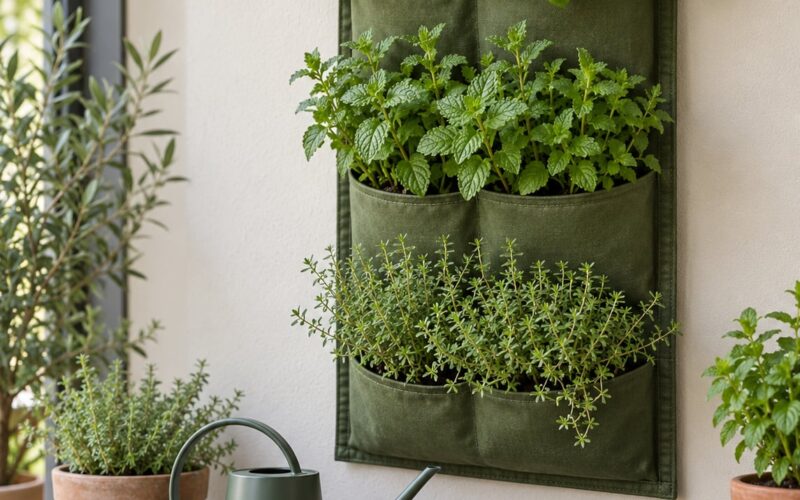
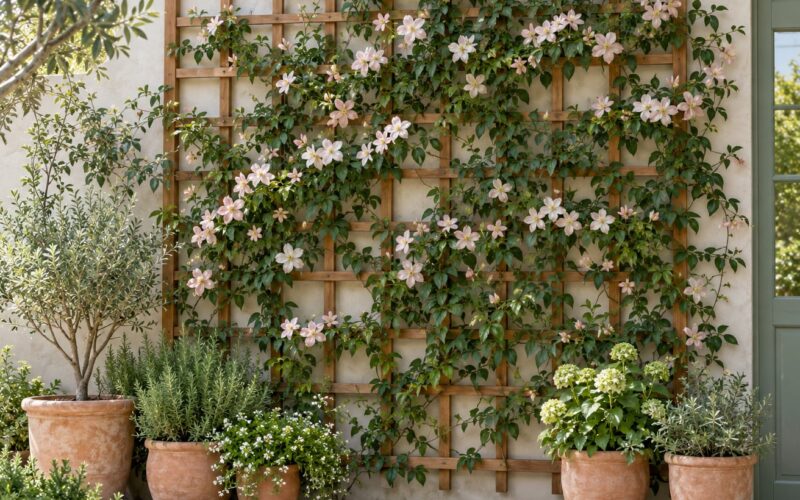
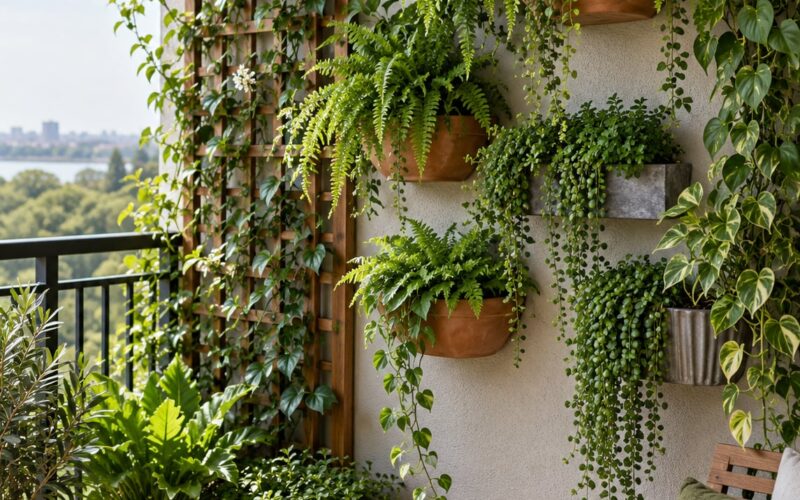
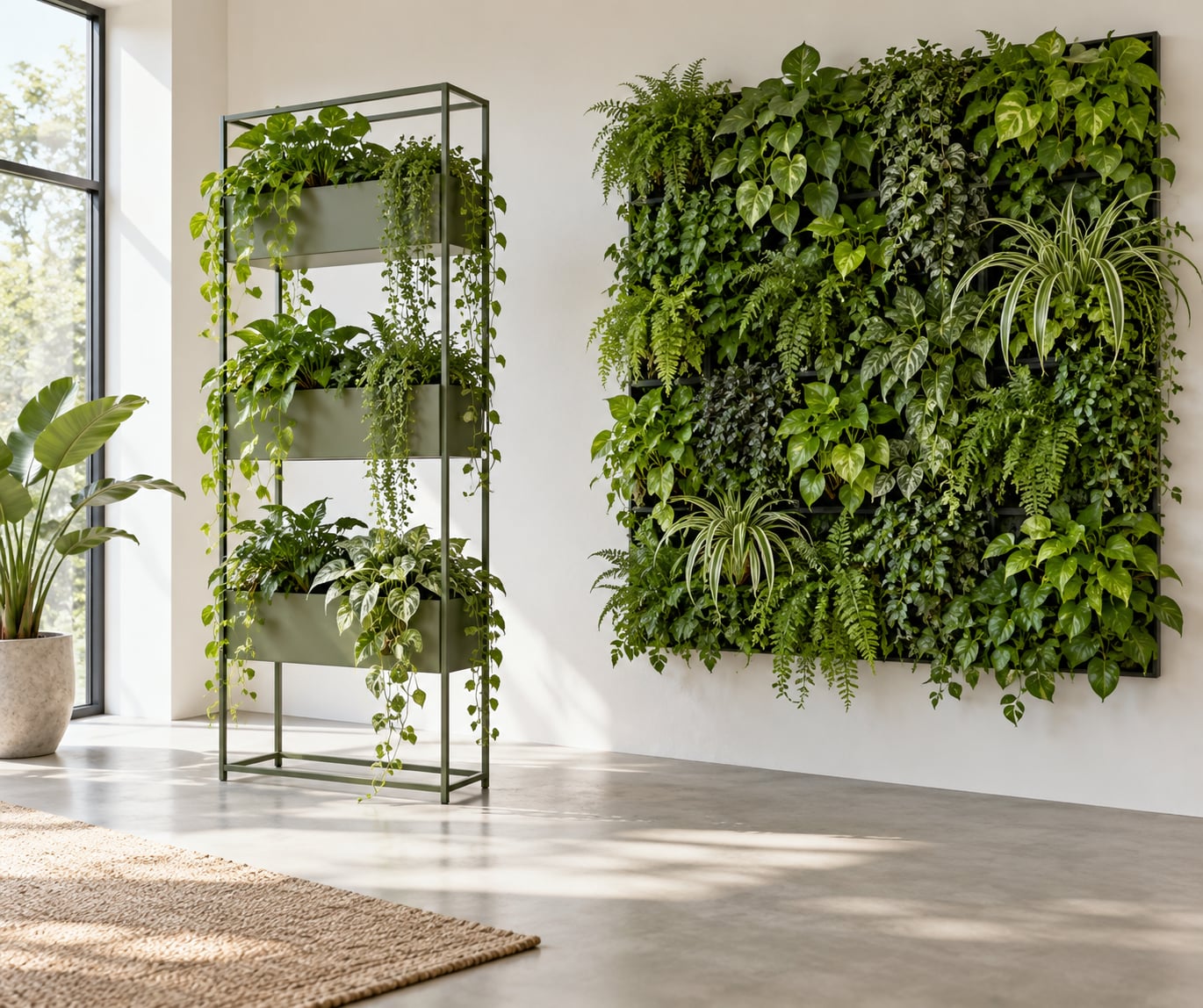
Common formats fall into a few families. Wall-mounted pots and planters hang on rails or brackets. Hanging planters and macrame holders suspend foliage from a ceiling, frame or rail. Pallet gardens fill the slats of a reclaimed pallet with soil and plant through them. Trellised climbers let vines run up a mesh or wire fixed a few inches off a wall. Stackable tiered planters stand on the ground and rise in tiers. Containers and modular pockets clip onto a freestanding frame, which is the most common indoor version.
What all of these share is that they are portable, repairable and entirely ordinary gardening. The medium is standard potting compost, watering is a hose or a can, and replacing a plant takes a minute. The trade-off is visual: you see pots, and the greenery reads as a collection rather than a single surface.
What Is a Green Wall?
A green wall, also called a living wall or living wall system, is the stricter term: a built system whose whole purpose is to cover a vertical surface with a continuous mass of vegetation. It has waterproof backing, a defined growing medium, built-in drainage and normally automated drip irrigation.
There are two construction families. Modular systems arrive as trays or cassettes that clip onto a rail or frame, so panels can be swapped one at a time. Panel or felt systems use a waterproof membrane with pockets or a felt layer pinned to it, so plants root into a shallow, continuous mat. Both are engineered. The build gets specified, the substrate thickness is decided by the manufacturer, and the irrigation is plumbed in.
One bit of housekeeping first: searching for green walls in 2026 pulls in a lot of results about the Great Green Wall desertification initiative across the Sahel. That is unrelated to anything here. When you want the built system, search living wall or living wall system instead.
Structure and Design Differences
A vertical garden is a set of containers on a support. A green wall is a layer applied to a surface. That single structural difference cascades into almost everything else you will compare.
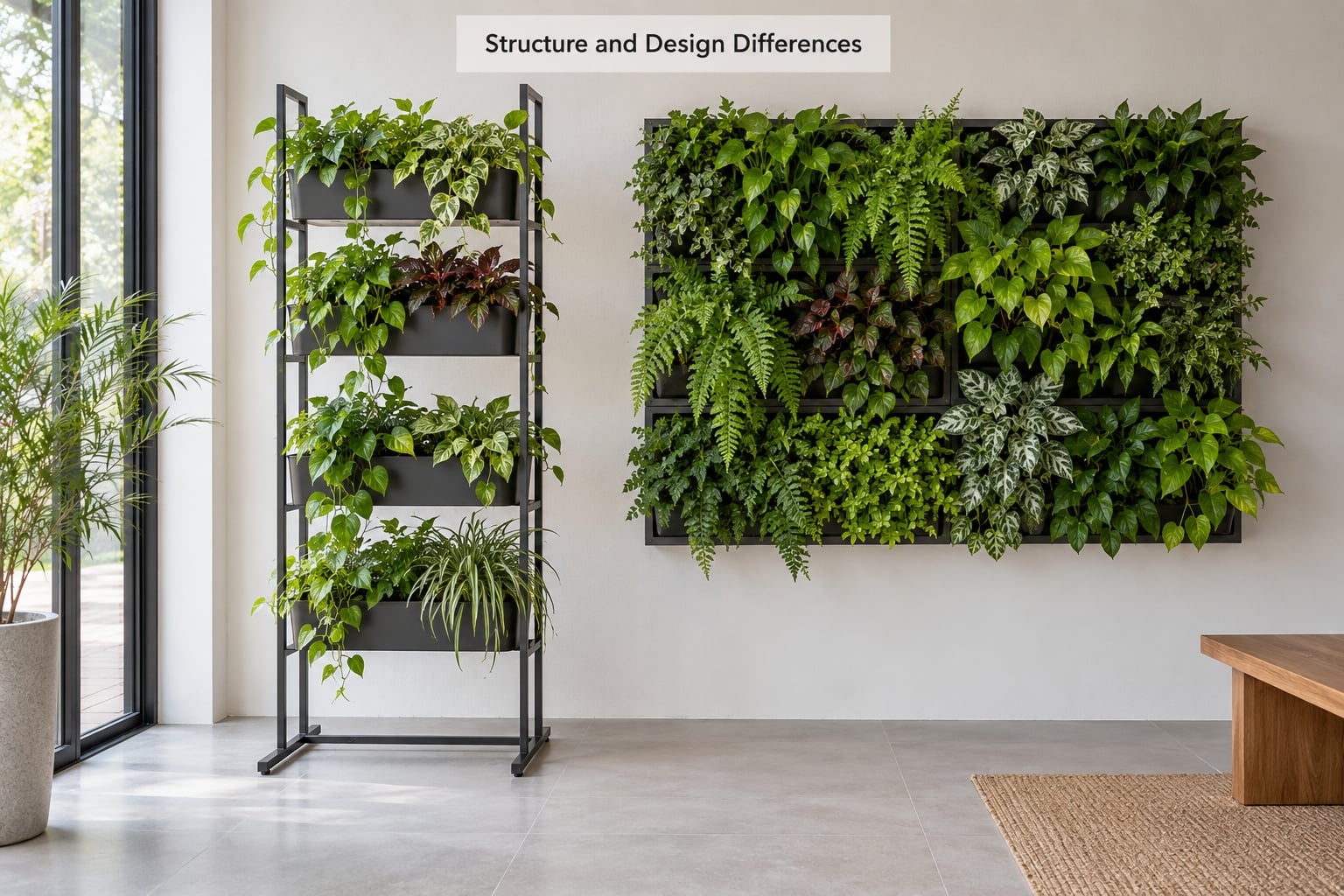
Physical construction. Vertical gardens use ordinary pots, troughs, pocket panels and frames that carry the load themselves. Green walls spread that load differently: the panel system or rail is fixed back to the wall, and the saturated weight of the growing medium sits on it. A mature living wall is heavier than most people expect.
Relationship to the wall. A vertical garden can stand 20-30 cm clear of a wall, which is exactly what you want indoors and in humid rooms because air still moves behind the foliage. Green walls are defined by being attached, which is where the waterproofing and structural questions come in.
Flexibility. Here the planter style wins clearly. Move a tiered planter to the balcony for summer, add a rail for herbs in the kitchen, take the whole thing down when you move house. A living wall is closer to a fixture. It can be removed, but it is a job, not a weekend.
Visual density. Planter arrangements look curated, with height variation and visible structure. A living wall is designed to disappear into green, which is the point for a reception area or a full facade.
Architectural integration. Direct and indirect greening, the two traditional wall-greening methods described in the Perini taxonomy from 2011, work with the building itself: climbers rooted at ground level climbing a support, or self-clinging plants on the masonry. Living wall systems sit in front of the facade as a separate layer. Neither is wrong; they simply answer different briefs.
Plant Choices and Planting Systems
Plant choice is really a consequence of root space, and root space is the clearest horticultural difference between the two systems.
In a vertical garden, each plant has its own volume of compost. That is why you can grow a cherry tomato in a bucket planter or a fern in a hanging pocket, and why failures are isolated to one container. In a living wall, plants share a thin, uniform layer of substrate. That constraint rules out deep-rooted or hungry plants and pushes you toward shallow-rooted, low-growing, relatively drought-tolerant species that stay compact.
The Royal Horticultural Society recommends Heuchera, thyme, sedum, Carex and ajuga for green wall plantings, with spring as the best planting season and small plugs used for the strongest establishment. Those same species work happily in pocket panels of a container-style vertical garden, which is one of the areas where the two systems overlap.
Density. Living walls are planted closer together so the surface knits together once established. Expect gaps in the first few months. Vertical gardens are spaced for light and air, and that deliberate spacing is also what keeps them healthy.
Replacement access. Modular living walls let a technician swap one failed panel. With a felt wall, replacement means cutting into the mat, which is slower and rougher. In planter gardens, you just pull the pot out.
Watering, Drainage, and Light Requirements
Water is where the two systems diverge most, and where a lot of disappointed wall owners end up. Vertical gardens can be hand-watered. Green walls normally cannot.
Irrigation. A planter setup needs a can, or a simple drip line on a timer if you forget. A living wall runs a drip irrigation circuit with a pump and a controller, distributed in zones across the wall. That is what makes it viable at scale and what makes it vulnerable: a failed pump, a stuck solenoid or a closed line takes out a whole zone.
Drainage. Pots drain into themselves, saucers or a tray. A living wall has engineered drainage built into the panel plus a waterproof backing, so water cannot reach the masonry behind. Skipping that layer is how a wall ends up damp or stained.
Light. Both need light, and this is where indoor plans go wrong. A sunny balcony suits a planter garden without complaint. A north-facing interior wall needs grow lighting before either system will hold up. The Royal Horticultural Society is blunt that indoor green walls need additional artificial lighting.
Watering logistics indoors. A wall-mounted system you cannot reach from the floor is awkward to water by hand, which pushes people toward the more engineered option, which then needs a plumbed line. For a rental or an office, that plumbing conversation is the real blocker, more than cost.
Installation and Maintenance
Installing a vertical garden is usually an afternoon. Installing a living wall is a build with a structural check, a waterproofing detail and an irrigation design.
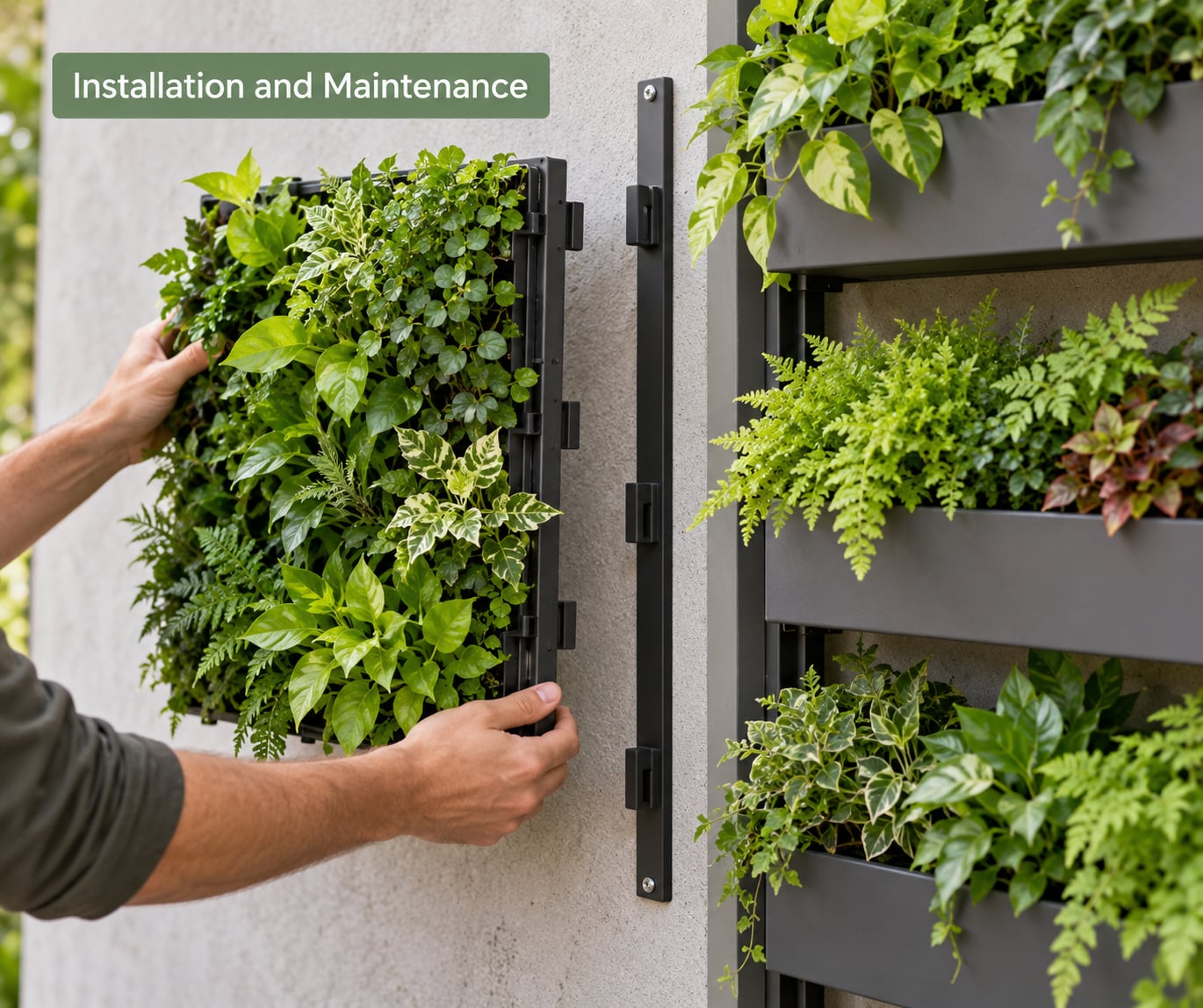
Before anything goes on the wall. For a living wall, have the wall’s capacity checked, agree where the water goes, and confirm what happens to runoff. Roots find cracks over years, and saturated planting against masonry is exactly the condition that damages it. Manufacturer guidance and a qualified installer should cover all three.
Ongoing care for a vertical garden. Water on a schedule, feed during the growing season, cut climbers back to keep them on their support, replace what dies. That is it. Expect to do it yourself on a ladder or step stool every week or two.
Ongoing care for a living wall. Same work, plus irrigation monitoring, pruning to stop plants outgrowing their pockets, feeding through the system, more frequent replacement because density means one failure shows, and pest checks on a tightly packed planting. Somebody has to own that. The Sydney case often cited in the industry press is instructive: an award-winning tower called Sky High turned brown inside a year because irrigation failed and nobody had clearly been responsible for putting it right between the body corporate, the property manager and the installer.
Fire safety. Dry, dead plant material in an unmaintained wall is a fire load, and the 2012 Sydney bar fire pushed calls for green wall provisions in building codes. Some jurisdictions now expect a fire performance rating on greening materials, real and artificial. Check yours before specifying.
Cost, Durability, and Best Locations
Since costs move, use relative tiers rather than figures. A planter vertical garden sits in the low tier for both the build and the running costs. A professional living wall sits in the high tier for both. An artificial green wall sits low to medium upfront and low ongoing. Typical US and UK ranges vary by region and change over time, so get a written quote for the actual wall.
Durability. The frame and hardware on a good vertical garden outlast most of the planting, which gets replaced every season or two anyway. Engineered living wall systems are routinely projected at up to 25 years of structure, but only with constant care. Artificial panels are limited by the backing and by UV fade; indoor ones last far longer than outdoor ones.
Where each one makes sense.
- Small apartment balcony: tiered planters or a railing planter. High sun, wind and a watering can are your whole irrigation plan.
- Rental or rental property: freestanding or hook-mounted vertical garden. Nothing drilled, nothing to patch on move-out.
- Interior with no window: artificial green wall, or a lit planter system. Both real options need a grow light and a plan for drainage.
- Office partition: modular living wall, ideally zoned so one failure is contained. It reads as a designed feature rather than as pots.
- Reception or restaurant fit-out: living wall with a maintenance contract, or artificial if the venue wants zero plant loss.
- Outdoor facade: direct or indirect greening on the building, which is the oldest answer to the question.
Which Should You Choose?
Choose a vertical garden if you rent, if you want to move the plants around, if you want to garden rather than maintain an installation, or if you are working with a balcony and a watering can.
Choose a green wall if the wall itself is the design intent. If you need a continuous green surface for a client or a fit-out, if the planting has to read as one mass from a distance, and if you can carry professional installation and a named maintenance owner, that is the right tool.
A useful test: if the plants are the point, go vertical garden. If the surface is the point, go green wall.
Frequently Asked Questions
Are a vertical garden and a green wall the same thing?
No. The terms overlap, which is where the confusion starts. A vertical garden is the broad term for any arrangement of planters, pockets or supports growing plants upward. A green wall, also called a living wall, is the stricter term for an engineered system built to cover a wall in one continuous planted surface, with a waterproof backing, a defined growing medium, built-in drainage and usually automatic drip irrigation. Every green wall is a vertical garden; not every vertical garden is a green wall.
Can a vertical garden be installed indoors?
Yes, and it is one of the most common indoor uses. Most indoor vertical gardens are freestanding frames, pocket panels or tiered planters that you water by hand and move as needed. Two things decide whether it works: light and drainage. A wall with no window needs a grow light, and the system needs somewhere for excess water to go. That is why many indoor installations are planter-style rather than engineered living walls.
Which option requires less maintenance?
A planter-based vertical garden needs less. Planter gardens need routine watering, feeding, trimming and replanting, all of which you can do yourself in an afternoon. A living wall needs that same plant care plus irrigation monitoring, pump servicing, more frequent plant replacement and occasional structural checks. The real risk is ownership: if nobody is contractually responsible for an engineered wall, it can degrade quickly.
What is the difference between a living wall and a green facade?
A green facade is the wider architectural term for any greenery applied to or growing on the outside of a building. That includes direct greening, where climbers root in the ground and climb the wall on supports, and indirect greening, where self-clinging plants attach to the masonry. A living wall is a specific engineered product mounted in front of that facade with its own growing medium and irrigation. A living wall is one type of green facade.
Do vertical gardens and green walls need irrigation?
Both need water, delivered differently. A vertical garden is hand-watered or fed by a simple drip line on a timer. A green wall almost always runs an automatic drip irrigation circuit with a pump, a controller and zoned lines across the panels. Because watering a wall you cannot reach is impractical by hand, irrigation is not an optional extra on an engineered system; it is part of how the system works.
Which is better for a small apartment balcony?
A vertical garden, almost every time. Balconies have wind, strong direct sun and limited weight tolerance, all of which favour freestanding tiered planters, railing planters and hanging pockets over anything fixed to the building. They are easy to water from inside, cheap to replace and removable when you move. A living wall on a balcony is possible but needs a structural check and a plumbed irrigation line.
A Clearer Way to Choose Your Green Feature
Start by deciding what you are buying: plants, or a surface. If you are moving into a rental or working with a balcony and a watering can, build a planter-style vertical garden and enjoy the gardening.
If the wall itself has to read as green, treat it as a construction job. Get the structural and drainage detail confirmed, get a maintenance contract in writing, and name the person or company responsible for irrigation checks before you sign.