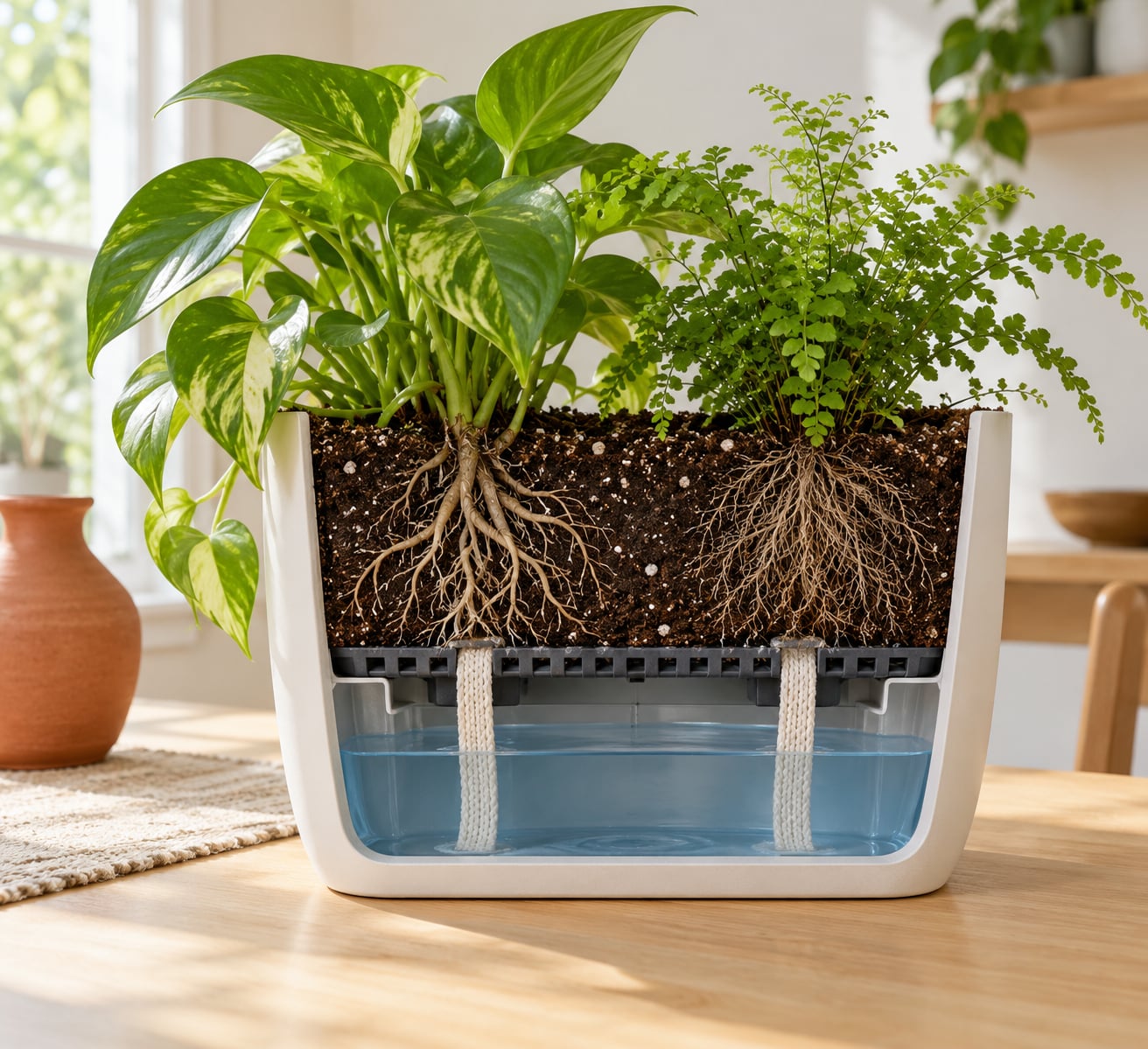
Self watering planters store water in a sealed reservoir at the base of the pot and pull it up into the soil by capillary action, so plant roots get a steady drink and stop drinking on their own when the mix is damp. You fill the reservoir instead of the soil, check a level indicator, and refill when it drops. If you have ever searched for self watering planters and how they work, the mechanism behind the marketing is simpler than most product pages suggest.
I have a lot of containers on a balcony that face a week of direct sun, and the first thing I learned is that most plant problems in pots are watering problems. Too much, too often, or too unevenly. A self-watering planter does not remove watering from the equation. It moves watering to a different place: below the root zone, where moisture can be metered instead of guessed.
If you are new to this, the useful thing to understand first is the mechanism. Once you know how the parts interact, choosing a planter, filling it, and knowing when something is wrong all become obvious.
Table of Contents
- How Do Self Watering Planters Work?
- The five-step watering cycle
- What Are the Main Parts of a Self Watering Planter?
- How Does a Wick Move Water to Plant Roots?
- Why Do Self Watering Planters Need a Drainage Hole?
- How Much Water Should a Self Watering Planter Hold?
- Do Self Watering Planters Water Plants Continuously?
- What Plants Are Best for Self Watering Planters?
- How to Refill and Maintain a Self Watering Planter
- Troubleshooting in order
- When Should You Avoid Using a Self Watering Planter?
- Frequently Asked Questions
- Do self watering planters actually work?
- What are the downsides of self watering pots?
- Do you put rocks in the bottom of a self-watering planter?
- How often do you have to water a self-watering planter?
- How do you know when to add water to a self-watering planter?
- What are the disadvantages of capillary matting?
- The Key Takeaway
How Do Self Watering Planters Work?
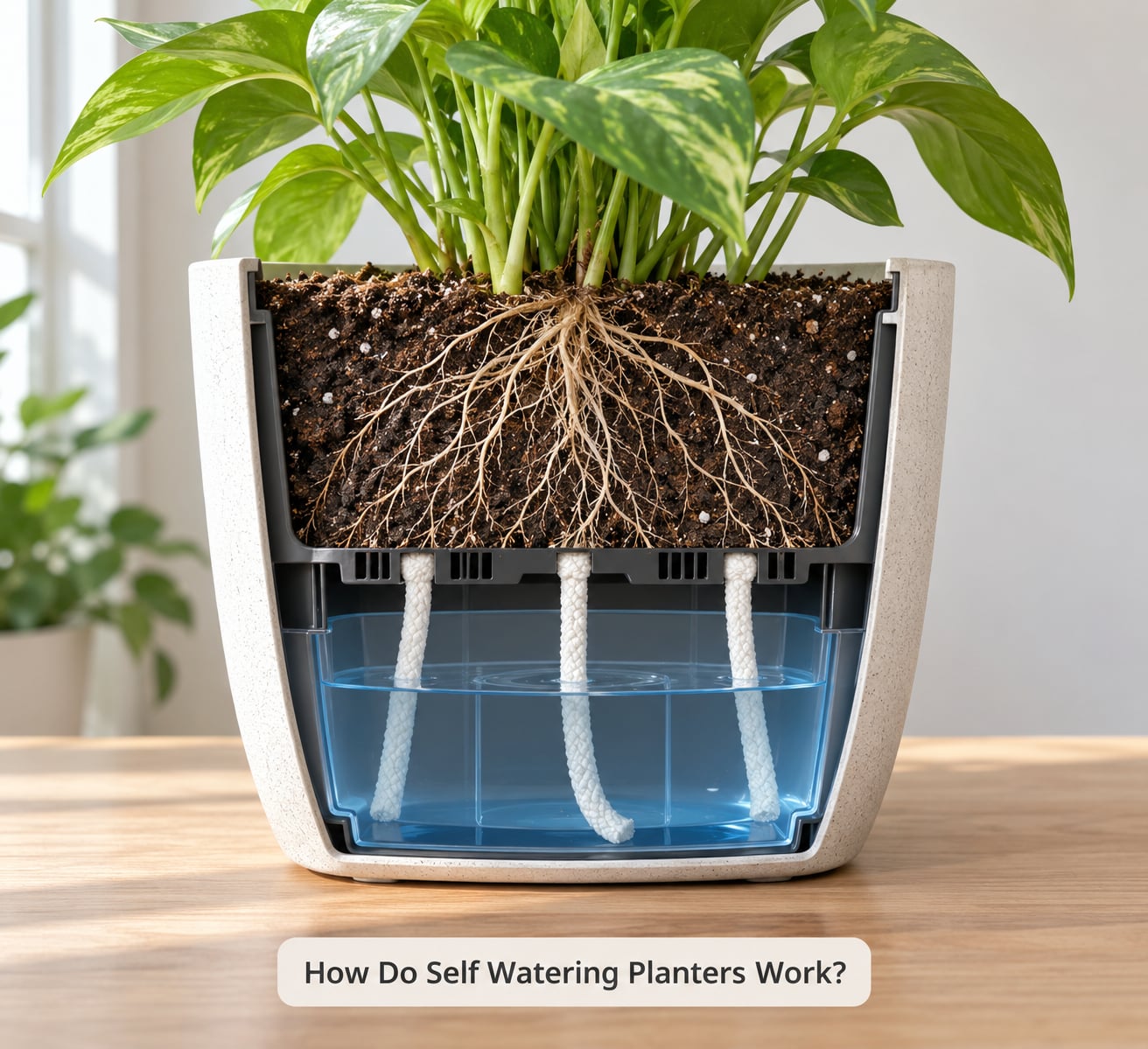
Water sits in a reservoir sealed at the bottom of the planter, separated from the soil by a false bottom or a perforated cone. A wick, or the soil column itself, connects that water to the root zone through capillary action. Roots draw moisture from the mix, the mix pulls more water up to replace it, and the flow slows and stops as the mix approaches saturation.
The delivery side of a self watering planter comes down to five moves that repeat:
The five-step watering cycle
- Top-water first. Water the soil from above until it drains, wet the wick, and settle the mix. This is the step people skip, and skipping it is the most common reason a new planter fails.
- Fill the reservoir. Pour water into the fill tube or the top opening until the indicator stops moving or you see water at the sight window.
- Let capillary action take over. The wick or the soil column draws water up from the reservoir. Nothing pumps it.
- Let the plant drink and regulate. As the plant pulls water, more climbs up. When the root zone is moist, the pull weakens and flow nearly stops on its own.
- Check and refill. When the indicator shows empty, top up. A monthly flushing of the mix keeps mineral salts from building up around the roots.
Nothing in that cycle requires daily attention. Most of the work happens in the first two to three weeks while the capillary column establishes itself, then settles into a rhythm you can predict.
What Are the Main Parts of a Self Watering Planter?
Every self-watering pot, from a fabric grow bag to a moulded plastic indoor planter, is built from the same handful of components. Each one has a job, and a planter that skips one of them usually shows you before long.
- Water reservoir: the sealed chamber in the base of the planter that holds the water your plant will drink, typically a quarter to a third of the total volume.
- False bottom or aeration screen: the perforated plate or cone that holds the soil above the water so the mix never sits submerged, while still letting water pass through to the wick.
- Wicking system: a cotton cord, rope, or geotextile strip that reaches from the root zone down into the reservoir and provides a continuous path for water to climb.
- Growing bed: the upper section filled with potting mix, ideally a coarser mix with perlite or bark that wicks reliably rather than a dense, collapsed soil.
- Fill tube and water level indicator: a vertical tube for pouring water in without disturbing the mix, paired with a sight window, float gauge, or red float that drops when the reservoir empties.
- Overflow drain: an outlet positioned near the top of the reservoir so excess water, heavy rain included, leaves instead of sitting at the base.
The fill tube and the indicator are the two parts people look for last, and they are the two that decide how easy a planter is to live with. Without an indicator you are guessing by lifting the pot. With one, a glance from across the room is enough.
How Does a Wick Move Water to Plant Roots?
Capillary action is water climbing a narrow space without being pushed. Inside potting mix, water clings to the surface of particles and to itself through surface tension. In a dry mix with open pore spaces, that tension pulls water upward from whatever is wet below it, and the pull weakens as the mix fills up.
That gives a self-regulating system without any moving parts. Wet mix has less suction, so less water climbs. Dry mix has strong suction, so water climbs quickly and the plant drinks. The plant sets its own watering rate, and the reservoir only needs topping up on a schedule you can roughly predict.
A wick improves the connection. It is a permanent channel of wet material running from the root zone into the reservoir, which means delivery keeps going even when the upper mix has started to dry. Three things decide how well it performs:
- Contact. The wick has to touch moist mix at the top and reach the reservoir at the bottom. A wick that ends in mid-air just drips into the chamber.
- Material. Cotton cord moves plenty of water but crusts over with minerals over time. Polypropylene rope and geotextile strips resist crusting and last longer, though they move less water per minute.
- Length and count. More wicking points and a longer reach into the reservoir move more water and cope better with chunky mixes.
Chunky bark-based mixes are the weak point. Air pockets between large chunks break the capillary chain, so water sits at the bottom without climbing. People running semi-hydro setups describe this constantly: the fix is more wicking points, a longer wick, or a finer component mix. Reddit users on r/SemiHydro and r/houseplants report the same pattern, that the wick does more work in a chunky mix than in soil.
Wickless planters drop the wick entirely and rely on the soil column touching the reservoir water through the holes in the aeration screen. Fewer parts to fail, but delivery depends entirely on the mix staying in good contact with the screen, so those planters suit finer mixes better.
Why Do Self Watering Planters Need a Drainage Hole?
The overflow drain sits near the top of the reservoir, not at the bottom of the planter. Its job is to let water leave once the chamber is full, so the plant can drink and still breathe.
Roots need air as much as water. When a reservoir stays sealed and full, the mix above it stays saturated, oxygen in the pore spaces runs out, and roots start to rot. On an outdoor planter, heavy rain fills the reservoir faster than the plant drinks, and the overflow is what stops the root zone from turning into a pond of stagnant, oxygen-poor water.
Where the outlet goes depends on the setting. Indoors, an overflow that drains into the cachepot is convenient but can leave standing water on a floor or shelf, so I prefer a planter whose shell drains to a saucer I can empty on my own schedule. Outdoors, route the overflow away from the wall or into a drain channel so it does not undermine the pot or waterlog the surface.
Plenty of decorative indoor planters have no overflow at all. They can work, but they depend on you topping up carefully and never overfilling the fill tube. I check for the outlet before anything else now.
How Much Water Should a Self Watering Planter Hold?
Reservoir size sets how long you can go between refills, not how healthy the plant is. The right figure comes from three things: the size of the planter, the thirst of the plant, and where the planter sits.
| Planter size | Typical reservoir volume | Refill interval, tropical foliage indoors | Refill interval, on a sunny balcony |
|---|---|---|---|
| Under 8 inch diameter, on a shelf | Roughly 0.5 to 1 litre | 7 to 10 days | 2 to 4 days |
| 10 to 14 inch floor or table planter | Roughly 2 to 4 litres | 6 to 9 days | 3 to 5 days |
| Large patio planter over 18 inch | Roughly 8 to 15 litres | 8 to 12 days | 2 to 3 days |
| Wide trough or grow bag | Varies widely by design | 5 to 8 days | 1 to 2 days |
These are ranges from how thirsty foliage plants behave in typical indoor conditions, not guarantees. A fern in a bright bathroom drinks faster than a rubber plant in a dim corner, and a plant in a glazed ceramic pot dries out more slowly than the same plant in a porous terracotta one.
For herbs on a kitchen windowsill, small planters are enough and the savings are minor. For a balcony running ferns, aroid mixes and small trees, a larger reservoir is what actually buys you time away from the house. Vacation maths works the same way: a 12-litre reservoir in a partly shaded balcony planter is often enough for roughly five to seven days in mild weather, and closer to three in a heatwave.
Do Self Watering Planters Water Plants Continuously?
No, and this is the misunderstanding that causes most of the damage. A self-watering planter does not keep the mix wet around the clock. It delivers water on demand, in response to what the plant is actually using.
When the mix is damp, the pull that drives capillary action weakens to almost nothing, and delivery slows to a trickle or stops. As the mix dries and the plant takes up moisture, the pull returns and flow increases. What looks like constant watering from outside is really a supply system responding to demand.
Where it does go wrong is the reservoir being kept full for weeks. Continuous availability removes the drying cycle that most plants want, and that is how root rot starts. During the establishment phase, some growers deliberately keep the reservoir topped up while also watering from above, to get the capillary column moving. Once the plant is drinking well, use the reservoir as a buffer and let it empty between refills.
The other extreme is just as common. People assume self-watering means never watering again, the reservoir runs dry, and the wick has nothing to move. Two to three weeks of neglect is enough to lose a plant.
What Plants Are Best for Self Watering Planters?
The deciding factor is how much water the plant wants and whether its roots like a mix that stays evenly moist. Self-watering planters suit plants with steady moisture needs, and they suit them because constant access removes the guesswork.
| Plant group | How well it works | Notes |
|---|---|---|
| Ferns, begonias, fuchsias | Excellent | Constantly moist roots are their natural state. Most people start here. |
| Tropical foliage such as philodendrons and anthuriums | Good | Use a coarser mix with bark or perlite so the wick keeps moving. |
| Herbs such as basil, mint and parsley | Good | Even moisture keeps them leafy, though mint will take over any planter you give it. |
| Peace lily and pothos | Good | Forgiving, and they wilt visibly before they suffer real damage. |
| Flowering balcony plants | Fair to good | Water demand rises in flower and in heat, so check more often. |
| Orchids in coarse bark | Caution | Air pockets in bark break the capillary chain. Many growers do better watering by hand. |
| Succulents, cacti, jade, echeveria | Poor fit | They need a dry cycle. A full reservoir usually rots them within weeks. |
| Snake plant and ZZ plant | Poor fit | Store water in their rhizomes and dislike permanently damp mix. |
| Bonsai | Avoid | Requires deliberate drying and shallow, fast-draining soil. |
People on r/succulents warn beginners about exactly this, and they are right to. Repotting a succulent into a self-watering planter is the most expensive way to find out it was a bad idea. If a plant prefers to dry out, a reservoir is working against it.
A practical approach, and the one that works for most collections, is to convert gradually. Start with the plants that will forgive mistakes, watch how they behave for a month, then move on to the fussier ones.
How to Refill and Maintain a Self Watering Planter
Refilling takes about a minute. Maintenance, beyond that, is what keeps a system working for years instead of months.
- Check the indicator before anything else. A sight window, float gauge or red float is your main cue. When it shows empty, fill through the fill tube slowly so the water is absorbed rather than pooling in the middle of the mix.
- Flush the mix once a month. Run water through from the top until it comes out of the overflow. This carries away fertiliser salts that collect around the roots in a closed system.
- Clean the reservoir when you refill. Wipe out algae film, and empty and scrub a deep narrow chamber every few months. Stagnant water smells, and the smell gets worse as root problems develop.
- Watch the wick. Pull it out every couple of months and check for mineral crust. If it feels stiff or slimy, soak it in a mild cleaning solution or replace it.
- Keep the surface open. A thick mulch or a dense crust of dried mix blocks the fill tube and slows evaporation from the surface. Bark or a light layer of gravel keeps the mix aerated.
- Feed lightly. Nutrients concentrate in a closed reservoir, so use a diluted feed and flush more often.
Troubleshooting in order
When a planter misbehaves, work through the list in this sequence rather than guessing.
- Check the reservoir. An empty reservoir means nothing to wick. Most reported problems start here.
- Check the wick. Is it still connected at both ends? Has it crusted over? Does it reach the water, or does it end in the chamber above the water line?
- Check the mix. Dense or collapsed soil and chunky bark mixes both break capillary flow. The mix should look evenly damp at 5 cm down, not dry and not saturated.
- Check the drain. A blocked overflow means the reservoir cannot empty and the root zone stays anaerobic.
- Check the roots. Dark, soft, smelly roots mean rot, and no adjustment to the reservoir will fix it. Repot into fresh, airy mix.
When Should You Avoid Using a Self Watering Planter?
There are situations where a self-watering planter is the wrong tool, and picking the wrong one costs you the plant.
- Deep-rooted plants and small trees. A mature citrus, olive or dwarf tree in a large pot pulls far more water than a small reservoir can store between visits.
- Freezing conditions. Water that sits in the chamber through a frost can expand and crack the planter. Bring containers in, or choose a planter rated for your climate.
- Plants with a bark or gravel-heavy mix. Unless you add several wicking points, water will not travel upward through it.
- Long periods away with no one to check it. A reservoir buys roughly a week. Two weeks away needs someone watering on your behalf, or a proper drip irrigation line.
- Heavy rain with no overflow. A planter without an overflow outlet can hold stagnant water in the root zone long enough to cause damage.
- Lightweight planters holding large plants. A full reservoir and wet mix are heavy, and a small plastic pot may not hold its own load on a balcony.
Frequently Asked Questions
Do self watering planters actually work?
They work well for plants that want steady moisture, such as ferns, begonias and tropical foliage. The reservoir feeds the roots by capillary action, and the flow slows when the mix is damp. They do not rescue a plant that already has root rot, and they are a poor choice for succulents, cacti and bonsai.
What are the downsides of self watering pots?
The main risks are overwatering and neglect. Keeping the reservoir full for weeks removes the drying cycle roots need, which can lead to root rot. Reservoir water can go stagnant and smell, mineral salts build up in a closed system, and a wick can crust over and stop drawing. Plants that prefer to dry out do badly in them.
Do you put rocks in the bottom of a self-watering planter?
No. A layer of rocks at the base of a self-watering planter reduces the volume available for roots without improving drainage, because the planter already separates soil from water with a false bottom or screen. It can also raise the soil line, leaving a small air gap that dries out quickly. Use an aeration mesh over the drainage holes instead.
How often do you have to water a self-watering planter?
Most indoor planters holding tropical foliage need a refill every 5 to 10 days, and sunny balcony planters every 2 to 4 days, depending on size and season. Check the indicator rather than a calendar. Top-watering the soil is still needed for the first two to three weeks while the capillary column establishes.
How do you know when to add water to a self-watering planter?
Most planters show it: a red float drops, a float gauge sinks, or water disappears from the sight window. If yours has no indicator, test the soil about 5 cm down and weigh the pot, since a full reservoir makes it noticeably heavier. Never rely on surface dryness alone, because a dry crust often hides a wet root zone.
What are the disadvantages of capillary matting?
Capillary matting spreads water evenly across a bench of small pots, which makes it a poor fit for plants with different needs. It stays permanently wet, so the mat rots and grows algae if it is not replaced regularly, and it cannot store water for holidays the way a reservoir does. It also works only over a flat surface with good contact.
The Key Takeaway
A self watering planter meters water to the roots instead of the surface, and the meter is capillary action rather than a pump. Check four things in order: the reservoir level, the indicator, the overflow drain, and the moisture of the mix at 5 cm down. Keep the first two weeks of top-watering, and use one for plants that want steady moisture rather than ones that want to dry out.